 EN
EN


Meta title: Magnesium L-Threonate Capsules Tablets or Powder
Meta description: Compare capsules, tablets and powder for magnesium L-threonate by dose capacity, consumer experience, manufacturing, packaging, testing and landed cost.
The format decision begins in the raw-material specification
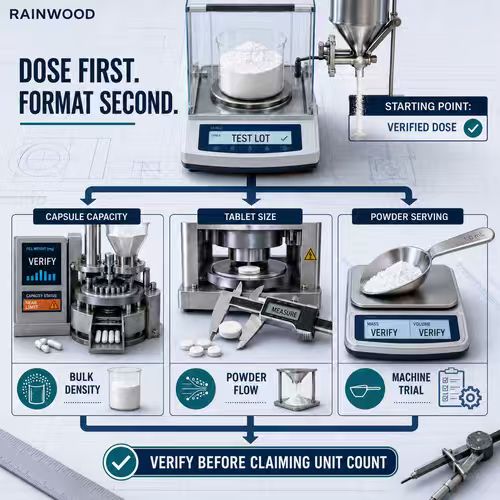
Public labels make the volume problem concrete: a 2 g Magtein® serving can require three capsules while providing 147 mg elemental magnesium. The official UK assessment also specifies bulk density above 0.4 g/mL and particle-size criteria for the evaluated ingredient. Those physical properties are not paperwork trivia; they determine how much material fits, how it flows and whether the claimed daily unit count is commercially repeatable.
A supplier can make a prototype look better by using a denser lot, hand-filling, omitting an excipient or quietly reducing the compound amount. Prevent that by approving the exact source and representative lot, performing a machine feasibility run and reconciling input weight, elemental magnesium, capsule count and yield. A photograph of two full capsules is not a capacity study.
Powders avoid shell count but introduce other deep-water issues: bitterness or mineral notes, scoop variability, settling in blends, moisture exposure and the temptation to use flavours or companion ingredients that complicate stability and claims. Tablets increase dose capacity but may become large and require binders or compression aids. Ingredient-level stability—36 months for the material evaluated by UK authorities—does not automatically establish the shelf life of a flavoured powder, blend, tablet or capsule in its final package.
Magnesium L-threonate format decisions are often made backward. A brand chooses a fashionable bottle or a two-capsule serving, then asks a manufacturer to force the intended dose into it.
The better sequence is to define the compound amount, elemental magnesium, target customer and price—then choose the format that can deliver them honestly.
This guide compares capsules, tablets and powder. It also explains when gummies or stick packs may be worth exploring.
Why format is unusually important for magnesium L-threonate
Magnesium L-threonate contains a relatively small percentage of elemental magnesium by weight. The EU authorised specification gives a magnesium range of 7.2%–8.3%. A commercially meaningful compound amount can therefore require a gram-level daily serving.
That creates four design pressures:
- physical volume;
- daily unit count;
- package size;
- cost per serving.
Before selecting a format, document:
- compound weight per daily serving;
- elemental magnesium calculation;
- other ingredients;
- number of daily use occasions;
- target consumer;
- target retail price;
- market and channel; and
- desired days per package.
Use our **magnesium L-threonate formulation brief** **[INTERNAL LINK -> Magnesium L-Threonate product page]** to align these inputs.
Option 1: capsules
Capsules are the default choice for many premium supplement brands. They are familiar, portable, easy to count and compatible with subscription models.
Advantages
- no flavour development;
- flexible capsule-shell choices;
- clear unit dosing;
- relatively fast product development;
- stock bottles and components available;
- easy to create 30- or 60-day counts; and
- strong fit with professional and DTC channels.
Challenges
- gram-level servings can require multiple capsules;
- actual capacity depends on bulk density and flow;
- more shells and filling time increase cost;
- large capsules may be difficult for some consumers;
- more capsules require a larger bottle; and
- low-flow powder may need excipients.
What brands often get wrong
Capsule-size charts show theoretical volume, not guaranteed fill. A powder can settle differently in a machine than in a hand test. Flow agents and blend composition also change capacity.
Require a feasibility fill using representative commercial material. Record:
- capsule size and shell;
- average target fill;
- weight variation;
- number per serving;
- excipient level;
- machine performance; and
- finished bottle fit.
Do not advertise “two capsules daily” until the trial confirms it.
Best fit
Capsules usually fit brands prioritising convenience, no taste, professional presentation and moderate first-run complexity—provided the customer accepts the unit count.
Review our **private-label capsule manufacturing process** **[INTERNAL LINK -> Capsule manufacturing service page]** for development steps.
Option 2: tablets
Tablets can place more material into a single unit and create a distinctive visual form. They are not automatically the solution to a high capsule count.
Advantages
- potentially higher material load per unit;
- lower shell cost;
- score lines or shapes may be possible;
- coating can improve appearance and swallowability;
- efficient high-volume production after development; and
- compact packaging in some configurations.
Challenges
- magnesium salts may not compress well without formulation work;
- tablets can become large and hard to swallow;
- binders, disintegrants and lubricants add label complexity;
- granulation may add process steps;
- tooling and coating create setup cost;
- friability, hardness and disintegration require control; and
- lower MOQs may be less economical.
What brands often get wrong
A tablet can be technically strong and commercially unusable because it is too large. Ask for dimensions, weight and an actual prototype—not only a rendering.
Compression can also change dissolution or disintegration. The finished specification should define appropriate performance tests.
Best fit
Tablets may suit higher-volume brands that can fund development, accept a larger unit and want to reduce daily count. Consumer testing is valuable.
Option 3: powder in a jar
Powder removes the capsule-capacity limit and lets consumers adjust the serving according to labeled directions.
Advantages
- accommodates gram-level servings;
- may lower capsule-shell and filling costs;
- fewer units to swallow;
- flexible flavoured or unflavoured positioning;
- visible ritual for evening or wellness products; and
- opportunity for combination formulas.
Challenges
- taste and mouthfeel;
- scoop accuracy and settling;
- moisture and caking;
- larger package;
- messy use;
- less portable;
- consumer preparation required; and
- additional flavour, sweetener or acid components.
Unflavoured versus flavoured
An unflavoured powder keeps the ingredient list shorter but may not taste neutral. “Unflavoured” does not mean tasteless.
A flavoured powder can improve experience but requires:
- flavour screening;
- sweetener selection;
- acidity control;
- serving-volume design;
- sensory stability;
- additional ingredient review; and
- target-market compliance.
Scoop accuracy
Powder density can change through settling. A scoop measures volume, not mass. Validate the selected scoop and instructions over representative lots and normal handling. Consider whether a stick pack offers better dose control.
Best fit
Powder suits consumers who dislike multiple capsules, brands with a ritual-based proposition and formulas requiring more material. It needs stronger sensory and packaging development.
Explore our **supplement powder and flavour development service** **[INTERNAL LINK -> Powder manufacturing service page]**.
Option 4: stick packs
Stick packs provide a premeasured powder serving and strong portability.
Advantages
- accurate individual serving;
- travel-friendly;
- premium presentation;
- reduced repeated jar opening;
- convenient sampling; and
- subscription-ready cartons.
Challenges
- specialised equipment;
- film minimums and print setup;
- seal integrity;
- higher packaging cost per serving;
- carton assembly;
- longer component lead time; and
- larger waste footprint.
Stick packs can work well for premium DTC or practitioner products when the retail price supports the packaging.
Option 5: gummies
Gummies attract consumers but are a difficult delivery system for high-load minerals.
Questions include:
- How much magnesium L-threonate fits per gummy?
- How many gummies make one serving?
- Can taste be masked?
- Does the mineral affect gel structure?
- What happens during heating and depositing?
- Is elemental magnesium consistent?
- Can water activity and microbiology be controlled?
- Does the target market permit all components and claims?
A gummy with an attractive front label but a token ingredient amount may generate short-term clicks and long-term distrust.
Use a pilot and stability program before announcing the format.
Compare consumer experience
| Factor | Capsules | Tablets | Jar powder | Stick packs |
|---|---|---|---|---|
| Taste exposure | None | Minimal | High | High |
| Daily unit convenience | Moderate | Moderate | One preparation | One packet |
| High gram capacity | Limited | Moderate | Strong | Strong |
| Portability | Strong | Strong | Weak | Strong |
| Development complexity | Moderate | High | Moderate–high | High |
| Low-MOQ suitability | Often strong | Variable | Often moderate | Variable |
| Packaging cost | Moderate | Moderate | Moderate | High |
The “best” score depends on the customer. A practitioner client may accept three capsules; a mainstream sleep-routine customer may prefer a drink.
Compare manufacturing risk
Capsules
Flow, fill weight, capsule integrity, count and bottle protection.
Tablets
Blend uniformity, compression, hardness, friability, disintegration, coating and tooling.
Powders
Blend uniformity, segregation, scoop accuracy, taste, caking, fill weight and seal.
Stick packs
All powder risks plus film, seal integrity, print registration and individual packet checks.
Gummies
Potency through processing, content uniformity, taste, texture, water activity, microbiology and stability.
Define critical attributes before quotation so suppliers are comparing the same development scope.
Packaging implications
Bottle count
More capsules require more bottle volume and possibly more desiccant. Too much headspace can look underfilled; too little creates line problems.
Powder jar
The jar must hold the stated net weight after expected settling. Scoop placement and induction sealing need validation.
Stick-pack carton
Count, packet seal, lot-code readability and carton dimensions affect retailer and fulfilment requirements.
Moisture protection
Select bottle, film, closure and desiccant based on the actual formula and stability rationale. A beautiful paper-forward pack may not provide adequate barrier.
Our supplement packaging and stability planning service can align format with shelf life.
Testing implications
All formats need suitable ingredient and finished-product controls. Additional dosage-form tests may include:
- capsule weight variation and disintegration;
- tablet hardness, friability and disintegration;
- powder blend uniformity and scoop verification;
- stick-pack fill weight and seal integrity;
- gummy water activity, texture and microbiology; and
- stability in the commercial package.
Testing should be linked to specifications and risk, not selected as a marketing checklist.
Read How to Verify Magnesium L-Threonate Quality Beyond the COA.
Cost comparison
Do not compare conversion cost alone. Calculate:
> Ingredient + excipients + conversion + testing + packaging + freight + fulfilment + returns
Capsules may cost more to fill but avoid flavour development. Powder may reduce conversion cost but use a larger jar. Stick packs may improve adherence and average selling price while adding packaging cost.
Also model customer acquisition and repeat purchase. A cheaper format that consumers abandon is not economical.
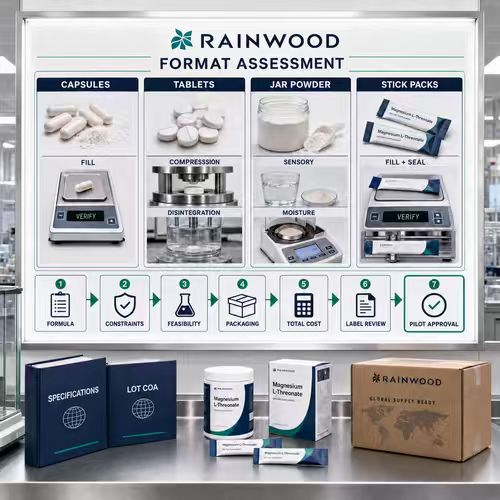
A format decision process
Step 1: Define the daily formula
Confirm compound and elemental magnesium, co-ingredients and market limits.
Step 2: Set customer constraints
Maximum capsules, taste expectations, portability, dietary preferences and monthly price.
Step 3: Conduct bench feasibility
Test fill, compression or sensory performance with representative ingredients.
Step 4: Prototype commercial packaging
Measure actual finished dimensions and consumer handling.
Step 5: Build total cost
Include testing, package, freight and channel economics.
Step 6: Review claims and label
Ensure format does not imply benefits unsupported by the evidence.
Step 7: Pilot and approve
Document specifications, sample attributes and change controls before scale.
Frequently asked questions
1.How many capsules will magnesium L-threonate require?
It depends on compound amount, powder density, excipients, capsule size and equipment. A physical fill trial is required for a reliable answer.
2.Can a tablet reduce three capsules to one?
Possibly, but the resulting tablet may be too large or require complex formulation. Prototype dimensions and performance.
3.Is magnesium L-threonate soluble in water?
Material specifications and practical dispersibility should be tested with the actual source. Solubility does not guarantee good taste or a clear beverage.
4.Are powders cheaper than capsules?
Sometimes at the conversion stage. Total cost may rise through flavouring, larger packaging, scoop controls and freight.
5.Is a gummy realistic?
It may be possible, but dose load and sensory constraints can create a high daily gummy count. Require technical feasibility before marketing.
Choose the format after the dose
Send us your target compound amount, elemental-magnesium goal, customer, market, retail price and preferred routine. We can help compare physical feasibility, packaging and cost before samples are made.
Request a magnesium L-threonate format assessment.
References
- Commission Implementing Regulation (EU) 2024/2694.
- European Food Safety Authority, *Safety of magnesium L-threonate as a novel food* (2024).
- US Food and Drug Administration, *Current Good Manufacturing Practice for Dietary Supplements*.
- US Food and Drug Administration, *Dietary Supplement Labeling Guide*.
- UK Advisory Committee on Novel Foods and Processes, [bulk-density, particle-size and stability information](https://acnfp.food.gov.uk/ACNFPAdviceonthesafetyofMagnesiumL-threonateasanovelfoodforuseinfoodsupplements).
- NIH Dietary Supplement Label Database, [three-capsule, 2 g Magtein serving example](https://dsld.od.nih.gov/label/274903).
*This article provides general formulation and business information. Product feasibility and requirements should be confirmed through qualified technical, quality and regulatory review.*