 EN
EN


Meta title: Why Magnesium L-Threonate Quotes Vary
Meta description: Learn why magnesium L-threonate quotes vary across identity, elemental magnesium, testing, market access, packaging and commercial terms.
Before comparing prices, ask what the seller is actually pricing
Public-market COAs show why two “99% magnesium L-threonate” offers may not be equivalent. Some identify the anhydrous CAS number and formula; others use company standards, titration or a single broad assay; the official EU and GB specifications concern the monohydrate and separately control magnesium, L-threonate, water or loss on drying, oxalic acid and residual ethanol. None of these differences proves a supplier is fraudulent, but they can explain a dramatic price gap.
Brand status adds another invisible line item. Magtein® is a controlled trade ingredient, while magnesium L-threonate is also used as a generic chemical name. A branded offer may include an authorised supply route, trademark permission and access to a product dossier or marketing support. A generic quote should be judged on its own identity, evidence and market-access package. Paying generic price while expecting branded rights—or paying a brand premium without verifying those rights—are both avoidable mistakes.
Build a quote-normalisation table before negotiation. Require the chemical form and CAS identifier, original manufacturer, exact assay basis, magnesium and L-threonate ranges, process-related impurities, test methods, market-access basis, trademark status, finished serving, capsule count, independent testing, Incoterm and payment terms. Only the price remaining after those fields match is a true price difference.
One supplier quotes magnesium L-threonate at a premium. Another offers what appears to be the same material or finished supplement at a dramatically lower price. The easy conclusion is that one supplier is overcharging.
Sometimes that is true. More often, the quotes are not technically or commercially comparable.
Importers should investigate the gap without assuming that price proves quality. This article shows which variables to align before negotiating.
1. The material may not have the same identity
“Magnesium L-threonate” should refer to a defined magnesium salt of L-threonic acid, but a product name alone does not establish:
- chemical identity;
- hydration state;
- optical form;
- assay basis;
- magnesium content;
- L-threonate content;
- impurity profile; or
- target-market regulatory position.
The EU specification introduced by Commission Implementing Regulation (EU) 2024/2694 describes magnesium L-threonate monohydrate at 98%–102%, magnesium at 7.2%–8.3% and L-threonate at 82%–91%, together with other chemical and microbiological criteria. A quotation based on a different internal specification is not automatically equivalent.
Ask each supplier to provide the complete specification, not only a product name and CAS number.
Start with our magnesium L-threonate technical specification guide.
2. One price may include lawful market access and another may not
Regulatory status is a cost and risk variable.
In the EU, magnesium L-threonate is an authorised novel food for adult food supplements under defined conditions. The authorisation includes specific labeling requirements and a five-year data-protection period ending 7 November 2029, during which the named applicant has protected access unless another applicant has an independent authorisation or agreement. Regulation (EU) 2025/2225 subsequently added magnesium L-threonate to the list of permitted magnesium sources for food supplements.
This means an importer cannot assume that any chemically similar powder may be placed on the EU market under the same authorisation.
In the United States, the regulatory analysis follows a different route, including dietary-ingredient status, any applicable NDI considerations, dietary supplement CGMP, labeling and claims. FDA’s 2014 “no questions” response to GRAS Notice 499 concerns specified conventional-food uses of magnesium L-threonate hydrate; GRAS status for stated food uses should not be casually presented as FDA approval of every supplement product or claim.
A cheaper offer may omit the documentation or rights required for the destination.
Review our market-access checklist for magnesium L-threonate before comparing landed prices.
3. Compound weight and elemental magnesium may be quoted differently
One finished-product quote may describe the weight of magnesium L-threonate. Another may focus on the elemental magnesium it provides. The numbers are not interchangeable.
Request a formula table showing:
- milligrams of magnesium L-threonate per serving;
- specified magnesium percentage;
- calculated milligrams of magnesium;
- capsule or scoop count;
- servings per container; and
- label declaration.
Then compare cost per daily serving and cost per declared milligram—not just cost per bottle.
4. The test package may range from paper review to independent verification
Testing can be a meaningful part of price. Possible scopes include:
- supplier COA review only;
- incoming identity testing;
- elemental magnesium;
- compound or L-threonate characterisation;
- heavy metals;
- microbiology;
- process-related impurities;
- finished-product verification;
- stability testing; and
- independent laboratory confirmation.
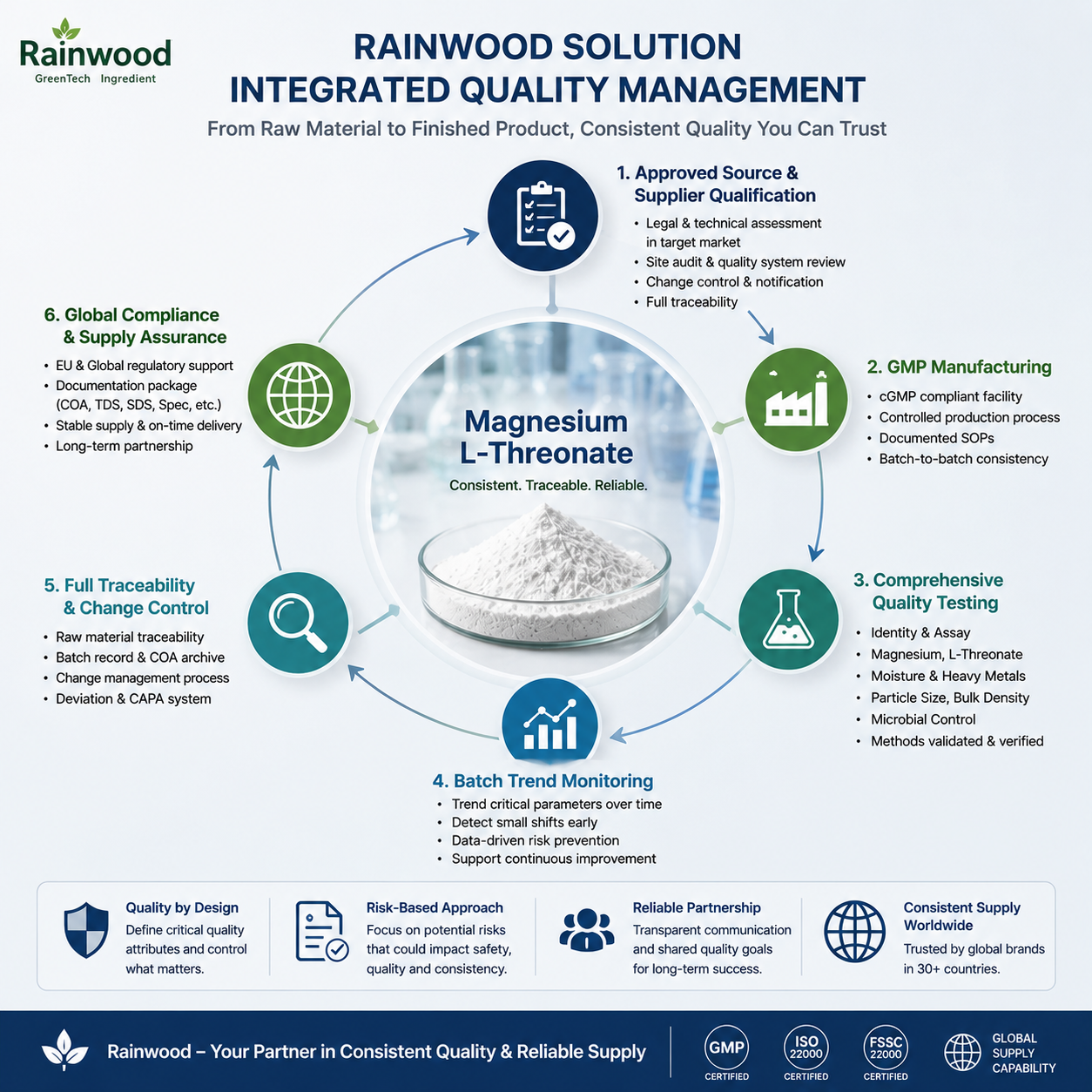
Not every test must be repeated at every stage, but the program should be justified. FDA’s dietary supplement CGMP framework requires appropriate identity verification for dietary ingredients and specifications for identity, purity, strength, composition and contamination limits.
Ask which tests are included, which methods are used, which lot is tested and whether the result belongs to the raw material or finished batch.
See How to Verify Magnesium L-Threonate Quality Beyond the COA.
5. Physical properties can change production cost
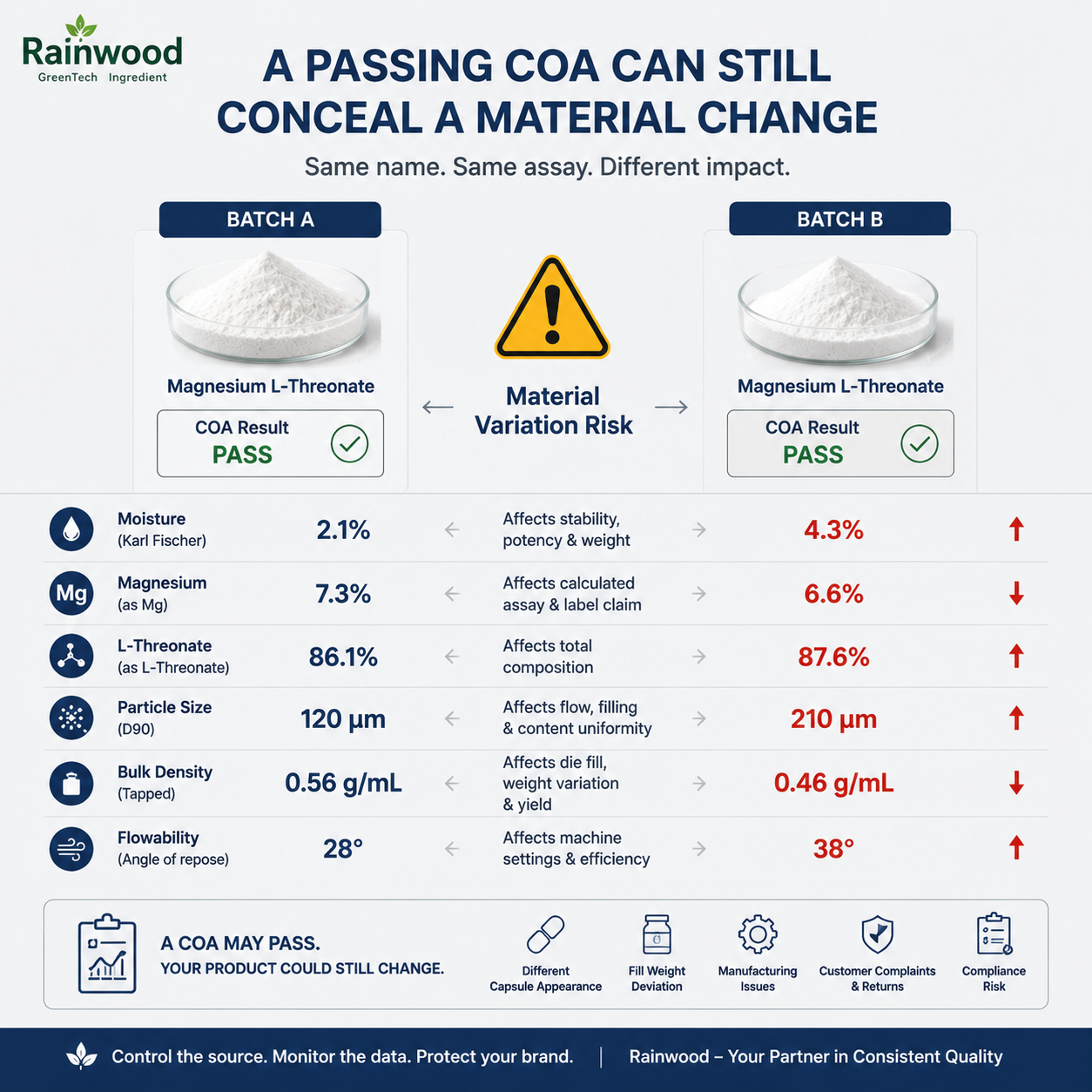
Two lots can meet a chemical specification yet behave differently in production. Bulk density, particle size, moisture and flow influence:
- capsule capacity;
- machine speed;
- use of excipients;
- tablet compression;
- rejection rate;
- blend uniformity; and
- packaging efficiency.
A very low ingredient price can lose its advantage if it requires an extra capsule per serving or creates slow, unstable production.
Importers buying raw powder should ask contract manufacturers to evaluate manufacturability before committing to a large shipment.
6. Packaging scopes may look similar but contain different components
“90 capsules in a bottle” does not define:
- bottle material and weight;
- capsule shell;
- closure;
- induction seal;
- desiccant;
- label stock and finish;
- coding;
- carton;
- case pack; or
- pallet configuration.
Request a bill of materials with stock numbers or agreed specifications. Separate custom-component setup and overrun costs from the recurring unit price.
7. Commercial terms can hide financing costs
A quote can be lower because it shifts risk to the buyer through:
- a larger deposit;
- earlier balance payment;
- non-refundable components;
- no credit for rejected material;
- Ex Works rather than delivered terms;
- short quote validity;
- no storage;
- broad quantity tolerance; or
- limited remedy for nonconforming goods.
Compare currency, Incoterm, payment milestones, title transfer, inspection rights and defect remedy. A low Ex Works price should not be compared with a delivered quote containing testing and customs support.
8. Lead time may assume perfect availability
Ask suppliers to break lead time into:
1. raw-material procurement;
2. incoming release;
3. packaging procurement;
4. production queue;
5. manufacturing;
6. finished testing;
7. quality release; and
8. freight.
A short headline lead time may begin only after every component reaches the facility. Imported ingredients, custom packaging or laboratory queues can add weeks.
Our magnesium L-threonate supply planning service helps map the real critical path.
Build a like-for-like quotation sheet
Put every supplier on one table:
| Comparison field | Supplier A | Supplier B | Supplier C |
|---|---|---|---|
| Material manufacturer and site | | | |
| Specification revision | | | |
| Market-access documents | | | |
| Compound weight per serving | | | |
| Elemental magnesium per serving | | | |
| Format and count | | | |
| Testing included | | | |
| Packaging specification | | | |
| MOQ and overrun tolerance | | | |
| Incoterm and payment | | | |
| Total released lead time | | | |
| Nonconformance remedy | | | |
Only negotiate after the blank cells are filled. The purpose is not to force identical supply models; it is to make trade-offs visible.
Frequently asked questions
1.Does a higher assay always mean a better material?
No. Identity, method suitability, impurities, magnesium content, manufacturability and regulatory fit all matter. An isolated assay number can be misleading.
2.Is a third-party COA enough to approve a supplier?
No. It can support qualification, but supply-chain traceability, methods, specifications, manufacturing controls, regulatory documents and change control remain important.
3.Why can finished-product quotations differ more than raw-material prices?
Formula fill, capsule count, testing, packaging, batch size, labour, quality scope and commercial terms compound the difference.
4.What should an importer send for an accurate quote?
Destination market, complete formula, serving, annual volume, packaging specification, testing requirements, Incoterm and desired delivery date.
Compare risk-adjusted landed cost
Send us two or more quotations with supplier identities removed if preferred. We can help organise a neutral comparison of specification, scope, documentation and landed-cost assumptions.
Request a magnesium L-threonate quote comparison.
References
- Commission Implementing Regulation (EU) 2024/2694.
- Commission Regulation (EU) 2025/2225.
- European Food Safety Authority, *Safety of magnesium L-threonate as a novel food and bioavailability of magnesium from this source* (2024).
- US Food and Drug Administration, *Current Good Manufacturing Practice for Dietary Supplements*.
- US Food and Drug Administration, GRAS Notice No. 499.
- UK Advisory Committee on Novel Foods and Processes, [assessed magnesium L-threonate specification and methods](https://acnfp.food.gov.uk/ACNFPAdviceonthesafetyofMagnesiumL-threonateasanovelfoodforuseinfoodsupplements).
- ThreoTech, [Magtein supply and authenticity statement](https://magtein.com/about-us/) (brand-owner source).
*This article provides general sourcing and regulatory information. It is not legal advice, and market access must be confirmed for the specific supply chain and destination.*