 EN
EN

Meta title: Verify Magnesium L-Threonate Quality Beyond a COA
Meta description: Verify magnesium L-threonate beyond the COA by checking identity, composition, contaminants, methods, finished-product quality and traceability.
Why “99% assay” may be the least informative line on the page
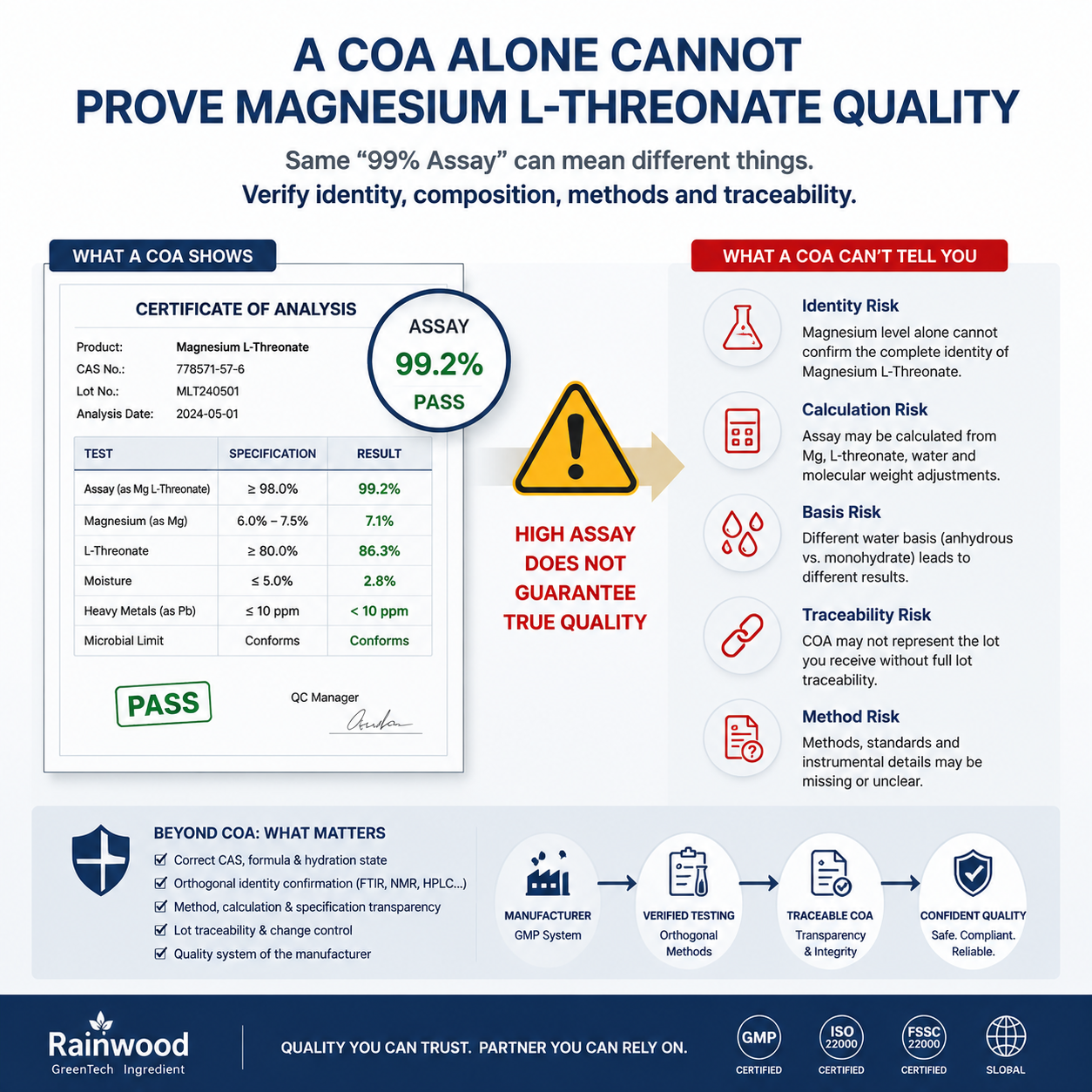
The official UK assessment exposes a detail most sales sheets omit. For the evaluated monohydrate, assay is calculated using the measured percentages of magnesium and threonate, a molecular-weight adjustment and water. It is not a single detector response that independently proves the whole molecule. A buyer therefore needs the component results, methods and calculation—not only the final percentage.
Start by establishing which material the laboratory is testing. FDA substance records distinguish anhydrous magnesium L-threonate, molecular weight 294.5 and CAS 778571-57-6, from magnesium L-threonate monohydrate, which is the form specified in the EU authorisation under CAS 500304-76-7. A COA that mixes the CAS number, formula weight, magnesium range or water basis can produce apparently precise but incoherent results.
Then match tests to the synthesis. The assessed route involves ascorbic-acid oxidation, calcium L-threonate, magnesium exchange, calcium-oxalate removal and ethanol crystallisation. This explains why identity tools such as FTIR plus compositional or chromatographic evidence, optical/stereochemical support, magnesium, L-threonate, oxalic acid, residual ethanol and water may matter. Heavy metals and microbiology are necessary controls, but they cannot tell you whether a white powder is the right magnesium salt.
Finally, verify independence and traceability. Obtain the original manufacturer’s lot COA, confirm methods and specification revisions, conduct risk-based testing at a competent laboratory, and reconcile every result to the received and finished-product lots. A beautiful PDF is a claim; a linked evidence chain is quality assurance.
A Certificate of Analysis is a summary. It is not the product, the method, the quality system or proof that the tested sample represents the lot you will receive.
For magnesium L-threonate, this matters because a simple total-magnesium result cannot establish the complete chemical identity, and a high “assay” number can mean different things depending on the method and calculation basis.
This guide shows how brands, importers and professional buyers can build a proportionate verification program beyond collecting a PDF.
Start by defining the material
Write an identity statement that answers:
- chemical name;
- common name;
- salt form;
- hydration state;
- stereochemical or optical form where relevant;
- molecular formula or reference;
- manufacturer;
- manufacturing site;
- branded or generic status; and
- target-market regulatory basis.
The EU novel-food specification is a useful example of specificity. Regulation (EU) 2024/2694 identifies magnesium L-threonate monohydrate, gives an IUPAC name and molecular formula, and defines ranges for magnesium L-threonate monohydrate, magnesium and L-threonate.
A supplier’s internal specification may use a different CAS number, hydration basis or analytical convention. Resolve the discrepancy before comparing numbers.
Our magnesium L-threonate product specification template provides a place to record these fields.
Understand what “assay” measures
A COA line reading “Assay: 99.2%” is incomplete without:
- analyte;
- method;
- standard;
- calculation;
- dry or as-is basis;
- acceptance range; and
- result units.
Possible meanings include:
- magnesium L-threonate by a specific analytical approach;
- total related material by calculation;
- L-threonate content;
- elemental magnesium converted to a theoretical compound value; or
- non-specific titration.
These are not interchangeable. Ask the laboratory to explain what generates the number and whether the method can distinguish the target from plausible substitutes or mixtures.
Use an orthogonal identity strategy
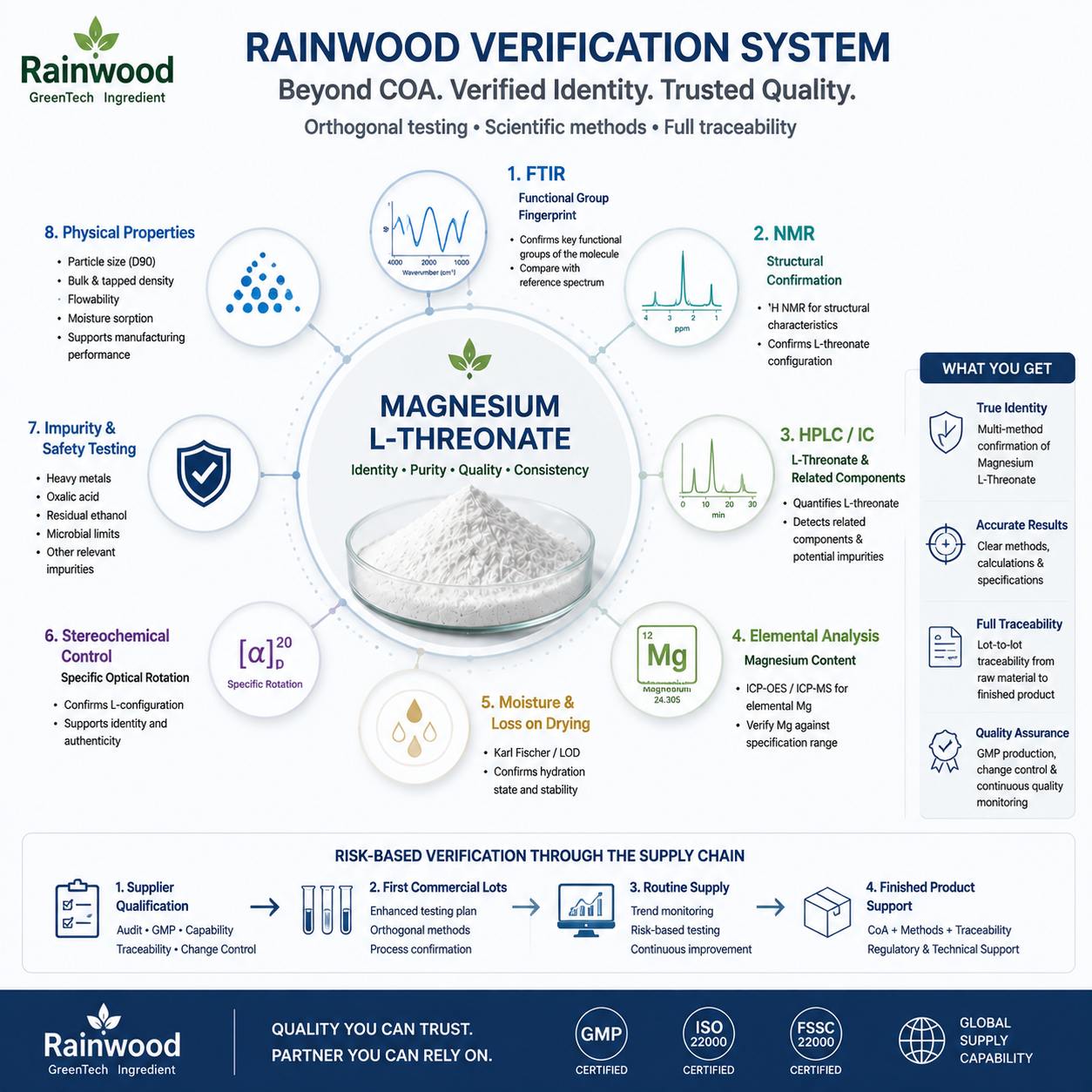
No single method answers every question. “Orthogonal” methods examine different properties and together provide stronger confidence.
Depending on material and laboratory capability, an identity strategy may include:
- infrared spectroscopy for functional-group fingerprinting;
- nuclear magnetic resonance for structural characterisation;
- chromatographic analysis of L-threonate or related components;
- elemental magnesium by a suitable elemental technique;
- specific optical rotation or another stereochemical control;
- water or loss on drying;
- mass balance and stoichiometric review; and
- comparison with a qualified reference material or authenticated spectrum.
The EFSA opinion reports that identity of the submitted novel food was supported by proton NMR, infrared spectra, elemental analysis and specific optical rotation. That does not mean every incoming lot needs the entire authorisation dossier repeated. It shows why identity is more than measuring magnesium.
A qualified analytical scientist should select methods based on risk and intended use.
Verify elemental magnesium separately
Elemental magnesium drives nutrition labeling and formula calculations. Use a suitable validated or verified method and record:
- result;
- units;
- sample basis;
- specification;
- uncertainty or method performance where relevant;
- dilution and calculation;
- laboratory; and
- lot.
Reconcile the result with compound composition. If a COA reports both 99% magnesium L-threonate and 12% magnesium for a monohydrate specification expecting 7.2%–8.3%, the numbers warrant investigation.
In a finished supplement, connect:
> Raw-material magnesium × formula input × process assumptions = expected elemental magnesium per serving
Then define how finished-product verification and label tolerances are managed.
Read Why Magnesium L-Threonate Quotes Vary So Much to see how calculation differences affect price.
Examine L-threonate and relevant impurities
The counterion is part of the identity. A material that contains magnesium and an organic-acid signal is not automatically qualified magnesium L-threonate.
The exact impurity program should reflect the manufacturing process. The EU specification includes oxalic acid and residual ethanol limits, reflecting information in the authorised material’s process and safety assessment.
Ask:
- What are the starting materials?
- What process-related impurities are plausible?
- Which residual solvents are used?
- Are degradation products known?
- Does the method separate L-threonate from related acids?
- Are impurity limits scientifically and regulatorily justified?
Do not copy an impurity test from another supplier without understanding whether its process is the same.
Control heavy metals and microbiology
Set contaminant limits for the destination, dosage and risk. “Heavy metals <10 ppm” is often too vague because it may not show individual results for lead, arsenic, cadmium and mercury.
Request:
- named analytes;
- individual limits;
- actual results;
- method;
- sample preparation;
- basis and units; and
- laboratory competence.
Microbiological controls may include total aerobic count, yeast and mould, and absence of specified pathogens. The finished-product risk can differ from the raw material because blending, handling and packaging add steps.
The EU authorised specification provides particular microbiological limits, but a finished product and another market may require additional or different controls.
Our dietary supplement contaminant testing overview explains how to define a market-specific panel.
Evaluate physical properties for manufacturability
Chemically conforming powder can still create production variation.
Measure or trend, when relevant:
- particle-size distribution;
- bulk density;
- tapped density;
- flow;
- hygroscopic behaviour;
- appearance;
- tendency to agglomerate; and
- solubility or dispersibility for powders.
These attributes can change capsule fill, blend uniformity, tablet compression, dust, machine speed and consumer experience. They may belong in an engineering specification rather than the regulatory release specification, but they should not be ignored.
Qualify the test method, not just the laboratory
Accreditation or a familiar lab name does not make every method suitable.
Ask whether the method is:
- compendial, published or internally developed;
- validated or verified for this matrix;
- specific for the analyte;
- sufficiently precise and accurate;
- linear over the relevant range;
- robust;
- supported by appropriate standards; and
- able to report the required units and basis.
For a non-compendial ingredient, method transfer and reference materials can be challenging. Plan time and budget before the first commercial batch.
When results disagree, do not average them. Investigate sampling, preparation, basis, method specificity, calculation and laboratory controls.
Control the sample
Testing cannot protect the buyer if the sample is not representative.
For high-risk or first orders:
- define the lot and quantity;
- use a statistically and practically justified sampling plan;
- sample sealed commercial containers;
- use an independent sampler where appropriate;
- seal and document samples;
- split samples for buyer, supplier and reserve;
- record chain of custody; and
- prevent lot substitution after approval.
A supplier-selected 20-gram sample sent before production may be useful for screening, but it does not prove the 500-kilogram shipment.
Review the manufacturing and quality system
FDA dietary supplement CGMP requires US manufacturers to establish specifications, verify identity of dietary ingredients with an appropriate test or examination, maintain master and batch records, investigate deviations and exercise quality-control responsibilities.
Your supplier review should cover:
- source qualification;
- incoming quarantine and release;
- status labeling;
- method and specification control;
- equipment cleaning;
- cross-contamination controls;
- deviation and out-of-specification investigations;
- change control;
- retained samples;
- complaint handling;
- records; and
- traceability.
Certificates can support this review but should be verified for site, scope, expiry and issuing body.
See our supplement supplier and facility audit framework.
Verify the finished product
Raw-material quality does not guarantee finished-product quality. The finished specification should address applicable attributes such as:
- identity or ingredient confirmation;
- elemental magnesium;
- serving-unit weight and variation;
- blend uniformity for complex formulas;
- disintegration or other dosage-form performance;
- microbiological quality;
- contaminant limits;
- appearance;
- package integrity;
- label and count; and
- shelf-life support.
FDA’s framework allows a statistically sound plan for verifying finished-product specifications rather than necessarily testing every attribute in every batch. The quality unit must justify the program.
Treat a COA as a controlled record
A reliable lot-specific COA should identify:
- product and lot;
- manufacturer or responsible laboratory;
- specification revision;
- manufacture and test dates;
- methods;
- acceptance criteria;
- actual results;
- units and basis;
- approval; and
- document revision or authenticity controls.
Confirm that “ND,” “ Build a tiered verification program Qualification stage Full document review, representative testing, site assessment, method evaluation and regulatory review. First commercial lots Enhanced incoming and finished-product verification with controlled sampling. Routine supply Risk-based testing, COA review, supplier-performance monitoring and periodic independent verification. Triggered requalification Return to enhanced controls after: - source or site change; This rewards reliable suppliers without abandoning independent control. Red flags that deserve investigation - COA has no lot number or uses a future date. A red flag is a question, not proof of misconduct. Document the answer. Frequently asked questions 1.Is HPLC enough to identify magnesium L-threonate? It depends on the analyte, detector, method and reference. A chromatographic result for L-threonate may support identity but may not alone prove the complete salt, magnesium content and stereochemical form. 2.Should brands test every raw-material lot? US dietary supplement CGMP generally requires at least one appropriate identity test or examination for each dietary-ingredient component unless an approved exemption applies. Additional tests can use qualified supplier COAs under defined conditions. Other markets differ. 3. Can an independent lab certify that a material is EU-authorised? A laboratory can report analytical results. Legal coverage under a novel-food authorisation also involves source, rights and conditions that chemistry alone cannot prove. 4.What is the most important finished-product test? There is no universal single test. The quality plan should verify the attributes that establish identity, strength, composition, safety and dosage-form performance for the product. 5.How can a buyer detect a substituted magnesium form? Use a combination of supply-chain controls and suitable orthogonal analytical methods. Total magnesium alone cannot distinguish forms. Turn the COA into a verification plan Send us the target market, supplier specification, redacted COA, format and expected annual volume. We can help organise a risk-based document and testing checklist for your qualified quality and regulatory teams. Request a magnesium L-threonate quality-file review. References - European Food Safety Authority, *Safety of magnesium L-threonate as a novel food and bioavailability of magnesium from this source* (2024). *This article provides general analytical and quality information. Test methods and specifications should be established by qualified professionals for the material, product and market.*
- specification or method change;
- repeated discrepancies;
- complaint trend;
- regulatory development;
- long supply gap; or
- significant process change.
- Every result is “conforms.”
- Total magnesium is the only identity evidence.
- Product name, formula or hydration basis changes across documents.
- Supplier refuses to name the manufacturer.
- Specification limits change with each quotation.
- Test method cannot be explained.
- Independent sample fails while supplier retest passes with no investigation.
- EU market access is claimed without supply-chain evidence.
- “FDA approved” is used for a dietary supplement or facility.
- Commission Implementing Regulation (EU) 2024/2694.
- US Food and Drug Administration, *Current Good Manufacturing Practice for Dietary Supplements*.
- US Food and Drug Administration, *Dietary Supplement Labeling Guide*.
- UK Advisory Committee on Novel Foods and Processes, [assay calculation, methods and process-related controls](https://acnfp.food.gov.uk/ACNFPAdviceonthesafetyofMagnesiumL-threonateasanovelfoodforuseinfoodsupplements).
- US FDA Global Substance Registration System, [anhydrous magnesium L-threonate identity](https://precision.fda.gov/uniisearch/srs/unii/1y26zz0otm).