 EN
EN

Meta title: Type II Collagen Joint Support Claim Review Guide
Meta description: “Joint support” can mean different things across markets. Build a type II collagen evidence file that matches product form, dose, wording, and channel.
The same product page is copied across the United States, Europe, Southeast Asia, and distributor catalogs. The phrase “joint support” feels safe because it is broad. Yet the risk does not disappear when the words are broad. Claims are interpreted through the ingredient identity, dose, evidence, audience, disease context, and jurisdiction where the product is sold.
For type II chicken collagen peptide, the first question is not “Can we say joint support?” It is “Which exact material, serving, format, evidence, and market are we describing?” A hydrolyzed peptide cannot borrow a structure-specific UC-II statement, and a general ingredient description cannot become a promise to treat a joint condition.
Build the claim file before the product page
Start with a claim inventory. Separate ingredient facts, structure or source descriptions, nutrition statements, function wording, testimonials, study summaries, and disease references. Then assign each statement to a market and channel.
Use our type II collagen claim and evidence checklist to keep the draft label, product page, distributor deck, and marketplace content aligned.
The evidence file should identify the exact form. Hydrolyzed type II peptides and undenatured type II collagen can require different identity and evidence logic. If the material is generic, do not insert a branded ingredient name or a branded study merely because the source category sounds similar.
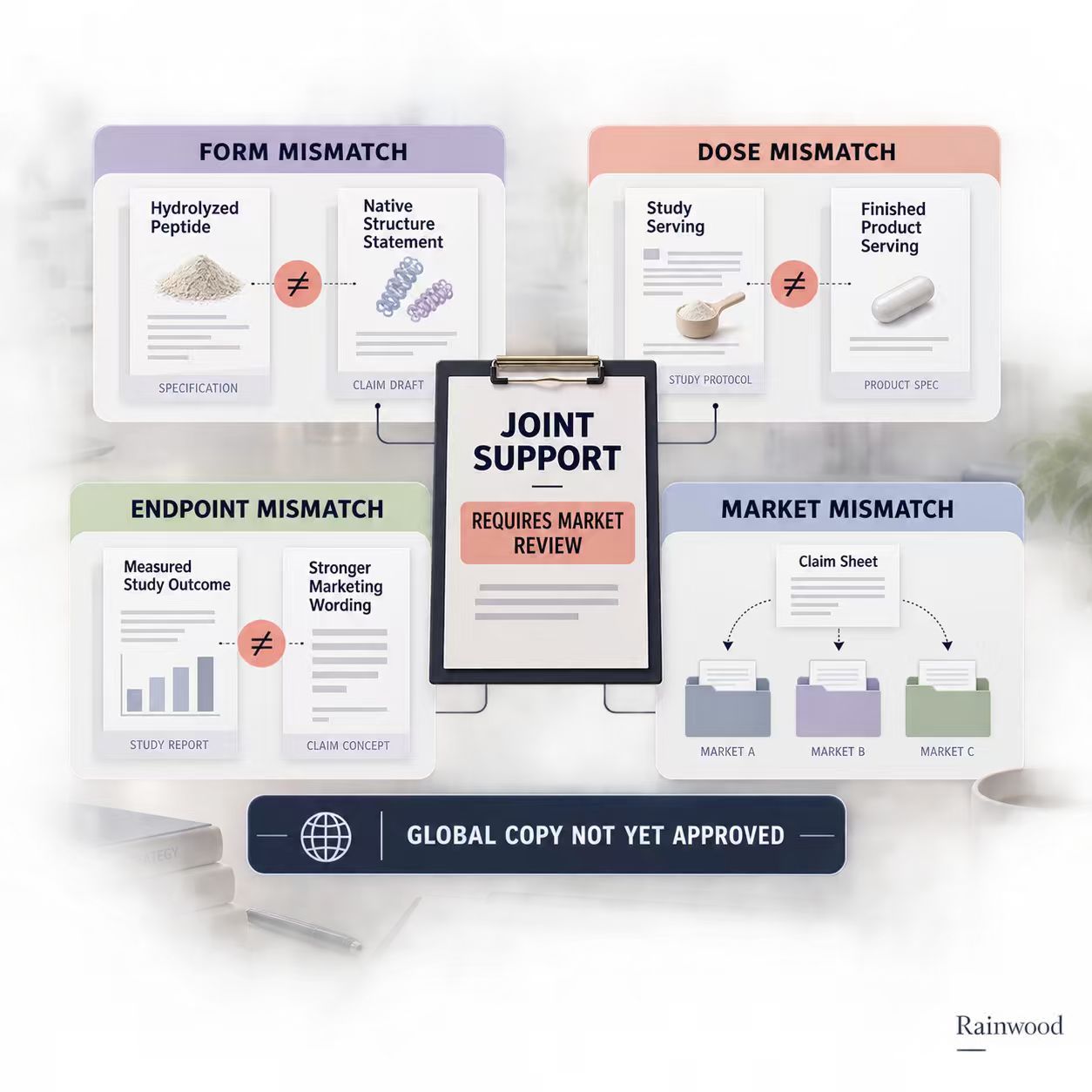
The four claim mismatches that create launch risk
Form mismatch
The claim describes preserved native structure while the purchased material is a hydrolyzed peptide. The wording may be scientifically familiar but commercially unsupported.
Dose mismatch
The study or supplier recommendation uses one serving amount, while the finished product delivers another. A lower amount may not support the same evidence statement.
Endpoint mismatch
The evidence measures a specific joint-related outcome, while the marketing copy promises treatment, prevention, or a guaranteed result. A broad claim can still imply a disease outcome when placed beside arthritis language.
Market mismatch
Words accepted in one market or channel may be restricted, interpreted differently, or require a different notification or evidence file elsewhere. “International” is not a regulatory category.
Read the UC-II versus generic peptide evidence gap before you reuse a study sentence across product forms.
A market-by-market claim matrix
Use a table like this before translation:
| Market or channel | Exact product form | Proposed wording | Evidence needed | Review status |
|---|---|---|---|---|
| U.S. dietary supplement | Hydrolyzed peptide | Ingredient and structure-neutral support wording | Identity, dose, label review | Pending qualified review |
| EU market | Exact grade and source | Market-specific nutrition or health wording | Novel-food and claim assessment where relevant | Pending jurisdiction review |
| Practitioner channel | Peptide or undenatured form | Technical product explanation | Dossier, dose, study match | Pending professional review |
| Marketplace listing | Finished formula | Short benefit-oriented copy | Platform and market policy check | Pending listing review |
This is a planning tool, not a legal conclusion. The destination market, final wording, product classification, and competent review determine the actual requirements.
Why a disclaimer does not repair an aggressive claim
A disclaimer can clarify that a product is not intended to diagnose or treat disease, but it does not automatically authorize a disease statement above it. A product page that says “reduces arthritis pain” followed by “not medical advice” still creates a claim issue. The safer process is to remove unsupported wording and keep the copy tied to the evidence and product form.
The same caution applies to testimonials and influencer scripts. A customer story can create an implied outcome that the approved label does not contain. Treat the whole channel as part of the claim file.
A practical claim review workflow
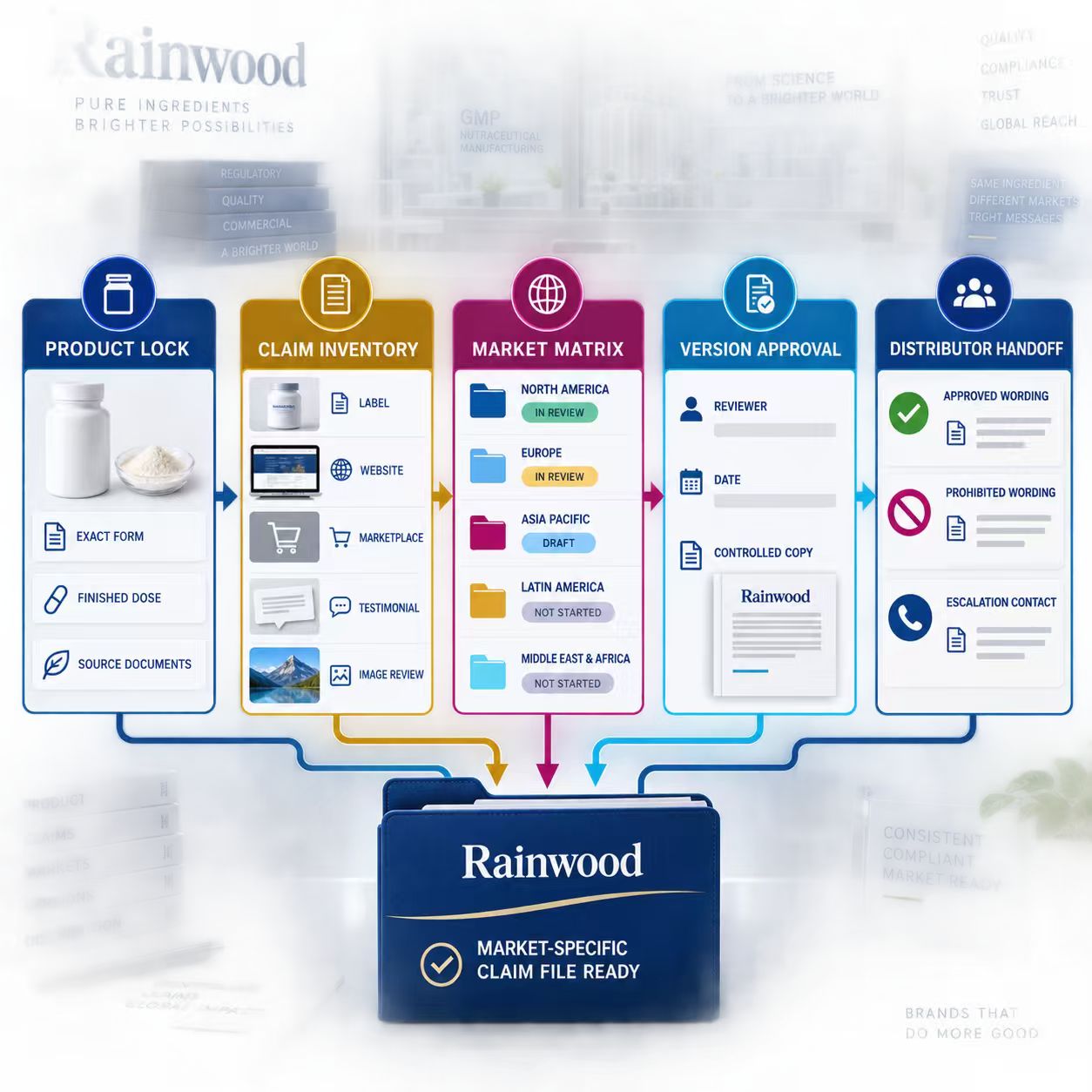
1. Freeze the ingredient identity and form.
2. Confirm the dose as delivered in the finished product.
3. List every customer-facing statement, including images and testimonials.
4. Match each statement to evidence, market, and audience.
5. Remove disease, prevention, cure, and guaranteed-outcome wording.
6. Record the reviewer, date, source, and version.
7. Reopen the review when the source, process, dose, format, or market changes.
Keep a redline history. A claim that is acceptable for one distributor may be unacceptable when translated or placed next to a condition name.
How RainwoodBio can support a market-specific project file
RainwoodBio publishes requirement confirmation, supplier management, testing and release documentation, OEM format development, packaging, and traceability. For claim-sensitive products, the useful control is to bring the target market and label wording into the technical brief instead of treating them as a final marketing task.
Request a market and claim evidence-gap review using your target countries, formula, serving size, draft label, and product-page copy.
Launch gate for a global product page
Do not publish until:
- the product form is stated accurately;
- dose and study material are matched;
- source and identity documents are available;
- claim wording has a market owner and review status;
- distributor and marketplace copy use the same approved boundaries;
- testimonials and images have been screened for implied disease claims;
- source or formula changes trigger a claim re-review.
Send the draft label, product page, study file, COA, target markets, and sales-channel list for a type II collagen claim-file review. RainwoodBio can help organize the technical inputs so your team knows which statements are ready, conditional, or unsupported.
The distributor handoff matters
Many claim problems appear after the manufacturer finishes its review. A distributor adds a headline, an influencer adds a testimonial, or a marketplace automatically places the ingredient beside an arthritis search term. Give every downstream partner an approved claim sheet with allowed wording, prohibited wording, material form, serving amount, evidence source, and escalation contact. Ask them to return the final localized page for review before publishing. This small control protects the connection between the type II peptide you qualified and the promise the customer actually sees.
Keep a version number on the claim file. When the supplier changes source, hydrolysis, dose, format, or target market, reopen the review rather than carrying old copy forward by habit.
Frequently asked questions
1.Is “supports joint health” automatically allowed everywhere?
No. The wording, product classification, evidence, target market, channel, and surrounding context all matter. Obtain a market-specific review.
2.Can I translate an approved English claim directly?
Not safely. Translation can change the implied strength or medical meaning. Review the localized wording in its market context.
3.Does a study on undenatured collagen prove a hydrolyzed peptide claim?
Not automatically. Confirm form, source, dose, finished product, and endpoint before making the connection.
References
- EFSA, Novel Food applications and guidance: https://www.efsa.europa.eu/en/applications/novel-food
- U.S. FDA, Exploring the Scope of Dietary Supplement Ingredients: https://www.fda.gov/media/191964/download
- Functional Characterization of Undenatured Type II Collagen Supplements: https://www.tandfonline.com/doi/pdf/10.1080/19390211.2021.1931621
- RainwoodBio Contact Us: https://www.rainwoodbio.com/contact-us
This article is for B2B procurement and educational purposes. Claims, safety, labeling, evidence, and regulatory requirements must be confirmed by qualified reviewers for the exact product, channel, and destination market.