 EN
EN

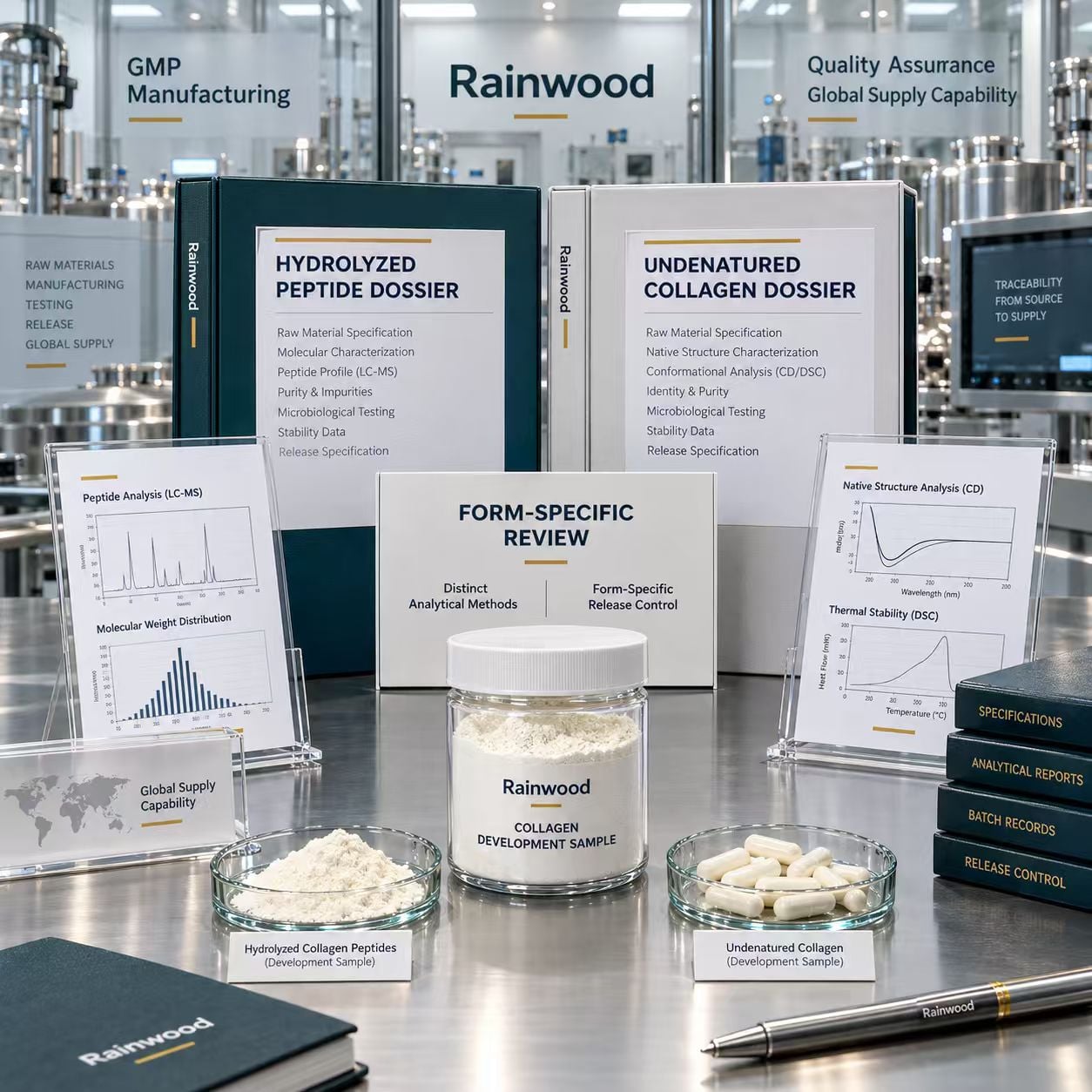
Meta title: Hydrolyzed or Undenatured Type II Collagen Guide
Meta description: Hydrolyzed type II peptides and undenatured collagen are not interchangeable. Learn how the form changes testing, dose, claims, and procurement risk.
Two suppliers send you products called “type II chicken collagen.” One is a fine peptide powder intended for a drink or capsule. The other is a low-dose capsule ingredient sold around preserved native structure. The names sound similar, but the technical dossier, testing logic, label language, and evidence file may be completely different.
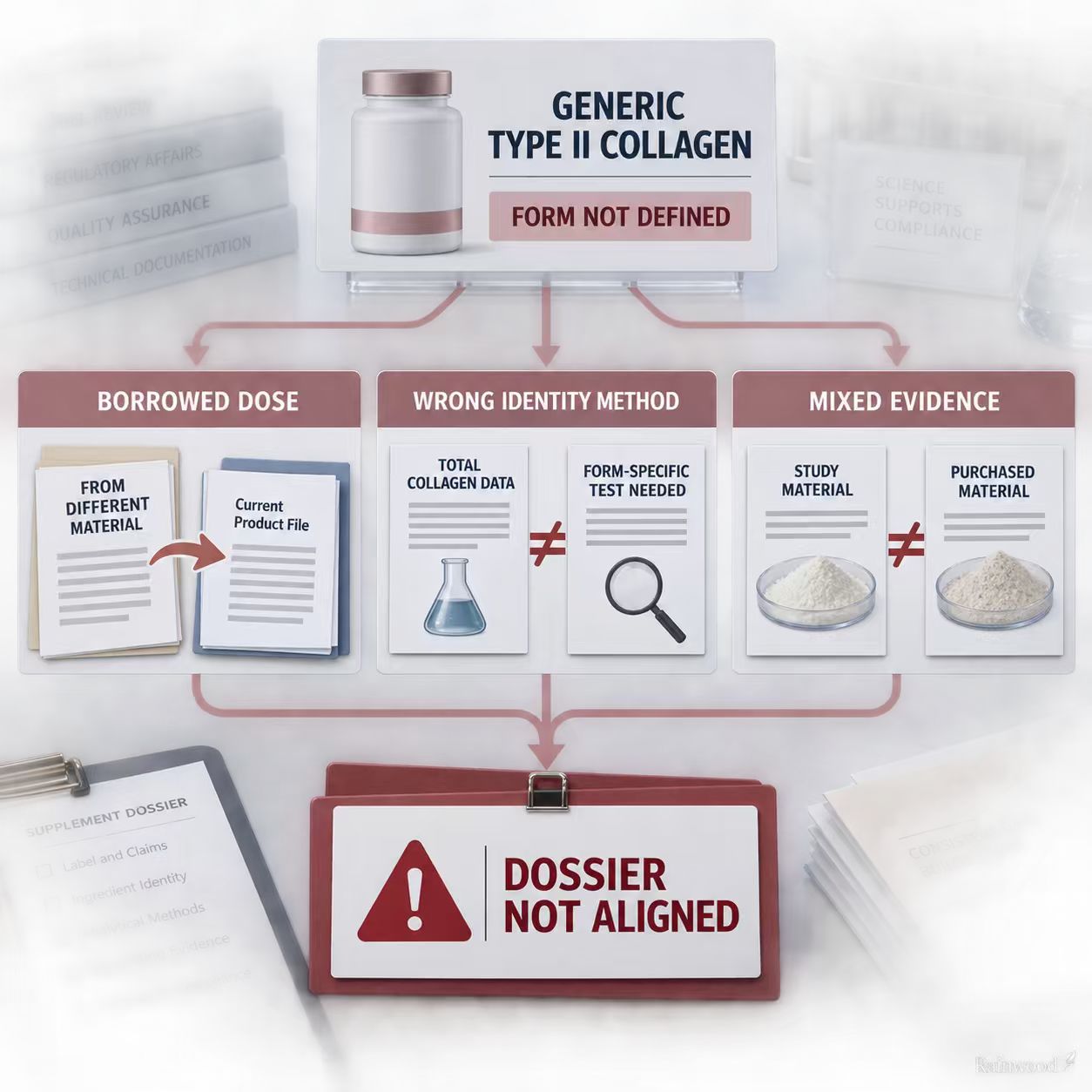
This is the distinction that can quietly break a launch. If your team treats hydrolyzed peptide material as a generic version of undenatured type II collagen, it may borrow the wrong dose, the wrong study, the wrong assay, and even the wrong customer explanation. The finished product can be physically acceptable and still be commercially misrepresented.
Hydrolysis changes the question you are buying
Hydrolyzed type II collagen peptide is produced by breaking larger collagen molecules into smaller peptide fragments. The process is designed to create a peptide material with a defined composition and handling profile. Temperature, enzyme system, time, pH, filtration, and drying influence the final molecular-weight distribution and physical behavior.
Undenatured type II collagen is a different proposition. Its value proposition depends on retaining aspects of the native collagen structure, including epitopes that can be lost or altered by hydrolysis. The U.S. FDA discussion of supplement ingredients describes UC-II-type material as undenatured type II collagen preserved through controlled processing, and it distinguishes native or partially hydrolyzed forms from fully hydrolyzed peptides. That is why a method designed for total collagen cannot automatically prove preserved native structure.
Use our type II chicken collagen product comparison when you need to compare commercial forms without collapsing them into one line item.
The first dossier failure: the borrowed dose
Undenatured type II collagen products are often positioned at much smaller daily amounts than hydrolyzed collagen peptides. A label database example for a UC-II product lists 40 mg of undenatured type II collagen per serving, but that product-specific label cannot establish the correct dose for a generic hydrolyzed peptide powder. The number is part of that ingredient’s formulation and evidence story, not a universal type II collagen rule.
The buyer loss appears when a brand copies the low-dose logic into a peptide formula. The label may underdeliver the intended ingredient amount, the sensory effect may not match the formulation plan, and the evidence file may no longer match the purchased material. The opposite error is also expensive: loading an undenatured ingredient at peptide-style quantities can distort cost, capsule count, and label expectations.
Before approving a dosage, write down the exact commercial form, the assay basis, the studied material, the serving size, and the intended claim language. If any line is “generic type II collagen,” stop and resolve the ambiguity.
The second failure: using the wrong identity method
For hydrolyzed peptides, a buyer may need source documentation, collagen or protein assay, molecular-weight distribution, moisture, ash, microbiology, heavy metals, and a process description. For an undenatured material, the buyer may also need a structure-sensitive identity test, such as an assay that recognizes preserved type II epitopes. HPLC or hydroxyproline can be useful in a broader package, but they do not answer every structural question.
The 2021 comparative study of undenatured type II collagen supplements found meaningful differences among products and warned that supplements should not be assumed interchangeable simply because their labels use similar words. That is a procurement lesson: the product name is an invitation to investigate, not proof of equivalence.
Read the COA identity questions for type II peptide buyers before accepting a one-page report as a complete dossier.
The third failure: mixing evidence across forms
A study can be scientifically credible and commercially irrelevant if the tested material does not match the product you plan to sell. Check whether the study used undenatured collagen, partially hydrolyzed collagen, or short peptides; whether the source was chicken sternum cartilage; whether the dose and delivery format match; and whether the study outcome supports a structure-specific mechanism or only a general nutrition statement.
Do not describe a generic hydrolyzed peptide as “clinically proven UC-II.” Do not imply that a supplier has permission to use a trademark simply because the material is type II collagen. Do not place a trademarked ingredient name beside a non-branded raw material unless authorization and identity equivalence have been independently confirmed.
For international buyers, also separate evidence from market access. A study does not approve a label, and a label database entry does not prove that a different ingredient is legal in your destination market.
A side-by-side procurement matrix
| Decision point | Hydrolyzed type II peptide | Undenatured type II collagen |
|---|---|---|
| Main product concept | Peptide mixture created by enzymatic or other hydrolysis | Collagen structure intentionally preserved |
| Typical dossier emphasis | Source, peptide distribution, assay, contaminants, physical properties | Structure-sensitive identity, source, preservation process, assay, contaminants |
| Dose logic | Must be set for the exact peptide material and formula | Must be linked to the exact undenatured ingredient and evidence |
| Format questions | Solubility, taste, moisture, bulk density, high fill weight | Low-dose blending, content uniformity, capsule compatibility |
| Evidence risk | Borrowed native-collagen or branded studies | Assumed interchangeability with generic peptides |
| Change-control priority | Enzyme, hydrolysis time, filtration, drying, and source | Temperature, processing intensity, source, and structure preservation |
Use this matrix during a supplier call. If the seller cannot state which column describes the product, you do not yet have a purchasable specification.
How RainwoodBio can keep the project form-specific
RainwoodBio publishes private-label and OEM support across powders, hard capsules, gummies, tablets, softgels, and related formats, together with requirement confirmation, sample development, testing and release documentation, packaging, and traceability. For this product, the important control is the initial form lock: the project brief should name hydrolyzed peptide or undenatured collagen before dosage, claims, packaging, or study language is discussed.
Ask for a form-specific OEM development review that keeps the material identity, serving math, format, and market language connected.
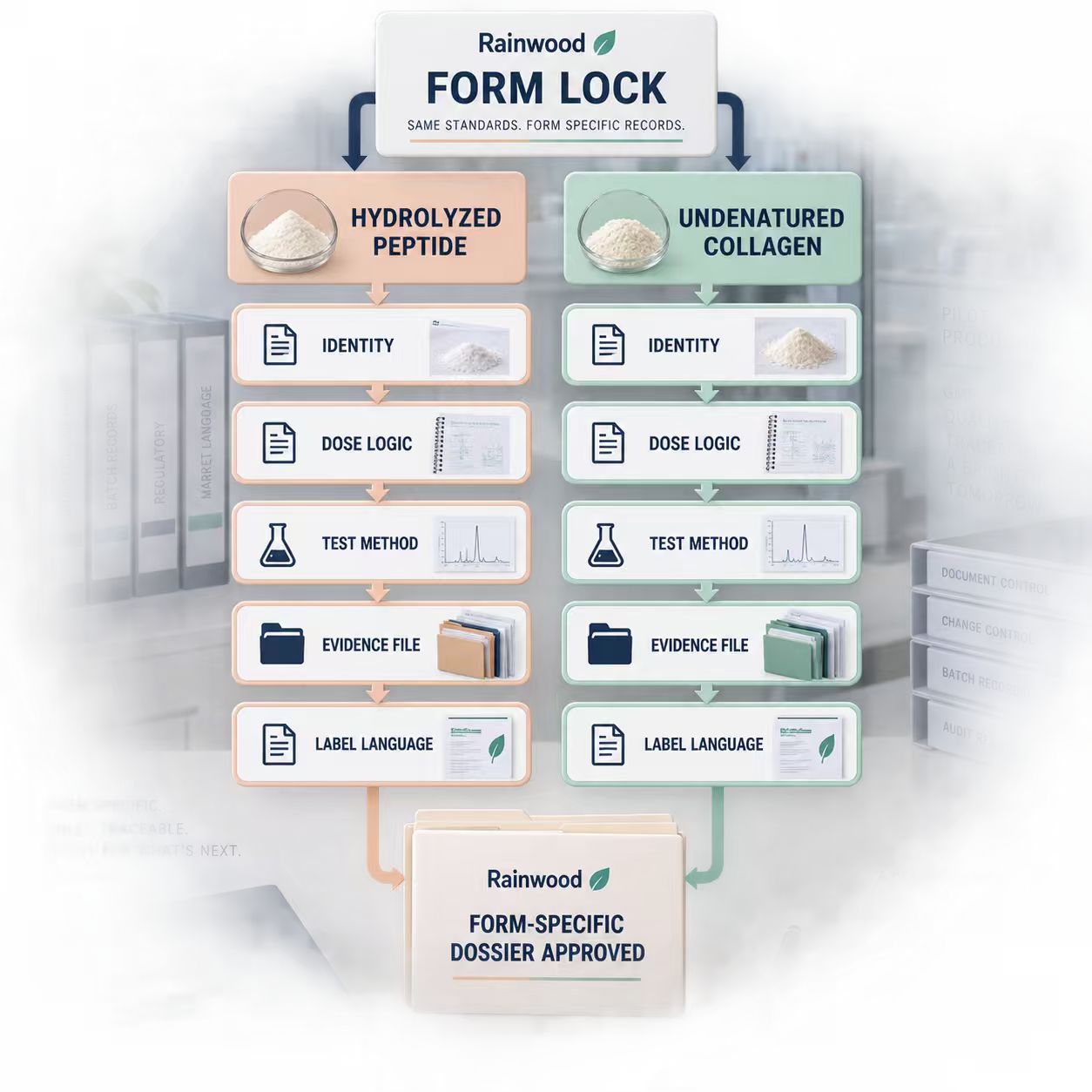
Your approval gate before using the name “type II collagen”
Require the supplier to answer these questions in writing:
- Is the product fully hydrolyzed, partially hydrolyzed, or undenatured?
- What chicken tissue is the source, and how is it traced to the lot?
- Which test supports type II identity for this form?
- Does the reported molecular-weight result describe an average, a range, or a distribution?
- Which study, if any, used the exact material, dose, and format?
- Is any trademarked name authorized for this purchase?
- Which target market and claim vocabulary will appear on the finished label?
Send your draft label, supplier COA, study link, target market, and planned serving size for a hydrolyzed-versus-undenatured dossier review. RainwoodBio can help separate the questions before your marketing copy, formulation, and evidence file become difficult to unwind.
Frequently asked questions
1.Are hydrolyzed peptides automatically inferior to undenatured collagen?
No. They are different materials designed around different technical and commercial propositions. The correct choice depends on the formula, evidence, target market, serving size, and claims you can support.
2.Can I use “UC-II” as a generic name for chicken type II collagen?
Do not assume that you can. UC-II is associated with a specific branded ingredient and evidence package. Confirm trademark rights, source, process, and equivalence before using the name.
3.Can one COA cover both forms?
Not necessarily. The release panel should match the form and the risk. A total protein result may be relevant to both, but structural or peptide-profile questions can differ materially.
References
- U.S. FDA, Exploring the Scope of Dietary Supplement Ingredients: https://www.fda.gov/media/191964/download
- NIH Dietary Supplement Label Database, UC-II label example: https://dsld.od.nih.gov/label/283151
- Functional Characterization of Undenatured Type II Collagen Supplements: https://www.tandfonline.com/doi/pdf/10.1080/19390211.2021.1931621
- RainwoodBio OEM information: https://www.rainwoodbio.com/oem
This article is for B2B procurement and educational purposes. Product identity, dose, evidence, safety, labeling, trademark rights, and regulatory requirements must be confirmed for the exact ingredient, formula, and destination market.