 EN
EN

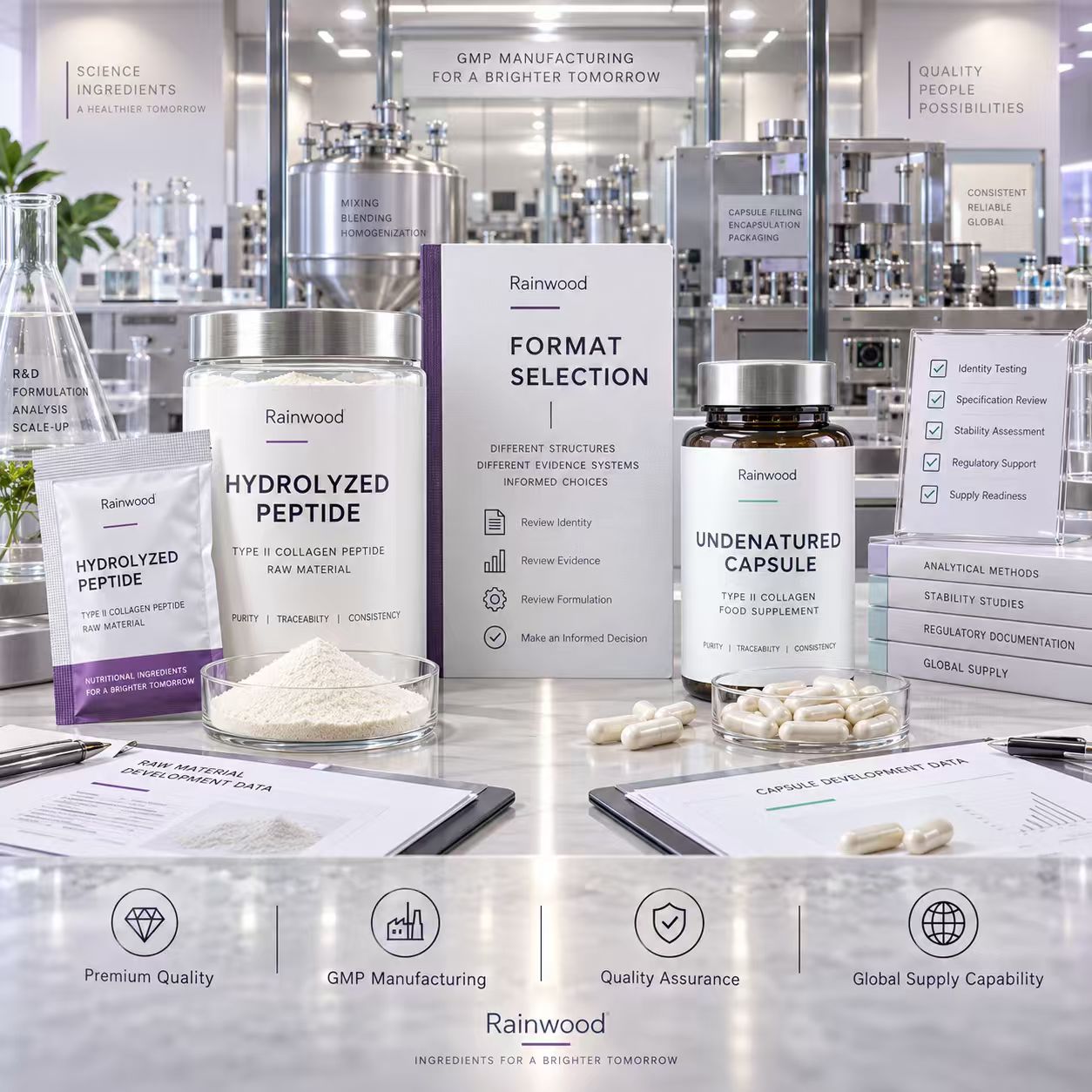
Meta title: Type II Collagen Peptide Format Selection Guide
Meta description: Choose between hydrolyzed peptide and undenatured capsule formats using dose, label clarity, evidence, cost, and buyer expectations.
Your product meeting starts with a familiar question: should the new joint-support product be a powder, a multi-capsule peptide formula, or a small-dose undenatured collagen capsule? The answer is not found in a trend report. It comes from the material form, the evidence you can support, the daily dose, and what your buyer can understand without a ten-minute explanation.
Hydrolyzed type II chicken collagen peptide and undenatured type II collagen are often placed side by side in sales decks. That comparison can be useful, but only if the team keeps their identity and evidence separate. A format decision made from the bottle appearance alone can produce a confusing label, an unworkable dose, or a claim that belongs to another ingredient.
Start with the buyer decision, not the delivery system
Ask who will buy the finished product. A sports-nutrition customer may accept a flavored powder and a larger serving. A practitioner channel may prefer a compact capsule with a tightly explained evidence file. An Amazon customer may compare capsule count, reviews, and price per month before reading the science.
Use our type II collagen product-format selection guide to map the material choice to a real buyer and a measurable commercial outcome.
Hydrolyzed peptide: flexible format, different education burden
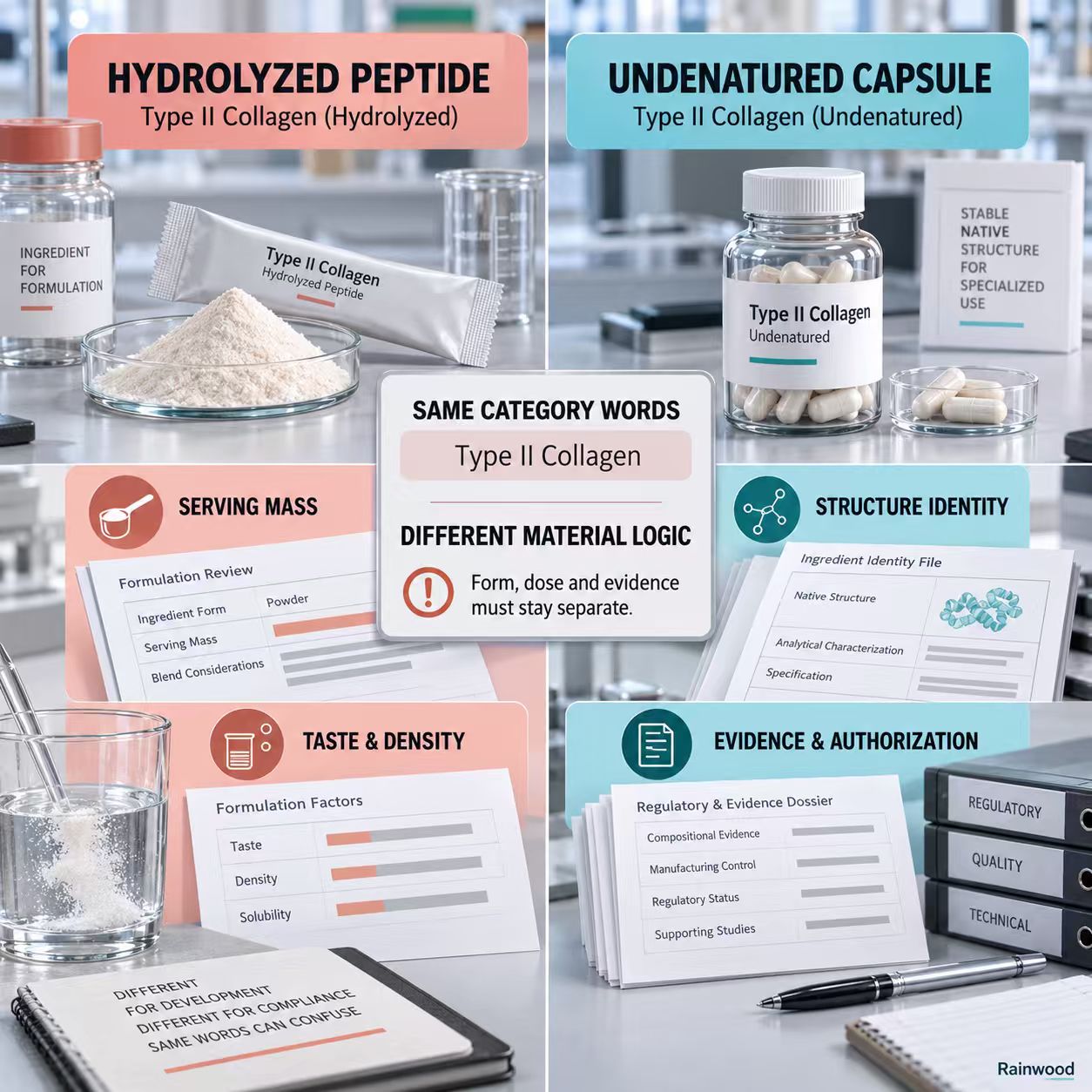
Hydrolyzed peptides can be considered for powders, sachets, capsules, tablets, and other formats depending on dose, taste, density, and process. Their marketing story usually requires explanation of source, peptide profile, serving amount, and formula purpose. The product team must avoid implying that a generic peptide is the same as a branded undenatured ingredient.
The commercial benefit can be format flexibility, but the cost may be higher serving mass, stronger taste, or more visible formula math. If the peptide dose is large, a powder may be more practical than a two-capsule promise. If the customer wants convenience, the brand may need a larger capsule or a different delivery system.
Undenatured capsule: compact serving, tighter identity story
Undenatured type II collagen products rely on preserved structure and an ingredient-specific evidence package. That can support a compact capsule proposition, but it also creates a stricter requirement for identity, process, trademark review, and claim language. The product should not be marketed as a generic low-dose version of every hydrolyzed collagen peptide.
The buyer loss is a trust gap. If the label promises a structure-specific ingredient but the dossier only proves total protein, a sophisticated retailer or practitioner can ask questions the brand cannot answer. If the ingredient is branded, confirm authorization rather than treating a familiar name as a generic category.
Read the evidence gap between generic peptides and UC-II studies before you approve a comparison chart or sales presentation.
The format decision table
| Decision factor | Hydrolyzed type II peptide | Undenatured type II capsule |
|---|---|---|
| Serving logic | Set for the exact peptide grade and formula | Set for the exact ingredient and evidence |
| Main formulation issue | Mass, taste, density, solubility, or compression | Low-dose blending and content uniformity |
| Label education | Explain peptide source and amount | Explain preserved structure and ingredient identity |
| Claim risk | Borrowed branded or native-collagen evidence | Unsupported generic use of trademark or study |
| Format options | Powder, sachet, capsule, tablet, or other validated form | Often compact capsule, but still product-specific |
| Buyer comparison | Cost per serving and delivered peptide | Evidence, authenticity, authorization, and dose |
Use the table to identify what must be proven. Do not use it to declare one form universally superior.
The price-per-day trap
Compare complete monthly economics, not only raw-material price per kilogram. Include serving amount, capsule count, excipients, flavoring, package size, filling loss, testing, freight, and expected reorder behavior. A lower-cost peptide can require more capsules or a larger package. A higher-cost undenatured ingredient can support a smaller serving but may require more documentation and stricter authorization control.
Then compare the customer explanation. If the salesperson needs to explain why two “type II collagen” products have different doses, the label and product page must be prepared for that conversation. Confusion becomes a conversion problem when the shopper sees a cheaper product with a larger milligram number and assumes it is stronger.
A practical format selection workshop
Invite procurement, formulation, regulatory, marketing, and sales to answer these questions:
- What exact form is being purchased?
- Which study or evidence file is relevant to that form?
- What daily amount can the formula physically deliver?
- Which format gives the buyer a clear and honest explanation?
- What sensory or manufacturing risk must be tested first?
- What claim language is allowed in each target market?
- What happens if the source or process changes?
Write the answers into the product brief. A format decision that exists only in a marketing meeting will be rewritten by cost pressure later.
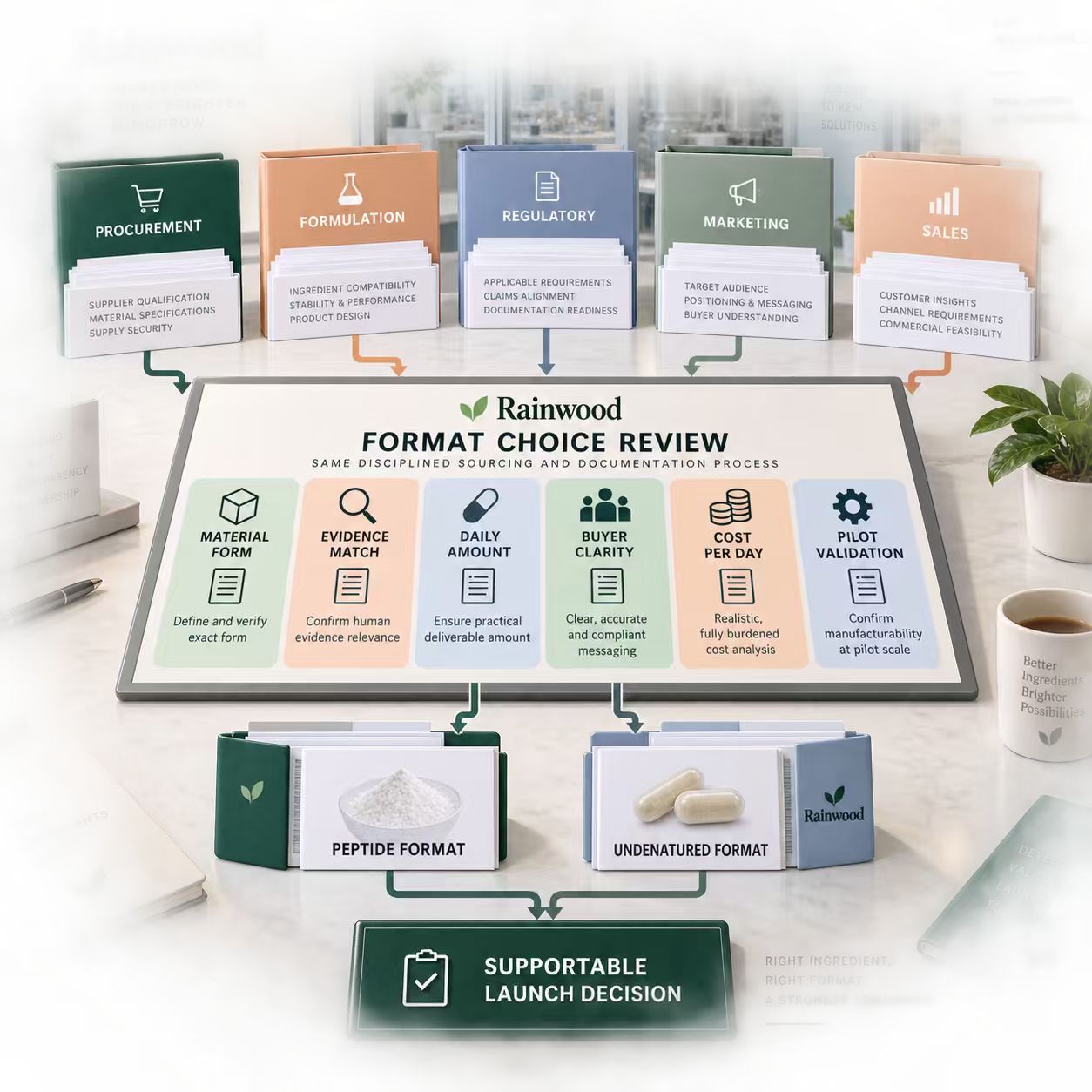
How RainwoodBio can compare delivery formats with the same sourcing discipline
RainwoodBio publishes multi-format OEM support, including hard capsules, gummies, powders, sachets, tablets, softgels, requirement confirmation, sample development, testing and release documentation, packaging, and traceability. The useful capability is not offering every format automatically. It is comparing the format against dose, process, package, target market, and buyer expectations.
Request a type II collagen format and cost comparison with your target monthly serving, capsule count, flavor preference, package size, and forecast quantity.
The launch gate
Do not approve the chosen format until:
- the material form is named precisely;
- the serving amount is linked to the exact evidence file;
- the format has passed a realistic pilot;
- the label avoids borrowed trademark or study language;
- the monthly cost includes manufacturing and package realities;
- the source and process change controls are documented;
- sales staff can explain the product without making a disease claim.
Send your two candidate formulas, supplier documents, target market, and draft product page for a type II collagen format-choice review. RainwoodBio can help identify which option is understandable, manufacturable, and supportable before the launch budget is committed.
Frequently asked questions
1.Is an undenatured capsule always easier for the customer?
Not automatically. It may offer a compact serving, but the customer still needs a clear explanation of the ingredient identity, dose, and evidence. Confusing trademark or structure language can undermine convenience.
2.Is a peptide powder less premium than a capsule?
No. Premium positioning depends on source, specification, evidence, format execution, and customer value. A powder can be the better choice when the peptide dose and flavor system demand more space.
3.Can one product page compare both forms?
It can, but the page should make the differences explicit and avoid implying equivalence. Keep source, dose, studies, and claims tied to the correct material.
References
- U.S. FDA, Exploring the Scope of Dietary Supplement Ingredients: https://www.fda.gov/media/191964/download
- NIH Dietary Supplement Label Database, UC-II label example: https://dsld.od.nih.gov/label/283151
- Functional Characterization of Undenatured Type II Collagen Supplements: https://www.tandfonline.com/doi/pdf/10.1080/19390211.2021.1931621
- RainwoodBio OEM information: https://www.rainwoodbio.com/oem
This article is for B2B procurement and educational purposes. Dose, evidence, safety, labeling, trademark rights, format performance, and regulatory requirements must be confirmed for the exact ingredient, formula, and destination market.