 EN
EN

Meta title: Type II Collagen Peptide Capsule Dose Planning
Meta description: High-dose collagen peptides can create capsule-count and cost problems. Use dose math, density, blend limits, and format trials before launch.
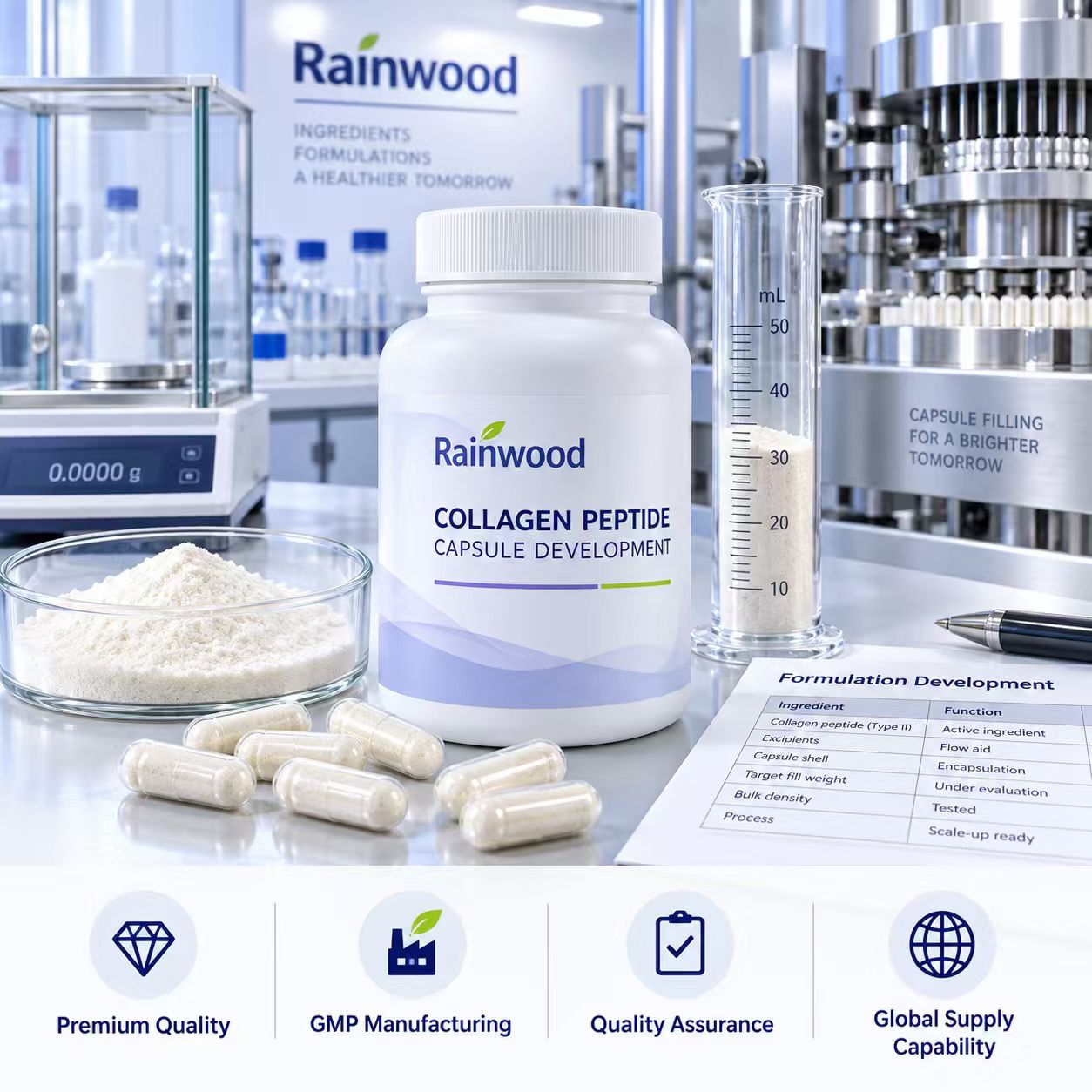
The bottle mockup is approved. The capsule looks familiar. Then the formulator calculates the actual serving and discovers that the product will need four, six, or more capsules per day. The marketing team wants a compact two-capsule routine, but the type II chicken collagen peptide dose and excipient system do not fit.
This is not a packaging problem. It is a dose-and-format problem that should have been solved before the label design. Hydrolyzed collagen peptides and undenatured type II collagen often use very different serving logic, so copying the capsule count from one form into the other can create a product that is technically underdosed, commercially expensive, or physically impossible to fill.
Start with delivered peptide mass, not the front label
Write the dose equation before you discuss capsule size:
Daily collagen peptide mass = target serving amount of the purchased grade × number of servings per day.
Then add the real constraints: active assay basis, moisture, carrier or excipient percentage, bulk density, capsule fill weight, blend uniformity, and manufacturing overage. If your supplier reports collagen on a dry basis but your label is calculated as received, the difference affects the delivered mass.
Use our type II collagen peptide dose and capsule specification to keep the ingredient amount and capsule plan connected.
Why the low-dose UC-II comparison can mislead your brand
Undenatured type II collagen products are often positioned at small serving amounts tied to a particular branded ingredient and evidence package. Hydrolyzed peptides are a different material. A low-dose native-collagen capsule example cannot be used as a universal benchmark for a generic peptide powder, and a peptide-style mass cannot automatically be assigned to an undenatured product.
The buyer loss is more than an awkward label. If the formula is underfilled, the finished product may not match the commercial positioning. If the formula is overfilled, the capsule count, shipping carton, subscription economics, and customer compliance can suffer. A “premium” formula that requires eight large capsules can lose its advantage at the checkout page.
Read hydrolyzed versus undenatured dose logic before you borrow a serving number from another category.
Capsule capacity is controlled by density, not only size
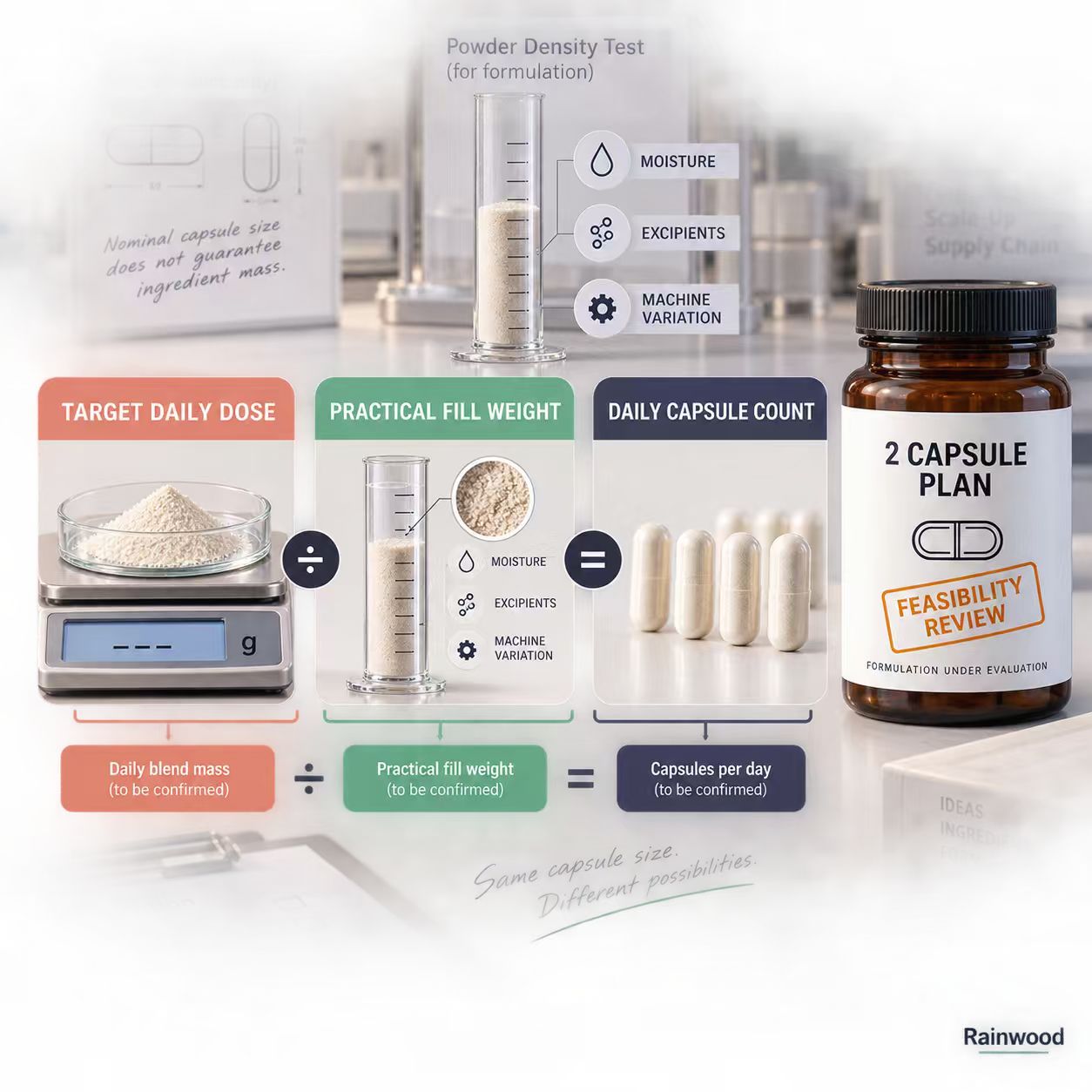
Capsule size charts show nominal volume, not a guaranteed ingredient mass. A fluffy peptide powder with low bulk density may occupy more space than the same weight of a denser powder. Moisture, particle size, agglomeration, and excipients alter flow and packing. The blend also needs enough uniformity to prevent one capsule from carrying more peptide than another.
Ask for the supplier’s bulk density range and test it with the actual formula blend. Use a simple feasibility calculation:
Approximate capsule count = daily blend mass ÷ practical fill weight per capsule.
Use practical fill weight, not the theoretical maximum. Leave room for machine variation, tamping behavior, and the excipient needed to improve flow. If the result is outside the marketing promise, change the dose, capsule size, serving count, or format before artwork is finalized.
Three hidden variables that change the fill plan
Moisture and hygroscopicity
A peptide powder that absorbs moisture can gain weight, clump, and flow differently during production and storage. The formula may need a moisture-barrier package or a desiccant. The label math should still reflect the agreed basis.
Blend uniformity
Low-dose actives are difficult to distribute, but high-dose peptides can create the opposite issue: the blend is large and may segregate during transfer. Sampling points, mixing time, particle-size differences, and bulk density differences all matter.
Sensory or excipient limits
If the peptide contributes odor or taste, the formulator may need a masking system. That additional material takes capsule space and can change cost. An excipient that improves flow may reduce the amount of peptide that fits in each unit.
A capsule feasibility gate for buyers
Run these calculations with the supplier and OEM before approving the bottle:
| Input | Required question |
|---|---|
| Target peptide dose | Is it linked to the exact purchased form and evidence? |
| Assay basis | As-is or dry basis, and how is moisture handled? |
| Bulk density | What is the lot range and test method? |
| Capsule size | What practical fill weight is validated on the machine? |
| Excipient system | How much space is needed for flow and uniformity? |
| Capsule count | Does the daily routine match the buyer promise? |
| Cost per serving | Does fill weight change the landed-cost model? |
| Stability | Does the package protect against moisture uptake? |
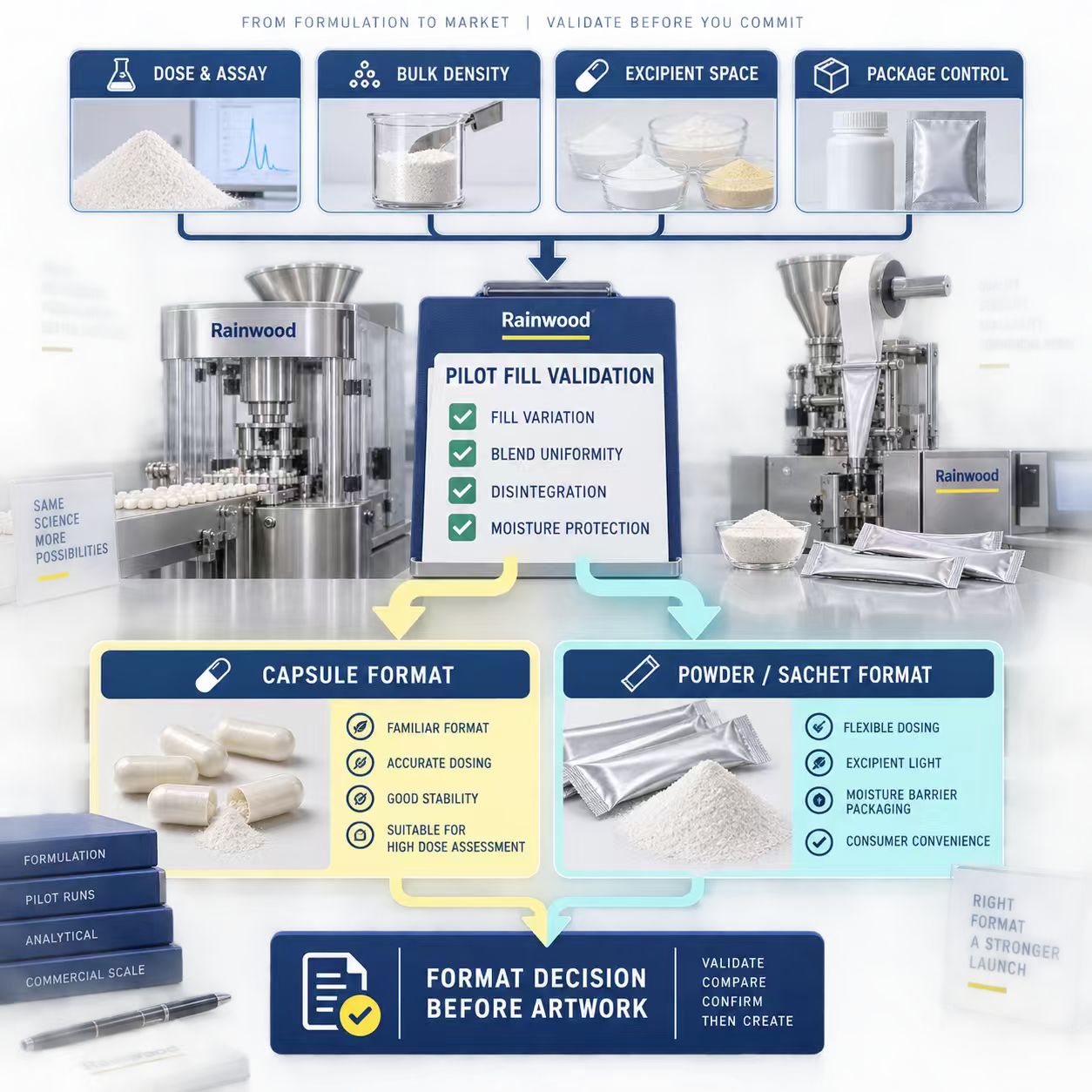
Do not approve the formula until a pilot run confirms actual fill-weight variation, capsule appearance, disintegration, and blend uniformity.
How RainwoodBio can compare formats before commitment
RainwoodBio publishes support for hard capsules, gummies, powders, sachets, tablets, softgels, and OEM/private-label development, along with requirement confirmation, sample development, testing and release documentation, and packaging. For a high-dose peptide, this format choice is a commercial decision, not a cosmetic one.
Ask for a capsule-versus-powder feasibility comparison using your target dose, capsule size, annual quantity, flavor requirements, and package dimensions.
The decision gate before label artwork
Confirm all of the following:
- The dose belongs to the exact material form you are buying.
- The active amount and assay basis are clear.
- Bulk density and moisture ranges are known.
- The formula has been trialed at production-relevant scale.
- Capsule count and customer routine match the positioning.
- The cost model includes excipients, overage, packaging, and freight.
- The finished product specification includes content uniformity, disintegration, and stability checks.
Send your target serving, draft formula, capsule size, packaging plan, and supplier COA for a **type II collagen capsule-dose review** **[INTERNAL LINK -> Contact Us Page]**. RainwoodBio can identify whether your current bottle promise survives the real fill calculation.
Frequently asked questions
1.Can I put a full collagen peptide serving in two capsules?
Possibly, but it depends on the target mass, bulk density, capsule size, excipient needs, and validated fill weight. Do the calculation and pilot run before promising the count.
2.Should I use a larger capsule to reduce the number of capsules?
Not automatically. Larger capsules can affect swallowability, packaging, machine tooling, and customer acceptance. Compare the finished routine, not only the theoretical capacity.
3.Does a higher assay reduce capsule count?
Only if the dose is calculated on the same basis and the higher assay represents the intended identity. It does not solve density, flow, or blend-uniformity constraints by itself.
References
- TGA, Hydrolysed Chicken Cartilage Extract compositional guideline: https://www.tga.gov.au/resources/resources/compositional-guidelines/hydrolysed-chicken-cartilage-extract
- NIH Dietary Supplement Label Database, UC-II label example: https://dsld.od.nih.gov/label/283151
- RainwoodBio OEM information: https://www.rainwoodbio.com/oem
This article is for B2B procurement and educational purposes. Dose, format capacity, safety, labeling, stability, and regulatory requirements must be confirmed for the exact ingredient, finished formula, equipment, and destination market.