 EN
EN

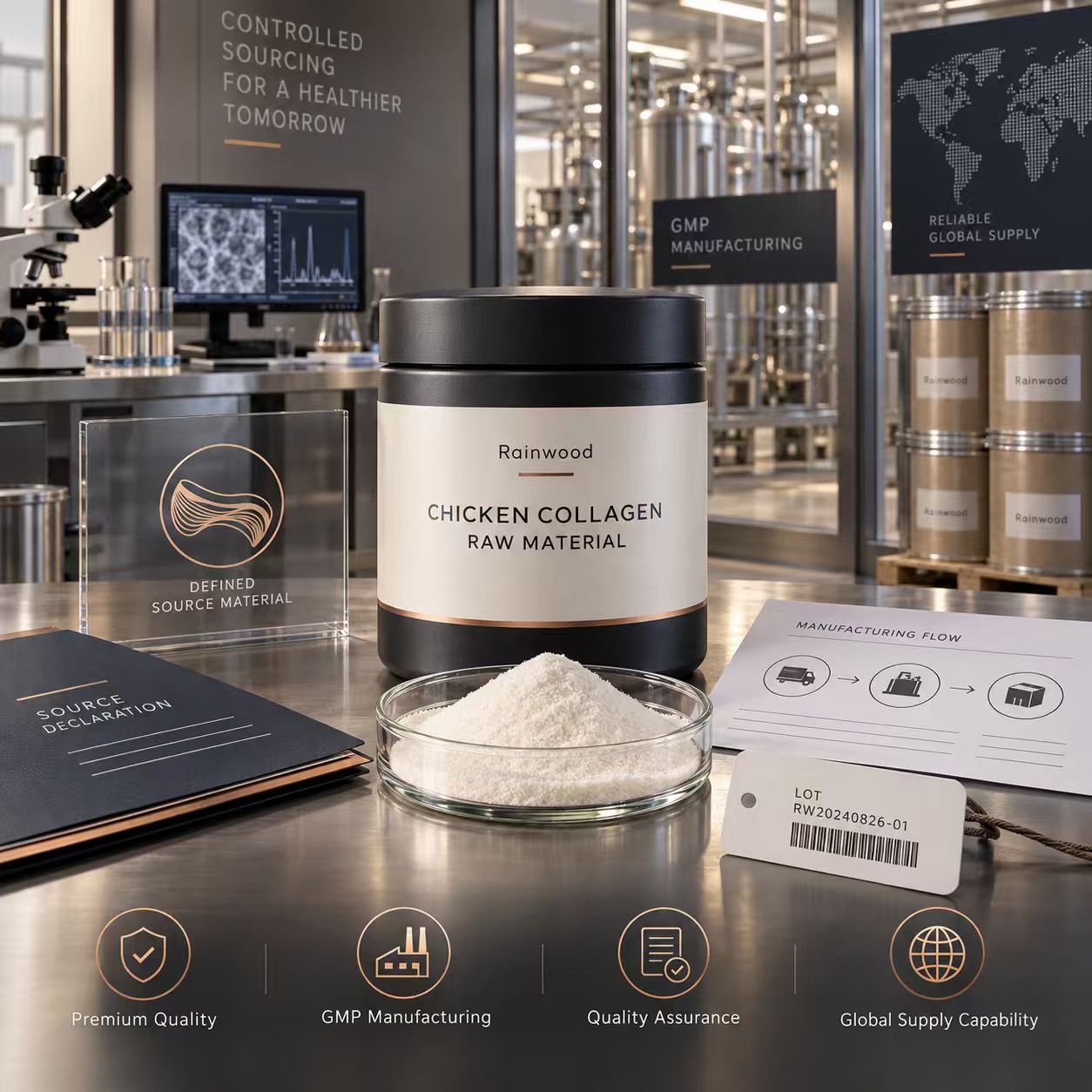
Meta title: Chicken Sternum Collagen Source Verification Guide
Meta description: “Chicken collagen” is not a complete source specification. Learn what importers should verify about tissue, species, processing, traceability, and labels.
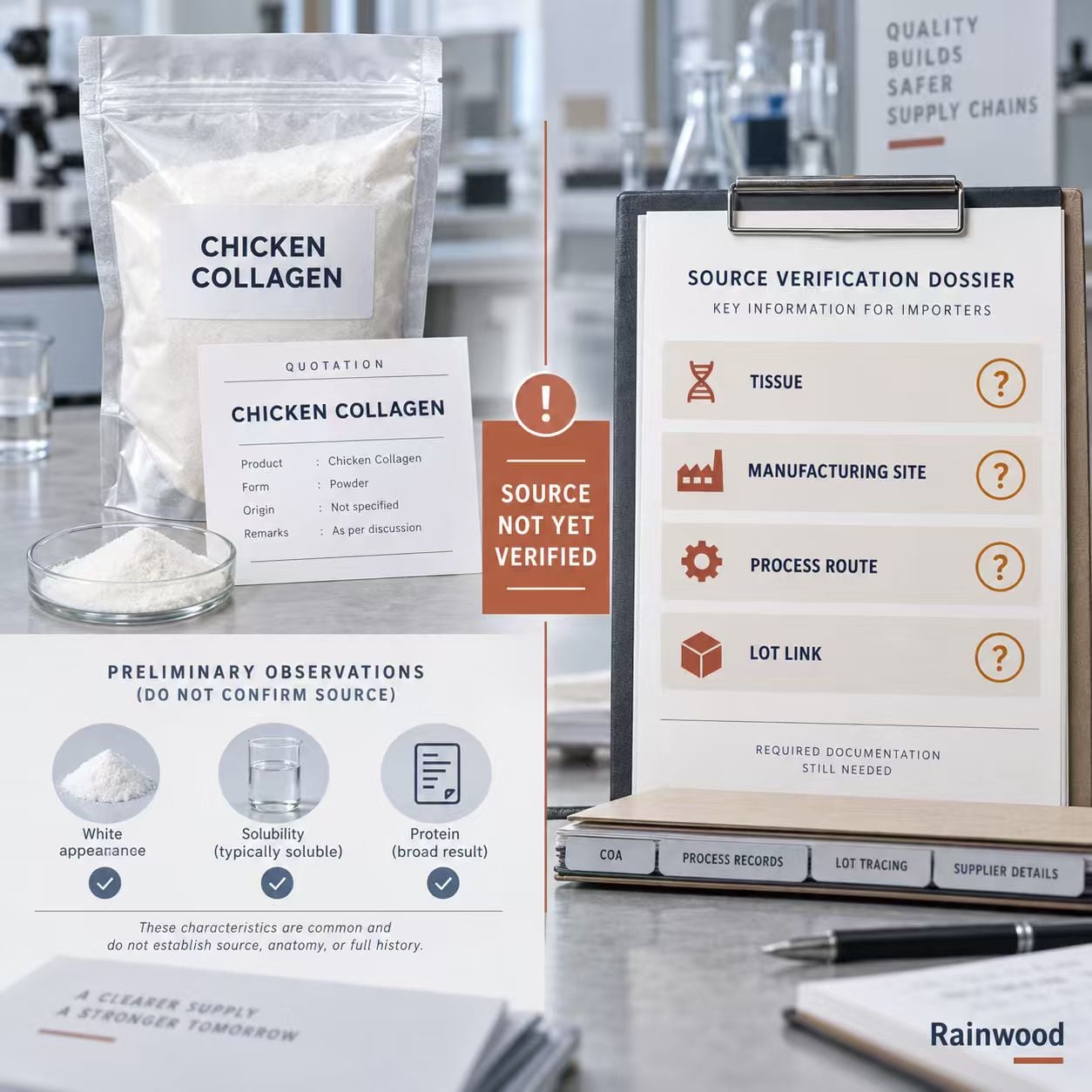
The quotation says “chicken collagen peptide.” The sample is white. The powder dissolves. The price is attractive. None of those facts proves that the commercial lot came from the chicken sternum cartilage source your label, customer, or market file requires.
For importers, source ambiguity is not a minor wording issue. It can affect allergen review, animal-origin statements, religious or customer requirements, customs documentation, claim language, and the credibility of every downstream test. If the supplier changes tissue, processor, or upstream source without a controlled change notice, the product may still look like the same powder while becoming a different procurement risk.
“Chicken collagen” can hide several unanswered questions
A useful source specification should answer more than the species. Ask whether the material comes from sternum cartilage, another cartilage location, skin, bone, or a blended animal stream. Ask whether the starting material is fresh, frozen, dried, or a recovered processing stream. Ask which site performs hydrolysis, filtration, concentration, and drying.
These details matter because tissue composition and process history can influence protein composition, glycosaminoglycan content, ash, odor, moisture, and peptide distribution. The TGA compositional guideline for hydrolysed chicken cartilage extract, for example, describes fresh chicken sternum cartilage and sets compositional and contaminant expectations for that specific type of material. It is not a universal specification for every supplier, but it shows why a defined source creates a stronger purchasing conversation.
Use our chicken cartilage collagen source specification to turn a broad marketing phrase into a document request.
The source sentence should connect to the lot
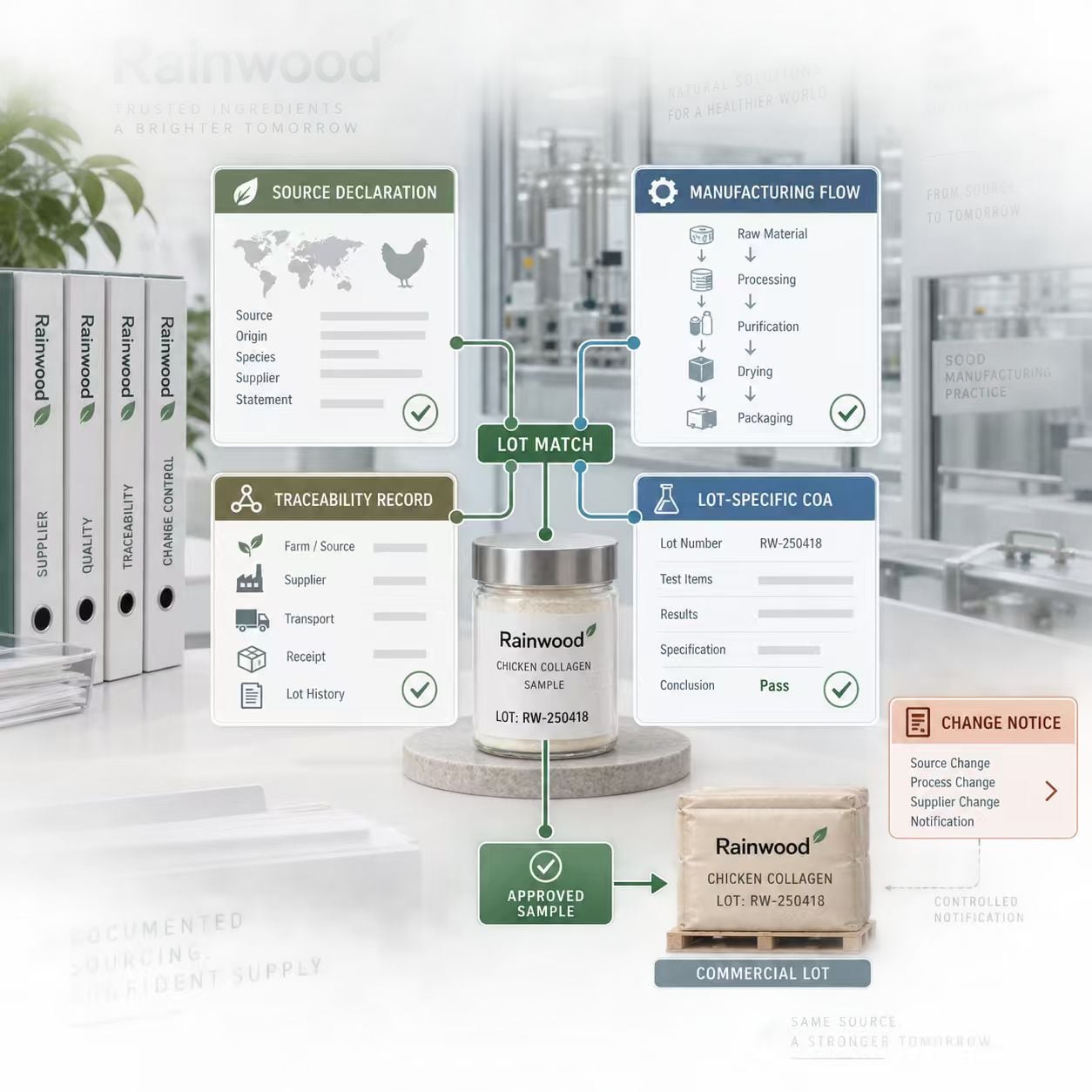
A supplier declaration is useful only when it connects to the material you are buying. The source statement should identify the manufacturing entity, site, raw-material category, lot or production period, and any relevant processing step. If the declaration is undated, unsigned, or issued by a trader with no manufacturer reference, treat it as a starting point rather than final evidence.
The buyer loss can arrive months later. Your initial sample may be made from a traceable source, while the replenishment lot uses a different processor because the original source became expensive. The powder may still meet a broad protein limit. But the color, smell, peptide distribution, ash, chondroitin content, or customer documentation can change enough to disrupt the finished product.
Ask for a source-change notification period in the purchasing agreement. A simple clause can require advance written notice for species, tissue, manufacturer, site, enzyme, hydrolysis, drying, or packaging changes.
Source verification is not the same as a species test
Species testing can be valuable, but it does not answer every source question. A test may support that material contains chicken-derived components. It may not prove that the collagen came from sternum cartilage, that it is type II, or that the product was processed under the agreed conditions.
The same logic applies to collagen markers. A collagen-like amino acid profile can support material characterization, yet it cannot replace the tissue declaration and traceability records. Build the evidence chain rather than searching for a single magic test.
Read the difference between type II identity and total collagen testing before you approve a source claim based on one assay.
Four documents an importer should request
1. Source and animal-origin declaration
The document should identify species, tissue, country or region where relevant, and whether any mixed-source material is permitted. If your customers require a particular animal-origin statement, define the exact wording before the first purchase.
2. Manufacturing flow description
Request the steps from cartilage receipt through hydrolysis, separation, concentration, drying, milling, and packing. The flow does not need to reveal proprietary enzyme names, but it should be detailed enough to evaluate identity and change-control risk.
3. Traceability example
Ask the supplier to show how a finished lot links back to raw-material intake and forward to packaging. A blank template is useful; a redacted completed example is better.
4. Lot-specific supporting documents
The COA, packaging label, production date, and sample record should refer to the same lot. A general product specification cannot replace evidence tied to the shipment you will release.
Source changes can become formula changes
When a new tissue stream brings more chondroitin sulfate, moisture, ash, or odor, the peptide powder may behave differently in a drink, gummy, or capsule. A change that looks like “same protein percentage” in procurement can create a different taste, flow, hygroscopicity, or blend-uniformity challenge in production.
This is why the source requirement must be connected to a sample-to-bulk gate. Compare the new lot against the approved reference for identity, appearance, odor, moisture, protein or collagen assay, molecular-weight distribution, relevant cartilage components, microbiology, and heavy metals. Add format-specific checks if the ingredient is going into a finished product.
RainwoodBio can connect source documents to a production decision
RainwoodBio describes supplier management, sample development, testing and release documentation, packaging, logistics, and traceability as parts of its project workflow. For an importer, the practical benefit is a documented handoff from source requirement to sample approval and commercial-lot review.
Ask for source-qualified OEM and private-label planning that names the source, format, market, and change-control expectations before commercial production.
Importer source checklist
Do not approve “chicken collagen” until you can answer:
- Is the source tissue defined as sternum cartilage or another specific material?
- Is the species statement tied to the lot and manufacturer?
- Are mixed tissues, mixed species, or recovered cartilage streams excluded or controlled?
- Which site performs hydrolysis and drying?
- Can the supplier demonstrate raw-material-to-lot traceability?
- What events trigger a change notice and requalification sample?
- Are animal-origin, allergen, and market-specific documents consistent with the label?
- Which tests will be repeated on the commercial lot?
Send the supplier quotation, source statement, COA, target market, and label wording for a chicken collagen source-risk review. RainwoodBio can help turn vague source language into a release checklist and a clearer comparison between suppliers.
Frequently asked questions
1.Is chicken sternum cartilage the only acceptable source?
Not automatically. The acceptable source depends on your product specification, customer requirements, target market, evidence file, and supplier controls. The important point is to define the source instead of leaving it implied.
2.Does a white powder prove a clean cartilage source?
No. Color is a physical observation, not a complete source or purity test. It should be reviewed alongside source records, assay, moisture, ash, contaminants, and lot traceability.
3.Should source changes always trigger a new stability study?
They should trigger a documented impact assessment. Depending on the change, you may need new sample testing, process trials, finished-product stability, label review, or market-specific requalification.
References
- TGA, Hydrolysed Chicken Cartilage Extract compositional guideline: https://www.tga.gov.au/resources/resources/compositional-guidelines/hydrolysed-chicken-cartilage-extract
- U.S. FDA, Exploring the Scope of Dietary Supplement Ingredients: https://www.fda.gov/media/191964/download
- Comparative analysis of chicken cartilage compounds and type II collagen peptides: https://pmc.ncbi.nlm.nih.gov/articles/PMC9005812/
- RainwoodBio About Us: https://www.rainwoodbio.com/about-us
This article is for B2B procurement and educational purposes. Source, animal-origin, allergen, analytical, safety, customs, labeling, and regulatory requirements must be confirmed for the exact lot and destination market.