 EN
EN

Meta title: Type II Collagen Label and Identity Review Guide
Meta description: Before printing a type II collagen label, connect source, analytical method, product form, dose, and market wording in one defensible review.
The label says “type II chicken collagen peptide.” The supplier specification says “collagen protein.” The study file says “undenatured type II collagen.” Three documents, three levels of language, and no obvious bridge between them. This is how a product name becomes more specific than the evidence behind it.
A label review should not be a proofreading exercise at the end of the project. It should be a controlled decision connecting source, analytical method, commercial form, serving amount, evidence, and destination-market rules. If those elements do not align, the safest action is to narrow the wording or obtain the missing proof before printing.
“Type II” is a conclusion that needs a route to evidence
The source may support chicken cartilage. The hydroxyproline result may support collagenous material. The molecular-weight profile may support a hydrolyzed peptide grade. None of those pieces should be silently upgraded into a complete type II identity statement without a method and source rationale that fit the product.
Use our type II collagen label review framework to map each label term to its supporting record.
The form matters. A hydrolyzed peptide has a different analytical and evidence question from an undenatured product whose value depends on preserved structure. The FDA discussion of supplement ingredients explains why methods that measure total collagen or hydroxyproline cannot automatically distinguish native structure from hydrolyzed material.
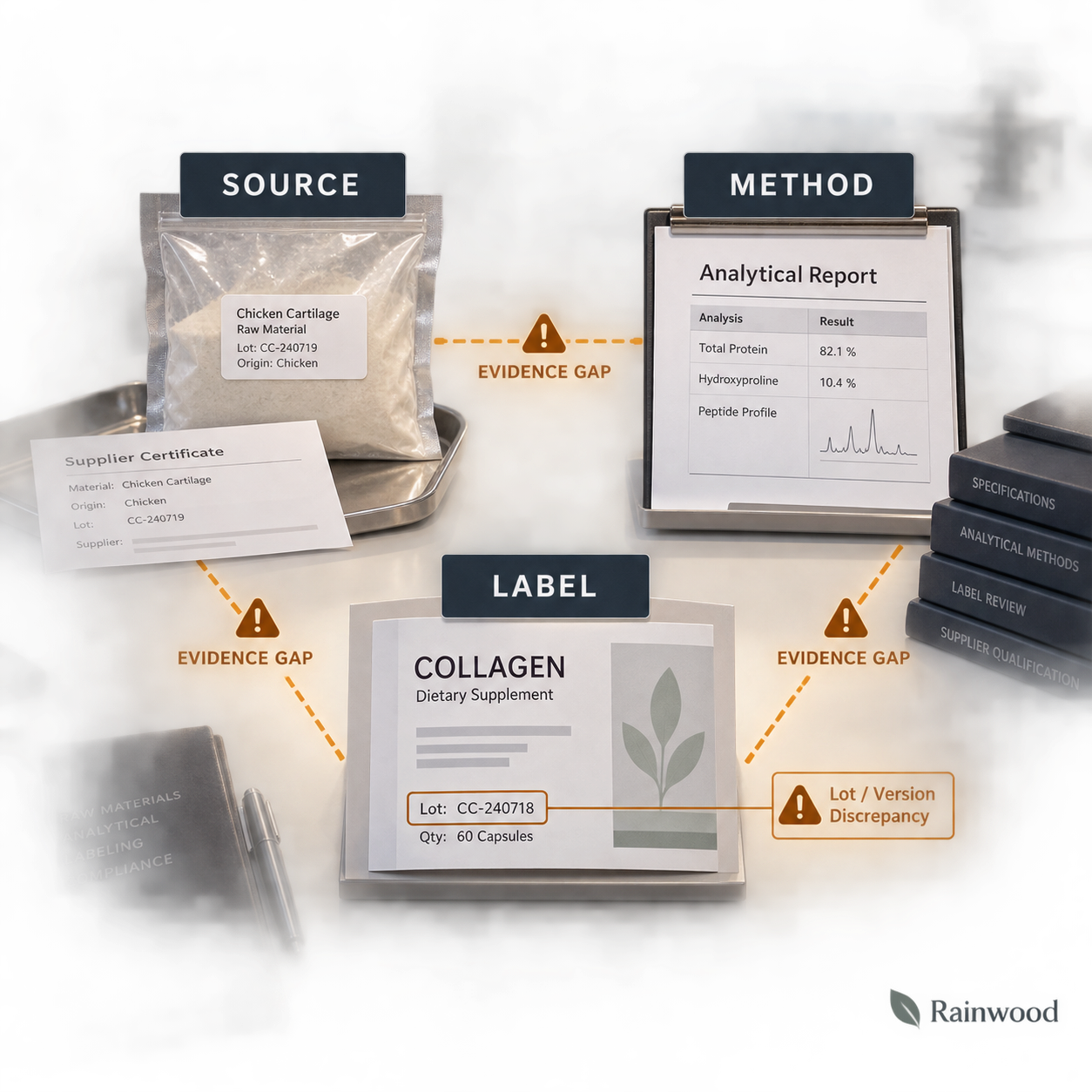
The source-method-label triangle
Review the product through three connected questions:
Source
Is the material from chicken sternum cartilage or another defined tissue? Is the source tied to the manufacturer, site, and lot? Are animal-origin, allergen, and customer-specific statements consistent?
Method
Does the test identify the claimed property? A protein assay measures protein under its method. A collagen marker supports collagenous character. A peptide-profile method describes distribution. A structure-sensitive assay may be needed for an undenatured claim.
Label
Does the printed name describe only what the source and method support? Is the serving amount calculated on the correct basis? Does the wording imply equivalence to a branded ingredient or a disease outcome?
If one corner changes, revisit the other two.
Common label shortcuts that create questions
“Chicken collagen” becomes “type II collagen”
Species does not automatically identify collagen type. Request type-specific support and source detail.
“Hydrolyzed type II collagen” becomes “UC-II”
Hydrolyzed peptides and undenatured branded ingredients are not interchangeable names. Confirm authorization and material match.
“Collagen peptides” becomes “clinically proven”
The claim requires a study match for form, source, dose, finished formula, and market wording.
“Joint support” becomes “relieves arthritis pain”
That is a major claim escalation and may move the product into a different regulatory risk category.
Read the study-to-product matching guide before inserting citations into your product page.
The label review packet
Keep one controlled packet containing:
- approved product name and synonyms;
- raw-material specification and source statement;
- identity and assay methods with calculation basis;
- molecular-weight or peptide-profile report where relevant;
- finished-product formula and serving calculation;
- target-market classification and claim review;
- trademark or branded-ingredient authorization;
- lot traceability and change-control plan;
- final label, website, distributor copy, and translations.
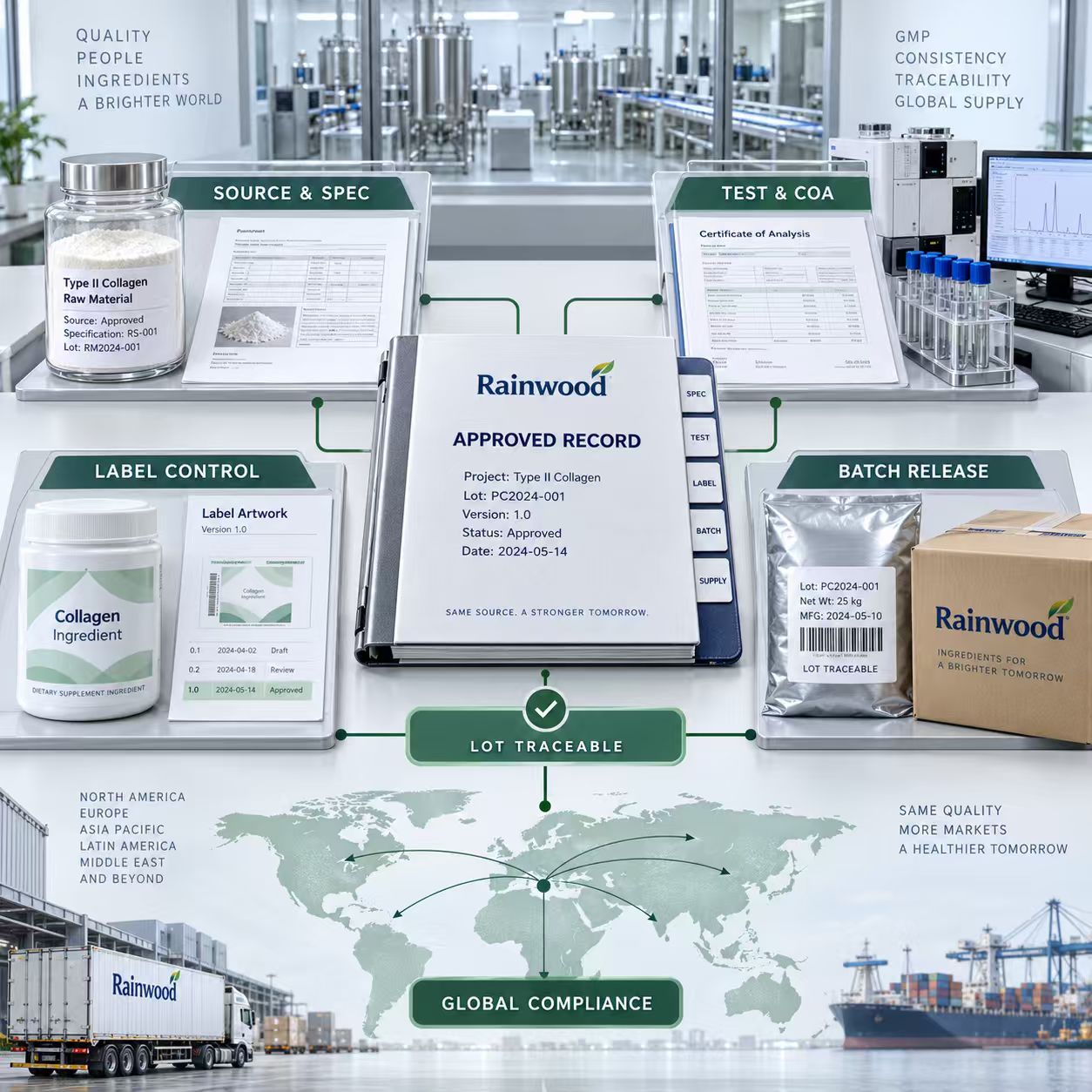
The packet should show who approved each item and which version is current. A label can be scientifically reasonable and still fail because the COA belongs to a different lot or the translated copy becomes more therapeutic.
A pass-fail label scorecard
| Review item | Pass condition |
|---|---|
| Species and tissue | Defined and traceable to the commercial source |
| Product form | Hydrolyzed or undenatured stated accurately |
| Type II evidence | Method and rationale support the wording |
| Assay basis | As-is or dry basis consistent with label math |
| Dose | Matches the exact finished formula and evidence |
| Trademark | Authorization confirmed or name removed |
| Claim | Market-reviewed and free of unsupported disease promise |
| Version control | Label, website, and distributor copy aligned |
Do not use a checklist to hide uncertainty. Mark each item as documented, conditional, or missing, then assign an owner and deadline.
How RainwoodBio can align label review with production documents
RainwoodBio publishes requirement confirmation, supplier management, testing and release documentation, packaging, traceability, and OEM format support. The relevant control is linking the label review to the same source, specification, batch, and finished-product records used for production release.
Request a label-to-specification alignment review before artwork is finalized or translated for distributors.
The final print gate
Before releasing artwork, confirm:
- the raw material form is stated accurately;
- the type II wording has a supportable evidence route;
- source, method, and dose documents refer to the same project;
- branded names and studies are authorized and matched;
- claims are reviewed for the destination market and channel;
- the production and packaging records can trace the final label to the lot;
- any source or process change triggers a label impact assessment.
Send your draft label, COA, source statement, study file, target market, and finished formula for a type II collagen label-readiness review. RainwoodBio can help identify which wording is supported now and which requires additional evidence.
When the evidence is incomplete
Do not force a more specific name simply because a distributor wants a stronger headline. A controlled temporary description can be more useful than a disputed permanent one. For example, the internal specification may identify the material as a hydrolyzed chicken cartilage collagen peptide while the type-specific wording remains pending a suitable method or source record. Record the reason, the owner, and the evidence needed to close the gap. This keeps procurement, formulation, regulatory, and marketing teams working from the same version instead of creating four different interpretations of the same powder.
The review should also cover translations, marketplace bullets, comparison charts, and sales presentations. A technically careful English label can become an implied medical claim after localization. Treat each customer-facing version as part of the controlled release package.
Frequently asked questions
1.Can a supplier specification define the label name?
It can inform the decision, but the label also depends on finished formula, market rules, evidence, and authorization. Do not copy a supplier sales name without a review.
2.Is “peptide” enough to show the product is hydrolyzed?
It is a form description, not a complete process or identity proof. Confirm the hydrolysis route, peptide profile, source, and specification.
3.Should a label mention chicken sternum cartilage?
That depends on the market, product category, consumer expectations, and source evidence. Use precise wording only after a qualified review.
References
- U.S. FDA, Exploring the Scope of Dietary Supplement Ingredients: https://www.fda.gov/media/191964/download
- TGA, Hydrolysed Chicken Cartilage Extract compositional guideline: https://www.tga.gov.au/resources/resources/compositional-guidelines/hydrolysed-chicken-cartilage-extract
- EFSA, Novel Food applications and guidance: https://www.efsa.europa.eu/en/applications/novel-food
- RainwoodBio About Us: https://www.rainwoodbio.com/about-us
This article is for B2B procurement and educational purposes. Product identity, label wording, dose, safety, trademark rights, and regulatory requirements must be confirmed by qualified reviewers for the exact formula and destination market.