 EN
EN

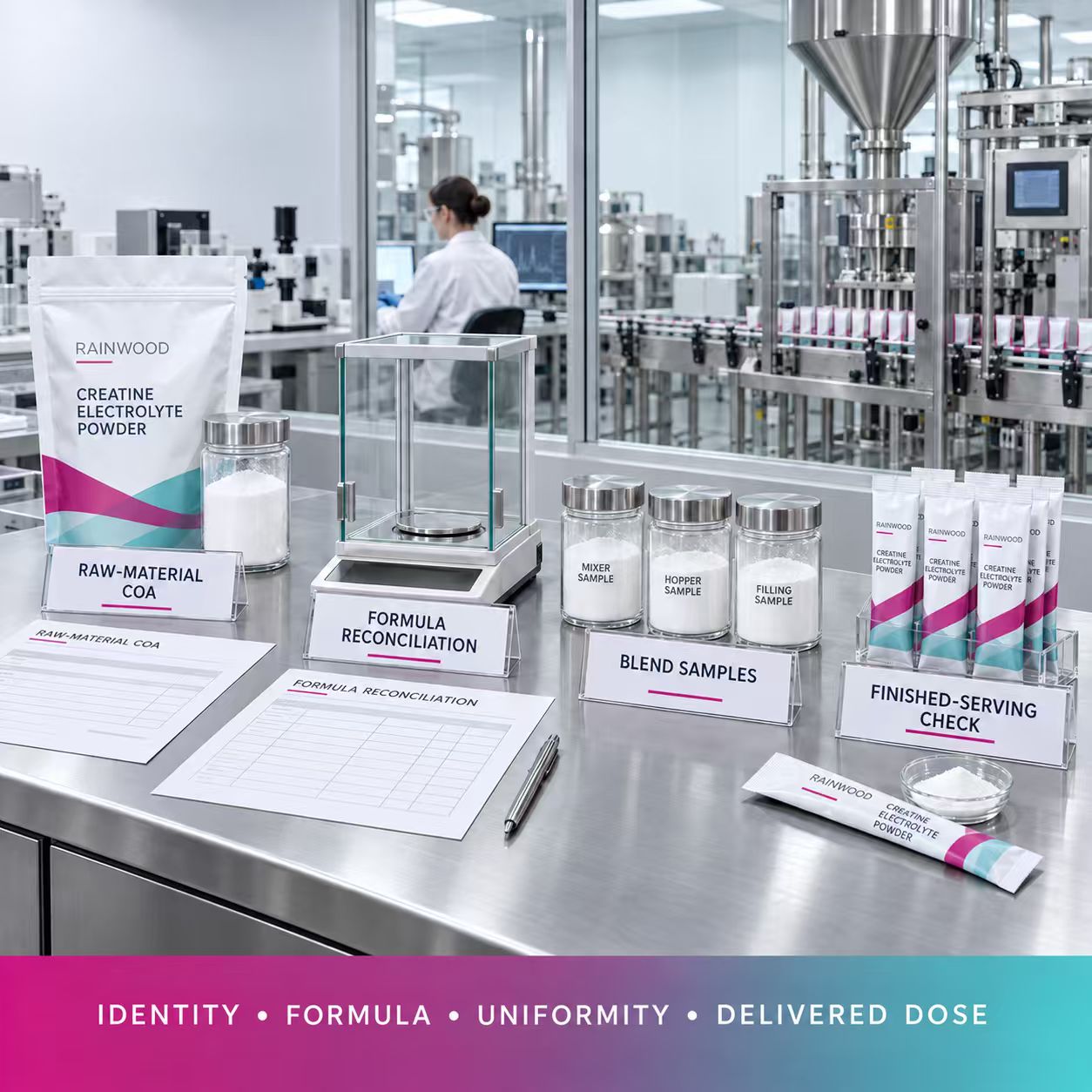
Meta title: Creatine Electrolyte Powder COA Dose Review
Meta description:** A creatine result does not prove the delivered dose in a blended electrolyte powder. Learn how buyers verify assay, moisture, blend uniformity, and label math.
The supplier COA says “creatine monohydrate: 99%.” Your formula sheet says “5 g creatine per serving.” The first production run is filled, the artwork is approved, and everyone assumes those two statements describe the same thing. They may not.
In a creatine electrolyte powder, the identity and assay of the creatine raw material are only the beginning. Moisture, serving weight, blend ratio, particle size, segregation, filling loss, and the difference between compound weight and active creatine can all change what the customer actually receives. A perfect raw-material COA cannot prove uniform delivery from a finished sachet or scoop.
That gap creates a specific B2B risk. The brand pays for a performance-oriented product but cannot demonstrate that every serving contains the intended creatine and electrolyte amounts. A retailer may question the label. A marketplace complaint may focus on sediment or taste while the internal team discovers a dose calculation problem. The answer is a connected release plan, not another generic purity statement.
A raw-material assay answers one question
An assay result tells you how much of the measured creatine compound was found under the stated method and calculation basis. It does not automatically confirm:
- how much creatine is present after blending with salts, sweeteners, flavors, and carriers;
- whether the label amount is stated as creatine monohydrate or creatine equivalent;
- whether moisture changes the as-is mass delivered per serving;
- whether the blend remains uniform from the first scoop to the last;
- whether the finished sachet or scoop is filled to the intended weight.
Use our creatine electrolyte powder specification guide to separate raw-material identity, formula math, and finished-product release.
The compound-weight trap
Creatine monohydrate contains creatine plus water of crystallization. If a specification or label uses “creatine monohydrate” while marketing says “5 g creatine,” the team must define which quantity is being promised. The same issue appears in electrolyte salts: sodium chloride, potassium citrate, and magnesium citrate have a raw-material weight that is different from the elemental sodium, potassium, or magnesium delivered.
The supplier may not be trying to confuse anyone. The commercial documents may simply use different conventions. But if purchasing, formulation, regulatory, and marketing each use a different convention, the finished label can be wrong without any single number looking absurd.
Write one formula table with columns for raw-material weight, active or elemental amount, assay, moisture basis, and label amount. Require every quotation and COA to map into that table.
The finished blend can lose uniformity after it passes the lab
Creatine crystals, sodium salts, potassium salts, magnesium salts, sweeteners, flavors, and anticaking agents can differ in density and particle size. During conveying, vibration, filling, or transport, those differences can create segregation. The first sachet may not have the same composition as the last one. A scoop taken from the top of a tub may not represent the entire batch.
The buyer loss is a failed content-uniformity investigation, not merely an untidy powder. If the electrolyte mix is sodium-heavy in one portion and creatine-heavy in another, customer experience and label confidence both suffer. If the blend is underweight, the brand may face a complaint even when the raw materials all passed release.
Read the creatine and electrolyte mixing-order guide before approving the production method.
Four layers of evidence you should keep separate
Raw-material identity
Confirm the creatine form, electrolyte salt forms, source, lot, assay, contaminants, and calculation basis. “HPLC tested” is not enough unless the report identifies the analyte, method, standard, and acceptance range.
Formula calculation
Show how much raw material is weighed for each batch and how that becomes active creatine and elemental minerals per serving. Include moisture or assay corrections where required.
Blend uniformity
Define sampling locations, number of samples, test method, and acceptance criteria. A composite sample can hide segregation, so use a plan that can detect location differences.
Finished format release
Test the actual sachet, scoop, or serving unit for weight, appearance, moisture, and relevant actives. If the product is flavored or acidic, include physical and stability checks for the finished formula.
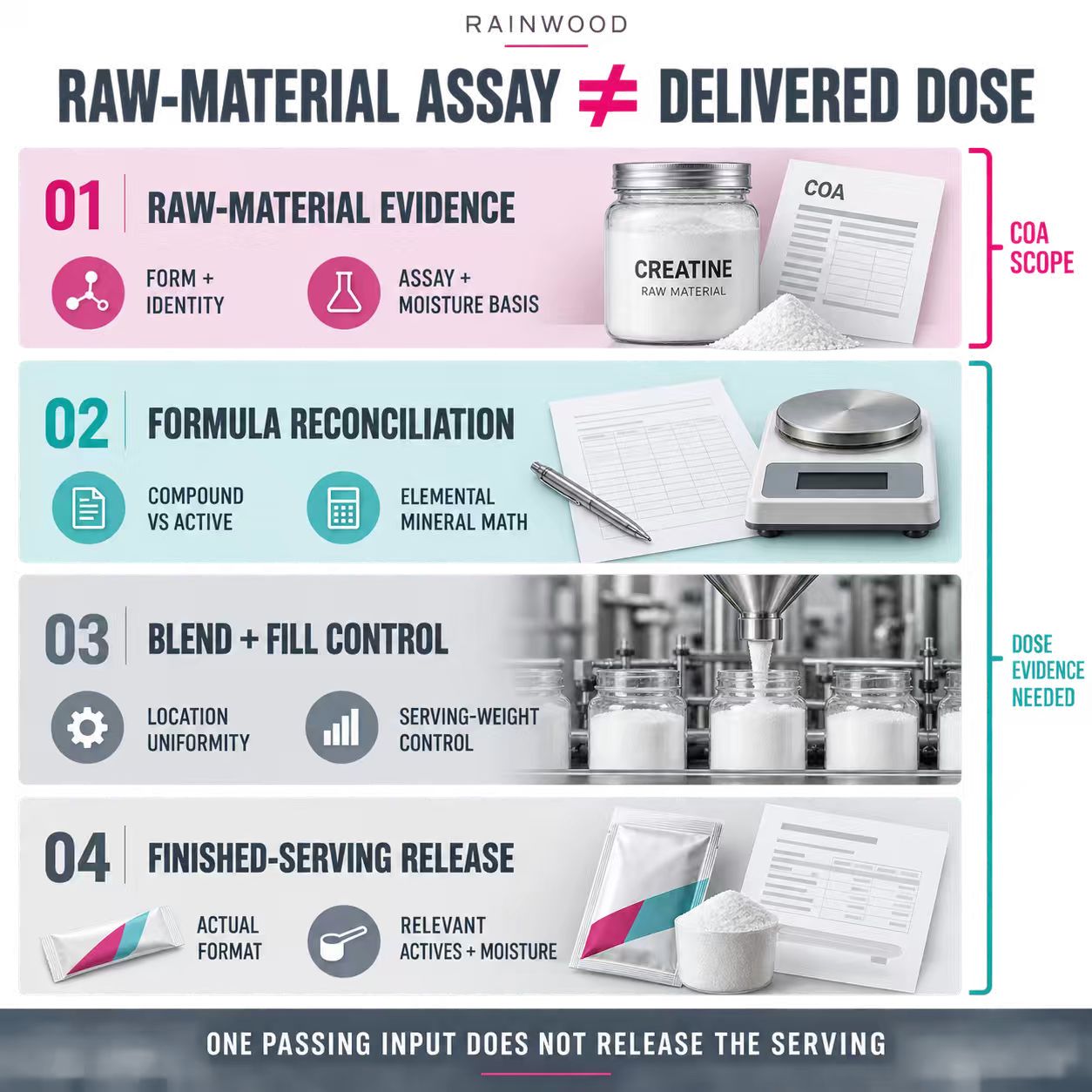
A practical dose reconciliation table
| Item | What to record | Why it matters |
|---|---|---|
| Creatine raw material | Form, assay, moisture, lot | Establishes the starting calculation |
| Electrolyte salts | Salt weight and elemental contribution | Prevents mineral label errors |
| Batch size | Theoretical and actual yield | Exposes filling and process loss |
| Serving weight | Target and tolerance | Connects formula to consumer use |
| Blend sampling | Locations and number of samples | Detects segregation |
| Finished serving | Creatine and mineral verification | Supports label and release |
Do not release a formula because the average result passes if one sampling location is consistently low. Average performance and uniform delivery are different questions.
How RainwoodBio can connect the COA to the finished formula
RainwoodBio publishes requirement confirmation, supplier management, production and process control, testing and release, documentation, packaging, logistics, and traceability as parts of its workflow. For a creatine electrolyte powder, the relevant capability is keeping the raw-material specification, blend record, sample, and finished-serving checks in one project file.
Ask for a creatine electrolyte dose and release review using your current COAs, formula, target serving, format, and destination market.
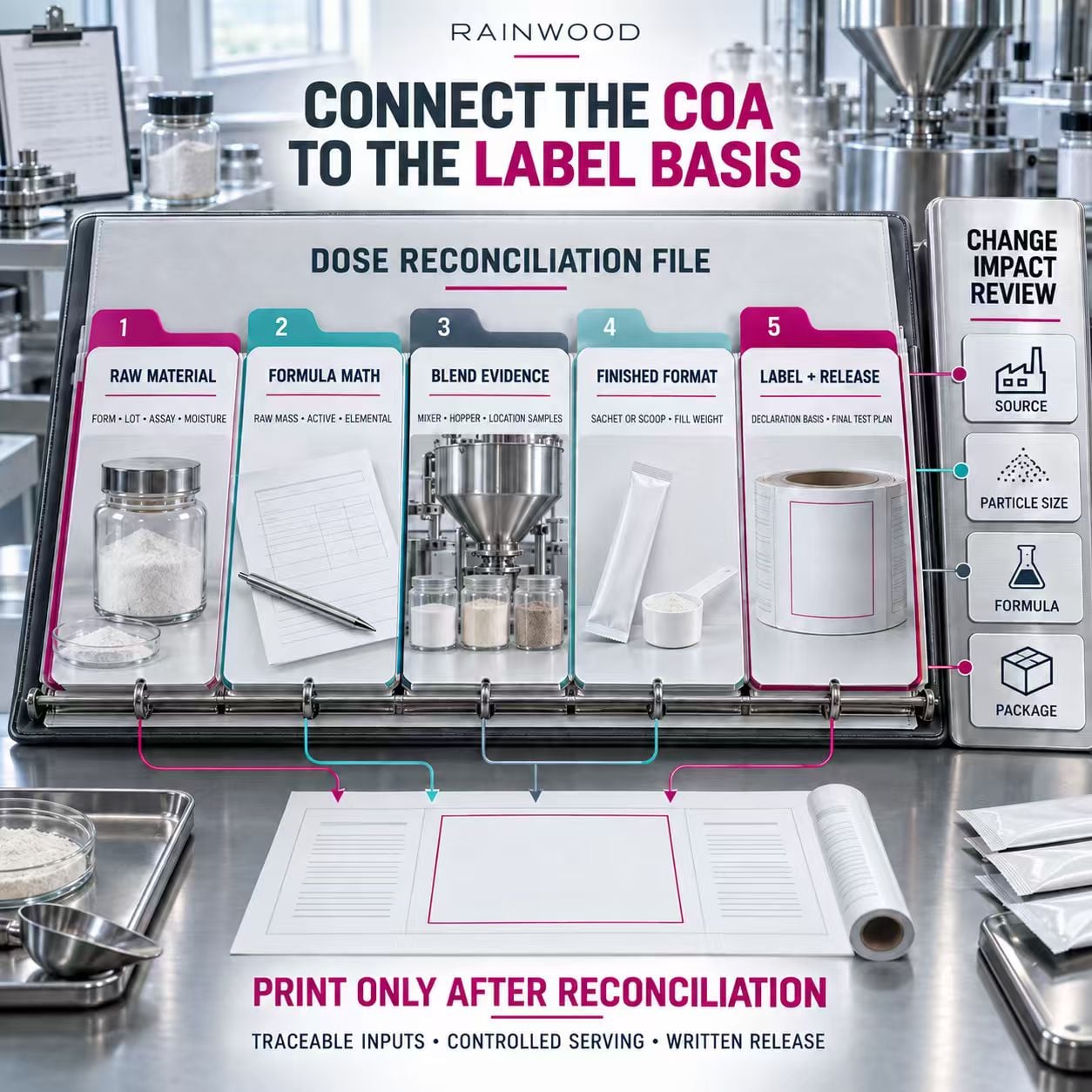
The release gate before you print the label
Approve the product only when:
- the creatine form and label basis are explicit;
- every mineral is calculated as an elemental amount where required;
- assay and moisture corrections are documented;
- blend uniformity has a defined sampling plan;
- the final sachet or scoop weight is controlled;
- finished-product testing matches the claims and target market;
- supplier changes trigger a formula and label impact review.
Send RainwoodBio your creatine COA, electrolyte specifications, batch formula, target serving, and draft label for a creatine electrolyte label-math and blend-risk review. The useful output is a reconciled calculation and a list of release controls before inventory is produced.
Frequently asked questions
1.Does a 99% creatine COA prove 5 g per serving?
No. It supports the raw-material assay under its stated method. The finished serving still depends on formula calculation, moisture basis, batch yield, blending, filling, and content uniformity.
2.Should creatine monohydrate be labeled as creatine or creatine monohydrate?
That depends on the market, ingredient declaration rules, and the amount you intend to communicate. Define the basis consistently across the formula, Supplement Facts or nutrition panel, and marketing copy.
3.Is a composite blend sample enough?
Not always. A composite can hide location-specific segregation. Use a sampling plan that can detect differences across the mixer, hopper, filling line, or finished package.
References
- NIH Office of Dietary Supplements, Exercise and Athletic Performance: https://ods.od.nih.gov/factsheets/ExerciseAndAthleticPerformance-HealthProfessional/
- FDA, Dietary Supplement Labeling Guide: https://www.fda.gov/food/dietary-supplements-guidance-documents-regulatory-information/dietary-supplement-labeling-guide
- FDA GRAS Notice 931, Creatine Monohydrate: https://www.hfpappexternal.fda.gov/scripts/fdcc/index.cfm?id=931&set=GRASNotices
- RainwoodBio About Us: https://www.rainwoodbio.com/about-us
This article is for B2B procurement and educational purposes. Product identity, dose calculation, analytical methods, safety, labeling, and regulatory requirements must be confirmed for the exact formula, finished format, batch, and destination market.