 EN
EN

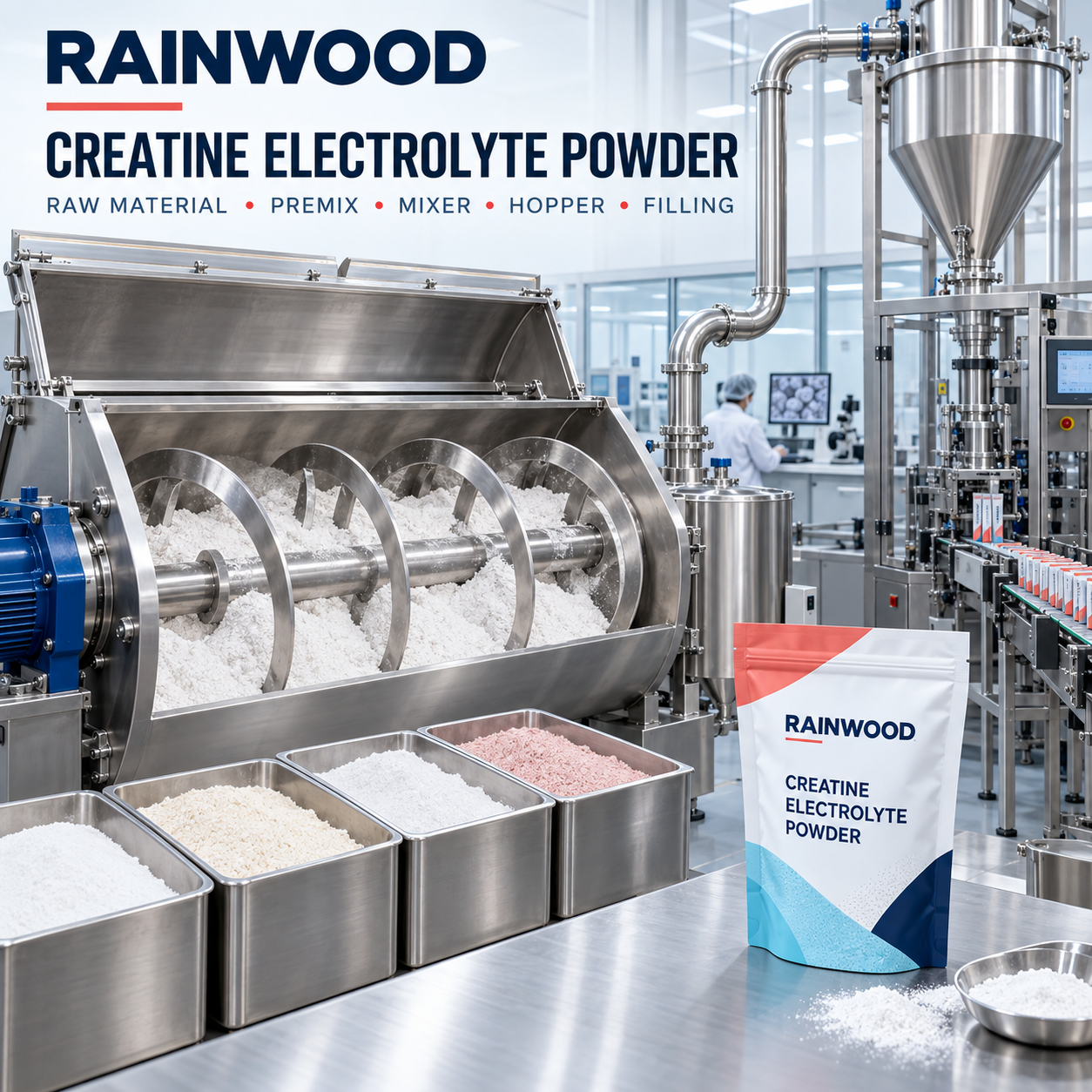
Meta title: Creatine Electrolyte Powder Mixing Order Guide
Meta description: Mixing order, particle size, density, and transfer can decide whether every creatine electrolyte serving is uniform. Build the process around segregation risk.
The formula is correct on the spreadsheet. The first production samples show a different reality: the opening sachets are sweet, the middle samples are salty, and the final samples contain more creatine powder. The team blames the filler, but the segregation may have started before the blend ever reached the hopper.
Creatine electrolyte powders are difficult because the formula combines ingredients with different particle size, density, shape, moisture, and flow. Mixing order, premix design, transfer distance, vibration, and filling speed determine whether the theoretical batch becomes a uniform commercial serving.
The right question is not “How long did we mix?” It is “Which steps can create or undo uniformity, and how will we prove the finished serving remains within range?”
Start with ingredient behavior
Collect the physical data for creatine, sodium salts, potassium salts, magnesium salts, sweeteners, flavors, acids, and carriers:
- particle-size range;
- bulk and tapped density;
- moisture and flow;
- electrostatic or dusting tendency;
- intended addition rate;
- sensitivity to heat or humidity.
Use our creatine electrolyte blending specification guide to design the process around the ingredients you actually purchased.
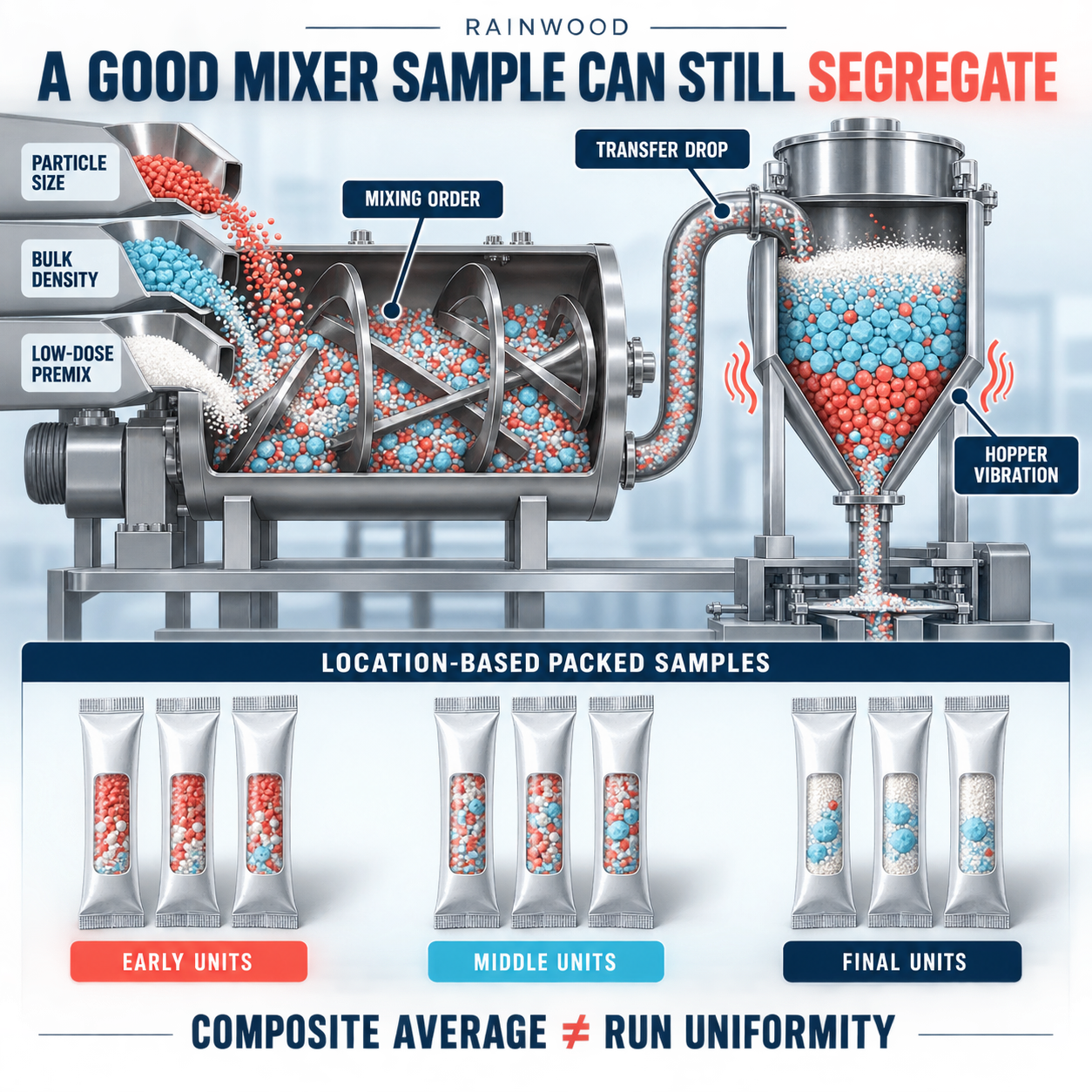
If one ingredient is very fine and another is a large crystal, the blend can segregate even after a visually uniform mixer sample. If a low-dose ingredient is added directly into a large batch, its distribution may be poor. If a flavor premix contains a carrier, it can change density and flow.
Premix low-dose and high-risk components
Create a controlled premix for ingredients that are low-dose, potent, sticky, dusty, or very different in density. Define the premix ratio, mixing time, equipment, and acceptance test. Then add that premix to the larger batch in a way that minimizes local concentration differences.
For creatine and minerals, the approach may be different depending on the dose. A gram-level creatine addition may dominate the batch, while a small amou
nt of magnesium or caffeine may require a separate dilution. Do not apply one mixing rule to every component.
Read the add-on ingredient and low-dose segregation guide if caffeine, taurine, amino acids, or flavor premixes are included.
Mixing order can change the finished dose
The order should be validated, not copied from a generic recipe. A practical process record may define:
1. sieve or inspect each raw material;
2. prepare controlled premixes;
3. combine compatible bulk ingredients;
4. add creatine and major mineral components;
5. add flavors, acids, sweeteners, or carriers at a validated point;
6. mix for the defined time and fill level;
7. transfer with minimal drop and vibration;
8. sample the mixer, hopper, and packed units.
The exact order depends on the equipment and powder properties. What matters is that the commercial batch has a validated process window and a test that can detect location-specific variation.
The hopper can undo a good mixer result
Vibration, screw feeding, air flow, and repeated filling can separate fine and coarse particles. A batch that passes a mixer composite sample can still fail in the first, middle, and last portion of the run. Sample at the beginning, middle, and end of filling and compare creatine and elemental minerals where relevant.
Avoid unnecessary transfers and uncontrolled manual additions. If the product uses a tub, consider how the powder settles during shipping and how the customer scoops from different levels.
Use a location-based uniformity plan
| Sampling point | What it can reveal |
|---|---|
| Mixer top or multiple zones | Initial blend uniformity |
| Transfer line or hopper | Segregation during movement |
| Early packed units | Start-up filling behavior |
| Middle packed units | Stable process condition |
| Final packed units | End-of-run drift or depletion |
| Retained finished sample | Future investigation reference |
Define sample quantity, analytical method, acceptance range, and investigation steps before production. A composite sample can be useful for average composition but should not replace location-based checks when segregation is a known risk.
Moisture and environment are process variables
Humidity changes powder flow, caking, electrostatic behavior, and density. A mixing room that behaves well in dry weather may create clumps or poor flow during a humid season. Record room conditions and packaging exposure. If the powder is hygroscopic, use a controlled hold time between blending and filling.
Do not solve a moisture problem by adding more anticaking agent without checking the label, taste, and finished-product specification. Correct the package, environment, or process with evidence.
How RainwoodBio can document a uniformity-focused production route
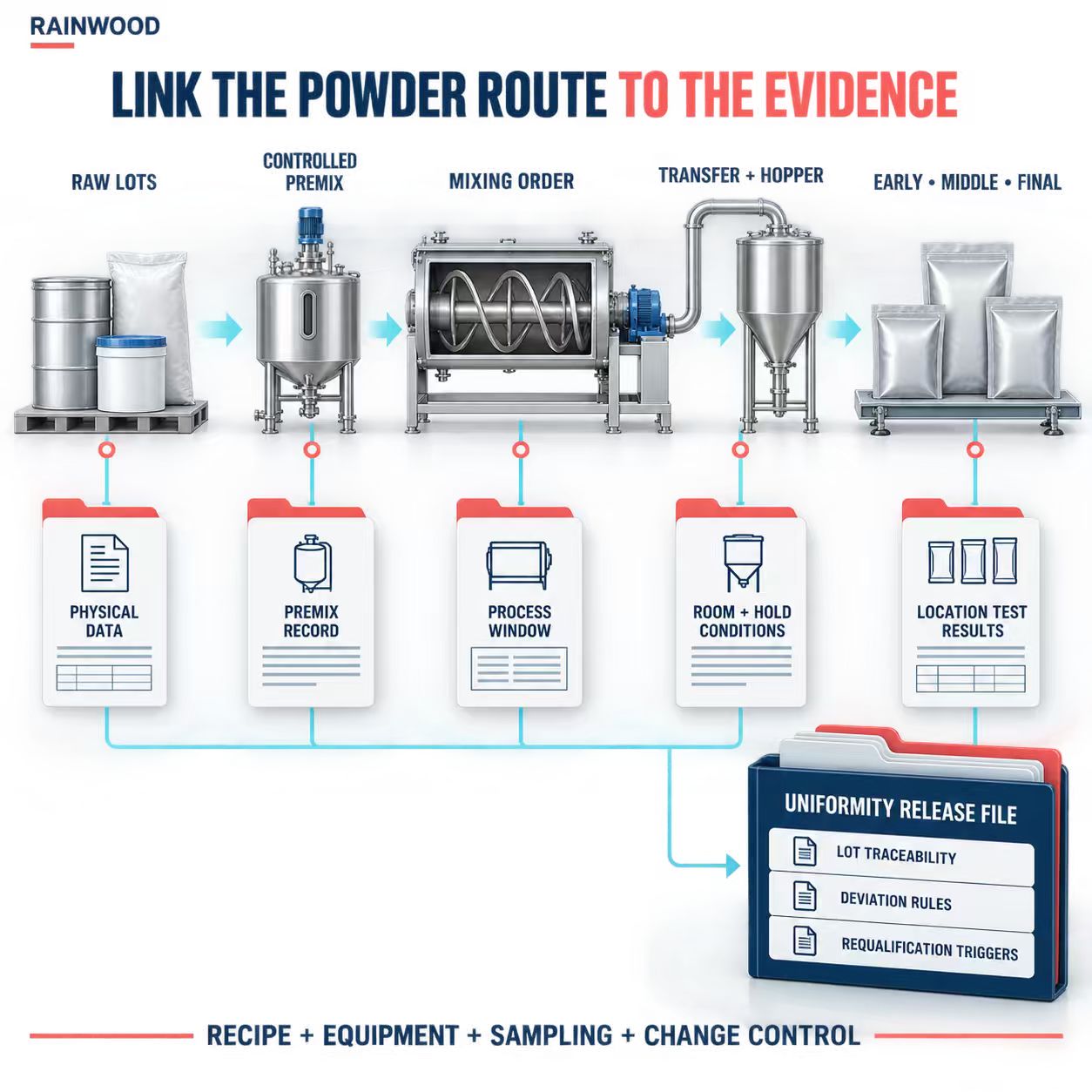
RainwoodBio publishes supplier management, production and process control, testing and release, packaging, logistics, and traceability. For a creatine electrolyte powder, the relevant capability is a controlled batch record that connects raw-material lots, premixes, mixing order, sampling, filling, and release.
Request a creatine electrolyte mixing and filling process review with your equipment, batch size, raw-material data, serving weight, and package format.
The process approval gate
Before commercial production, confirm:
- physical data for all ingredients are available;
- premix requirements are defined;
- mixing order and time have a validated range;
- transfer and hopper risks are included;
- environmental conditions are recorded;
- beginning, middle, and end samples are tested;
- deviations and rework rules are written;
- changes in particle size, supplier, or package trigger requalification.
Send your formula, equipment flow, ingredient COAs, process draft, sampling plan, and target market for a creatine electrolyte blend-uniformity review. RainwoodBio can help identify where the theoretical formula may be losing control on the production floor.
Record the process window, not only the recipe
A batch record that says “mix for ten minutes” is not enough when the fill level, mixer speed, humidity, or transfer route can change. Record the validated ranges for each variable and define which changes require a new uniformity trial. Keep a reference sample from the start, middle, and end of a successful run. When a new supplier lot or particle-size distribution arrives, repeat the comparison inside that reference window. This turns a mixing instruction into a reproducible process and gives QA a meaningful basis for investigating a failed sachet instead of relying on operator memory.
Frequently asked questions
1.Does longer mixing always improve uniformity?
No. It can help reach uniformity, but excessive mixing, heat, dust, or repeated movement can also create segregation or flow changes. Validate a process window.
2.Should every ingredient be sieved?
Not automatically. The right screen and handling depend on particle size, moisture, equipment, and the supplier specification. Test before making it a universal step.
3.Is a composite sample enough for release?
It may support an average result, but location-based sampling is important when the blend can segregate during transfer or filling.
References
- FDA, Dietary Supplement Labeling Guide: https://www.fda.gov/food/dietary-supplements-guidance-documents-regulatory-information/dietary-supplement-labeling-guide
- NIH Office of Dietary Supplements, Exercise and Athletic Performance: https://ods.od.nih.gov/factsheets/ExerciseAndAthleticPerformance-HealthProfessional/
- ISSN position stand on energy drinks and electrolytes: https://pmc.ncbi.nlm.nih.gov/articles/PMC9987737/
- RainwoodBio About Us: https://www.rainwoodbio.com/about-us
This article is for B2B procurement and educational purposes. Mixing, uniformity, dose, safety, analytical, packaging, and regulatory requirements must be confirmed for the exact formula, equipment, batch, and destination market.