 EN
EN

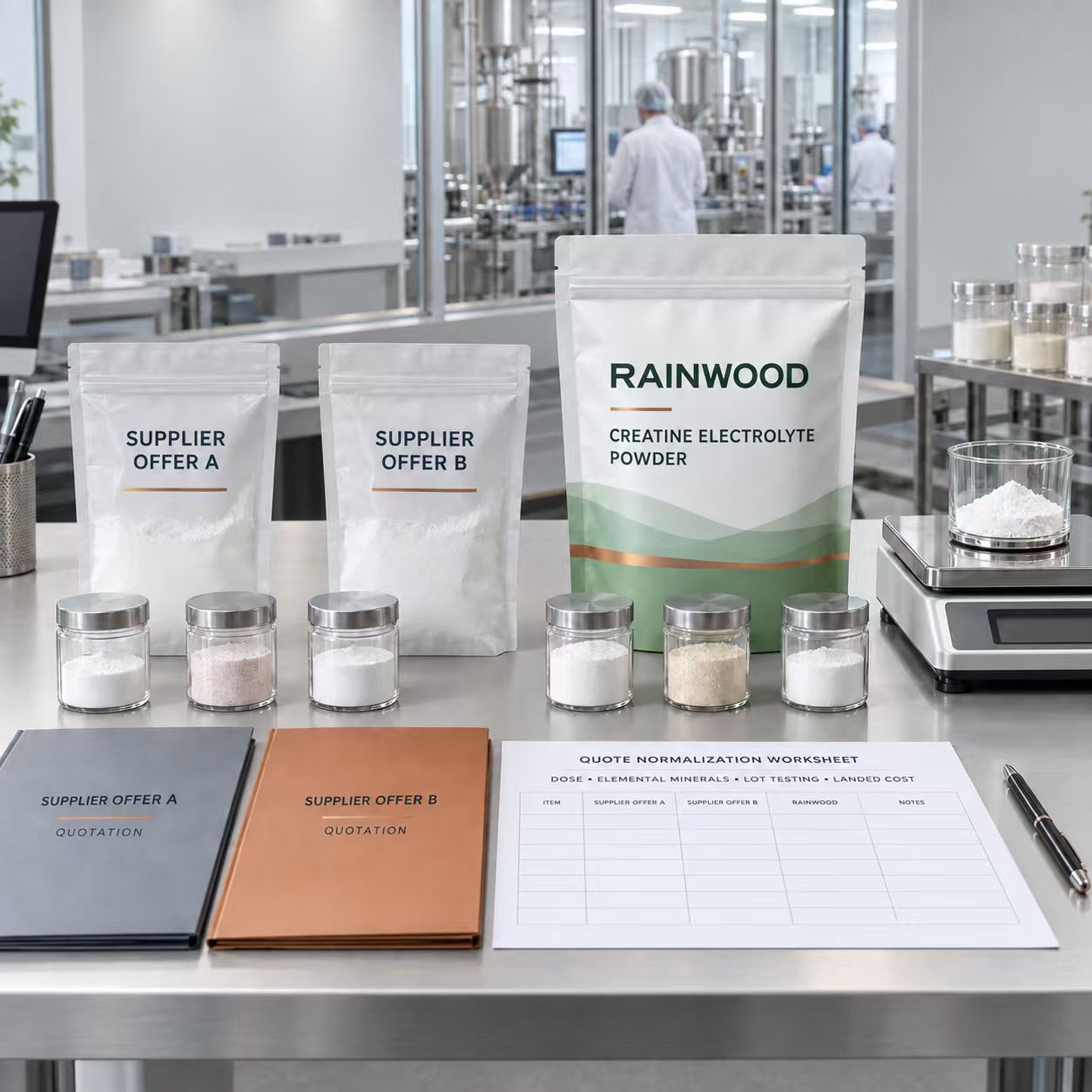
Meta title: Cheap Creatine Electrolyte Powder Quote Risk Guide
Meta description: A low quote may hide low elemental minerals, extra carriers, weak testing, or packaging risk. Normalize creatine electrolyte offers before you buy.
The quotation is 15% below your incumbent supplier. It says “creatine electrolyte powder,” includes a pleasant flavor, and promises a fast lead time. Purchasing sees an immediate saving. The formulation team sees a vague ingredient list and no clear statement of elemental sodium, potassium, or magnesium.
The cheapest creatine electrolyte quote can be a genuine efficiency. It can also be a different product dressed in similar language. A supplier may reduce the creatine dose, use a lower-elemental mineral salt, add more carrier or sweetener, omit lot-specific testing, or quote a smaller net weight than your comparison assumes. If the commercial offer is not normalized, the low price is not a real price advantage.
Compare delivered performance, not the front-line kilogram price
Put each supplier into one comparison sheet with:
- exact creatine form and assay;
- creatine amount per serving;
- electrolyte salt forms and elemental amounts;
- sweeteners, carriers, flavors, acids, and anticaking agents;
- moisture, bulk density, and particle-size expectations;
- packaging barrier, net weight, and number of servings;
- test panel and lot coverage;
- MOQ, lead time, Incoterm, freight, and payment terms;
- replacement and change-control terms.
Use our creatine electrolyte quote-normalization checklist before ranking the offers.
How an underdosed mineral can create a false saving
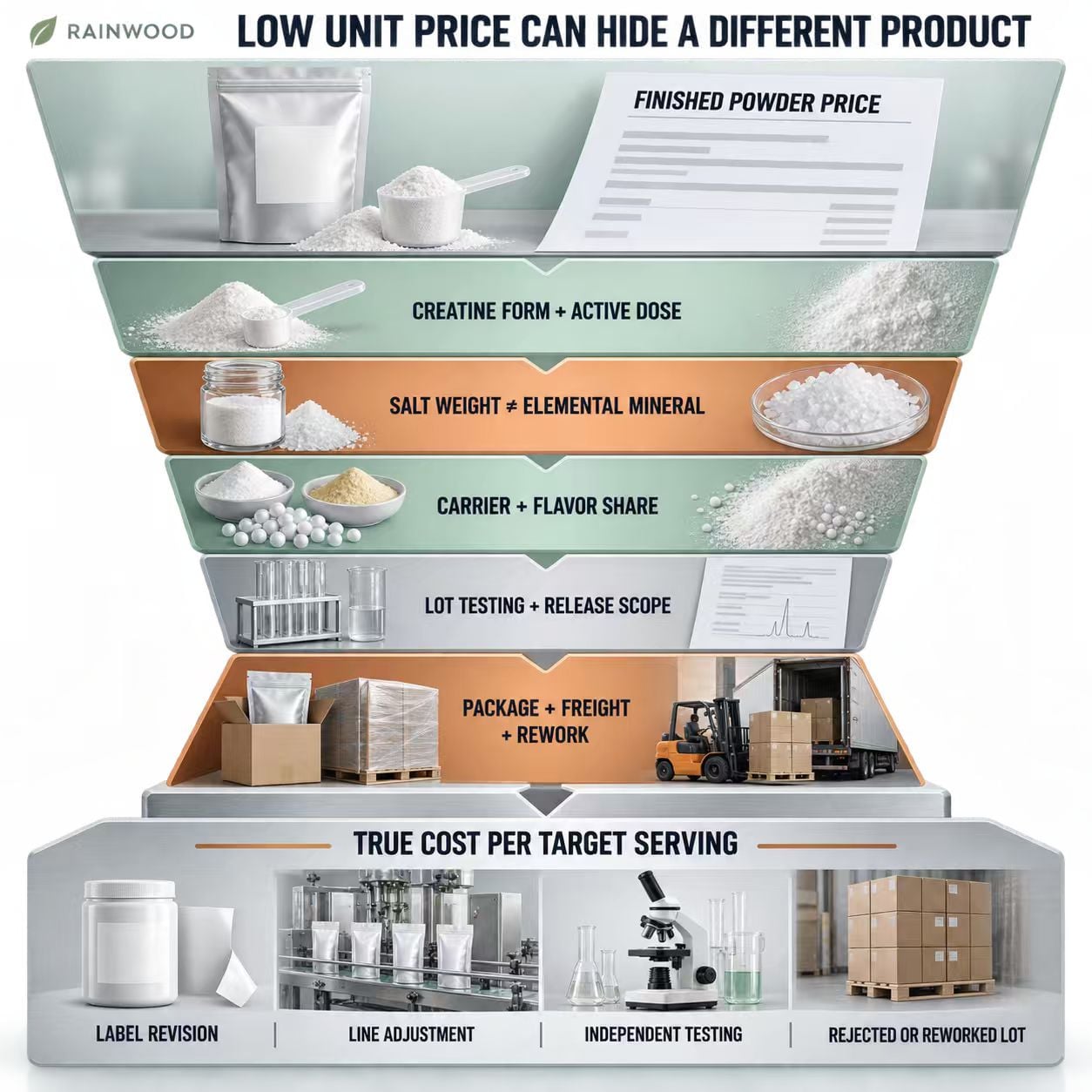
Two powders can use the same sodium salt while delivering different elemental sodium per serving. One supplier may quote a large salt weight, while the other quotes the actual target mineral. If you compare only total powder cost, the lower offer may require a larger scoop or a higher daily serving to reach the intended electrolyte profile.
The same problem applies to magnesium and potassium. A cheaper salt may have a different elemental percentage, sensory effect, or moisture behavior. If more flavoring or sweetener is added to hide bitterness, the final serving weight grows and the delivered mineral percentage falls again.
The buyer loss appears on the finished label. A formula promoted as a performance hydration product may deliver far less of the mineral the customer expects. Correcting it after artwork can mean new panels, reprinted packaging, and unsold inventory.
Read the elemental electrolyte calculation guide before comparing mineral lines in a quotation.
Carrier cost is not always visible
Carriers, maltodextrin, sugars, soluble fibers, flavors, acids, and anticaking agents all occupy the serving. They may be useful, but they are not the same as creatine or electrolytes. Ask for the complete formula by weight or an agreed range, not only the three headline actives.
A quote that contains more carrier can be cheaper per kilogram while being more expensive per delivered active serving. It may also change sweetness, caloric content, solubility, and the claims available in different markets.
Normalize using two calculations:
Cost per kilogram of finished powder and cost per target serving of creatine plus elemental electrolytes.
Then add freight, package, testing, scrap, and expected number of finished servings. The second number is usually the one that matters to the brand.
Testing scope can explain a price gap
Ask which tests are included on every lot. A low quotation may provide only a generic COA, while your project needs creatine identity and assay, mineral verification, moisture, microbiology, heavy metals, blend uniformity, package integrity, and finished-serving checks. Add the cost of independent verification if the supplier cannot provide a suitable method or lot record.
Do not treat a certificate logo or a named instrument as proof that the exact blend was released. Confirm the entity, laboratory, sample, lot, method, and scope. A company-level certificate and a product-level test report answer different questions.
The landed-cost model buyers should use
| Cost line | Supplier A | Supplier B |
|---|---:|---:|
| Finished powder price | | |
| Creatine per serving | | |
| Elemental sodium per serving | | |
| Elemental potassium per serving | | |
| Elemental magnesium per serving | | |
| Packaging and servings per case | | |
| Testing and release | | |
| Freight and duty | | |
| Expected usable servings | | |
| Cost per target serving | | |
Add an adjustment for rejected or reworked lots if the supplier has weak sample-to-bulk controls. A low invoice price is not low cost if the powder fails your flavor, density, or uniformity trial.
Questions that expose a non-comparable offer
Ask the supplier:
- Is the creatine number raw-material weight or active amount?
- Are mineral figures salt weight or elemental amounts?
- What percentage of the serving is carrier, sweetener, or flavor?
- What is the moisture and bulk-density range?
- Which tests are performed for every lot?
- Does the price include the package, desiccant, and sampling?
- What happens if the commercial lot does not match the approved sample?
- Which source, flavor, salt, or process changes require advance notice?
The goal is not to force every supplier into one formula. It is to make the trade-offs visible.
How RainwoodBio can compare cost with formulation risk
RainwoodBio publishes requirement confirmation, supplier management, formula development, testing and release, packaging, logistics, and traceability. For a mixed creatine-electrolyte powder, the relevant capability is comparing quotations on delivered dose and production risk instead of headline price.
Request a two-quotation creatine electrolyte normalization review with supplier COAs, full formulas, target serving, packaging, Incoterms, and annual volume.
The purchasing approval gate
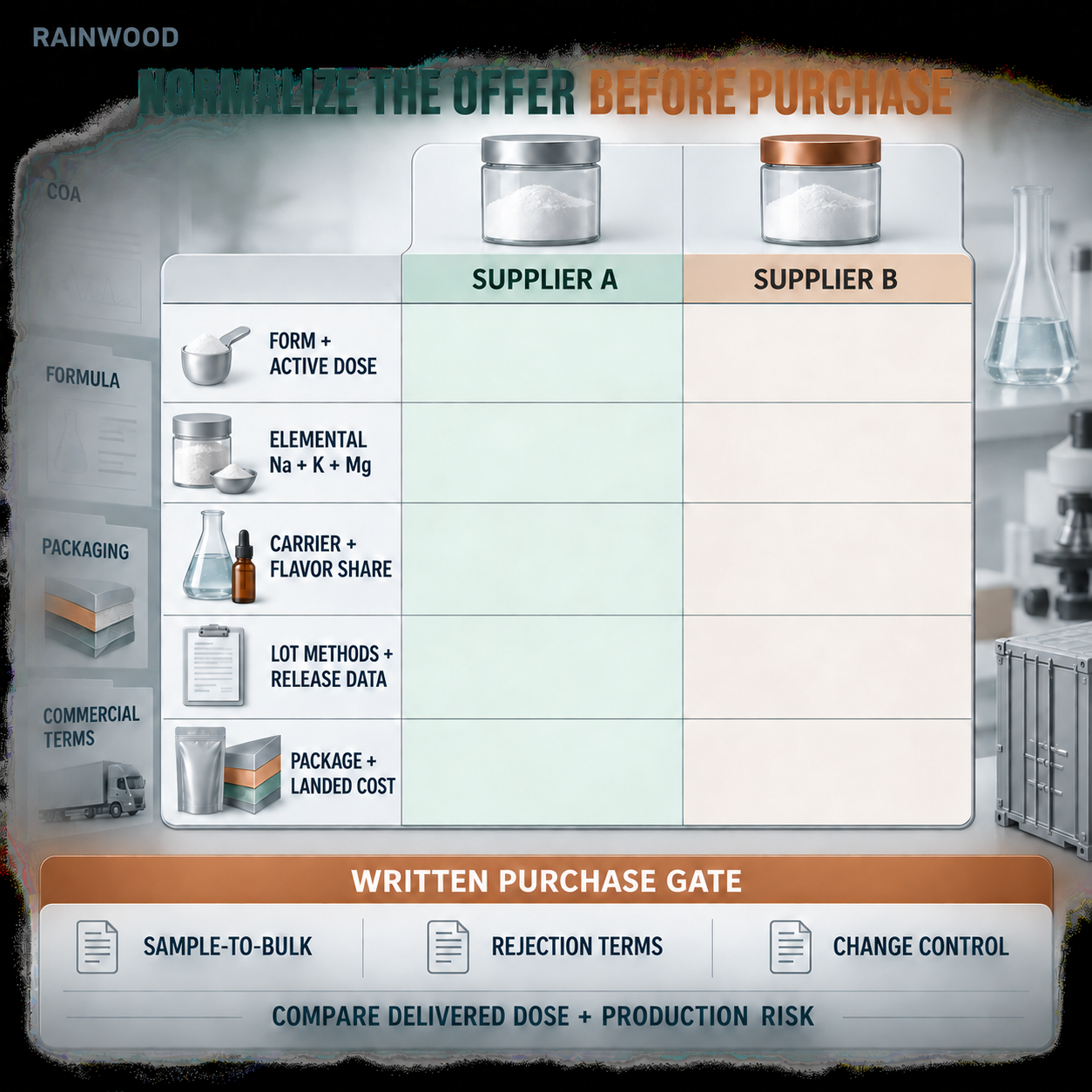
Do not approve the cheapest quote until:
- the forms and doses are equivalent;
- elemental minerals are normalized;
- carrier and flavor percentages are visible;
- testing and release scope are comparable;
- packaging and landed cost are included;
- sample-to-bulk and rejection terms are written;
- change control covers the exact ingredients and finished blend.
Send the quotations, COAs, formula target, package plan, and delivery terms for a creatine electrolyte quote and risk review. RainwoodBio can help show whether the saving is real or whether it simply moves cost into your warehouse, label, and production line.
Frequently asked questions
1.Is a low price always caused by an inferior formula?
No. It may reflect scale, sourcing, package, or logistics efficiency. Normalize the exact product and test scope before assuming either quality or risk.
2.Should a quotation disclose every flavor component?
The supplier may protect proprietary flavor details, but the buyer still needs enough composition and allergen information to calculate the formula, label, and safety review.
3.Can a cheaper mineral salt work just as well?
Possibly, if the elemental dose, taste, stability, safety, and market requirements are validated. Compare the delivered function, not only the raw-material name.
References
- FDA, Dietary Supplement Labeling Guide: https://www.fda.gov/food/dietary-supplements-guidance-documents-regulatory-information/dietary-supplement-labeling-guide
- NIH Office of Dietary Supplements, Exercise and Athletic Performance: https://ods.od.nih.gov/factsheets/ExerciseAndAthleticPerformance-HealthProfessional/
- ISSN position stand on energy drinks and electrolytes: https://pmc.ncbi.nlm.nih.gov/articles/PMC9987737/
- RainwoodBio OEM information: https://www.rainwoodbio.com/oem
This article is for B2B procurement and educational purposes. Price, dose, composition, analytical, safety, logistics, labeling, and regulatory requirements must be confirmed for the exact finished formula and destination market.