 EN
EN

Meta title: Tagatose Claims: Low Sugar Is Not Low Glycemic Proof
Meta description: Separate low-sugar, low-calorie, low-glycemic, and prebiotic tagatose claims by evidence, dose, label rules, and finished-product verification.
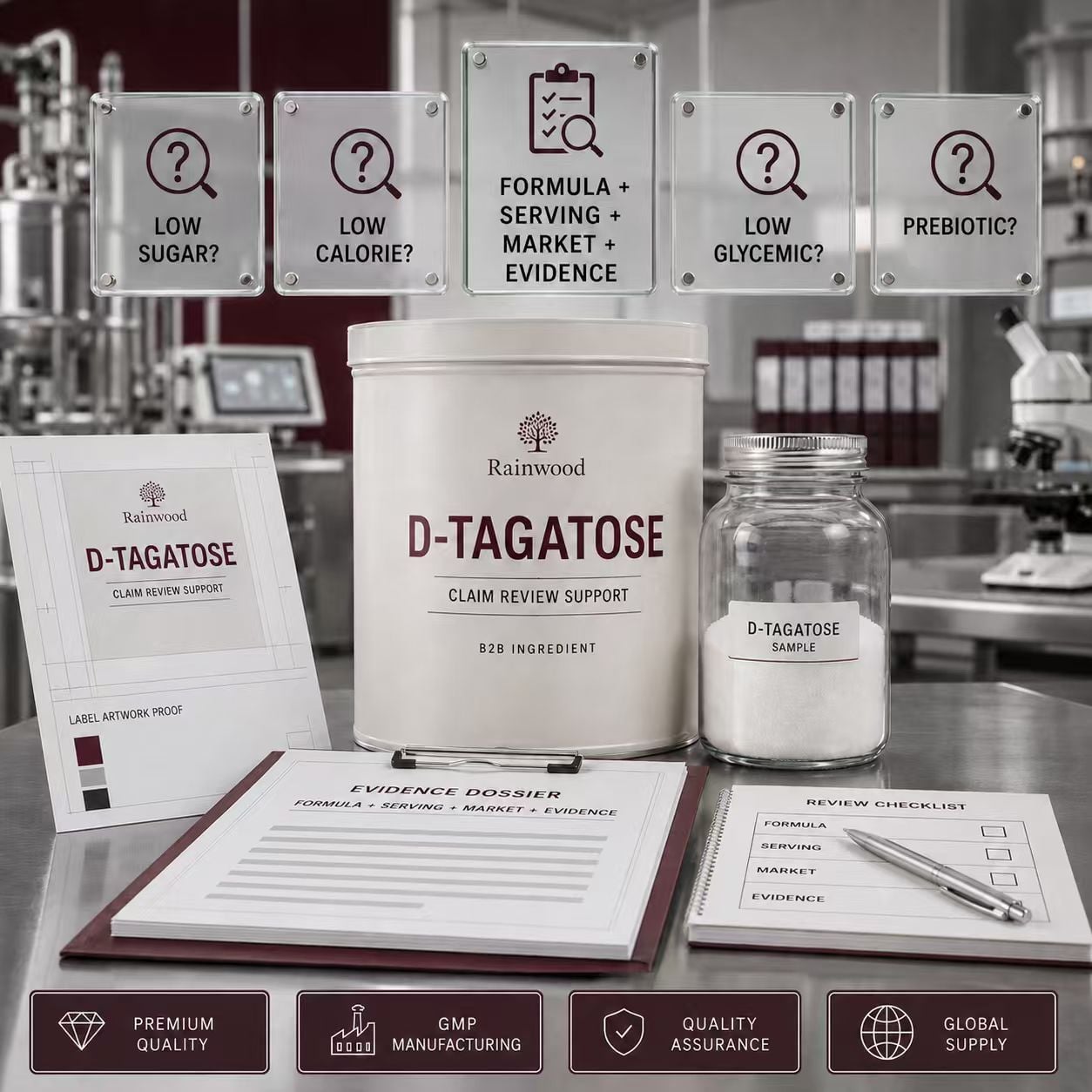
The marketing brief wants four badges: “low sugar,” “low calorie,” “low glycemic,” and “prebiotic.” The raw-material supplier sends a brochure with all four concepts. The brand team assumes the label is ready.
It is not.
Each claim answers a different question, under different evidence and regulatory conditions. A tagatose ingredient may have a low-calorie positioning in one market, an added-sugar labeling requirement in another, human studies at specific doses, and gastrointestinal tolerance limits that matter to the finished serving.
The commercial risk is clear: a claim that sounds attractive can become a listing challenge, a regulator question, or a customer complaint when the formula and evidence do not match.
Use the RainwoodBio tagatose product context, but build a claim-to-evidence file for the exact finished product before approving marketing copy.
“Low sugar” is a nutrition calculation, not a mood
“Low sugar” can refer to total sugars, added sugars, or a regulated nutrient-content claim depending on the destination market. Replacing sucrose with tagatose does not automatically make the finished product eligible for a claim. The full formula, serving size, other carbohydrates, and local threshold must be assessed.
In the United States, FDA states that D-tagatose must be declared as an added sugar on the Nutrition Facts label, even though the agency has discussed a lower calorie contribution in a specific labeling response. [FDA’s 2023 update](https://www.fda.gov/food/hfp-constituent-updates/fda-issues-supplemental-response-labeling-d-tagatose-nutrition-facts-label) should be read before using “no added sugar,” “reduced sugar,” or similar wording.
An ingredient that sounds like sugar is not the same as a finished product meeting a regulated claim definition.
“Low calorie” needs the correct calculation basis
FDA’s update describes an intent to exercise enforcement discretion around using 1.5 kcal/g for D-tagatose in calculating the % Daily Value for added sugars in a specific petition context. That is not a universal permission to use the same number in every country, every product category, or every blend.
Calculate the finished product using the actual tagatose form, moisture, serving, other ingredients, and applicable jurisdiction. A syrup with water and a crystalline powder may deliver different tagatose solids per serving. A premix may contain carriers that change the calorie calculation.
Read the tagatose dry-basis calculation guide before turning an ingredient specification into a front-of-pack number.
“Low glycemic” is a performance claim
A raw ingredient’s biochemical description does not prove the glycemic response of your finished food. The result can change with serving size, carbohydrate matrix, protein, fat, fiber, cooking, particle size, and the consumer population.
Human research has examined acute D-tagatose effects and reported dose-related gastrointestinal symptoms at high intakes. [One PubMed study](https://pubmed.ncbi.nlm.nih.gov/11225640/) investigated D-tagatose in subjects with and without type 2 diabetes; it does not prove that every tagatose-containing product is low glycemic or suitable for a disease-related claim.
If the brand wants a low-glycemic statement, define:
- exact finished product and serving;
- available carbohydrate and test meal;
- population and study design;
- comparator;
- endpoint and time course;
- statistical and practical significance;
- claim wording and local rule.
Do not borrow a raw-material study for a new gummy, beverage, or blend without checking the evidence chain.
“Prebiotic” needs dose and tolerance context
Some studies and regulatory submissions discuss fermentation and possible prebiotic effects of D-tagatose. That does not mean every dose, format, or consumer will receive the same effect. The evidence may involve a specific amount, duration, population, and endpoint.
High single doses can cause gas, bloating, nausea, or diarrhea in some subjects. A claim file that mentions only a positive mechanism and ignores dose or tolerance is incomplete. The finished serving should be evaluated for both the desired consumer benefit and the risk of an unpleasant experience.
Use the tagatose evidence and tolerance checklist to match every claim to the dose and formula actually sold.
A claim-to-evidence matrix
| Proposed wording | What it may require | What raw COA cannot prove |
|---|---|---|
| Low sugar | Local nutrient threshold and finished label | Finished product eligibility |
| Low calorie | Jurisdiction-specific calorie calculation | Finished serving calories |
| Low glycemic | Appropriate human or validated test evidence | Consumer response from assay |
| Prebiotic | Definition, dose, endpoint, and claim acceptance | Benefit in every user |
| Gut health | Market-specific health-claim substantiation | Disease or treatment outcome |
| Diabetes-friendly | Very high regulatory and medical risk | Safety or efficacy for patients |
The matrix should be reviewed by regulatory, formulation, QA, and marketing before artwork is approved.

The EU serving warning can change the claim strategy
The EU D-tagatose entry requires the designation “D-Tagatose” and specifies a warning for products above 15 g per serving and beverages above 1% as consumed. [The EUR-Lex entry](https://eur-lex.europa.eu/legal-content/en/ALL/?uri=CELEX%3A32017R2470) means the claim, serving size, and warning assessment need to be considered together.
A marketing team that increases the dose to make a stronger “functional” story may also change the label warning and tolerance discussion. More ingredient is not automatically more credible.
How RainwoodBio can support a claim-gap review
RainwoodBio’s public tagatose page provides company-published product context. It does not establish that a raw-material study applies to a specific finished formula, that every market accepts the same claim, or that a product treats or prevents a disease.
Ask RainwoodBio to organize:
- exact ingredient and source documents;
- finished formula and serving calculation;
- target-market label questions;
- claim-to-evidence mapping;
- sample and finished-product test plan;
- packaging, stability, and complaint-response controls.
Use the label and evidence-gap review service before making a claim the commercial batch cannot support.

The launch gate for a tagatose claim
Before publication, confirm:
1. The wording is defined in the target market.
2. The finished formula and serving meet the relevant threshold.
3. The evidence material matches the ingredient, dose, matrix, and endpoint.
4. The label includes the correct ingredient name and any warning.
5. The manufacturing lot is traceable to the evidence and release file.
6. Customer-service language does not expand the claim into treatment or prevention.
Request a tagatose claim and label evidence-gap review. Send RainwoodBio the proposed copy, formula, serving, market, target consumer, supplier COA, and supporting studies so the team can identify the gaps before the listing goes live.
Frequently asked questions
1.Can I call a tagatose gummy “low glycemic” because tagatose is low calorie?
No. Calorie contribution and glycemic response are different questions. Review the exact finished product, serving, evidence, and market rule.
2.Is “prebiotic” automatically a permitted claim?
No. Claim definitions and substantiation expectations vary. Confirm the dose, endpoint, wording, and jurisdiction before publication.
3.Does a disclaimer protect an unsupported diabetes claim?
No. A disclaimer does not turn treatment, prevention, or disease-management language into an acceptable claim.
References
- FDA D-tagatose Nutrition Facts update: https://www.fda.gov/food/hfp-constituent-updates/fda-issues-supplemental-response-labeling-d-tagatose-nutrition-facts-label
- PubMed acute D-tagatose tolerance and glycemic study: https://pubmed.ncbi.nlm.nih.gov/11225640/
- EU D-tagatose labelling conditions: https://eur-lex.europa.eu/legal-content/en/ALL/?uri=CELEX:32017R2470
- FDA GRAS Notice 977, D-tagatose: https://www.fda.gov/media/155246/download
- RainwoodBio tagatose page: https://www.rainwoodbio.com/ja/custom-tagatose-powder
*This article is for international B2B procurement and educational purposes. Health, nutrition, prebiotic, glycemic, calorie, and other claims must be substantiated and reviewed for the exact formula, serving, evidence, and destination market.*