 EN
NAD+ stability depends on moisture, pH, light, oxygen, temperature, and packaging. Build a finished-product stability plan before setting shelf life.
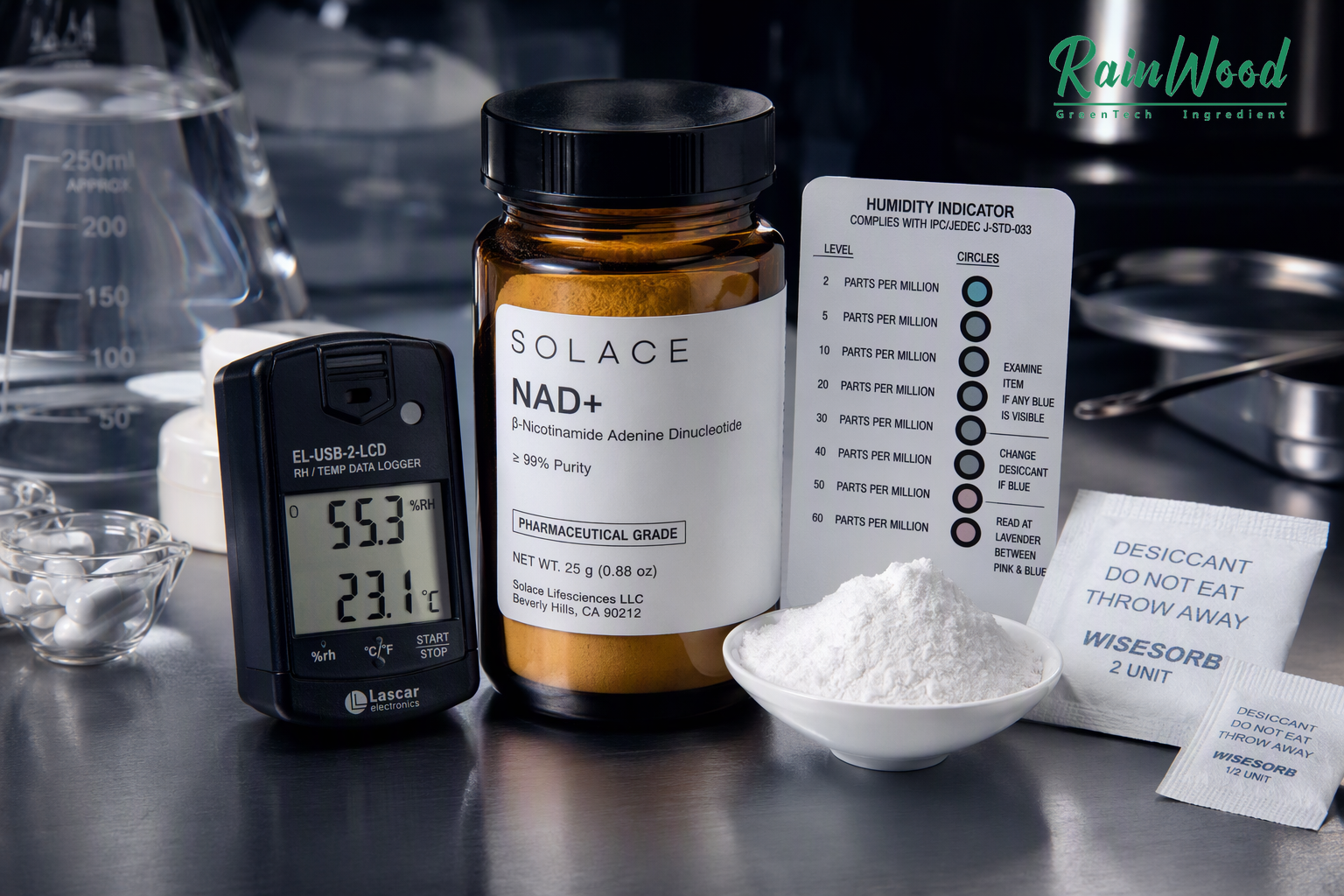
Laboratory stability testing and climate monitoring of pharmaceutical grade NAD+ raw material.
The NAD+ powder is bright and free-flowing when sampled. After transport, it arrives slightly darker and begins to cake in the container. The assay is still reported as acceptable, but the formulation team has not measured redox state, related substances, or in-use stability.
NAD+ stability is not solved by printing an expiry date. The buyer must connect material form, moisture, oxygen, light, temperature, pH, package, dosage form, shipping route, and customer handling. A sealed raw-material result does not automatically prove a finished capsule or solution will remain within specification.
Define what must remain stable
Use this NAD+ stability specification checklist to define:
- NAD+ identity and assay;
- NADH or redox-related forms;
- degradation products and related nucleotides;
- water and physical flow;
- color and odor;
- dissolution or disintegration;
- package seal and label readability;
- microbial limits where relevant.
The critical attributes depend on the format. A powder sachet may prioritize moisture and seal integrity. A capsule may prioritize fill uniformity and bottle exposure. A solution requires pH, buffer, oxygen, container closure, and in-use controls.
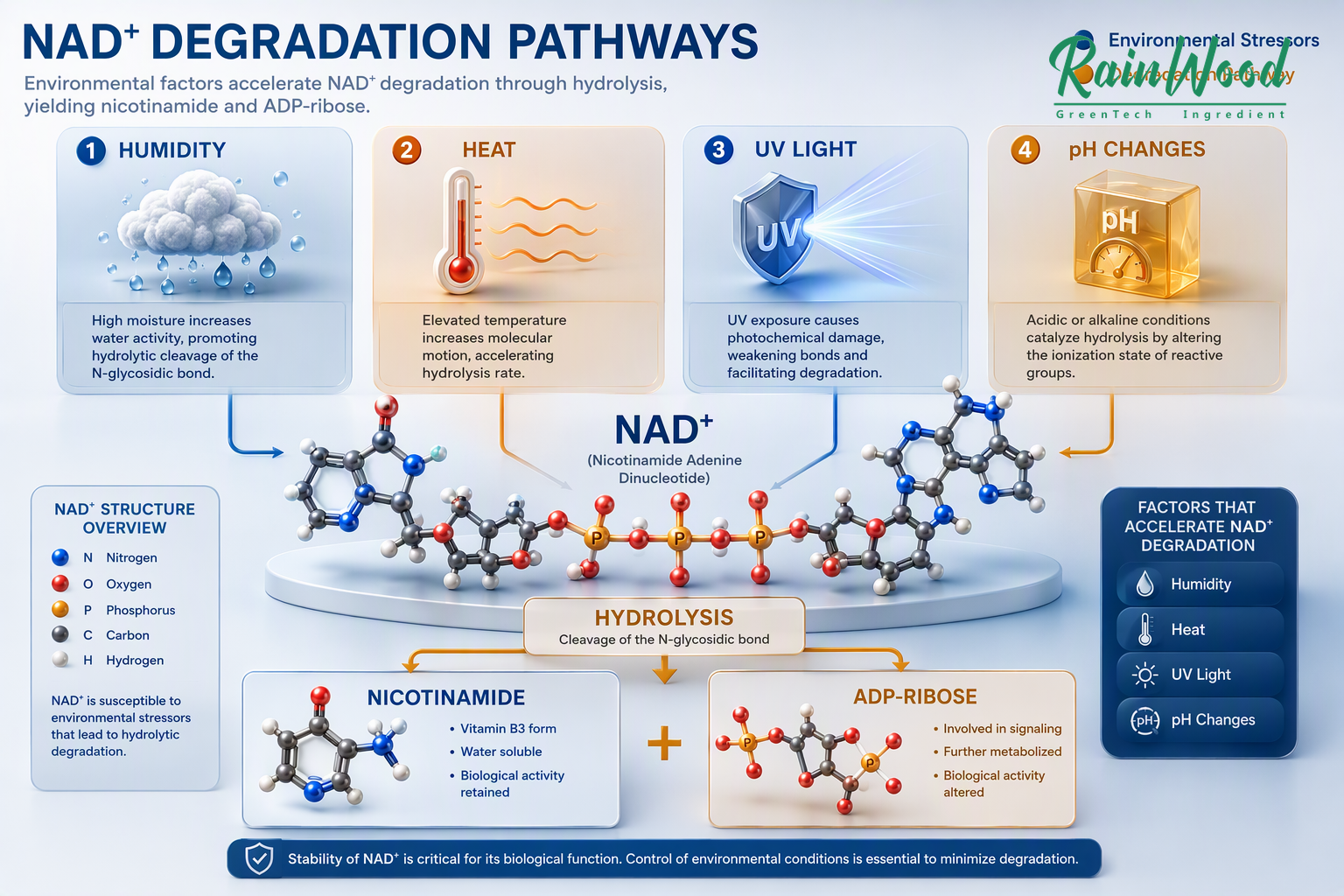
Chemical degradation pathway of NAD+ under humidity, heat, and pH shifts into nicotinamide and ADP-ribose.
Moisture changes concentration and handling
Water can reduce active concentration on an as-is basis and create caking, flow changes, or fill variation. Repeated opening adds humidity, and the customer’s storage may differ sharply from the supplier’s warehouse. If the formula includes hygroscopic ingredients, the risk belongs to the blend.
Request moisture or water-activity testing appropriate to the material and format. Define sampling points, package, storage, and acceptance limits before production.
Read the NAD+ dosage-form and packaging guide before selecting a bottle, sachet, blister, or liquid container.
pH and solution handling need their own controls
NAD+ solutions can behave differently from dry powder. Define buffer, pH, concentration, temperature, light, oxygen exposure, container, reconstitution, and in-use period. A solution that passes immediately after preparation may not remain stable after repeated withdrawals or temperature cycling.
Do not use a powder retest date as proof of solution stability. The presentation and exposure conditions are different.
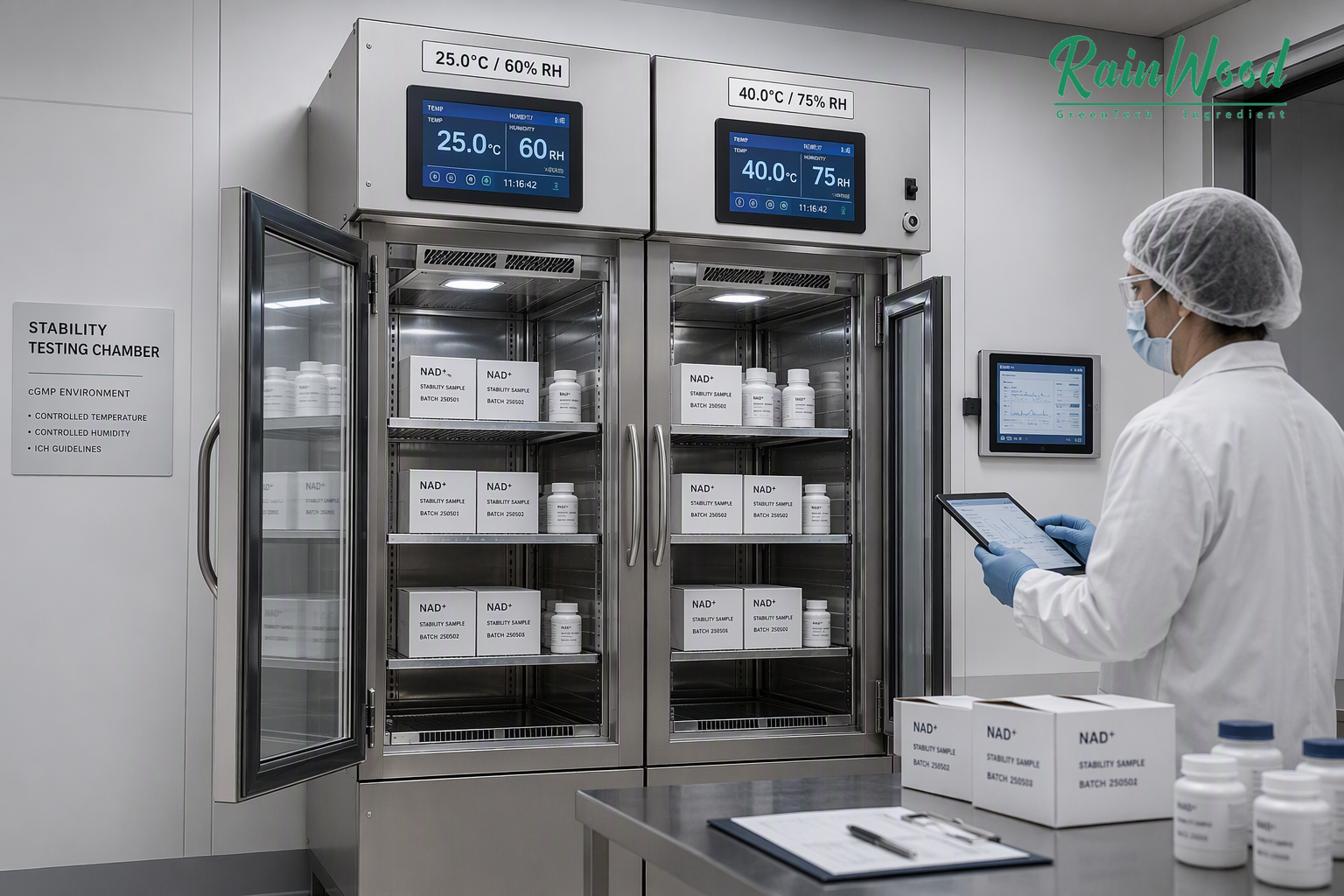
Controlled climate stability chamber evaluating real-time and accelerated shelf life of bulk NAD+ lots.
Light and oxygen belong in the package review
The correct barrier depends on the product and route, but a buyer should evaluate light exposure, headspace, closure, liner, oxygen transmission, moisture barrier, and opening frequency. A more expensive package may protect the product; it may also increase freight and filling cost.
Use filled packages and the intended shipping configuration in the stability plan. Empty-container tests cannot predict the complete product.
Build a practical stability matrix
| Attribute | Initial | Stress point | End point |
|---|---|---|---|
| NAD+ assay | Record | Compare | Confirm limit |
| Redox-related forms | Record | Trend | Confirm limit |
| Degradation products | Record | Trend | Confirm limit |
| Moisture/flow | Record | Observe | Confirm handling |
| Color/odor | Record | Panel | Confirm acceptance |
| Package integrity | Inspect | Challenge | Confirm closure |
If the finished product is a blend with resveratrol, pterostilbene, CoQ10, minerals, or vitamins, test the complete formula rather than relying only on the NAD+ powder file.
Shipping can create a different stability condition
Map the route from supplier warehouse to export, customs, fulfillment center, and consumer storage. Hot containers, warehouse delays, freezing and thawing, and repeated package opening can create exposure not represented in a laboratory sample.
Set a response plan for an out-of-trend result. A good stability program identifies who investigates, which tests are repeated, and whether the lot is held or replaced.
How RainwoodBio can connect storage to release
RainwoodBio publicly describes requirement confirmation, GMP process control, testing and release, packaging, warehousing, logistics, and traceability. For NAD+, the relevant control is planning stability around the exact grade, formula, package, shipping route, and customer storage behavior.
Confirm the test methods, time points, package, storage conditions, production site, and lot evidence available for your order. Public quality-system information does not replace a finished-product stability plan.
Stability belongs in the purchase order
Write the expected shelf life, storage range, transport conditions, package, and opening instructions into the specification or quality agreement. Ask whether the quoted expiry is supported by real-time data, accelerated data, a retest policy, or a supplier convention. These are different levels of evidence and should not be presented as equivalent.
At receipt, record the package condition and the actual time from manufacture to opening. Hold a retained unit from every lot and define the pull points for finished-product stability. If the product is a powder, inspect caking, flow, water, color, odor, and assay. If it is a solution, add pH, clarity, container closure, and in-use exposure. If it is a blend, test the NAD+ attribute separately from the overall appearance.
A stability failure should trigger a decision tree: confirm the result, check sampling and method, review transport and storage, assess related substances, and decide whether the lot is acceptable, reworked, downgraded for another use, or rejected. A written storage and packaging checklist can help buyers turn this into a practical supplier questionnaire.
The NAD+ stability approval gate
Before printing a shelf-life date, verify:
- critical attributes are defined for the format;
- moisture and physical handling remain acceptable;
- NAD+ assay and redox-related forms are trended;
- degradation products are controlled;
- package barrier and closure are tested;
- finished blends and solutions have their own stability review;
- supplier, package, or formula changes trigger reassessment.
Request a NAD+ stability and packaging review. Send the verified COA, formula, package drawings, storage target, shipping route, proposed shelf life, and current data. RainwoodBio can help identify which stability question remains open before inventory is released.
Define the “open” condition before setting expiry
Many stability conversations stop at the sealed package. A customer, however, may open a bottle daily, tear a sachet in a humid gym, or leave a powder drink container unsealed. Define the intended opening frequency, use environment, and closure instruction. If the product is sensitive to these conditions, make the instruction visible and test a realistic in-use scenario.
Review the data in the same order a failure would occur: package integrity, water or pH shift, appearance and odor, assay, and related substances. This sequence helps the team distinguish a handling problem from a chemical problem and prevents a single assay result from hiding a broader stability issue.
Frequently asked questions
Does a NAD+ expiry date prove stability in my finished bottle?
No. Confirm the lot, package, storage conditions, method, and finished formula behind the date.
Is a powder automatically more stable than a solution?
Not automatically. Each presentation has different exposure and testing requirements.
Does refrigeration solve every NAD+ stability problem?
No. Stability depends on pH, oxygen, moisture, package, handling, and the specific grade.
References
- JHFC, NAD+ Testing Standards: https://www.jhfc.or.jp/en/downloads/nad-testing
- NAD+ analytical characterisation monograph: https://compoundedevidence.com/monographs/nad-plus/analytical/
- NAD+ research and metabolism review: https://pubmed.ncbi.nlm.nih.gov/34041853/
- RainwoodBio About Us: https://www.rainwoodbio.com/about-us
*This article is for B2B procurement and educational purposes. Stability, shelf life, safety, packaging, labeling, and regulatory requirements must be confirmed for the exact NAD+ grade, finished product, package, and destination market.*
Looking for Reliable NAD+ or Coenzyme Ingredient Supply?
Rainwood Bio delivers verified HPLC-grade NAD+, Liposomal NMN, and NR raw materials supported by full identity testing, moisture control, and cGMP finished-dosage manufacturing.
Table of Contents
- Define what must remain stable
- Moisture changes concentration and handling
- pH and solution handling need their own controls
- Light and oxygen belong in the package review
- Build a practical stability matrix
- Shipping can create a different stability condition
- How RainwoodBio can connect storage to release
- Stability belongs in the purchase order
- The NAD+ stability approval gate
- Define the “open” condition before setting expiry
- Frequently asked questions
- References