 EN
NAD+ format choice affects dose, flow, moisture, taste, packaging, and stability. Compare capsules, tablets, and sachets before choosing private label.
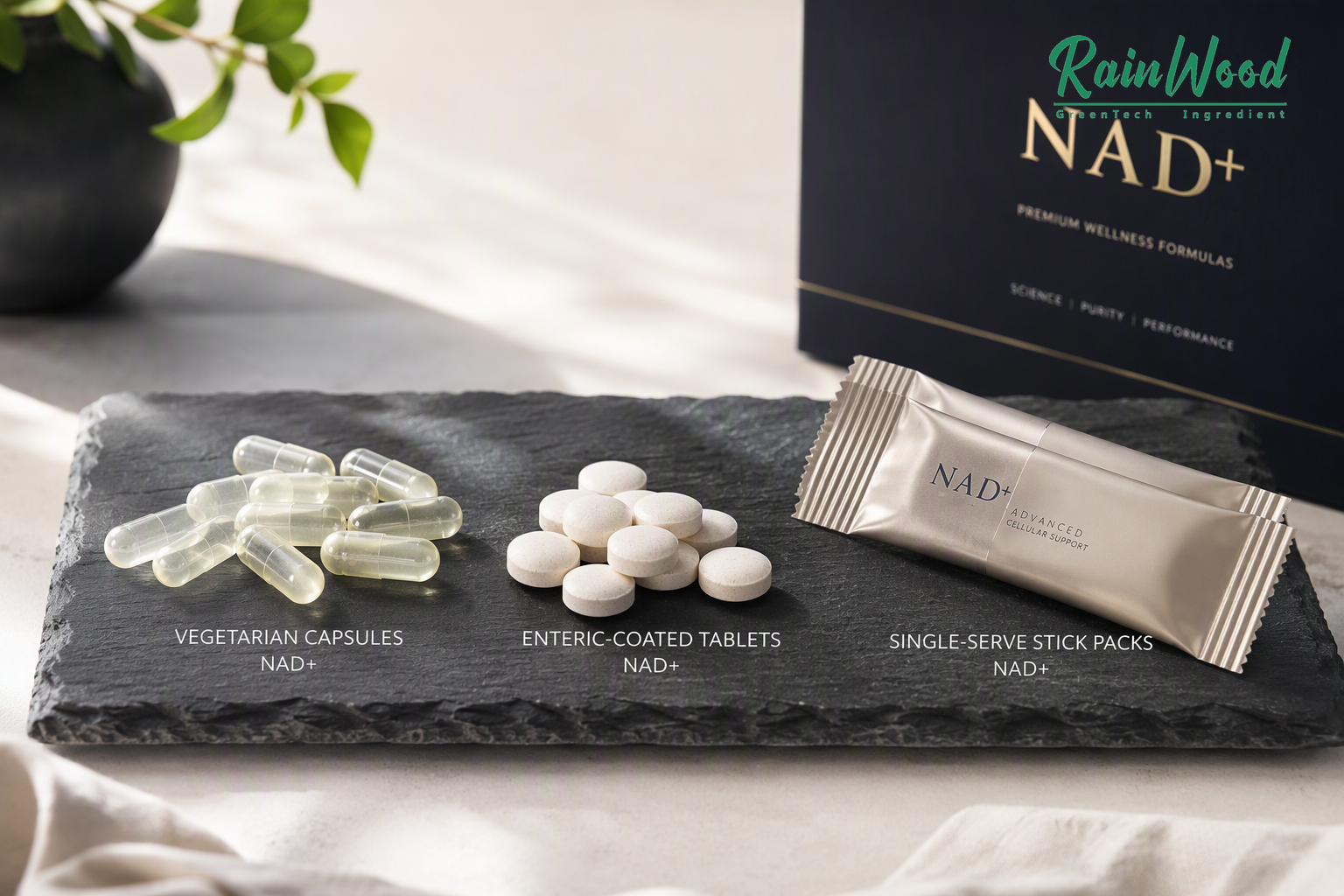
Finished dosage format comparison: hard capsules, enteric-coated tablets, and moisture-barrier powder sachets.
The brand wants NAD+ capsules for a clean consumer experience. The product team proposes a sachet for a flexible dose. The retailer asks for tablets. The same raw powder will not automatically run well in all three formats.
NAD+ format selection should begin with the chemical grade and customer routine. A powder that passes a verified COA may still flow poorly, absorb humidity, compress unevenly, or require a package that changes the project economics.
Capsules reduce taste but limit volume
Use our NAD+ dosage-form feasibility checklist NAD+ powder product page to define:
- target daily NAD+ amount;
- assay-corrected powder mass;
- bulk density and flow;
- capsule size and fill weight;
- number of capsules per serving;
- shell and package compatibility;
- bottle duration and monthly cost.
Capsules can shield direct taste, but they do not remove fill-weight, moisture, odor, or swallowing concerns. Calculate the actual units per day before designing the bottle.
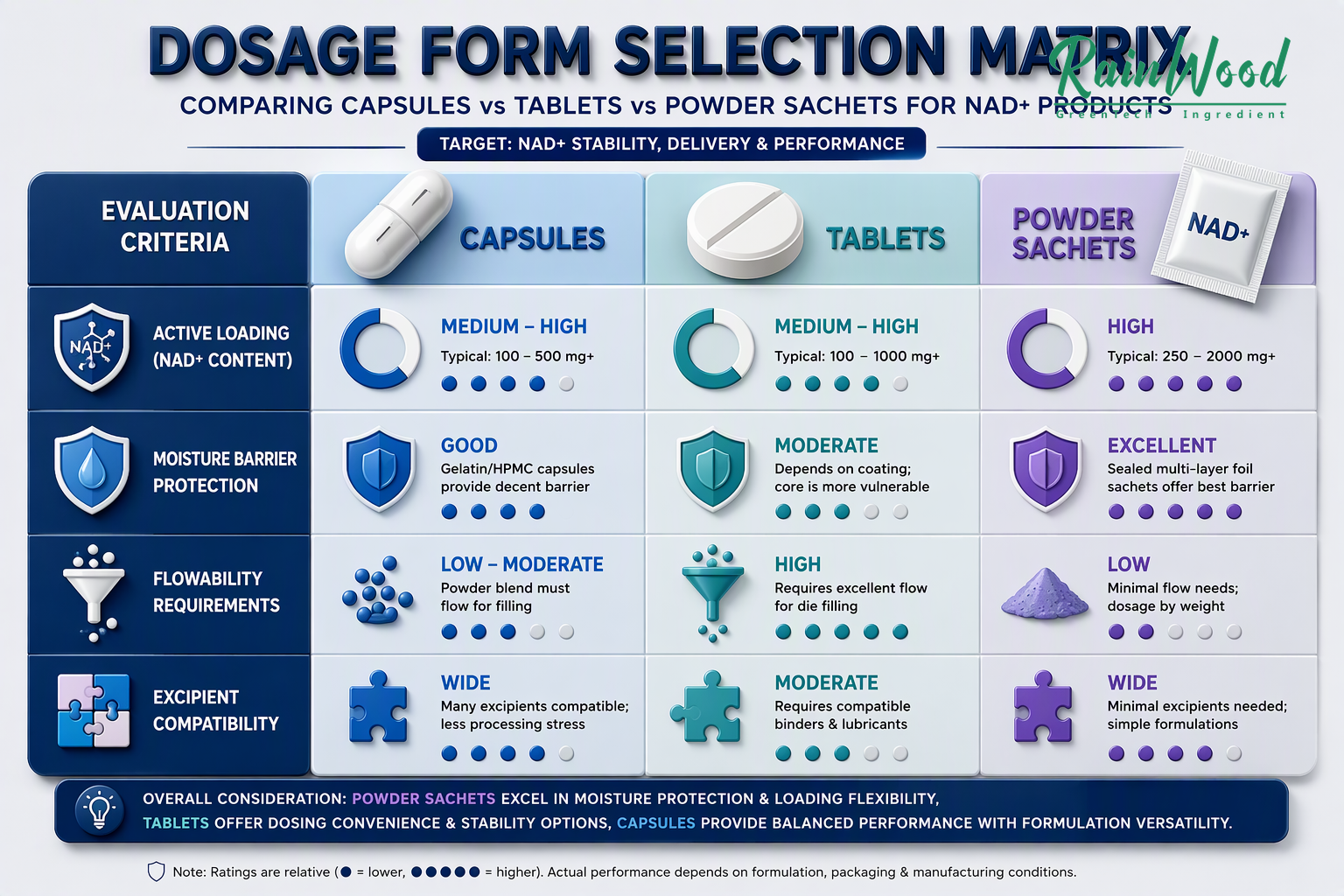
Technical comparison matrix of active loading, flowability, moisture barrier, and excipient fit across NAD+ delivery formats.
Tablets add compression and disintegration risk
Tableting applies pressure, lubrication, dwell time, and sometimes heat. NAD+ may behave differently after compression, and blends with minerals, vitamins, or botanicals can create sticking, capping, lamination, or segregation.
Run a pilot at the target hardness and tablet weight. Test assay, uniformity, friability, disintegration, appearance, moisture, and stability in the final package. Do not use powder data as proof of tablet performance.
Read the NAD+ stability and package guide NAD+ stability guide before choosing a tablet bottle or blister.
Sachets create single-use control and filling decisions
Sachets can reduce repeated opening and support a defined serving, but they require accurate filling, low dusting, seal integrity, film selection, tear performance, and moisture protection. If the customer mixes the powder, test wetting, taste, and reconstitution with the final sachet.
Do not assume an individual packet eliminates the need for stability testing. Film, seal, headspace, and shipping exposure still matter.
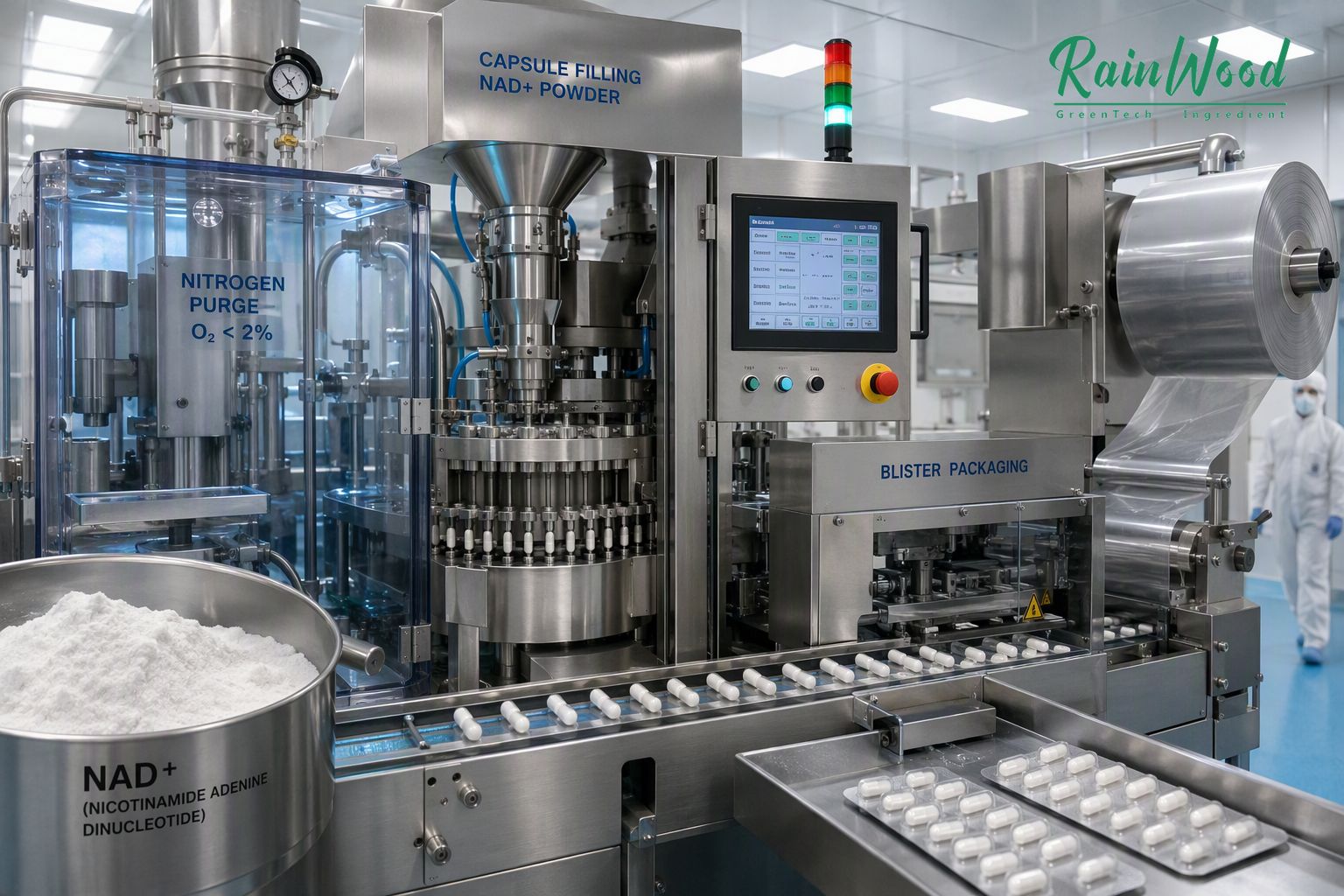
High-speed cGMP automated capsule encapsulation line equipped with nitrogen flush barrier packaging.
Compare format economics honestly
| Format | Potential benefit | Main risk |
|---|---|---|
| Capsule | Familiar and taste-shielded | Unit count and fill weight |
| Tablet | Compact and retail-friendly | Compression and disintegration |
| Sachet | Single-use dose control | Seal, film, filling, moisture |
Add production yield, packaging, freight, testing, and customer handling to the cost per serving.
Dose and label math should remain visible
If the raw material is assayed at 98% or supplied as a salt, the powder mass needed for a declared active amount changes. State whether the serving amount is compound mass, active NAD+ amount, or an assay-corrected amount. Keep capsule count, tablet weight, or sachet content aligned across label, product page, and distributor sheet.
Use the NAD+ dose calculation guide NAD+ dose and cost guide before final artwork.
How RainwoodBio can connect the grade to the format
RainwoodBio publicly describes custom hard capsules, tablets, powder drinks, sachets, testing and release, packaging, custom samples, and logistics. For NAD+, the relevant control is validating the specified grade on the actual equipment and in the final package before launch.
Confirm the exact capsule, tablet, or sachet equipment, pilot method, package, stability data, and batch evidence available for your order. Public format capability does not guarantee every NAD+ dose is feasible without validation.
Run a format-specific pilot before final artwork
The pilot should use the proposed NAD+ grade, excipients, capsule shell or film, filling equipment, and package. Measure unit weights across the run, not only the average. Check blend uniformity at beginning, middle, and end. Record dusting, bridging, sticking, capping, seal defects, and the time the bulk blend remains exposed before filling. These process details often reveal why a material that looked excellent in a jar does not perform on a production line.
The finished product should then be evaluated in the package that will reach the customer. Track appearance, water, assay, related substances, and any format-specific performance attribute. For a sachet, test seal integrity after transport. For a bottle, include repeated opening and closing. For a tablet, review disintegration after storage. This evidence is more useful than choosing a format from a competitor's product page.
If the brand changes from capsule to sachet after approval, reopen the risk assessment. The dose, moisture exposure, package, and customer instructions have changed. The NAD+ stability guide should be part of that change-control review.
The format approval gate
Before production, verify:
- active amount and unit count are clear;
- powder flow and fill variation pass;
- tablet compression or sachet filling is controlled;
- moisture and package barriers are adequate;
- finished-product assay and uniformity are tested;
- customer directions match the actual use;
- format changes trigger a new pilot.
Request a NAD+ capsule, tablet, or sachet feasibility review contact form. Send the verified COA, target dose, format, unit count, formula, package, target market, and price goal. RainwoodBio can help select the format that protects chemistry, margin, and customer use.
The format also changes the customer-service burden
Capsule customers may ask why the daily serving requires several units. Tablet customers may notice compression marks, color variation, or slower disintegration. Sachet customers may report clumping, seal defects, or difficulty dissolving the powder. These are not only marketing issues; they are signals that the grade, process, package, or instructions may not match the format.
Before launch, prepare a format-specific complaint tree. Link a complaint to the lot, package, storage condition, and use instruction, then decide which retained sample and test result can confirm the cause. This reduces the temptation to blame the raw NAD+ before checking the finished product.
Do not approve a format from average fill weight alone
Average weight can pass while individual units vary. Review the distribution, the sampling plan, the active assay, and the worst-case units. For a retail product, also inspect opening convenience and package protection because a technically uniform batch can still create complaints if the consumer cannot use it as instructed.
Document the reason for the chosen format
Keep a short design record explaining why the format was selected, which quality risks it controls, and which new risks it introduces. This record helps sales, manufacturing, and regulatory teams tell the same story when the product is updated or a customer asks why the brand chose capsules instead of sachets.
Frequently asked questions
Is NAD+ better in capsules than sachets?
Not automatically. Capsules mask taste, while sachets may offer dose and travel flexibility. Choose based on stability, dose, and customer routine.
Can NAD+ powder be compressed directly into tablets?
Do not assume so. Flow, compression, lubrication, disintegration, and stability need a pilot with the actual formula.
Does one NAD+ grade fit every format?
Not necessarily. Physical and stability requirements are format-specific.
References
- JHFC, NAD+ Testing Standards: https://www.jhfc.or.jp/en/downloads/nad-testing
- NAD+ analytical characterisation monograph: https://compoundedevidence.com/monographs/nad-plus/analytical/
- RainwoodBio home page: https://www.rainwoodbio.com/
- RainwoodBio OEM information: https://www.rainwoodbio.com/oem
*This article is for B2B procurement and educational purposes. Dose, format, manufacturing, stability, safety, labeling, and regulatory requirements must be confirmed for the exact NAD+ product and destination market.*
Looking for Reliable NAD+ or Coenzyme Ingredient Supply?
Rainwood Bio delivers verified HPLC-grade NAD+, Liposomal NMN, and NR raw materials supported by full identity testing, moisture control, and cGMP finished-dosage manufacturing.
Table of Contents
- Capsules reduce taste but limit volume
- Tablets add compression and disintegration risk
- Sachets create single-use control and filling decisions
- Compare format economics honestly
- Dose and label math should remain visible
- How RainwoodBio can connect the grade to the format
- Run a format-specific pilot before final artwork
- The format approval gate
- The format also changes the customer-service burden
- Do not approve a format from average fill weight alone
- Document the reason for the chosen format
- Frequently asked questions
- References