 EN
NAD+ and NADH are different redox forms with different stability and testing questions. Learn how buyers protect identity, assay, and label accuracy.
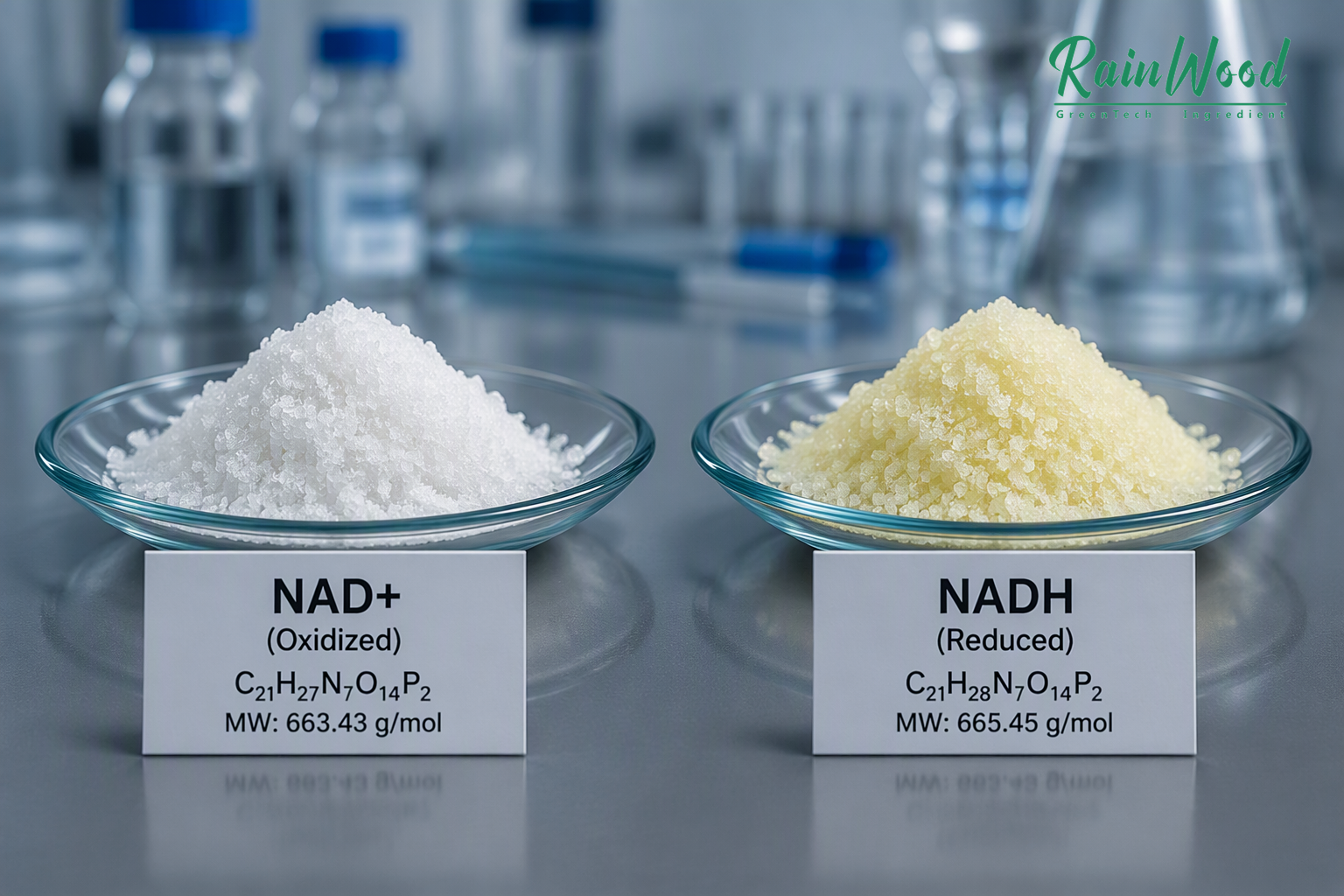
Comparative laboratory inspection of oxidized NAD+ coenzyme and reduced NADH coenzyme raw materials.
The product name says NAD+. The supplier’s test report says total NAD. The marketing image shows “reduced coenzyme” in another section. A customer asks whether the bottle contains NAD+ or NADH, and the brand cannot answer from the specification.
NAD+ and NADH share a related coenzyme structure but differ in redox state. That difference matters to analytical methods, stability, processing, storage, and the wording used on a label. A buyer should not approve a “NAD” material when the finished product depends on one defined form.
Lock the redox form before the quotation
Use our NAD+ and NADH identity checklist NAD+ powder product page to specify:
- oxidized NAD+;
- reduced NADH;
- total NAD-related material;
- acceptable ratio or limit if both are relevant;
- free acid or salt form;
- assay and identity method;
- storage and packaging requirements.
Do not let “coenzyme I,” “NAD,” and “NAD+” become interchangeable commercial terms. The PO, verified COA, label, and product page should use one controlled vocabulary.
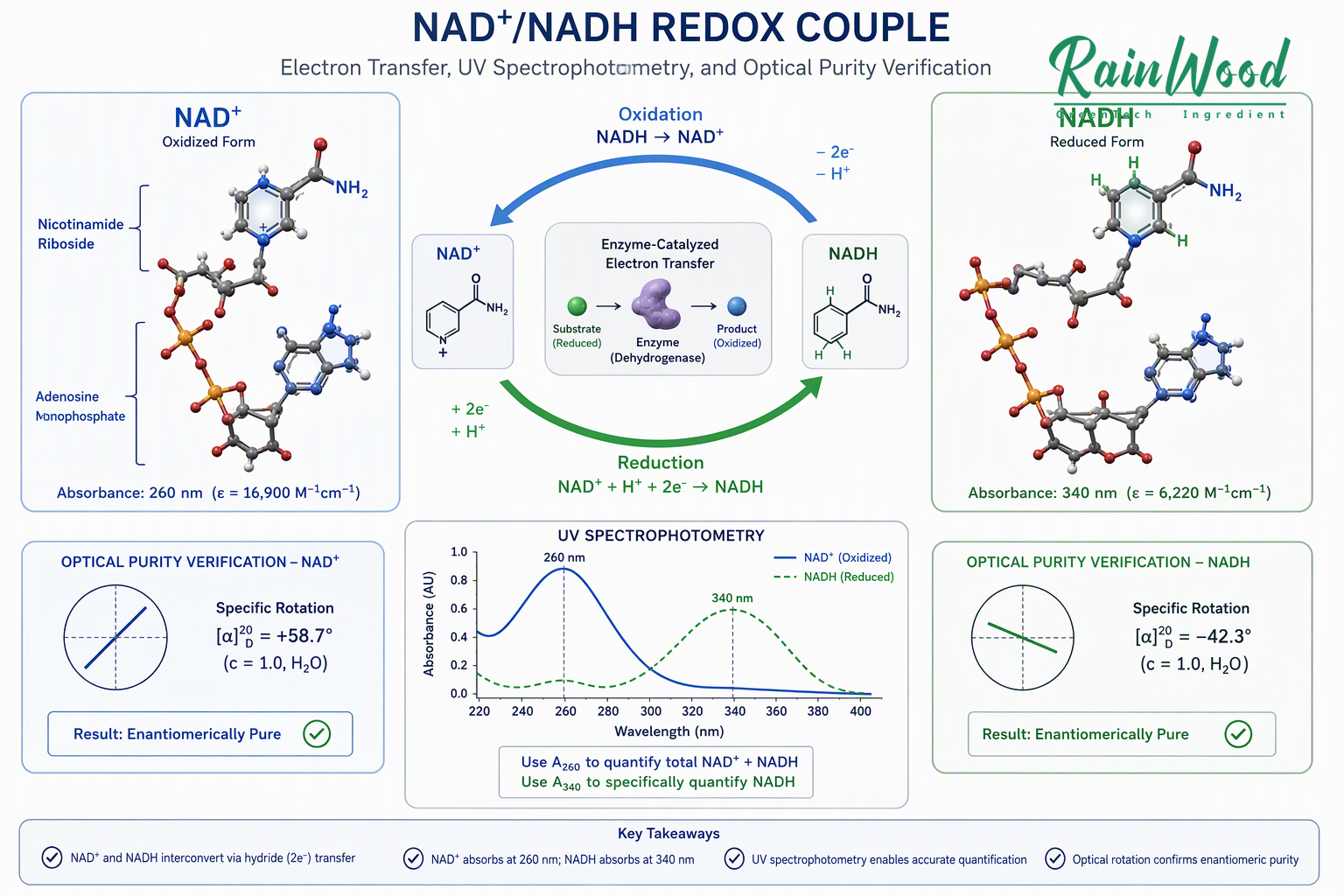
Biochemical redox couple cycle and UV absorbance spectrum comparison (260 nm vs 340 nm) for coenzyme identity.
Redox state can change during handling
Light, oxygen, moisture, temperature, pH, metals, and solution exposure can influence NAD-related stability. The exact behavior depends on the material and formulation, but a buyer should assume that redox state deserves a defined storage and testing plan.
Ask the supplier how the powder is protected, whether the container is oxygen- or moisture-controlled, and whether the method monitors the intended oxidized form after storage. A fresh sample result does not prove the same redox composition at the end of shelf life.
Read the NAD+ stability and packaging guide NAD+ stability guide before choosing a bottle, sachet, or liquid presentation.
Total NAD measurement can hide the wrong form
An enzymatic or broad spectrophotometric result may measure total redox-related activity without separating NAD+ and NADH. That can be useful for a defined research question but insufficient for a label that promises direct NAD+.
Request a chromatographic or orthogonal identity strategy that matches the release decision. Ask which form the reference standard represents, how the sample is prepared, and whether the extraction or pH conditions alter the redox balance before measurement.
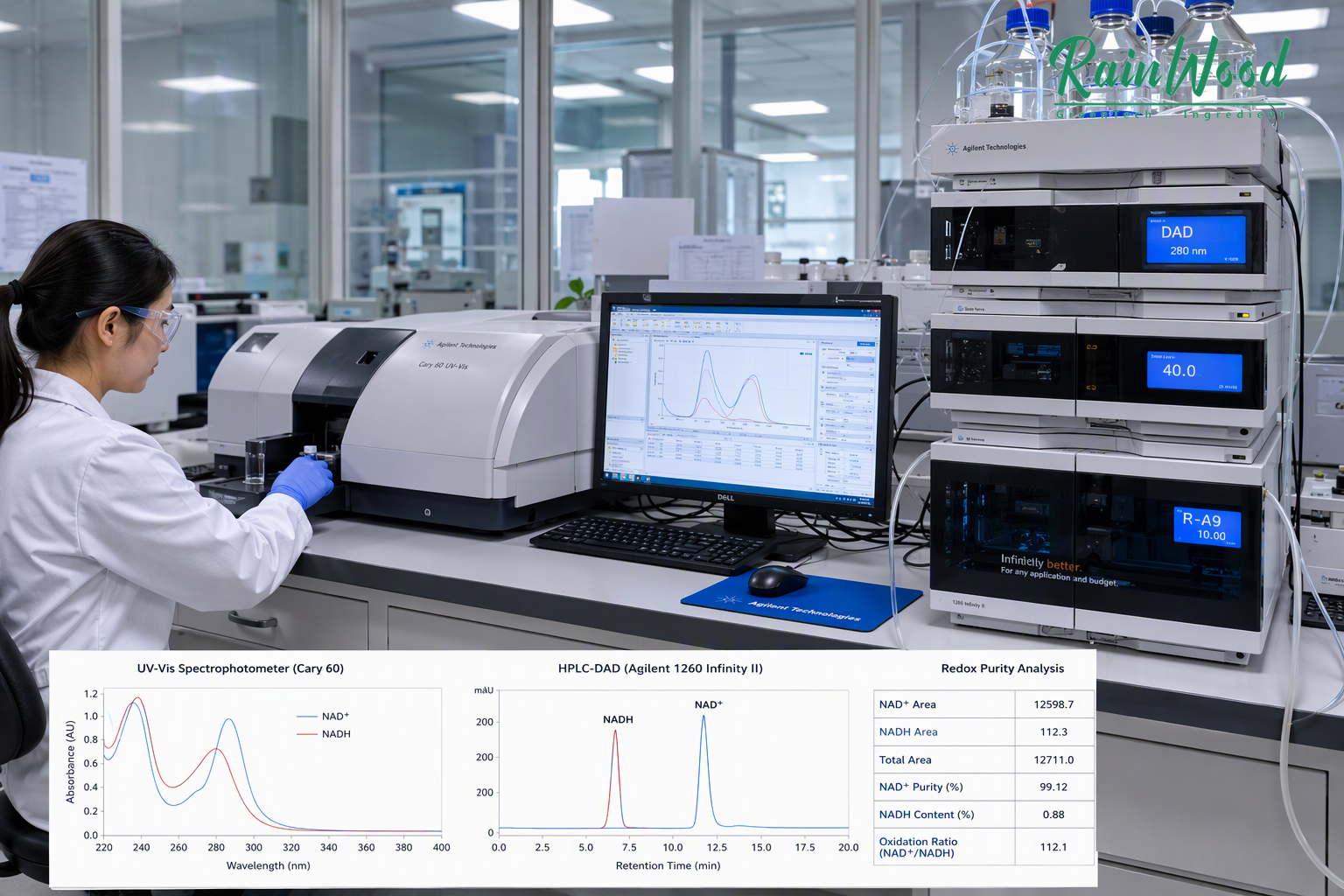
Precision diode-array HPLC detector analyzing redox purity and oxidation ratio of incoming coenzyme lots.
The label must not combine opposite forms casually
“NAD+ and NADH complex” may be accurate for a defined blend, but it should not be used as a shortcut for an unidentified material. If the product is NAD+, do not write “reduced NAD” or “reduced coenzyme” unless the formula actually contains NADH and the wording is permitted.
The buyer loss is customer confusion, repeated marketplace questions, and a dossier that cannot match the batch test. Clarify the redox form before artwork and advertising are approved.
Dose and stability are linked
If NAD+ converts or degrades during storage, the effective amount per serving may drift even when the initial fill weight is correct. Use a stability plan that measures both chemical content and relevant degradation or redox attributes. A capsule shell or outer package may protect handling without proving chemical stability.
For a solution, define pH, buffer, light, oxygen, temperature, container closure, and in-use period. For a powder, define moisture, oxygen exposure, and reconstitution instructions.
Use a redox-state release table
| Control point | Buyer decision |
|---|---|
| Identity | NAD+ or NADH clearly named |
| Assay | Form-specific method and basis |
| Related form | Limit or ratio defined |
| Packaging | Oxygen, moisture, and light controls |
| Stability | Time-point redox and degradation data |
| Label | No mixed or misleading terminology |
| Change control | Process or package changes trigger review |
Explore our NAD+ analytical and release review NAD+ verified COA guide before you accept a total-NAD result as proof of direct NAD+.
How RainwoodBio can align redox identity with the finished format
RainwoodBio publicly describes requirement confirmation, supplier management, GMP process control, testing and release, packaging, multiple dosage forms, and traceability. For an NAD+ project, the relevant value is linking the specified redox form to the sample, package, stability plan, and lot release.
Confirm the exact analytical method, storage conditions, batch evidence, facility scope, and finished-format controls available for your project. Public manufacturing information does not prove that a particular package preserves NAD+ rather than a related redox form.
Control redox state from receipt to release
Ask how the supplier protects the material during manufacture, drying, storage, sampling, and shipment. Record the package headspace, opening instruction, light exposure, and any recommendation to work under controlled conditions. The final product should be tested with a method that can distinguish NAD+ and NADH rather than reporting only a combined “total NAD” value.
When comparing suppliers, request both a certificate and a chromatogram or method summary where the redox distinction is critical. Review the calculation basis and reference standard. If the final formula contains reducing or oxidizing co-ingredients, run a compatibility study instead of assuming the capsule shell will protect the active. A short pilot at the intended dose can reveal a problem that a raw-material test cannot.
Document the change-control trigger. A new supplier, salt form, drying process, package, or excipient may change the redox profile. Treat it as a new qualification event until equivalent data are available. The NAD+ stability guide explains why redox identity and storage stability need to be considered together.
The redox approval gate
Before launch, verify:
- NAD+ or NADH is clearly defined;
- method and reference standard match the intended form;
- packaging controls the relevant exposure risks;
- stability measures the finished product, not only fresh powder;
- label and claims use consistent terminology;
- source, process, or package changes trigger review.
Request a NAD+ versus NADH redox-state review contact form. Send the verified COA, method summary, package, formula, storage target, label, and market. RainwoodBio can help identify whether the product is selling a defined redox form or an undefined “NAD” idea.
Redox language should be visible in the quality agreement
Write the required redox form, allowable related form, method, and reporting basis into the quality agreement. If both forms are intentionally present, define the ratio or total and explain how the label reflects it. If only NAD+ is intended, require the supplier to notify the buyer before any process, source, or package change that could affect redox balance.
For a finished product, review the formula for redox-active excipients, minerals, flavors, and botanical extracts. The interaction may be slow and invisible at release, which is why a short accelerated study can be useful before committing to a long shelf-life claim. A professional supplier will explain what is known and what remains to be verified.
Frequently asked questions
Is NADH the same as NAD+?
No. They are related redox forms with different chemical states and product specifications.
Can a total NAD assay distinguish NAD+ and NADH?
Not automatically. Use a method that answers the redox-specific identity question.
Does a sealed capsule guarantee NAD+ stability?
No. Stability depends on material, shell, package, storage, exposure, and finished-product evidence.
References
- PubMed, NAD+ Homeostasis in Human Health and Disease: https://pubmed.ncbi.nlm.nih.gov/34041853/
- JHFC, NAD+ Testing Standards: https://www.jhfc.or.jp/en/downloads/nad-testing
- NAD+ analytical characterisation monograph: https://compoundedevidence.com/monographs/nad-plus/analytical/
- RainwoodBio OEM information: https://www.rainwoodbio.com/oem
*This article is for B2B procurement and educational purposes. Redox identity, assay, stability, safety, labeling, claims, and regulatory requirements must be confirmed for the exact NAD-related material and destination market.*
Looking for Reliable NAD+ or Coenzyme Ingredient Supply?
Rainwood Bio delivers verified HPLC-grade NAD+, Liposomal NMN, and NR raw materials supported by full identity testing, moisture control, and cGMP finished-dosage manufacturing.
Table of Contents
- Lock the redox form before the quotation
- Redox state can change during handling
- Total NAD measurement can hide the wrong form
- The label must not combine opposite forms casually
- Dose and stability are linked
- Use a redox-state release table
- How RainwoodBio can align redox identity with the finished format
- Control redox state from receipt to release
- The redox approval gate
- Redox language should be visible in the quality agreement
- Frequently asked questions
- References