 EN
A high NAD+ purity number does not automatically prove oxidation state, related substances, or lot identity. Review the COA before buying.
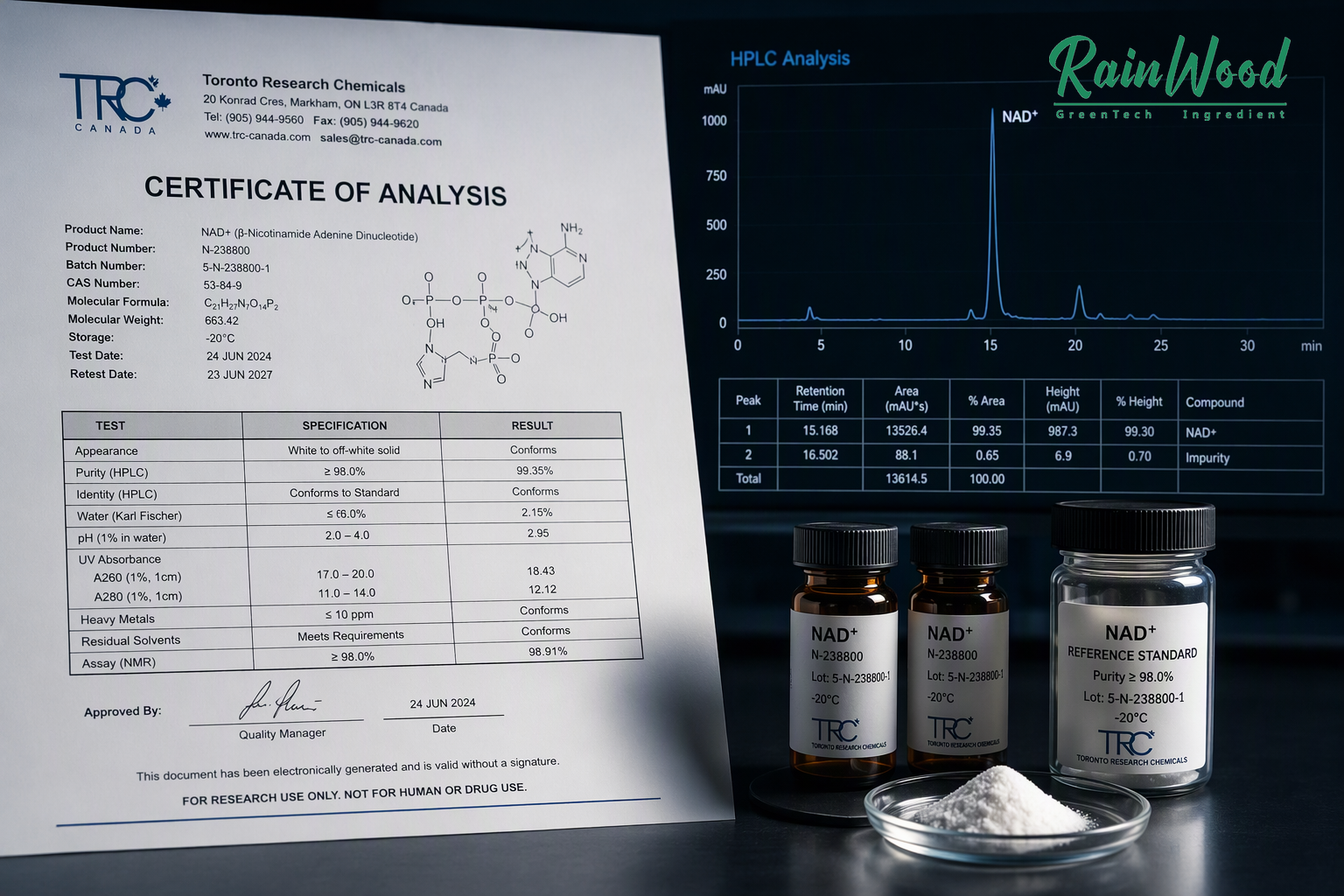
Quality control documentation review comparing official Certificate of Analysis against HPLC chromatograms.
The verified COA says NAD+ 99.5% by HPLC. The buyer sees a strong number and approves the quotation. The quality reviewer asks which reference standard was used, whether NADH was separated, how degradation products were measured, and whether the result belongs to the shipped lot. The supplier sends the same one-line certificate.
That certificate may be accurate and still incomplete. Purity is one result under one method. It does not automatically prove oxidation state, molecular identity, related nucleotides, counterions, water content, or batch traceability.
Separate the questions inside an NAD+ COA
Use this NAD+ COA verification checklist to separate:
1. Is the material NAD+ rather than NADH, NMN, or NR? 2. Does the assay quantify NAD+ on a defined basis? 3. Are related substances and degradation products controlled? 4. Are residual solvents, metals, and microbiology within limits? 5. Does the result belong to the lot being shipped?
The JHFC NAD+ testing material emphasizes that direct NAD+ has different chemistry, stability, and analytical requirements from NR or NMN. Use that distinction in your specification instead of copying a generic supplement COA.
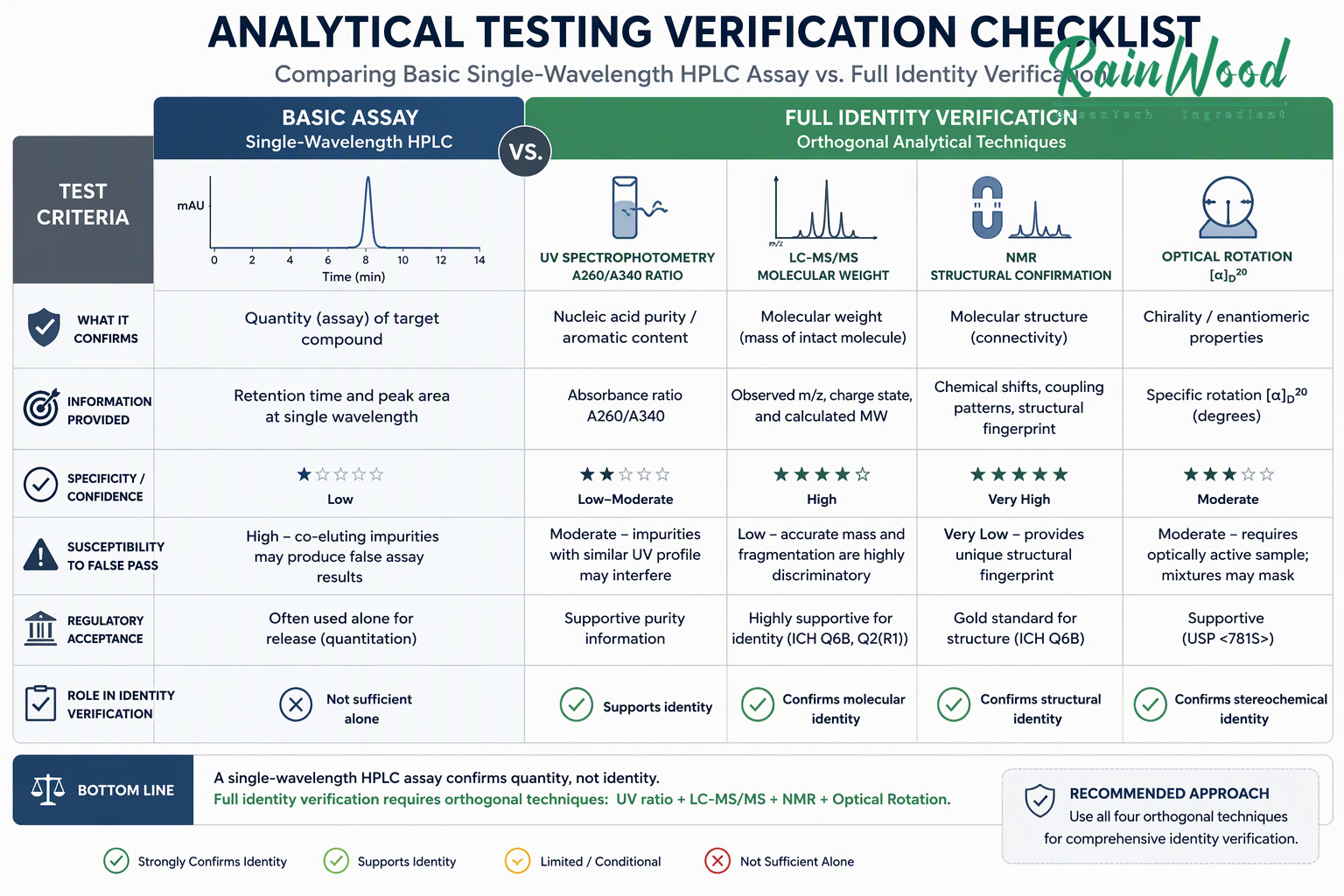
Testing protocol checklist comparing single-wavelength HPLC assay with full UV ratio, LC-MS/MS, and NMR validation.
Read the analytical method before the percentage
Ask for the chromatographic mode, detection wavelength, reference standard, sample preparation, system suitability, reporting basis, and acceptance criterion. A method that cannot retain or separate a charged nucleotide appropriately may not answer the identity question.
Do not treat the word “HPLC” as a complete method. The instrument is only part of the evidence. The method must distinguish NAD+ from likely related compounds and connect the result to the tested lot.
Check the analytical method and testing details below before you compare two purity numbers from different laboratories.
Oxidation state needs explicit control
NAD+ and NADH are redox-related forms. If the product is specified as NAD+, the buyer should ask whether the method can detect or limit NADH and other redox-related degradation. A high total signal does not prove that the desired oxidized form remains dominant.
Request an identity strategy that may combine chromatography with an orthogonal confirmation where appropriate. The exact method depends on the grade and intended use, but the question should be written into the specification.
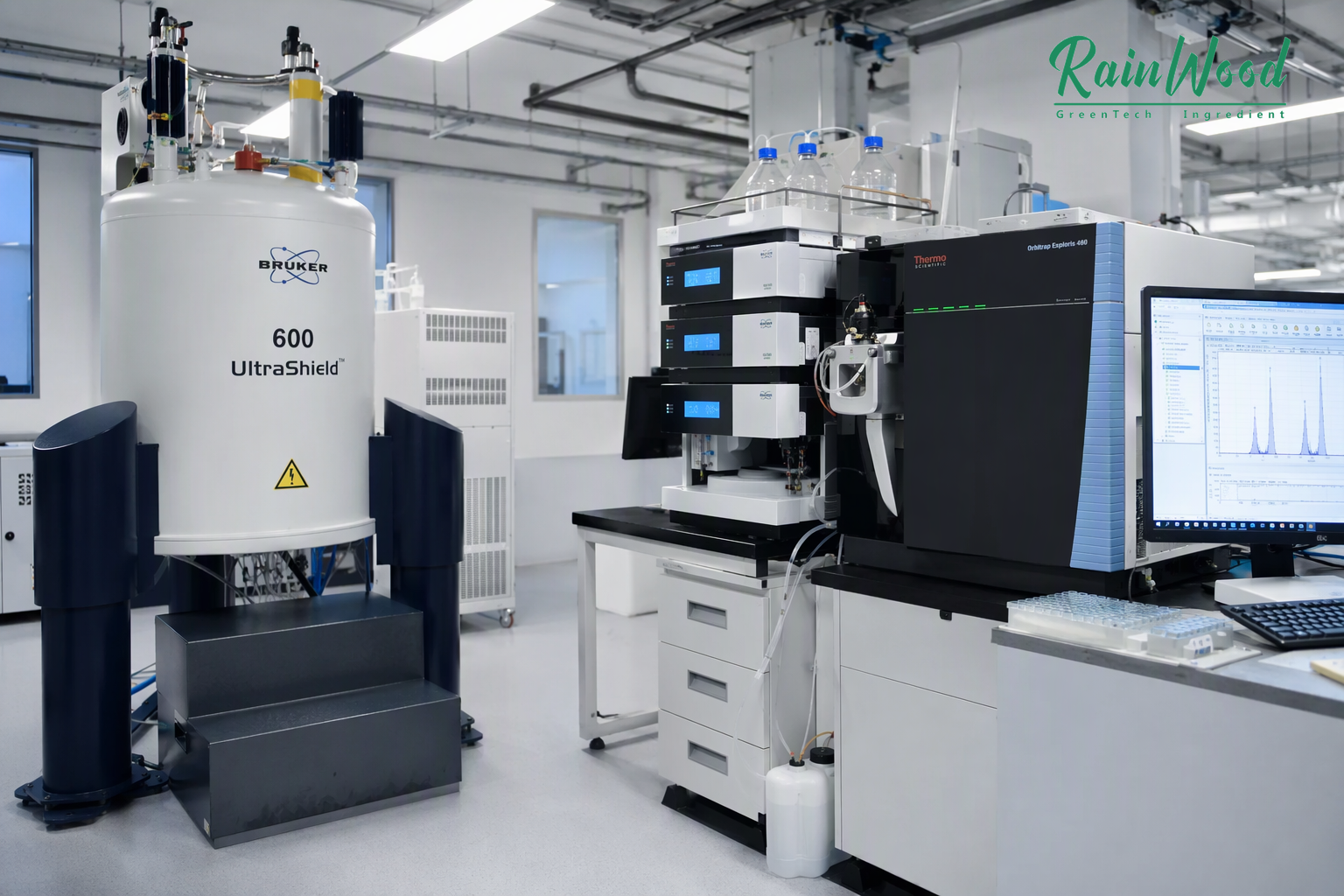
High-field NMR spectrometer and LC-MS instrument validating exact molecular fingerprint and counterions.
Related substances can tell you how the material was made and stored
NAD+ may be affected by hydrolysis, oxidation-reduction changes, pH, temperature, light, moisture, or solution handling. The impurity profile can therefore be a process and stability signal. Ask the supplier to identify likely degradation products and set limits for the relevant lot.
The buyer loss is a finished product that passes a basic assay but changes during storage or fails a customer’s analytical review because the remaining material was never defined.
Lot linkage is a release requirement
Use a lot-link table:
| Record | Required match |
|---|---|
| Approved sample | Code, date, and identity |
| Specification | NAD+ form and limits |
| verified COA | Same product code and batch |
| Test report | Same sample and lot |
| Package | Lot printed on container |
| Shipment | Invoice and packing list match |
| Retained sample | Available for investigation |
If the COA is “typical,” label it that way. Do not use a typical result as a batch release result.
Assay basis changes the commercial comparison
NAD+ may be supplied as a free acid, salt, hydrated material, or formulated presentation. Confirm whether the assay and net content are reported on an as-is, dry, salt-inclusive, or active-material basis. A 99% result from one basis is not automatically comparable with a 99% result from another.
This matters when calculating capsule fill, sachet content, price per active gram, and finished-product label statements.
How RainwoodBio can support an NAD+ release package
RainwoodBio publicly describes supplier management, GMP process control, testing and release, compliance documentation, packaging, and traceability. For NAD+, the relevant control is setting a fit-for-purpose identity, redox, impurity, safety, and lot-link package before the material enters production.
Confirm the exact method, reference standard, laboratory, release limits, stability evidence, production site, and batch documents available for your NAD+ project. A company certificate or generic verified COA cannot replace a method and lot review.
Turn the verified COA into a release decision
Create a review checklist with four columns: requirement, reported result, method or evidence, and buyer decision. Flag any line that is missing a method, basis, lot link, or acceptance limit. If the report says “pass” without showing the actual result, request the result. If the method is proprietary, ask for enough information to assess specificity, reference standard, and suitability for NAD+.
Use orthogonal evidence when the material is high value or the supplier is new. Identity can combine a suitable chromatographic or spectroscopic method with a reference standard. Purity should be interpreted alongside related substances and water. Stability should be evaluated through time and package exposure rather than inferred from one release assay. Finished-product release should include the unit-dose and matrix attributes that the raw COA cannot measure.
Keep the reviewed COA with the purchase order, lot record, retained sample, and final release decision. This creates an audit trail when a retailer or customer asks why the material was accepted. The NAD+ supplier checklist can help turn this review into a repeatable qualification step.
The NAD+ verified COA approval gate
Before accepting a lot, verify:
- NAD+ identity and oxidation state are addressed;
- assay basis and method are stated;
- related substances are defined;
- residual solvents, metals, moisture, and microbiology fit the project;
- results are linked to the shipped batch;
- sample and bulk are comparable;
- deviations and retesting responsibilities are written.
Request a NAD+ COA and impurity-profile review. Send the COA, specification, chromatogram or test report, sample code, lot number, target market, and dosage form. RainwoodBio can help determine whether the COA proves the product—or only proves that one method produced one number.
Do not release a high-value lot from a screenshot
Request the original controlled document or a verifiable laboratory report, not only a cropped image sent in a chat. Confirm the lot number, issue date, laboratory identity, method, reference standard, and whether the result belongs to the material you received. Keep the sealed sample and document who opened it, when, and how it was stored before testing.
If the supplier's method and your laboratory's method disagree, compare specificity and calculation basis before deciding that one result is wrong. A difference can come from sample preparation, dry-basis correction, standards, or separation of related compounds. The resolution should be recorded as part of the lot release, not left as an informal email explanation.
Frequently asked questions
Does 99% HPLC NAD+ prove the material is pure NAD+?
It supports an assay result under the stated method. Identity, oxidation state, related substances, safety, and lot traceability still require review.
Should NADH appear on an NAD+ verified COA?
The appropriate control depends on the specification and method. If oxidation state matters, define how NADH and related redox forms are assessed.
Is an outside laboratory report automatically enough?
No. Check method suitability, laboratory identity, sample and lot linkage, report authenticity, and acceptance criteria.
References
- JHFC, NAD+ Testing Standards and Analytical Methods: https://www.jhfc.or.jp/en/downloads/nad-testing
- NAD+ analytical characterisation monograph: https://compoundedevidence.com/monographs/nad-plus/analytical/
- Cayman Chemical NAD+ verified COA example: https://cdn.caymanchem.com/cdn/downloadCofa/Cayman-CofA-16077-0803651.pdf
- RainwoodBio OEM information: https://www.rainwoodbio.com/oem
*This article is for B2B procurement and educational purposes. Analytical identity, assay, oxidation state, impurities, safety, stability, and regulatory requirements must be confirmed for the exact NAD+ lot and destination market.*
Looking for Reliable NAD+ or Coenzyme Ingredient Supply?
Rainwood Bio delivers verified HPLC-grade NAD+, Liposomal NMN, and NR raw materials supported by full identity testing, moisture control, and cGMP finished-dosage manufacturing.
Table of Contents
- Separate the questions inside an NAD+ COA
- Read the analytical method before the percentage
- Oxidation state needs explicit control
- Related substances can tell you how the material was made and stored
- Lot linkage is a release requirement
- Assay basis changes the commercial comparison
- How RainwoodBio can support an NAD+ release package
- Turn the verified COA into a release decision
- The NAD+ verified COA approval gate
- Do not release a high-value lot from a screenshot
- Frequently asked questions
- References