 EN
A practical buyer guide to NAD+ color, odor, moisture, packaging, and stability checks before a supplement batch is released.
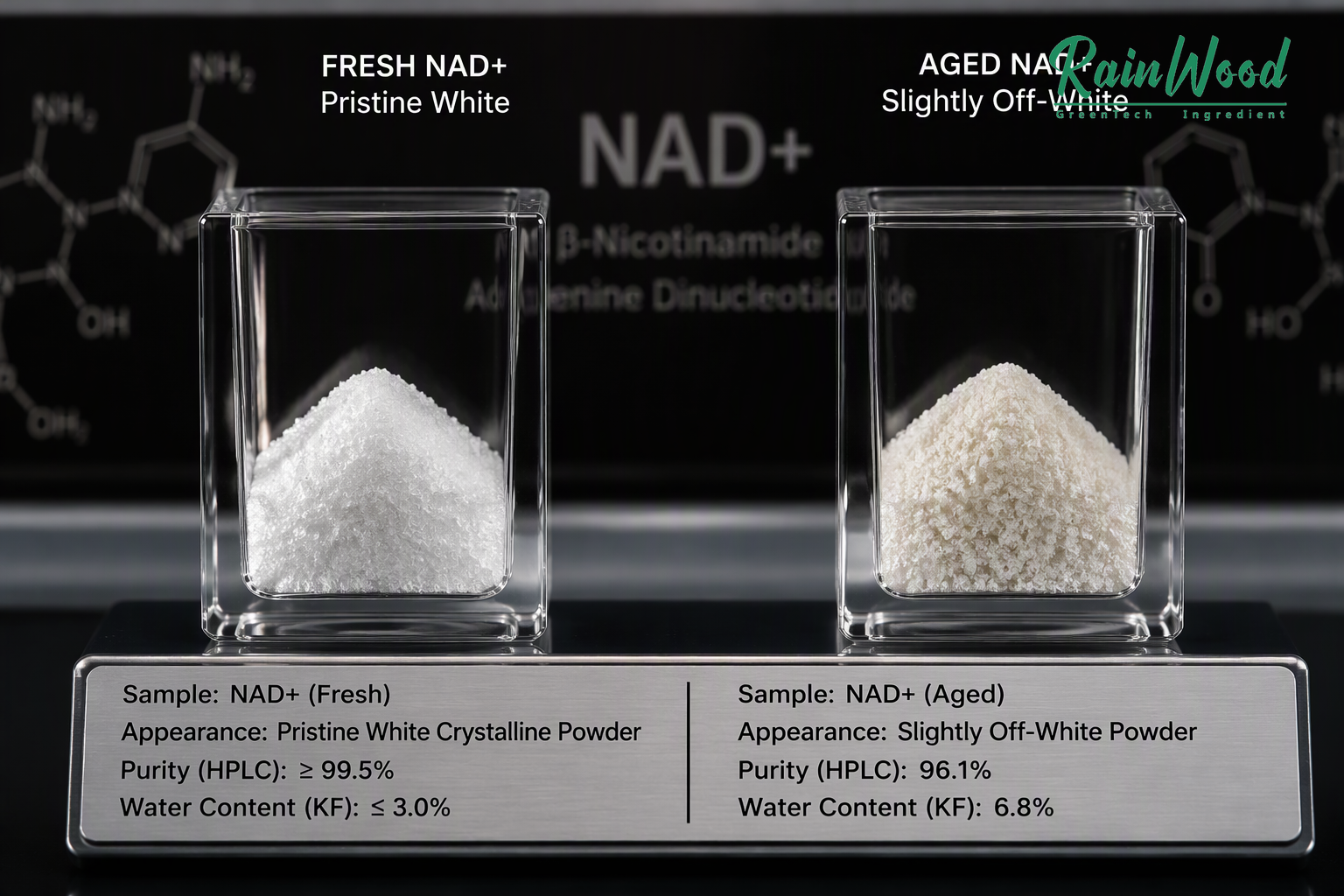
Sensory and physical inspection comparing fresh white NAD+ crystalline powder with aged material under daylight.
A visual change is not a diagnosis
When a buyer opens an NAD+ drum or a finished sachet and notices a different shade, a sharper odor, or a less uniform powder, the first reaction is often simple: reject it or accept it. That is not enough. A sensory change can reflect moisture exposure, oxidation, a packaging interaction, a formulation ingredient, or a real change in chemical profile. The commercial mistake is treating appearance as either proof of failure or proof of safety.
NAD+ is a high-value, specification-sensitive ingredient. It is not purchased only by weight. The buyer is purchasing a named chemical form, an agreed assay, controlled impurities, suitable water and solvent limits, and a stability story that survives conversion into the final product. A color or odor change matters because it may be the first visible signal that one of those controls has shifted.
The correct response is a structured investigation. Compare the retained sample with the incoming sample, review the shipment and storage history, inspect packaging integrity, and test the attributes that can explain the observation. A visual decision made without this sequence creates two risks: rejecting usable material and releasing material that no longer matches the specification.
What can change the appearance of NAD+
NAD+ powder may show a color range that depends on concentration, particle size, residual moisture, manufacturing history, and the container in which it is observed. A thin layer in a clear bag can look different from a compacted layer in a drum. Lighting and the color of an adjacent excipient can also change perception. This is why a specification should describe a comparison standard and observation conditions rather than rely on a vague phrase such as “white powder.”
Odor requires the same discipline. A new odor may come from the material itself, the liner, a desiccant, a cleaning residue, a co-ingredient, or a volatile contaminant. A closed package can concentrate a faint odor that would not be noticed in an open production room. If the finished product contains flavors, acids, botanical extracts, or plastic components, the sensory profile cannot be attributed to NAD+ without a control sample.
The first procurement question is therefore: what exactly changed, and against which reference? The answer should identify the lot, package, storage duration, temperature range, relative humidity exposure if known, and whether the comparison was made on raw NAD+ or on a finished blend.
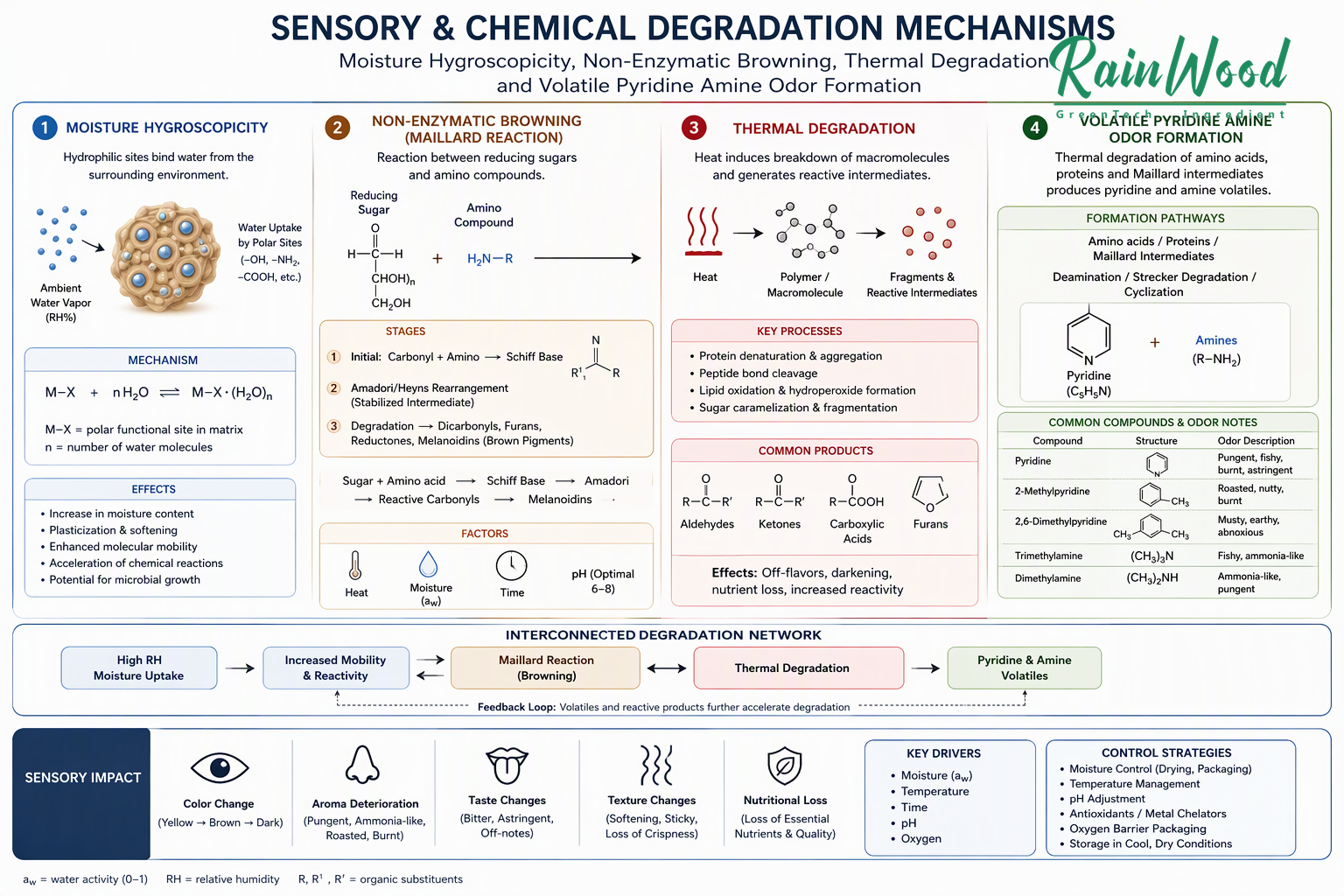
Degradation mechanism chart detailing moisture hygroscopicity, non-enzymatic browning, and volatile odor formation.
The loss when buyers rely on color alone
For a supplement brand, an unexplained change can become a launch delay, a customer complaint, or a costly rework. If the brand releases a darker or odorous lot without investigation, consumers may interpret it as degradation or contamination. If the brand rejects a lot that only looks different because of sampling or lighting, it may pay for emergency replacement, lose production time, and miss a sales window.
The hidden loss is data quality. Once a brand makes a release decision based only on appearance, it may not know whether the real cause was moisture, packaging, a blend interaction, or a different raw-material form. The same failure can then repeat in the next shipment.
A buyer verification sequence that works
Start with a retained-sample comparison. The supplier should provide a sealed reference from the approved lot, and the buyer should compare it with the production sample under the same lighting and sample depth. Photograph both samples with the lot numbers visible. Do not compare a fresh sample with a sample that has already been opened for weeks.
Next, review package integrity. Check liner seals, desiccant condition, vacuum or nitrogen claims if applicable, evidence of condensation, and the time between receipt and opening. A damaged liner can explain moisture-driven changes even when the outer drum looks intact. If the material moved through a humid port or warehouse, the logistics record is part of the quality investigation.
Then test the attributes that connect the observation to a mechanism. Water content or loss on drying helps evaluate moisture exposure. Assay alone is insufficient; identity confirmation and a related-substances or degradation profile are needed if the concern is chemical change. If odor is the issue, the laboratory should use an agreed sensory procedure and, where justified, an analytical screen suited to volatile or packaging-related contaminants. Microbiological testing may be relevant for the finished formulation or an exposed material, but it should not be treated as a substitute for chemical identity testing.
The sampling plan matters. NAD+ can be unevenly distributed after settling or caking. Take samples from multiple locations in a drum or from multiple finished units, and document the composite or individual-unit approach. A single scoop from the top is weak evidence for a commercial batch.
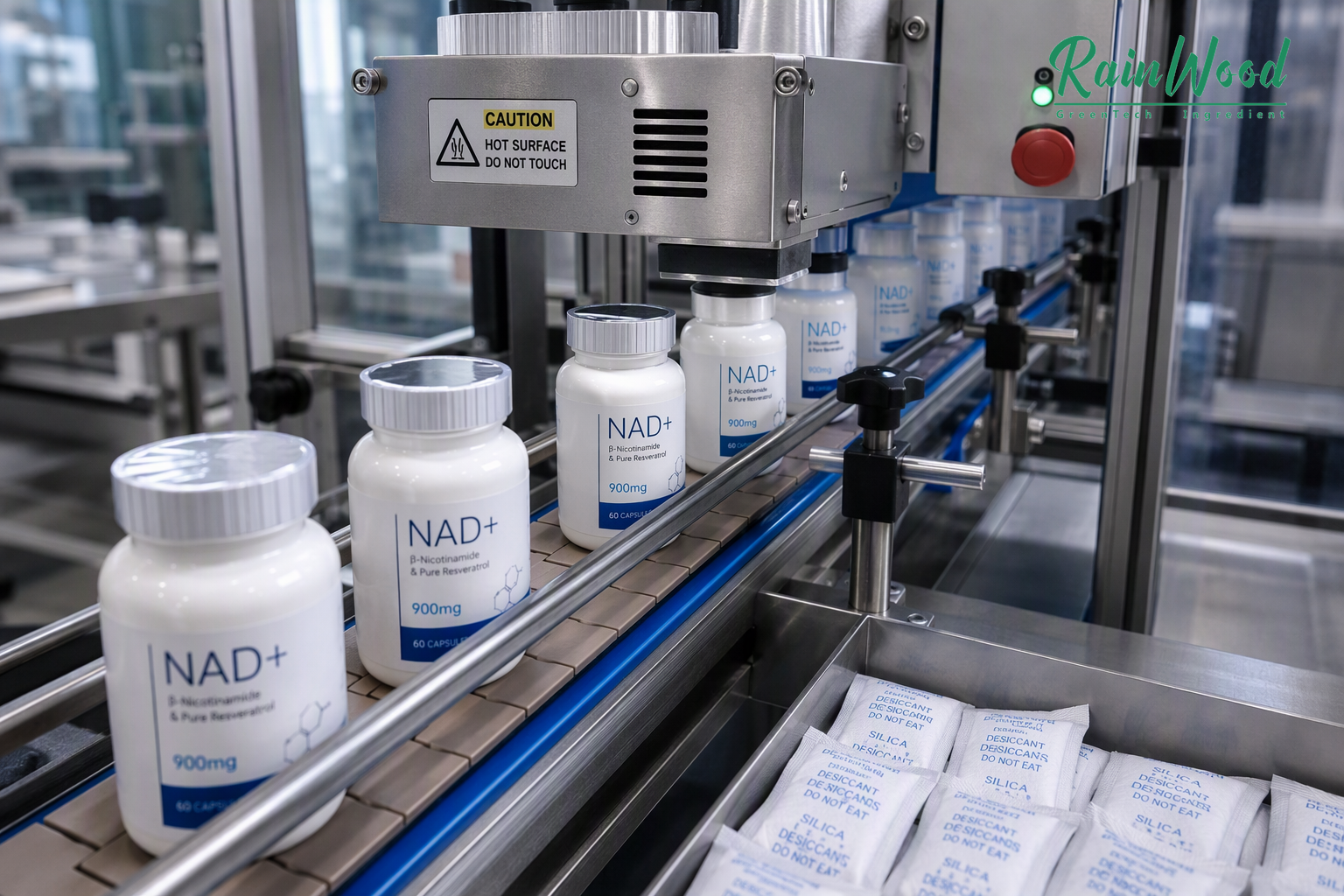
Hermetic induction foil sealing line applying multi-layer aluminum barrier liners to prevent humidity ingress.
How a supplier should control the risk
A reliable supplier defines appearance and odor with an approved reference, not with marketing language. The incoming-material procedure should record package condition, lot number, seal status, and storage instructions. The release package should connect the certificate of analysis to the exact lot and the agreed methods. When a sensory deviation occurs, the supplier should preserve the original sample, open a documented deviation, and explain the test plan before proposing a replacement.
For RainwoodBio, the relevant capability is not a generic promise of strict quality. Its public OEM process describes requirement confirmation, supplier and raw-material management, production-process control, testing and release, traceability, and warehousing/logistics coordination. Those controls are relevant when a brand needs one accountable process from NAD+ receipt through a finished capsule, tablet, powder, or sachet. The specific NAD+ product still needs product-level evidence: approved appearance standard, lot verified COA, analytical method, packaging specification, and stability data.
Raw NAD+ and finished products need different checks
An NAD+ raw material can change appearance because of its own chemistry or because of storage. A finished sachet can change because of the NAD+ plus the carrier, acidulant, flavor, flow aid, film, or laminate. The investigation must therefore test the raw material and the finished blend separately. A finished-product color shift does not prove that the NAD+ assay failed, and an acceptable raw-material verified COA does not prove that the final package is stable.
Use the appropriate product path through the NAD+ stability guide and compare the presentation options in the NAD+ format guide before you choose the package. If a buyer is still defining the specification, the NAD+ COA guide explains why identity, related substances, water, and method details should accompany the headline assay.
Questions to ask before accepting a changed lot
Ask for the approved color and odor reference, the exact lot history, the transport and storage conditions, the package-integrity inspection, the retained-sample comparison, and the proposed confirmatory tests. Ask whether the reported assay is on an as-is or dry basis. Ask whether the result is generated by a method validated or verified for NAD+ rather than a generic UV response. Ask for an explanation of any change in water, related substances, or pH-related behavior.
These questions turn a subjective complaint into a release decision that can be defended to a retailer, auditor, or customer. They also help distinguish a manageable presentation issue from a real material-risk issue.
Frequently asked questions
Does darker NAD+ always mean degradation?
No. Lighting, sample depth, moisture, particle size, and formulation context can change perceived color. A chemical conclusion requires identity, assay, related-substances, and relevant stability evidence.
Can a verified COA prove the odor is harmless?
Usually not. A routine COA may not include a volatile screen, packaging-extractables assessment, or a documented sensory method. The test plan must match the suspected cause.
What should a buyer photograph?
Photograph the outer package, liner and seal, lot label, sample container, and side-by-side reference under consistent lighting. Images support the investigation but do not replace testing.
Should a brand automatically reject the lot?
Hold the lot while investigating. Automatic rejection without a cause can create unnecessary cost; automatic release without evidence can create a larger recall or complaint risk.
Conclusion
Color and odor are useful warning signals, not stand-alone specifications. A professional NAD+ buyer links the observation to packaging, moisture, chemistry, sampling, and finished-product context. That is how a brand protects release decisions and avoids paying twice for the same preventable uncertainty. If you need a lot-specific review, send the proposed specification, package format, and verified COA through the contact form for an NAD+ stability and release discussion.
Disclaimer: This article is for procurement and formulation information. It is not medical advice, and it does not establish that NAD+ treats, prevents, or cures any disease.
References
- https://pubmed.ncbi.nlm.nih.gov/34041853/
- https://pubmed.ncbi.nlm.nih.gov/41655607/
- https://www.fda.gov/food/dietary-supplements-guidance-documents-regulatory-information/dietary-supplement-labeling-guide
Looking for Reliable NAD+ or Coenzyme Ingredient Supply?
Rainwood Bio delivers verified HPLC-grade NAD+, Liposomal NMN, and NR raw materials supported by full identity testing, moisture control, and cGMP finished-dosage manufacturing.
Table of Contents
- A visual change is not a diagnosis
- What can change the appearance of NAD+
- The loss when buyers rely on color alone
- A buyer verification sequence that works
- How a supplier should control the risk
- Raw NAD+ and finished products need different checks
- Questions to ask before accepting a changed lot
- Frequently asked questions
- Conclusion
- References