 EN
A practical supplier-qualification checklist for private-label NAD+ brands covering identity, testing, stability, OEM control, documentation, and commercial risk.
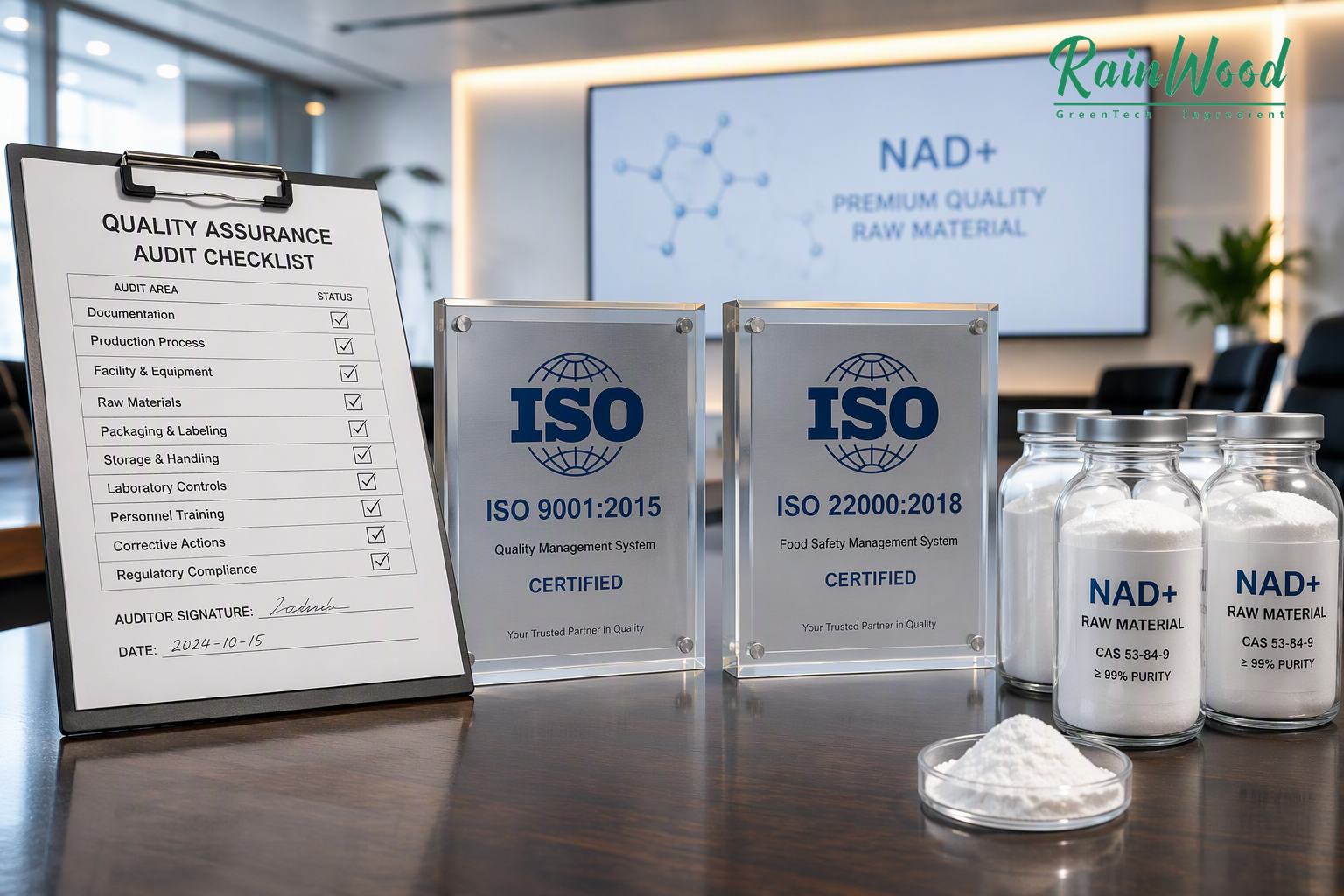
Quality assurance audit binder and ISO certification documentation for dietary supplement raw material vetting.
A supplier is qualified only when the evidence fits your product
Private-label brands often qualify an NAD+ supplier through a sample, a factory presentation, and a competitive quote. Those are useful first steps, but they do not answer the questions that determine whether the product can be launched, repeated, and defended. Supplier qualification should show that the partner can control the exact NAD+ form, the selected dosage format, the target market, the finished-product specification, and the documentation needed when something changes.
The checklist below is designed for a buyer who wants fewer surprises after the purchase order. It is not a scorecard based on logos. It is a sequence of questions that connects chemistry, manufacturing, evidence, and commercial accountability.
1. Confirm the exact identity before discussing price
Ask the supplier to name the substance and form in writing. Confirm whether it is direct NAD+, NADH, NR, NMN, or a blend. If it is a salt, record the counterion and how assay is calculated. If the quote says only “NAD+ powder,” the qualification process has not started.
Request an identity method that is appropriate to the material and capable of distinguishing likely related substances. Ask for the reference standard, sample preparation, and lot link. The NAD+ identity guide explains why related products cannot be compared by marketing category alone.
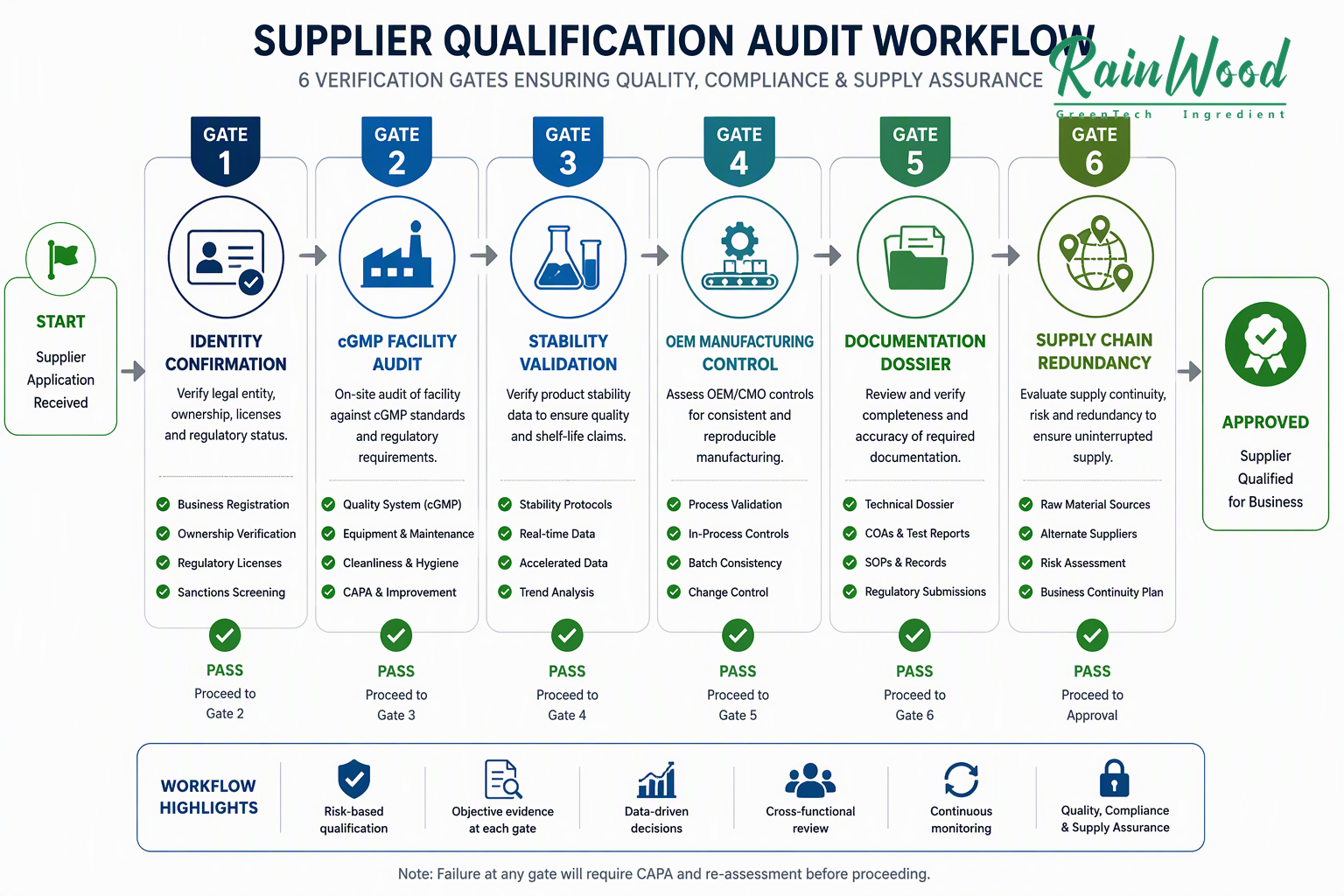
Six-stage supplier qualification audit flowchart covering testing, stability, OEM control, and supply redundancy.
2. Review the specification and verified COA as a connected set
The specification should include identity, assay basis, related substances, water, residual solvents or metals where relevant, microbiological attributes where relevant, appearance, storage, and shelf life. The COA should identify the lot, manufacturing or test date, methods, results, and acceptance criteria. A “98%” line without basis or method is not a complete release decision.
Ask whether the assay is as-is or dry basis. Ask whether related substances are identified individually or reported as a total. Ask whether the method is stability-indicating. Compare the supplier document with your own incoming-release plan and the requirements of your destination market.
3. Verify the sample-to-bulk bridge
Request enough sample for identity confirmation, pilot manufacturing, stability retention, and a sealed reference. Document the sample form, package, lot, date, and storage. Before bulk shipment, request a pre-shipment sample from the actual commercial lot. At receipt, sample across packages and compare against the approved sample, not only the supplier's verified COA.
Ask what happens if commercial bulk differs in color, water, flow, assay, or related substances. The NAD+ sample to bulk guide describes how scale, drying, packaging, and sampling can create drift even when a sample was genuinely good.

On-site quality inspector auditing climate-controlled raw material warehouse and quarantine zones in cGMP facility.
4. Test the supplier's stability logic
Ask for storage conditions, package barrier information, opening instructions, retest or expiry basis, and stability data. Find out whether the data are for the same NAD+ form, package, and dosage format you plan to sell. A raw-powder study cannot automatically establish the shelf life of a flavored sachet or a capsule bottle.
The NAD+ stability guide helps structure this review. Ask how moisture, light, temperature, pH environment, and oxygen exposure are controlled. If the supplier recommends refrigeration, clarify the transport and warehouse plan and what happens after opening.
5. Audit the manufacturing and traceability path
Request the manufacturing site, raw-material qualification process, change-control procedure, deviation and complaint process, batch-record approach, and traceability from incoming material to finished units. Confirm how rejected or reworked material is segregated. Ask how subcontractors are controlled and how a change in raw-material source is communicated.
RainwoodBio publicly describes requirement confirmation, supplier management, process control, testing and release, traceability, and warehousing/logistics coordination. These are relevant controls for private-label programs. The buyer should still verify the product-specific evidence and confirm the scope and current validity of any certificate or audit claim.
6. Match the supplier to the final format
For capsules, check fill-weight control, blend uniformity, capsule-shell compatibility, and moisture exposure. For tablets, check compression, friability, disintegration, and heat or pressure effects. For sachets, check flow, dusting, seal integrity, laminate barrier, and unit-dose uniformity. For powder drinks, check dissolution or dispersion, flavor compatibility, moisture after opening, and consumer instructions.
The NAD+ format guide explains why a capable raw-material supplier is not automatically a capable finished-product partner. Request a pilot run in the intended format before approving the commercial design.
7. Review the market and claim file
Confirm the target countries, product category, label language, responsible entity, warning statements, lot coding, and claims. Ask who reviews the label and how changes are controlled. Confirm that direct NAD+ is not being represented as a precursor or supported by evidence from a different molecule. The supplier can provide technical information, but the brand remains responsible for its market-facing claims and legal review.
Use the NAD+ market dossier guide to build a document index that covers the raw material, finished product, package, stability, and market requirements.
8. Qualify commercial accountability
The purchase order should state the agreed specification, sample approval, lot-release documents, packaging, shelf life at shipment, storage, lead time, inspection rights, nonconformance handling, and change notification. Clarify whether testing, translation, label review support, and stability work are included or quoted separately.
Ask how the supplier handles a complaint that appears six months after delivery. A professional answer includes retained samples, traceability, an investigation workflow, and communication timing. A vague promise to “check with the factory” is not a qualification control.
A simple supplier decision rule
Approve only when the supplier can answer four questions with evidence: Is it the exact NAD+ product requested? Can the supplier reproduce it at scale? Can the finished product remain within specification through its intended shelf life? Can the brand obtain and defend the documents needed for its market and channel?
If one answer is no, classify the supplier as conditional or not yet qualified. Do not let a low price or attractive sample silently convert a gap into an approval.
Frequently asked questions
Is a factory audit enough to qualify an NAD+ supplier?
No. An audit reviews systems; product qualification also needs exact identity, lot evidence, methods, stability, format performance, and market documents.
Should every batch be independently tested?
The testing frequency should reflect risk, history, contract terms, and market requirements. New suppliers or unexplained variation justify stronger confirmation.
What is the most overlooked qualification item?
Often it is change control: the buyer does not know how a source, process, method, package, or site change will be communicated and assessed.
Can RainwoodBio provide a ready-made NAD+ dossier?
Ask for the exact product and market scope. Public capability information is useful context, but the dossier must be built from product-specific and lot-specific evidence.
Conclusion
The best NAD+ supplier is not the one with the loudest claim. It is the one that can connect identity, testing, stability, manufacturing, format, documentation, and accountability into one repeatable process. If you want to run this checklist against a proposed NAD+ project, send the formula, target market, and format through the contact form for a qualification review.
Disclaimer: This checklist is for commercial and procurement planning. It is not legal, regulatory, or medical advice and does not establish that NAD+ treats, prevents, or cures disease.
References
- https://pubmed.ncbi.nlm.nih.gov/41655607/
- https://www.jhfc.or.jp/en/downloads/nad-testing
- https://www.fda.gov/food/dietary-supplements-guidance-documents-regulatory-information/dietary-supplement-labeling-guide
Looking for Reliable NAD+ or Coenzyme Ingredient Supply?
Rainwood Bio delivers verified HPLC-grade NAD+, Liposomal NMN, and NR raw materials supported by full identity testing, moisture control, and cGMP finished-dosage manufacturing.
Table of Contents
- A supplier is qualified only when the evidence fits your product
- 1. Confirm the exact identity before discussing price
- 2. Review the specification and verified COA as a connected set
- 3. Verify the sample-to-bulk bridge
- 4. Test the supplier's stability logic
- 5. Audit the manufacturing and traceability path
- 6. Match the supplier to the final format
- 7. Review the market and claim file
- 8. Qualify commercial accountability
- A simple supplier decision rule
- Frequently asked questions
- Conclusion
- References