 EN
Learn why a good NAD+ sample may not predict the bulk lot and how to control sampling, scale-up, testing, packaging, and stability before purchase.
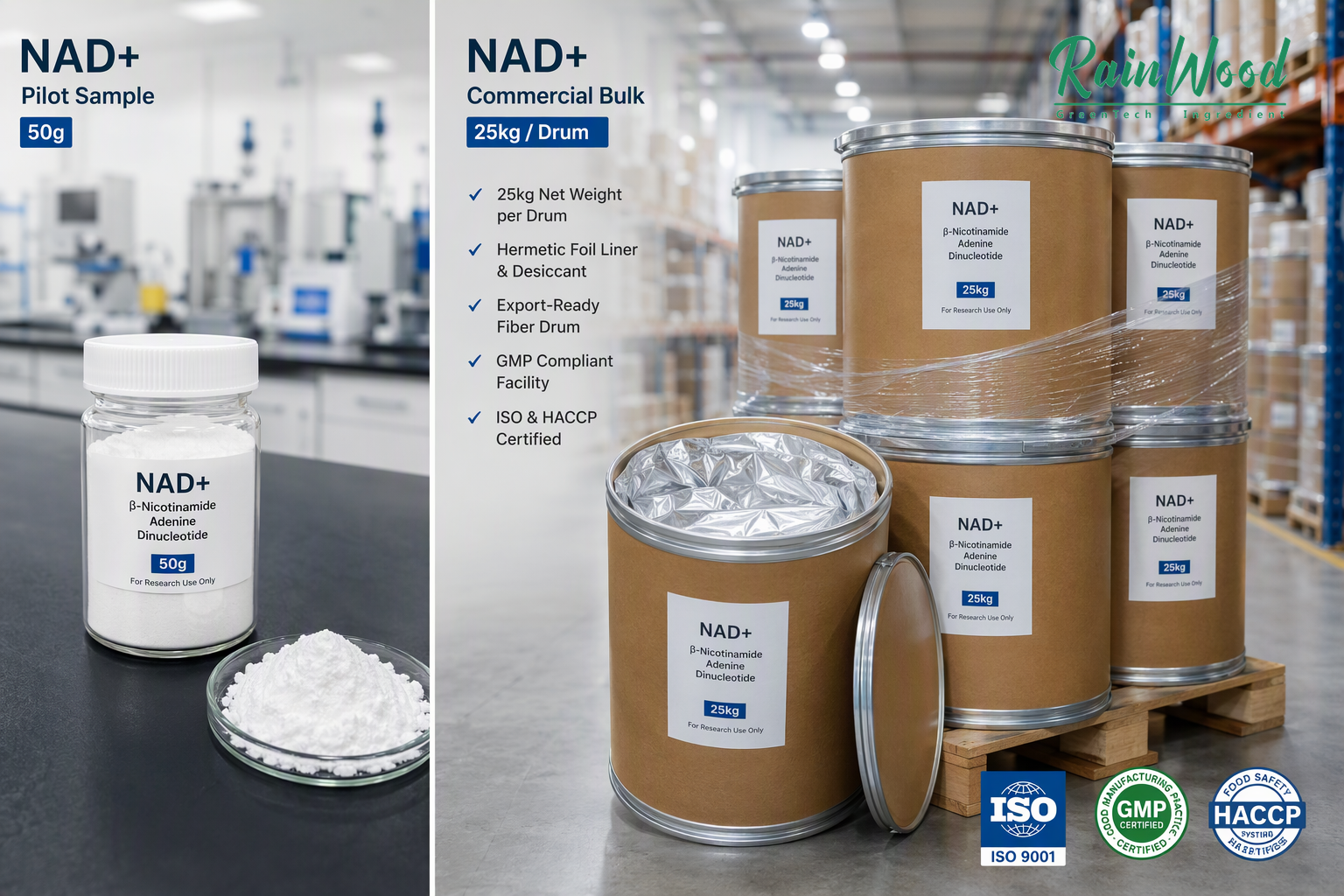
R&D qualification comparison: 50g pilot evaluation sample versus 25kg commercial export drum packaging.
The sample is a promise, not the shipment
Many NAD+ projects begin with a convincing sample. The powder looks clean, the verified COA shows an attractive assay, the supplier answers quickly, and the pilot formula performs well. Then the commercial lot arrives with a different flow, color, odor, water result, or assay. The brand is left asking whether the sample was misleading or whether the bulk lot simply changed during manufacture and transport.
The answer is often more complicated. A sample can be genuinely good and still fail to predict bulk because the sample size, sampling point, drying history, packaging, or test method is different. The procurement task is not to distrust every sample. It is to design a bridge between sample approval and commercial release so that the approved characteristics remain visible at scale.
Why NAD+ scale-up can change the result
Scale changes heat transfer, mixing time, drying profile, milling, and exposure to air and moisture. A small laboratory batch may dry evenly, while a larger batch develops zones with different residual moisture. A pilot sample may be taken from the best-looking part of a lot. A commercial drum may contain normal variation that the sample did not capture.
Packaging changes too. A small foil pouch with a desiccant provides a different barrier from a large liner inside a fiber drum. The headspace, seal area, time in transit, and number of package openings all influence exposure. A sample used immediately after production is not equivalent to bulk material held for months before filling.
Testing can create another false sense of continuity. One laboratory may report a UV-based assay, while the buyer's laboratory uses a chromatographic method that separates NAD+ from related substances. Results can differ without either laboratory making an obvious error. Unless the method, reference standard, basis, and sample preparation are agreed, “the sample was 99%” does not define the commercial quality target.
The identity issue is especially important. Direct NAD+ should not be substituted with NR or NMN because the market conversation treats them as related. Use NAD+ identity guide to define the chemical target before comparing sample and bulk results.
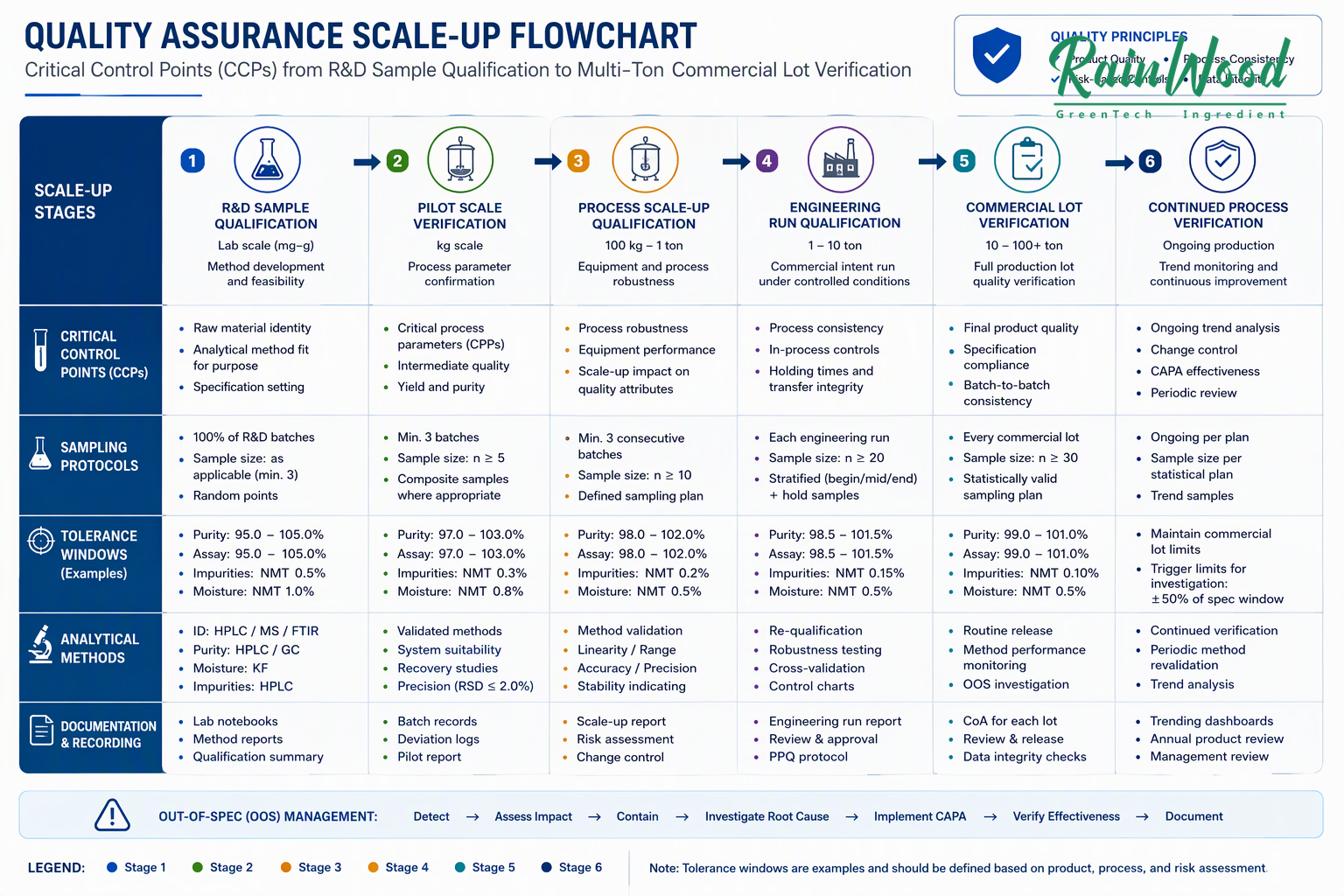
Critical Control Point (CCP) scale-up workflow mapping specification tolerances from pilot validation to commercial bulk release.
The buyer loss from sample-to-bulk drift
The immediate loss may be a rejected shipment or a delayed production run. The larger loss is trust in the product specification. If the brand launches from sample data and then discovers bulk variation, it may need to revise the label, repeat stability work, explain a color difference to retailers, or absorb expedited freight for replacement material. An unplanned change can also undermine future forecasting because the buyer no longer knows which attributes are reproducible.
Private-label brands face an additional risk: the sample may have been made specifically for the sales conversation, while the commercial lot is sourced or processed through a different route. The only protection is a documented equivalence plan tied to the approved specification.
Build a sample approval protocol
The approval document should identify the supplier, manufacturing site if known, product code, NAD+ form, lot number, sample date, package type, quantity, test methods, and acceptance criteria. Record sensory observations using photographs and an approved reference. Record water, assay, identity, related substances, bulk density, particle-size or flow information if the final format depends on it.
Ask for enough sample to perform confirmation testing, pilot production, and retention. A few grams may be enough for a visual review but not for a meaningful blend trial and stability check. If the supplier cannot provide sufficient sample, the limitation should be recorded rather than silently ignored.
The sample approval should also state what may change at scale. If the sample is lyophilized but the commercial material is spray-dried, that is not an equivalent sample. If the sample uses a laboratory packaging format and the bulk uses a different liner, the package risk must be assessed. If a specification is “typical” rather than a release limit, do not treat it as a guaranteed commercial attribute.
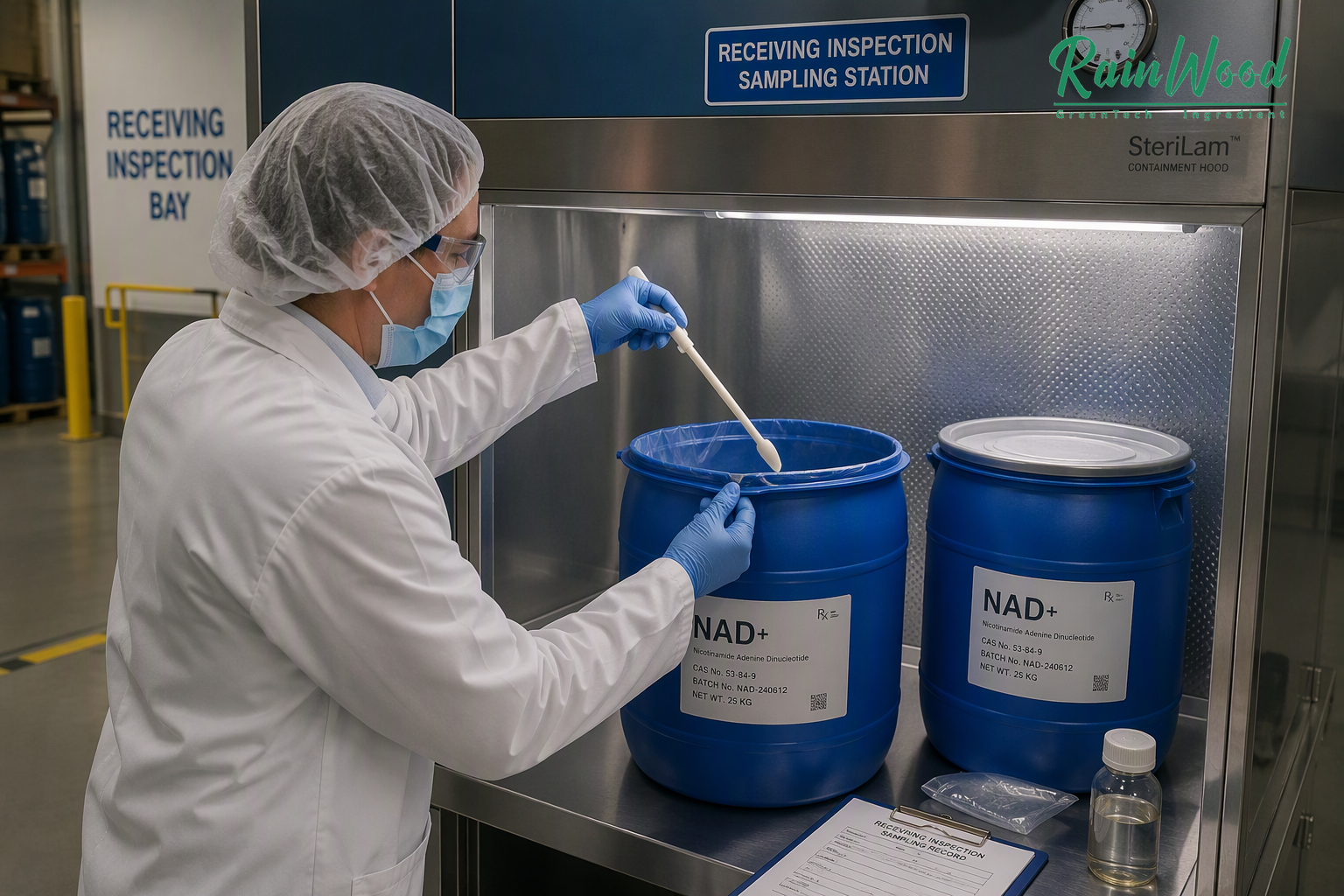
Warehouse raw material receiving inspection using sterile composite sampling protocols under laminar flow.
Use a first-article or pre-shipment control
Before the full commercial shipment, request a pre-shipment or first-article sample from the actual lot. The sample should be collected under a documented plan, sealed, and tested against the approved specification. For a high-value NAD+ ingredient, consider independent confirmation of identity, assay, related substances, and water before authorizing shipment or production.
At receipt, inspect every package for damage, moisture, and seal condition. Sample across locations and containers rather than taking one top scoop. Compare the result with both the approved sample and the supplier's verified COA. If there is a meaningful difference, place the lot on hold and open a deviation before blending.
The contract or purchase order should define what happens if the commercial lot fails equivalence: replacement, credit, rework, additional testing, or a mutually agreed investigation. This is not hostile procurement. It is a way to avoid arguing about quality after the material is already on a production line.
Match the test to the risk
For identity, request a method that distinguishes NAD+ from structurally related substances and matrix interference. For assay, define whether the result is as-is or dry basis and identify the reference standard. For degradation, control related substances and include a stability-indicating approach where possible. For storage, measure water and review package barrier data. For the finished product, test unit-dose uniformity and the attributes that matter to the intended format.
The NAD+ verified COA guide explains why an attractive purity number is not the whole specification. The NAD+ stability guide explains how to connect the test plan to moisture, light, temperature, and package exposure. These are different control questions and should not be collapsed into one “pass” line.
How RainwoodBio can support the bridge
RainwoodBio publicly describes requirement confirmation, raw-material supplier management, process control, testing and release, and traceability through warehousing and logistics. For a brand moving from sample to OEM production, those controls are relevant because they create a place to document the approved specification, lot review, production record, and finished-product release. The buyer should still request the specific NAD+ evidence: sample-to-bulk equivalence results, product form, test methods, packaging configuration, and stability plan.
Do not ask only, “Can you make the same sample?” Ask, “How will you prove the commercial lot remains within the agreed identity, assay, related-substances, water, and presentation limits?” That question reveals whether the supplier has a repeatable system or only a persuasive sample.
A practical acceptance table
Define three levels before the project starts. “Must match” attributes include chemical form, identity, assay basis, and safety limits. “Must remain within range” attributes include water, bulk density, particle size, color, and odor when they influence production. “May vary with explanation” attributes include non-critical flow or visual differences that do not affect quality but still need documentation.
This approach prevents endless arguments about harmless variation while protecting the attributes that affect label accuracy, stability, and customer perception. It also gives the factory a clear target for process control.
Frequently asked questions
Is third-party testing required for every shipment?
Not necessarily. The frequency should reflect risk, supplier history, contract terms, and market requirements. New suppliers, new forms, and unexplained variation justify stronger confirmation.
Can the supplier's verified COA prove the sample and bulk are equivalent?
It supports the claim but does not prove it alone. Sampling, method comparability, and independent confirmation may be needed for critical attributes.
What if bulk is slightly darker but still passes assay?
Hold and investigate. Color can be benign or can signal moisture, degradation, or packaging interaction. Assay alone cannot answer the cause.
How much sample should a buyer request?
Enough for identity and quality confirmation, pilot production, stability retention, and a reference sample. The amount depends on the test panel and format.
Conclusion
A good NAD+ sample is valuable only when the supplier can reproduce it at commercial scale and show the evidence. Lock the form, method, package, sampling plan, and acceptance criteria before the purchase order. If you are moving from an approved sample to bulk NAD+ or an OEM finished product, use the contact form to request a sample-to-bulk equivalence review.
Disclaimer: This article is for procurement and quality-planning information. It is not medical advice and does not establish that NAD+ treats, prevents, or cures disease.
References
- https://pubmed.ncbi.nlm.nih.gov/34041853/
- https://pubmed.ncbi.nlm.nih.gov/41655607/
- https://www.jhfc.or.jp/en/downloads/nad-testing
Looking for Reliable NAD+ or Coenzyme Ingredient Supply?
Rainwood Bio delivers verified HPLC-grade NAD+, Liposomal NMN, and NR raw materials supported by full identity testing, moisture control, and cGMP finished-dosage manufacturing.
Table of Contents
- The sample is a promise, not the shipment
- Why NAD+ scale-up can change the result
- The buyer loss from sample-to-bulk drift
- Build a sample approval protocol
- Use a first-article or pre-shipment control
- Match the test to the risk
- How RainwoodBio can support the bridge
- A practical acceptance table
- Frequently asked questions
- Conclusion
- References