 EN
How buyers should distinguish research-grade and supplement-grade NAD+ by specification, documentation, manufacturing controls, and intended use.
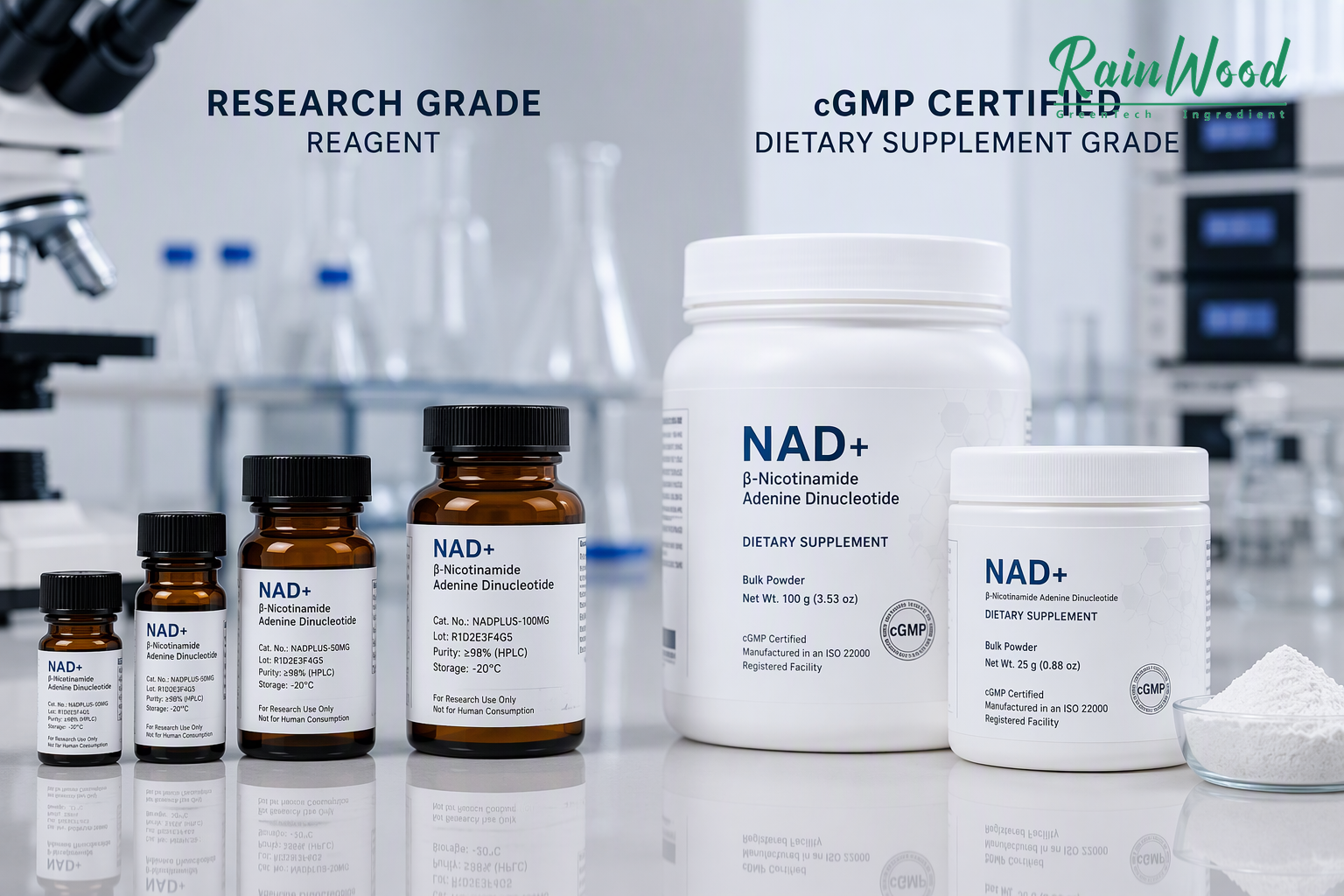
Laboratory inspection comparing chemical research grade vials against cGMP certified supplement grade bulk packaging.
“Grade” is not a complete quality specification
Research-grade and supplement-grade NAD+ are often treated as two simple price tiers. That shortcut creates confusion. “Research grade” may describe a material sold for laboratory work, while “supplement grade” may describe an ingredient intended for a regulated food or dietary-supplement supply chain. Neither phrase, by itself, tells a buyer the exact chemical form, identity method, impurity limits, manufacturing controls, package, or legal suitability for a finished product.
The right question is not which label sounds more advanced. It is whether the material and documentation match the intended use. A laboratory purchaser may prioritize traceability and a narrow analytical specification. A supplement brand needs those qualities plus food- or supplement-appropriate manufacturing, risk controls, shelf-life support, packaging, and a dossier that can be reviewed by its target market.
Do not use a research-grade label as a shortcut for human safety or market authorization. Do not use a supplement-grade label as proof that every identity and stability question has been answered. Request evidence against the actual specification.
What each intended use usually requires
For research use, a buyer may need a lot-specific certificate, purity, identity, storage, reconstitution information, and a method suitable for the experiment. The material may be supplied in a small vial, with a short recommended opening time or a research-only statement. That can be perfectly appropriate for the laboratory and still be unsuitable for a retail supplement.
For a supplement ingredient, the buyer needs a controlled supply route and documents that support incoming release, formulation, finished-product testing, and market review. The package may be a larger moisture-barrier container. The specification may include water, related substances, residual solvents, metals, microbiological attributes where relevant, and a defined shelf life. The manufacturing and quality system must be appropriate to the product category and jurisdiction.
These are not mutually exclusive worlds. A supplier can have strong analytical documentation and still need additional evidence for a supplement program. The buyer should map each requirement rather than infer it from a marketing word.
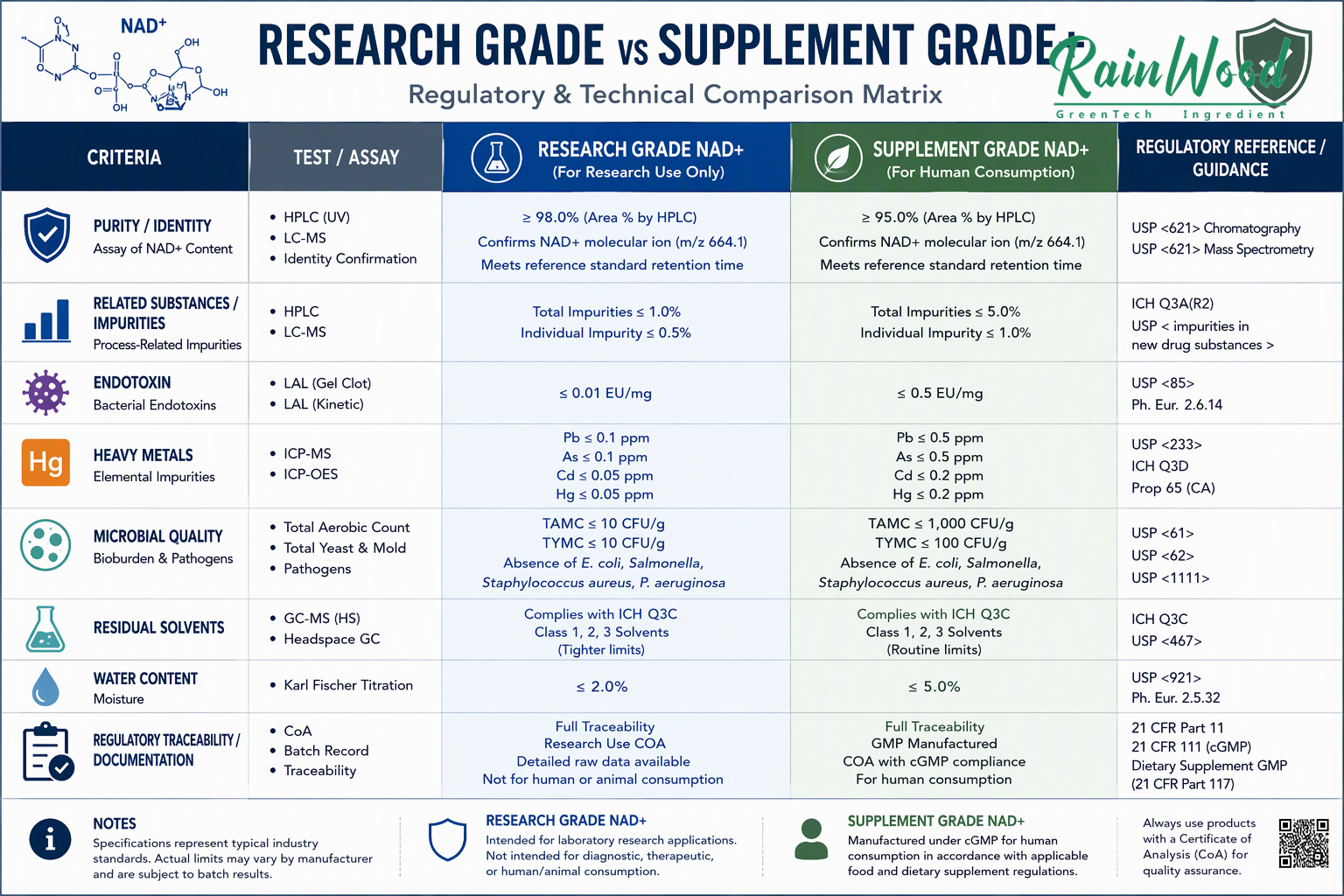
Comprehensive regulatory and testing matrix evaluating assay standards, endotoxins, heavy metals, and traceability.
The loss from choosing the wrong grade
If a brand buys research-labeled NAD+ for a consumer product, it may discover that the certificate says nothing about food-use controls, allergen management, microbial expectations, or regulatory documentation. The material can pass an assay and still fail the brand's quality or market-entry review. Replacing it after production planning can create a long delay.
If a research team pays a premium for a full supplement dossier it does not need, it may waste budget and accept a format that is inconvenient for its experiments. In both cases, the problem is not that one grade is “bad.” The problem is a mismatch between evidence and use.
Compare the evidence line by line
Start with identity. The document should name direct NAD+ and the exact form, not simply “NAD,” “NAD supplement,” or “NAD precursor.” It should state the reference standard and method used to confirm identity. If NADH, NR, NMN, or other related compounds are possible confounders, the method should address them.
Next examine assay and impurities. Is the assay on an as-is or dry basis? Are related substances listed individually or hidden in a total? Is the method suitable for stability monitoring? Does the COA link to the lot and manufacturing date? Are acceptance criteria defined or is the result only “typical”? The NAD+ COA guide provides a practical framework for this review.
Then evaluate manufacturing and handling. Ask where the material was made, how raw materials are qualified, how deviations are handled, and how package integrity is controlled. For a supplement program, request the documents needed for the target market and the final format. For a research program, request storage, reconstitution, and experiment-use instructions.
Finally examine stability. A small research vial opened once in a controlled lab is not the same exposure as a large ingredient drum opened repeatedly during commercial filling. The NAD+ stability guide explains why water, light, temperature, pH, and package design should be tied to the use case.
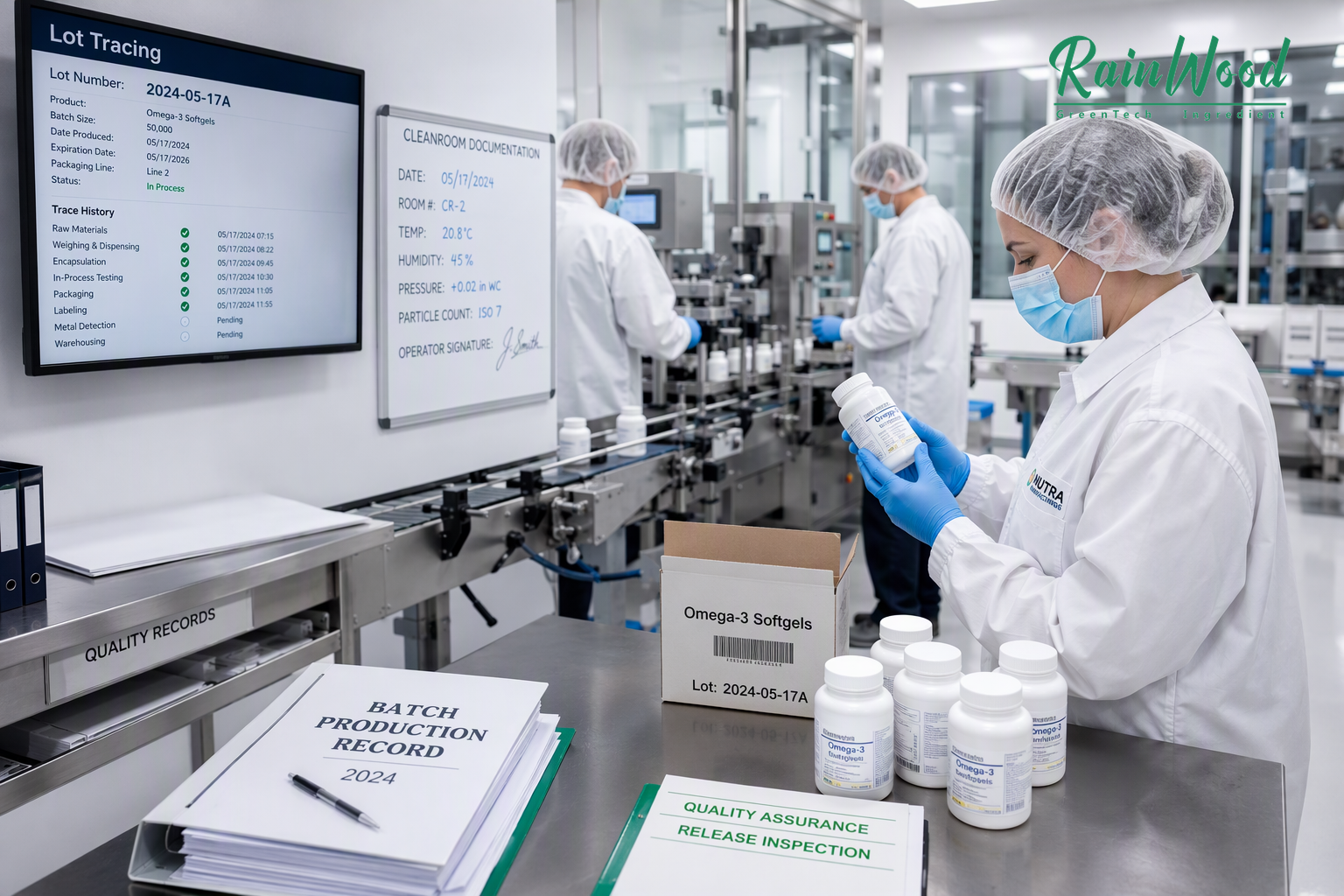
cGMP compliant cleanroom packaging line with automated lot tracing and strict release documentation.
Why the final format changes the grade decision
NAD+ destined for a capsule, tablet, or sachet has to perform in a manufacturing process. Flow, bulk density, dose uniformity, compression, dusting, moisture pickup, and package barrier can determine whether a high-purity material is commercially usable. A research vial does not have to meet those same process requirements.
The NAD+ format guide compares presentation choices. Ask whether the offered material was actually developed for the selected format or merely repacked from a laboratory container. If the brand wants a finished OEM product, the supplier should show how raw-material release, blending, filling, packaging, and finished-unit testing connect.
RainwoodBio capability versus product proof
RainwoodBio publicly presents requirement confirmation, supplier and raw-material management, process control, testing and release, traceability, and OEM formats such as capsules, tablets, powder drinks, softgels, powders, and sachets. Those capabilities are relevant to a supplement-grade project because they address the path from requirement to finished product. They do not automatically prove that a particular NAD+ material meets every market or batch requirement.
Request product-specific evidence: exact form, approved specification, lot verified COA, analytical methods, impurity and water limits, stability data, package configuration, and target-market documentation. Also confirm the scope and current validity of any certificate rather than relying on a logo or a generic “GMP” statement.
A useful decision matrix
Choose research-oriented supply when the material is only for controlled laboratory work and the documentation matches that purpose. Choose supplement-oriented supply when the ingredient will enter a food or dietary-supplement manufacturing chain and the supplier can support the required quality, traceability, packaging, and compliance dossier. If the project may move from research to commercialization, define the transition early so the pilot material does not create an avoidable specification gap.
Do not approve a grade until the intended country, product format, dose, and claim strategy are known. Those choices determine which documents matter.
Frequently asked questions
Is research grade purer than supplement grade?
Not automatically. The terms may reflect intended use and documentation rather than a universal purity ranking. Compare the actual methods, limits, and lot evidence.
Can research-grade NAD+ be used in a capsule?
Only after the material, manufacturing route, and market requirements have been separately assessed and documented. A research label is not a retail authorization.
Does supplement grade guarantee clinical effectiveness?
No. Grade describes quality and intended supply context, not proof of a health outcome.
What should appear on the purchase order?
Exact identity and form, assay basis, impurity and safety limits, methods, package, shelf life, storage, lot documentation, sampling, and acceptance/rejection terms.
Conclusion
The professional buyer compares evidence, not labels. Match the NAD+ grade to the intended use, final format, target market, and documentation burden. If you are deciding between research supply, raw-material supply, or an OEM finished product, use the contact form to request a fit-for-purpose NAD+ specification review.
Disclaimer: This article is for procurement, formulation, and documentation planning. It is not medical advice and does not establish that NAD+ treats, prevents, or cures disease.
References
- https://pubmed.ncbi.nlm.nih.gov/41655607/
- https://pubmed.ncbi.nlm.nih.gov/37068054/
- https://www.fda.gov/food/dietary-supplements-guidance-documents-regulatory-information/dietary-supplement-labeling-guide
Looking for Reliable NAD+ or Coenzyme Ingredient Supply?
Rainwood Bio delivers verified HPLC-grade NAD+, Liposomal NMN, and NR raw materials supported by full identity testing, moisture control, and cGMP finished-dosage manufacturing.
Table of Contents
- “Grade” is not a complete quality specification
- What each intended use usually requires
- The loss from choosing the wrong grade
- Compare the evidence line by line
- Why the final format changes the grade decision
- RainwoodBio capability versus product proof
- A useful decision matrix
- Frequently asked questions
- Conclusion
- References