 EN
A buyer-focused guide to comparing NAD+ quotes by usable quality, testing, stability, packaging, and total landed cost rather than price per kilogram.
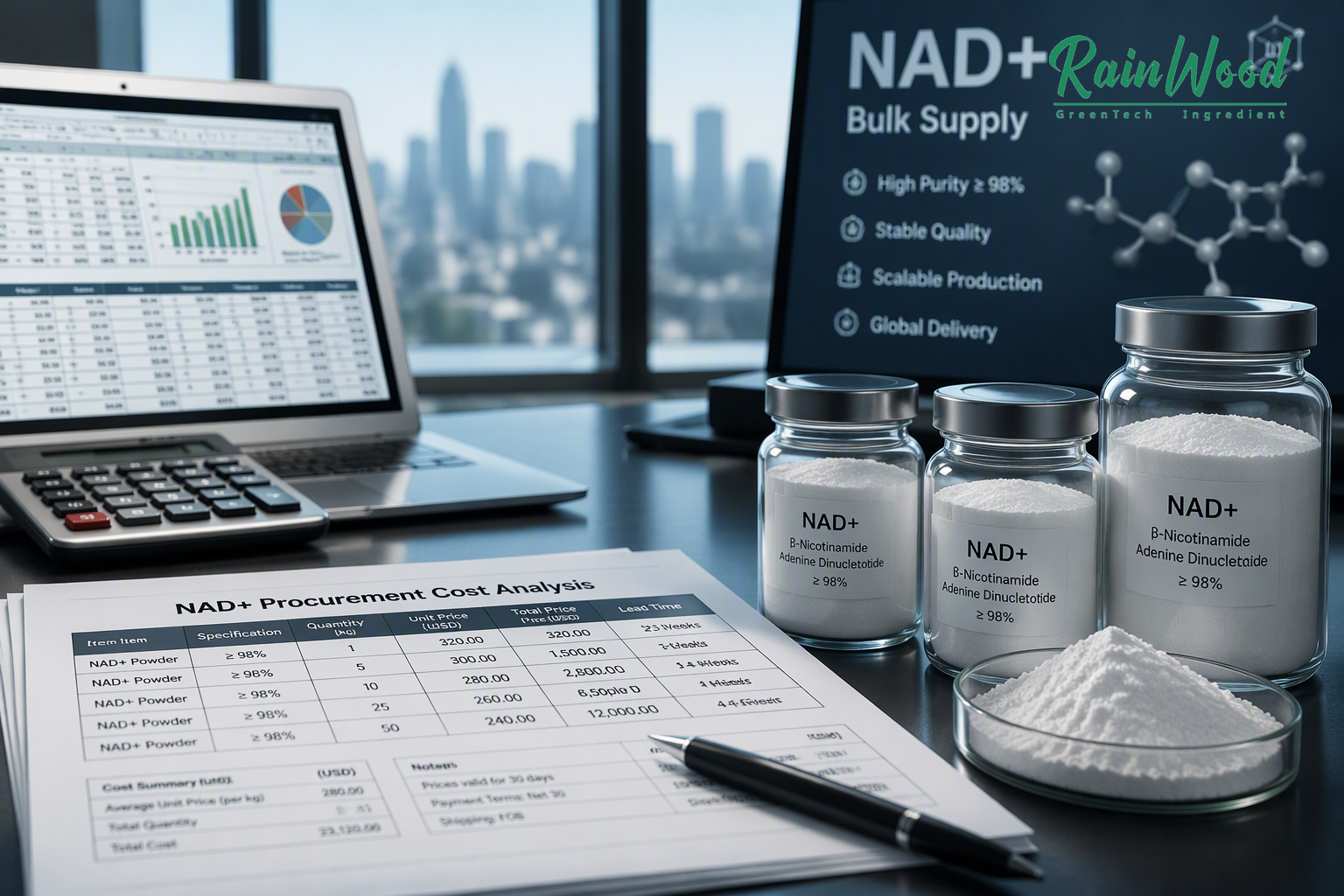
B2B procurement evaluation comparing initial kilogram quotation against total landed formulation cost.
The lowest quote is rarely the lowest cost
NAD+ is expensive enough that buyers naturally compare price per kilogram. That number is useful, but it is not a procurement decision. A low quote may reflect a different chemical form, a weaker test panel, a dry-basis calculation, a smaller declared dose, a short shelf-life assumption, or packaging that shifts the stability burden to the buyer. Two materials with the same product name can therefore produce very different usable costs.
The goal is not to reject low prices. The goal is to find out what the quote actually includes. A professional comparison turns “NAD+ 98%” into a complete commercial specification: identity, form, assay basis, related substances, water, microbiology where relevant, package, shelf life, storage, testing method, documentation, and replacement terms.
Where the apparent saving can disappear
The first gap is identity. Direct NAD+ is not the same as NR or NMN, even though they are often discussed together in the supplement market. If the quotation does not name the exact substance, the buyer cannot compare it with another offer. Use NAD+ identity guide before comparing prices.
The second gap is assay basis. An as-is assay includes water and other volatile content in the denominator; a dry-basis assay removes some of that effect. A quote that looks stronger may be using a different basis. The quotation should also state whether the result comes from a method that separates NAD+ from related materials or from a less specific response.
The third gap is stability. Material with a good initial assay may require low-moisture packaging, cold storage, rapid filling, or a shorter shelf life. If those controls are absent, the brand may pay for extra testing, replacement stock, or a failed stability study. The NAD+ stability guide shows why moisture, light, temperature, and pH belong in the price comparison.
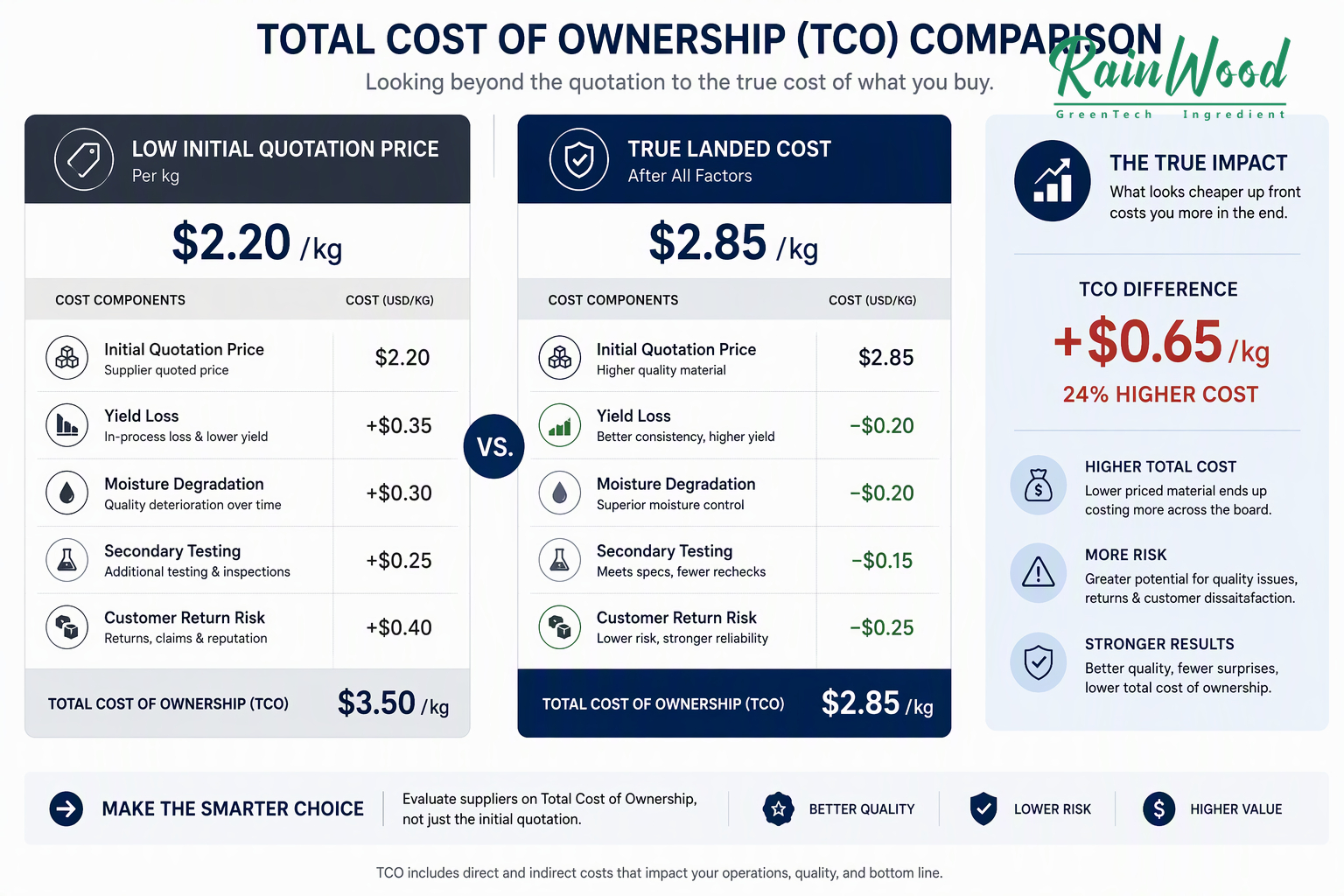
Total Cost of Ownership (TCO) breakdown detailing yield loss, moisture degradation, and secondary testing expenses.
The commercial loss of buying only by price
The direct loss is obvious: a cheap lot can be rejected, reworked, or scrapped. The indirect loss is larger. Production can stop while the quality team investigates. A launch can miss a retailer deadline. A brand can pay premium freight for replacement material. Finished units may require relabeling if the input form or declared amount does not match the approved dossier.
There is also a customer-acquisition cost. A brand that promotes a premium NAD+ product but cannot explain its identity, stability, or testing looks less professional when a buyer or retailer asks for documentation. Low input cost is not a competitive advantage if it weakens the evidence behind the product.
Compare quotes on a like-for-like basis
Create a quotation comparison sheet with the following lines: exact chemical name and form; assay and calculation basis; identity method; related-substances limits; water or loss-on-drying limit; residual solvents or metals where relevant; microbiological requirements; package size and barrier; shelf life; storage conditions; minimum order quantity; lead time; sample and pre-shipment policy; and documentation included.
Then calculate usable cost. Include testing, freight, import handling, storage, expected yield, rejected or reworked material, and the amount of input required to meet the finished-unit dose. If one supplier quotes a carrier-based CoQ10-style delivery form in a blend, for example, the active amount—not only the input weight—must drive the comparison. NAD+ quotes deserve the same discipline.
Ask whether the quote is for raw powder, a protected or stabilized preparation, or an OEM finished product. A lower raw-material quote may be more expensive than a higher quote that includes validated packaging, release testing, and a usable shelf-life window.
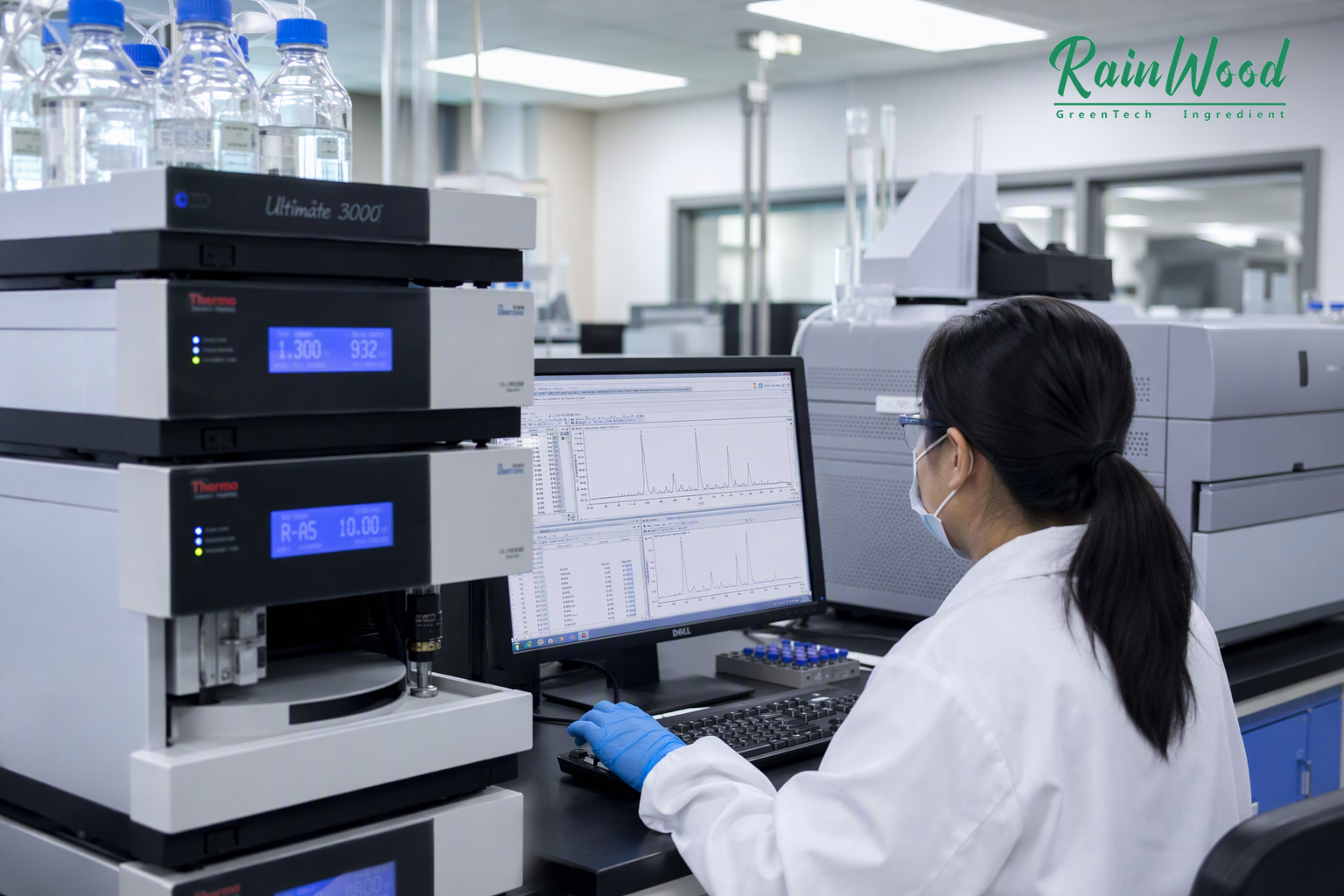
Advanced HPLC purity testing and related-substance profiling on incoming bulk raw material shipments.
Testing questions that expose weak quotes
Ask for a sample COA and identify every method. Does the identity method distinguish NAD+ from NADH, NR, NMN, or other related peaks? Is the assay stability-indicating? Are related substances reported individually or only as a total? Is water measured by a suitable method? Are results linked to the exact lot and reference standard? Does the laboratory report an as-is or dry basis?
Ask what is not included. Some quotes include only an assay and appearance. That may be acceptable for an early budget estimate, but it is not a release package. A supplier should be willing to separate indicative pricing from the final quality specification so the buyer knows what still needs to be purchased or verified.
A certificate is evidence, not a substitute for method review. Public COA examples from specialist chemical suppliers show how the reported method, lot, and specification can be documented, but a buyer must still confirm that the method and limits fit the intended supplement product and jurisdiction.
Package and logistics are part of the quote
Request the liner material, seal configuration, desiccant or oxygen-control approach if used, package unit, headspace expectations, and storage instructions. Ask how long the material can remain open during production and whether the supplier has data after transport. A package that protects a small sample may not protect a commercial drum.
For finished products, compare bottle, blister, sachet, and powder formats using the NAD+ format guide. A sachet may improve unit-dose control but require stronger moisture-barrier film and seal validation. A bottle may need a desiccant and a clear opening-use instruction. A low raw-material quote does not settle these format costs.
The RainwoodBio conversation should be evidence-based
RainwoodBio publicly describes requirement confirmation, supplier management, GMP/process control, testing and release, and traceability through warehousing and logistics. Those are the controls a buyer needs when comparing total cost rather than a headline number. The brand should request product-specific proof for NAD+: the exact form, lot verified COA, analytical methods, stability data, proposed package, and release criteria. Public capability information does not by itself prove a particular NAD+ lot.
Use the supplier conversation to ask for a quote that separates raw material, testing, packaging, OEM processing, and documentation. This makes it easier to compare suppliers honestly and identifies where the commercial risk is being placed.
A simple quote red-flag list
Be cautious when a quote names only “NAD+ powder” without form or identity method; reports “98%” without basis; promises a long shelf life without package or stability evidence; offers a verified COA with no lot number; cannot describe sampling; changes the quoted form after sample approval; or refuses to state what is included in testing and documentation.
None of these points proves fraud. They show that the buyer does not yet have enough information to compare offers. The correct response is clarification and evidence, not an accusation.
Frequently asked questions
Is a lower price always a quality warning?
No. A supplier may have scale, efficient logistics, or a different commercial model. The warning is an unexplained difference in specification, testing, form, or usable shelf life.
Should the buyer ask for a third-party verified COA?
Third-party confirmation can be valuable, especially for a new supplier or high-value lot. The method still needs to match the material and decision being made.
What is the most important line in a quote?
There is no single line. Exact identity and form come first, followed by assay basis, impurities, package, shelf life, and the testing/documentation included.
Can a low quote be used for a pilot?
Yes, if it is clearly labeled as an indicative or pilot quotation and the commercial release requirements are defined before scale-up.
Conclusion
Compare NAD+ quotes by usable quality and total landed cost, not by the biggest discount. A professional supplier should make the chemical form, testing, stability, package, and accountability visible. If you have two competing NAD+ quotations, send them with the target format through the contact form for a like-for-like specification and cost review.
Disclaimer: This article is for commercial and procurement information. It is not medical advice and does not establish that NAD+ treats, prevents, or cures disease.
References
- https://pubmed.ncbi.nlm.nih.gov/41655607/
- https://www.jhfc.or.jp/en/downloads/nad-testing
- https://cdn.caymanchem.com/cdn/downloadCofa/Cayman-CofA-16077-0803651.pdf
- https://goldbio.com/documents/2727/N-030-COA_Sample.pdf
Looking for Reliable NAD+ or Coenzyme Ingredient Supply?
Rainwood Bio delivers verified HPLC-grade NAD+, Liposomal NMN, and NR raw materials supported by full identity testing, moisture control, and cGMP finished-dosage manufacturing.
Table of Contents
- The lowest quote is rarely the lowest cost
- Where the apparent saving can disappear
- The commercial loss of buying only by price
- Compare quotes on a like-for-like basis
- Testing questions that expose weak quotes
- Package and logistics are part of the quote
- The RainwoodBio conversation should be evidence-based
- A simple quote red-flag list
- Frequently asked questions
- Conclusion
- References