 EN

NAD+ dose, assay basis, powder density, and capsule size can change the monthly cost dramatically. Use this framework before setting the bottle size.
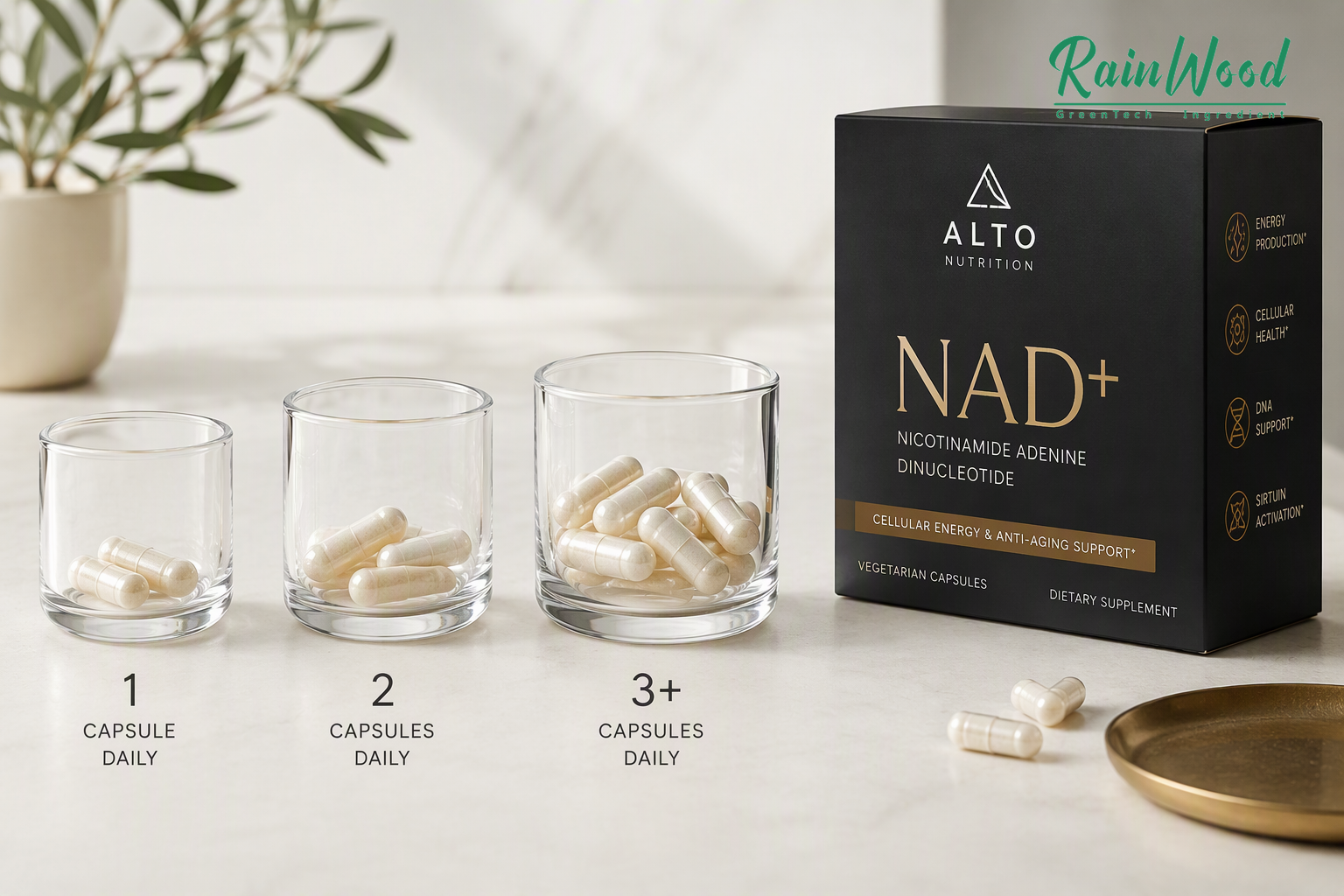
Finished supplement dosing study evaluating daily capsule unit count and consumer routine ergonomics.
The formula sheet shows a small NAD+ number. Finance approves the raw-material quote. The capsule line calculates assay correction, density, excipient load, and fill weight. The “small” serving becomes four capsules daily and a bottle that lasts only fifteen days.
NAD+ dose design must start with the customer routine and finished format—not the kilogram price. A dose that works on paper may be inconvenient, expensive, or difficult to explain on the final label.
Calculate the complete daily serving
Use our NAD+ dose and capsule-cost calculator NAD+ powder product page to record:
- target NAD+ amount per day;
- assay and form basis;
- powder mass required;
- capsule or tablet fill weight;
- number of units per serving;
- carriers and other actives;
- days per bottle and monthly cost.
If the material is a salt, hydrate, or assay-corrected powder, confirm the conversion before you set the serving.
Read the NAD+ free-acid and salt-form guide NAD+ salt form guide before calculating active content.
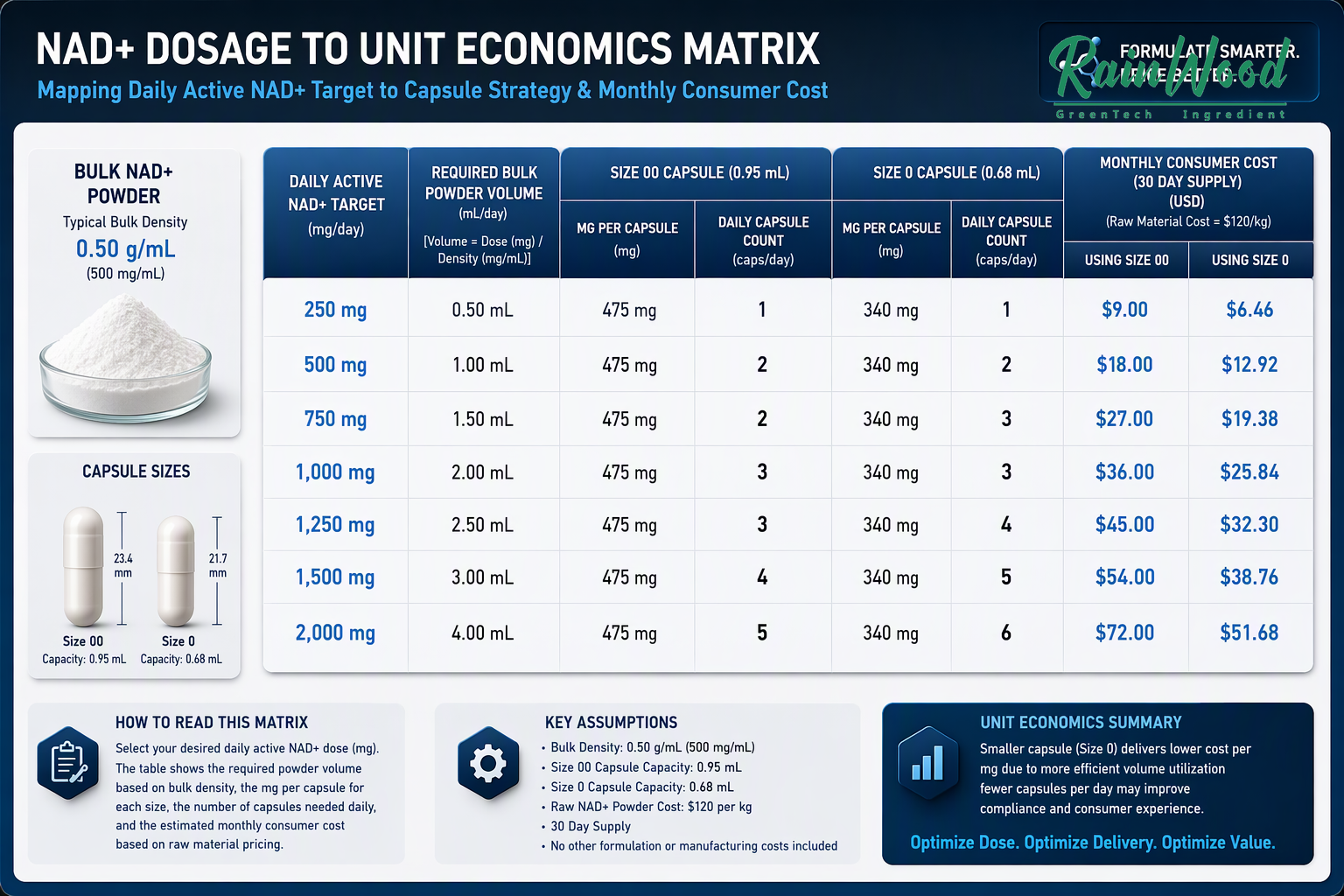
Formulation matrix mapping active NAD+ target to bulk density, capsule size (Size 00 vs 0), and monthly cost.
A dose statement is not a capsule statement
“NAD+ 500 mg” can mean per capsule, per serving, or per day. Put the amount and unit count together in every document. A customer should not need to infer whether one capsule or two delivers the declared amount.
| Label field | Required decision |
|---|---|
| Amount per unit | Assay-corrected NAD+ amount |
| Units per serving | Capsule, tablet, or sachet count |
| Servings per day | Primary directions |
| Total daily amount | Sum of actual directions |
| Bottle duration | Total units divided by daily count |
This also protects subscription timing and distributor comparisons.
Bulk density changes the formula economics
Two NAD+ powders with the same assay can have different density, particle size, moisture, and flow. One may fit a capsule while the other requires more excipient or a larger shell. A high-density grade may reduce volume only if uniformity and stability remain acceptable.
Request bulk-density and fill-weight data for the actual lot. Confirm whether the powder is intended for direct filling, granulation, or a carrier system.
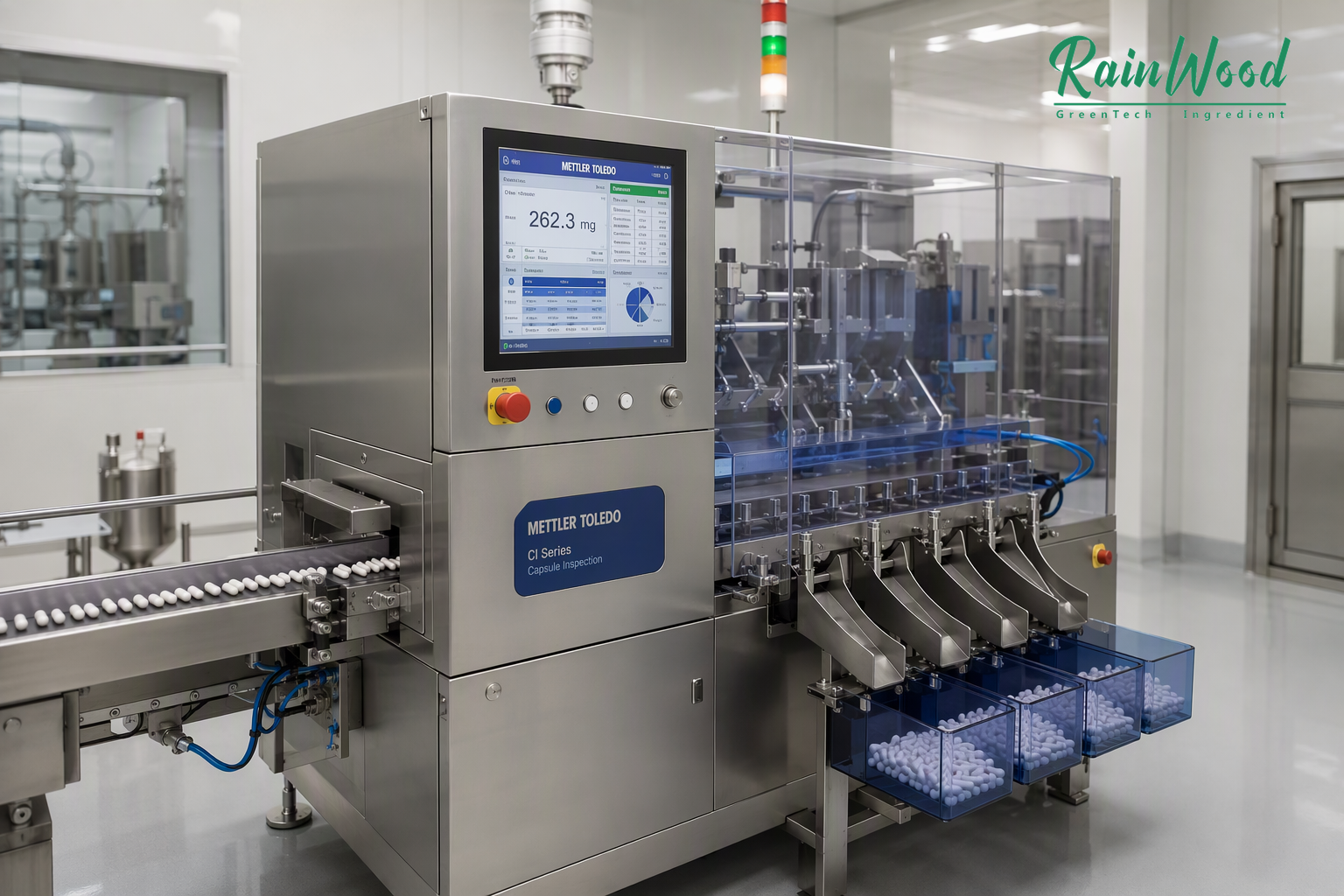
Automated high-speed capsule checkweigher inspecting 100% fill weight precision on the encapsulation line.
Companion ingredients consume the capsule budget
NAD+ products may include resveratrol, pterostilbene, CoQ10, vitamins, minerals, or botanical extracts. Each addition changes total mass, homogeneity, taste, and monthly cost. A long ingredient list can leave the core NAD+ amount unclear.
Use a daily active-mass table before the marketing name is chosen. Keep compound weight, active weight, and carrier weight separate.
Bottle economics include the days of supply
Calculate:
`monthly product cost = actives + excipients + capsules + filling + bottle + label + testing + freight + fulfillment`
Then divide by actual days of supply. A 60-capsule bottle is not automatically a thirty-day product. If the label requires four capsules daily, it lasts fifteen days.
Use the NAD+ format and package feasibility guide NAD+ format guide before selecting bottle count.
Evidence and dose must stay connected
Research may use a specific precursor, dose, route, and duration. Do not imply that any lower commercial dose has the same evidence, and do not present a precursor study as direct NAD+ proof. Keep research discussion separate from consumer directions.
How RainwoodBio can turn dose math into a viable product
RainwoodBio publicly describes formula development, capsules, tablets, powders, testing and release, custom samples, packaging, and logistics. For NAD+, the relevant value is checking active mass, fill weight, unit count, cost, and finished-product documentation before artwork approval.
Confirm the exact assay basis, density, equipment, unit count, pilot data, and batch evidence available for your project. Public format capability does not replace a dose and cost calculation.
Build a dose scenario before choosing the bottle
Create at least three scenarios: a compact capsule, a premium higher-dose format, and a sachet or powder format. For each, calculate active NAD+ per serving, input material required after assay adjustment, carrier and excipient weight, units per serving, servings per container, and expected monthly consumption. Add the cost of testing, package, filling, freight, and wastage. This makes the trade-off visible before the artwork is designed.
Then connect each scenario to its evidence. A higher amount may create a heavier fill but does not automatically create a better product or a stronger permitted claim. A lower amount may be practical for a daily capsule but needs a clear and compliant explanation. If the supplier changes from free acid to a salt or from direct NAD+ to a precursor, rerun the entire calculation.
Ask the factory to provide a line trial with actual fill weights and unit-dose results. Do not rely on a spreadsheet alone. The NAD+ format guide explains why flow, density, and packaging can change the commercial answer.
The dose approval gate
Before launch, verify:
- daily NAD+ amount is explicit;
- assay and salt basis are aligned;
- unit count matches days of supply;
- other actives do not hide the NAD+ amount;
- customer swallowing or preparation is realistic;
- price per day and subscription timing are correct;
- evidence matches the actual product and dose.
Request a NAD+ dose, capsule-count, and cost review contact form. Send the target amount, verified COA, formula, capsule or tablet size, bottle count, cost target, and market. RainwoodBio can help turn a small number on a formula sheet into a workable serving.
Present dose decisions as a commercial trade-off
When presenting options to a brand, show the dose, unit count, bottle size, target price, and evidence boundary together. A compact one-capsule concept may be attractive but require a higher concentration or a different form. A two- or three-capsule serving may be easier to formulate but change shipping weight and customer perception. A sachet may solve capsule-volume pressure while adding film, filling, and moisture costs.
Ask the buyer which constraint is most important: price per serving, premium positioning, convenience, or a specific amount of direct NAD+. The answer determines the right optimization. There is no responsible reason to promise that the largest number on the label is automatically the most valuable product.
Recheck the economics after every specification change
Changing assay basis, salt form, carrier, capsule size, or package count can move the cost even when the headline dose remains unchanged. Keep a dated calculation with the approved specification so the buyer can see why a quotation changed and which quality or format decision caused it.
Frequently asked questions
Is a lower NAD+ dose always better for capsules?
No. Dose should be set by evidence, market, format, customer routine, and product positioning.
How many NAD+ capsules should a bottle contain?
Calculate from the actual daily direction and desired days of supply.
Can I claim the same result at any NAD+ dose?
No. Match claim language to the exact ingredient, dose, format, and evidence.
References
- 2026 NAD+ systematic review: https://pubmed.ncbi.nlm.nih.gov/41655607/
- Human NAD+ precursor review: https://pubmed.ncbi.nlm.nih.gov/37068054/
- FDA, Dietary Supplement Labeling Guide: https://www.fda.gov/food/dietary-supplements-guidance-documents-regulatory-information/dietary-supplement-labeling-guide
- RainwoodBio OEM information: https://www.rainwoodbio.com/oem
*This article is for B2B procurement and educational purposes. Dose, safety, claims, label wording, format, and regulatory requirements must be confirmed for the exact NAD+ product and destination market.*
Looking for Reliable NAD+ or Coenzyme Ingredient Supply?
Rainwood Bio delivers verified HPLC-grade NAD+, Liposomal NMN, and NR raw materials supported by full identity testing, moisture control, and cGMP finished-dosage manufacturing.
Table of Contents
- Calculate the complete daily serving
- A dose statement is not a capsule statement
- Bulk density changes the formula economics
- Companion ingredients consume the capsule budget
- Bottle economics include the days of supply
- Evidence and dose must stay connected
- How RainwoodBio can turn dose math into a viable product
- Build a dose scenario before choosing the bottle
- The dose approval gate
- Present dose decisions as a commercial trade-off
- Recheck the economics after every specification change
- Frequently asked questions
- References