 EN
Executive Summary: Why counterion form matters in NAD+ procurement: molecular weight differences, active assay basis, hygroscopicity, stability, and formulation impact.
Explore premium Liposomal NMN Powder, Liposomal NR Raw Material, and turnkey Custom OEM Supplement Capsules with verified analytical testing and complete regulatory dossiers.
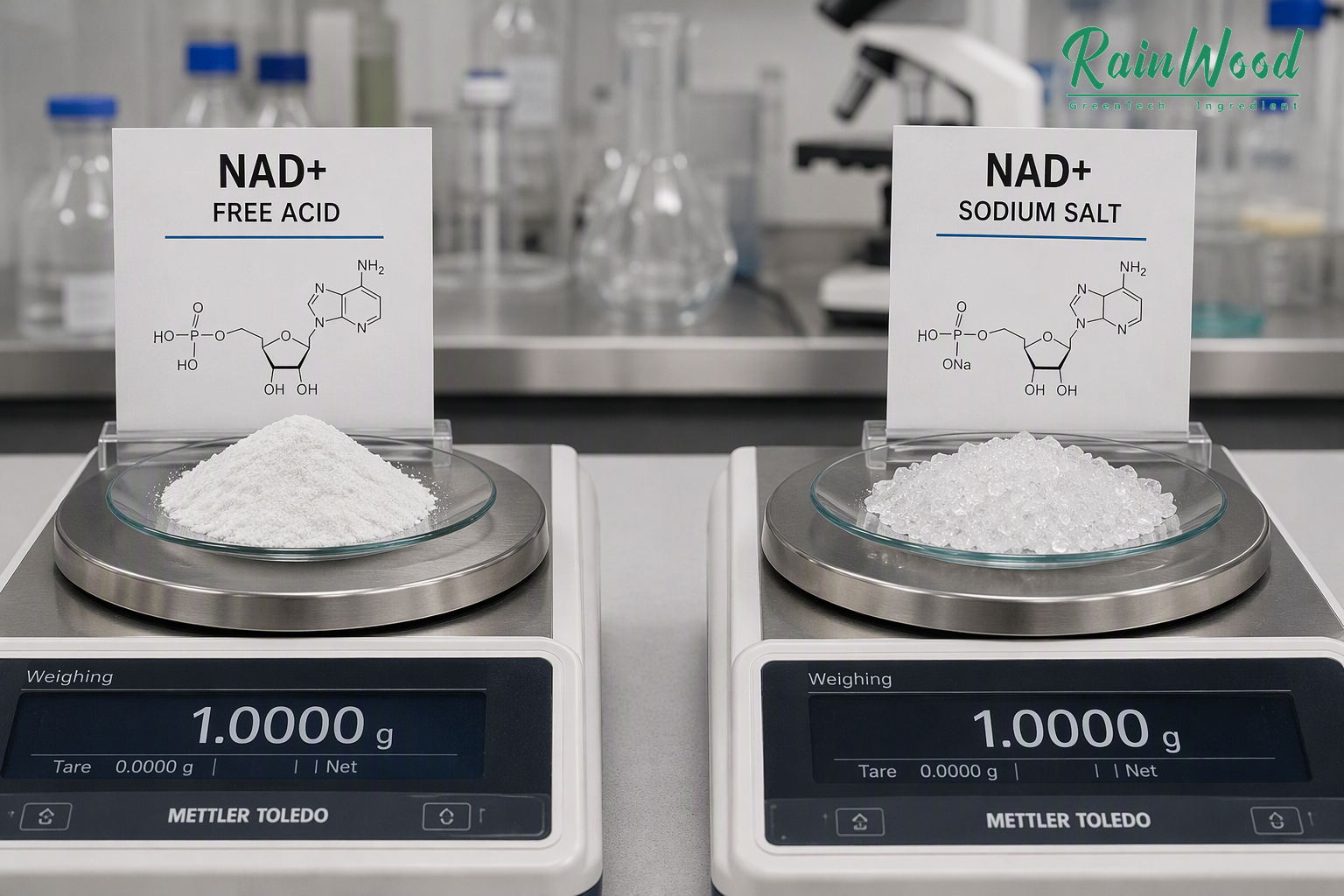
Free Acid or Salt Form NAD+: The Counterion Question in Procurement—Shaanxi Rainwood Biotech cGMP Manufacturing Standard
The supplier quotes NAD+ by kilogram. The specification names a salt. The formula team calculates the serving as free-acid NAD+. The finished label then declares a different mass than the amount in the COA.
Free-acid and salt forms are not a minor naming detail. A counterion or associated species changes molecular weight, assay basis, net active amount, hygroscopicity, processing behavior, and sometimes the stability file. Buyers must define which chemical form is being purchased before they compare price or dose.
Write the chemical form into the specification
Use our NAD+ form and counterion checklist NAD+ powder product page to define:
- NAD+ free acid or named salt;
- counterion and stoichiometry;
- hydrate or solvate status where relevant;
- molecular formula and molecular weight;
- assay basis;
- active amount per serving;
- water and residual-solvent limits;
- label ingredient name.
Ask the supplier to state whether the percentage assay is reported against the salt-inclusive mass or the NAD+ active moiety.
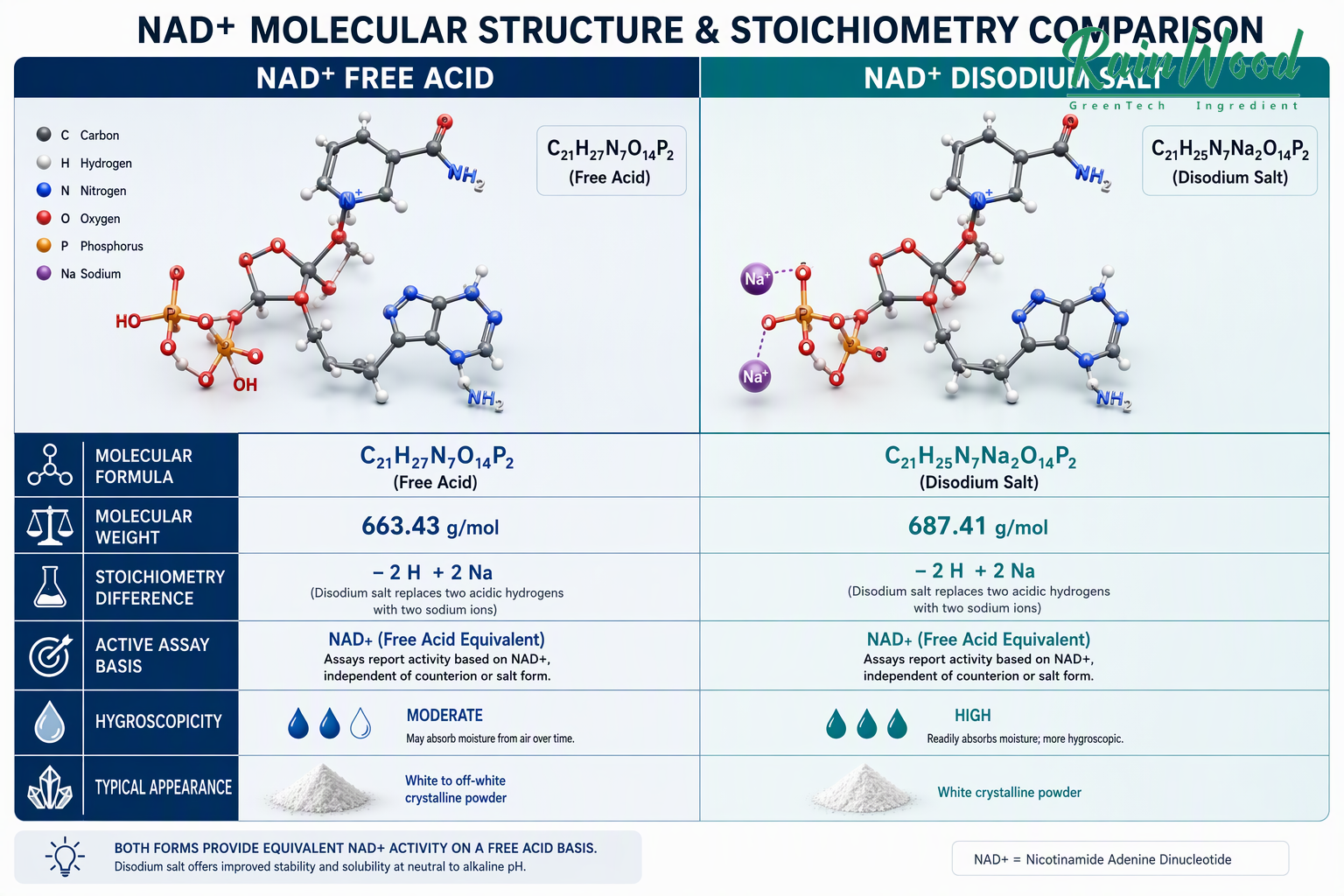
Figure 1: Chemical Stoichiometry & Molecular Comparison—NAD+ Free Acid vs NAD+ Disodium Salt counterion properties.
Why molecular weight changes the dose calculation
If the formula requires a defined amount of NAD+ active material, a salt may require a different as-is powder mass than the free acid. The difference can affect capsule fill, tablet weight, sachet content, and price per serving.
Use a simple normalization:
`active NAD+ amount = as-is material × assay fraction × NAD+ fraction of the declared form`
The exact calculation depends on stoichiometry, hydration, and the approved specification. Do not use a generic conversion from an online calculator without confirming the chemical form.
Read the NAD+ dose and capsule-cost guide NAD+ dose and cost guide before finalizing the serving size.
Counterions can influence physical performance
Salt and free-acid forms may differ in moisture sensitivity, flow, solubility, pH behavior, and compatibility with carriers or other actives. A grade that fills well in a capsule may behave differently in a powder drink or compressed tablet.
Test the exact form in the selected dosage form. Do not approve a salt based on a free-acid sample or use a free-acid stability file for a salt without an equivalence assessment.
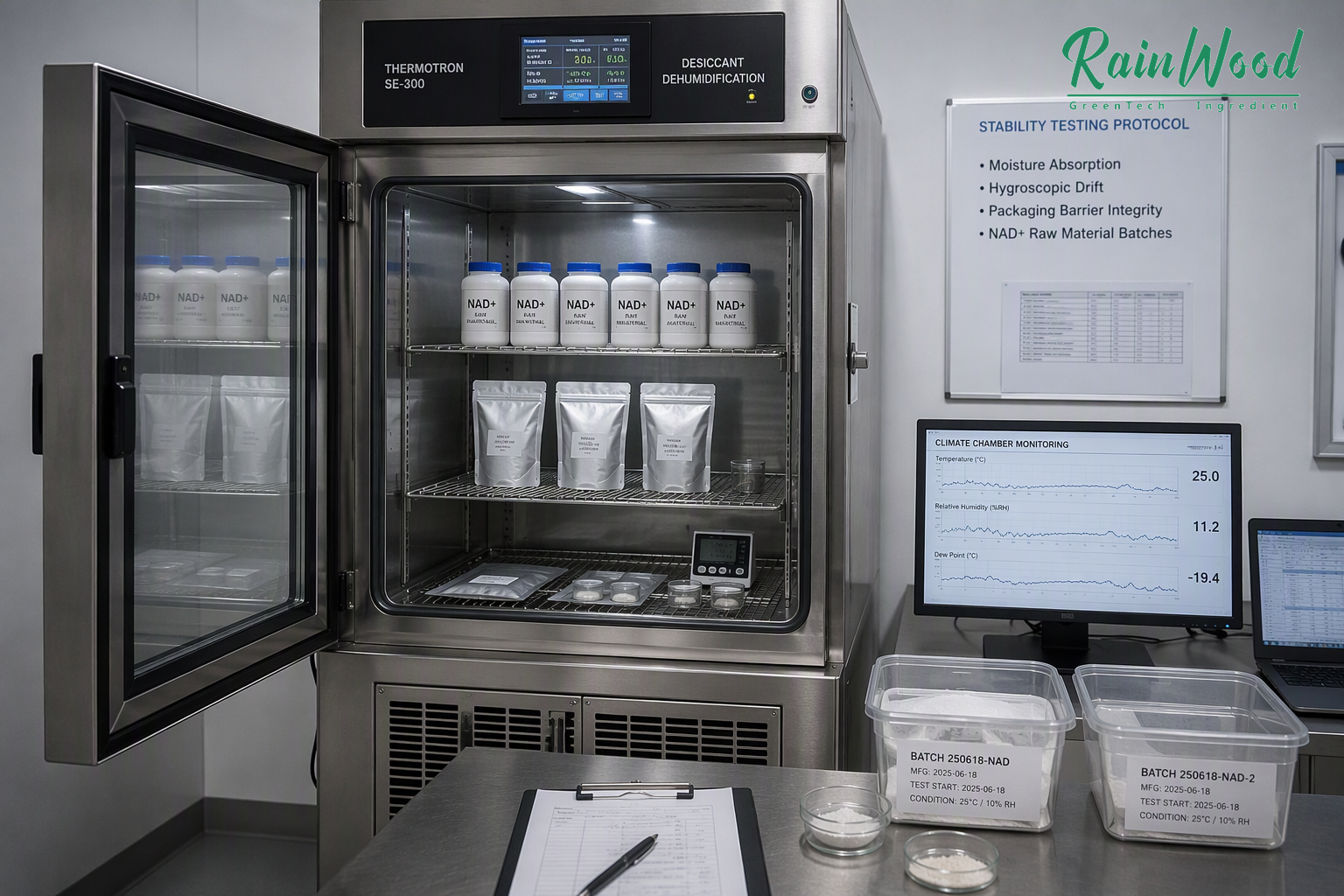
Figure 2: Environmental Humidity and Stability Chamber Testing—monitoring moisture uptake and packaging barrier performance.
The COA and label need the same basis
Create a form-control table:
| Document | Required wording | |---|---| | Purchase order | Full NAD+ form and counterion | | COA | Assay basis and net content basis | | Specification | Molecular formula and limit | | Label | Market-allowed ingredient name | | Product page | Amount per serving on the same basis | | Invoice | Same identity as PO and COA |
If the COA says a salt and the label says free NAD+, place the lot on hold until the amount and wording are reconciled.
Salt form does not solve stability automatically
A counterion may improve handling or create a different moisture profile, but it does not make NAD+ stable under every condition. Test the final package, pH, oxygen exposure, and storage. For a solution, the counterion and buffer can influence chemical behavior and analytical recovery.
Use the NAD+ stability and packaging guide NAD+ stability guide when you compare presentation forms.
How RainwoodBio can align form, dose, and documentation
RainwoodBio publicly describes requirement confirmation, raw-material supplier management, formulation, GMP process control, testing and release, packaging, and capsules, tablets, powders, and sachets. For an NAD+ project, the relevant control is connecting the approved chemical form to the dose calculation, sample, format, and release file.
Confirm the exact salt or free-acid form, method, manufacturing site, stability data, and batch evidence available for your order. Public format capabilities do not prove that two chemical forms are interchangeable.
Ask for a mass-balance explanation
When a salt form is quoted, ask the supplier to explain how the declared NAD+ amount is calculated from the total salt mass. The answer should identify the active moiety, the counterion contribution, the assay basis, and whether water of hydration is included. This is especially important when comparing a free-acid quote with a salt quote from another supplier. A lower price per kilogram may simply reflect a different amount of active NAD+ in the weighed material.
The same explanation belongs in the finished-product formula. If a capsule contains 250 mg of a salt but the label declares 250 mg of NAD+, the technical file should show why that declaration is correct. If the amount is expressed as salt weight, the label and product page must use wording that the target market permits. Keep the raw-material specification, master formula, COA, and label on the same basis.
Run a side-by-side pilot when changing form. Compare fill weight, water, flow, assay, dissolution or dispersion, and short-term stability. The NAD+ dose and cost guide is useful here because the form can change both capsule count and monthly cost even when the label appears to show the same number.
The counterion approval gate
Before ordering, verify:
- form, counterion, hydration, and formula are explicit;
- molecular weight and assay basis match;
- active NAD+ amount is calculated correctly;
- sample, COA, label, and invoice use the same identity;
- the finished format is tested with the actual form;
- storage and stability are form-specific;
- form changes trigger requalification.
Request a NAD+ free-acid versus salt-form review contact form. Send the COA, specification, molecular formula, label, dose, format, target market, and quotation. RainwoodBio can help prevent a counterion difference from becoming a dose or label discrepancy.
Put the form decision into change control
Do not allow a supplier to switch from free acid to a salt because the new form is easier to source or less expensive. The change can affect assay basis, dose calculation, water behavior, flow, taste, capsule volume, label wording, and stability. Require a revised specification, representative sample, comparative testing, and updated finished-product calculation before approval.
The buyer should also clarify whether the target customer cares about a named salt, a total NAD+ amount, or a particular delivery format. A technical form that works in bulk may not work in a small capsule or a flavored powder. Treat the form as a design input, not a hidden raw-material detail.
Frequently asked questions
#
Is salt-form NAD+ the same as free-acid NAD+?
No. They may contain the same active moiety but differ in mass, counterion, specification, and processing behavior.
#
Can I use the same label amount for both forms?
Only after confirming the active basis, stoichiometry, assay, and destination-market labeling rules.
#
Does a salt form always improve NAD+ stability?
No. Stability depends on the complete material, formula, package, and storage conditions.
References
- JHFC, NAD+ Testing Standards: https://www.jhfc.or.jp/en/downloads/nad-testing
- NAD+ analytical characterisation monograph: https://compoundedevidence.com/monographs/nad-plus/analytical/
- Cayman Chemical NAD+ COA example: https://cdn.caymanchem.com/cdn/downloadCofa/Cayman-CofA-16077-0803651.pdf
- RainwoodBio OEM information: https://www.rainwoodbio.com/oem
*This article is for B2B procurement and educational purposes. Chemical form, assay basis, dose, safety, stability, labeling, and regulatory requirements must be confirmed for the exact NAD+ material and destination market.*
Partner with a Qualified NAD+ & Cellular Nutrition Manufacturer
Shaanxi Rainwood Biotech Co., Ltd. supplies high-purity NAD+, Liposomal NMN, Liposomal NR, and comprehensive contract manufacturing solutions with complete batch COAs, third-party HPLC verification, and fast global shipping.
Table of Contents
- Write the chemical form into the specification
- Why molecular weight changes the dose calculation
- Counterions can influence physical performance
- The COA and label need the same basis
- Salt form does not solve stability automatically
- How RainwoodBio can align form, dose, and documentation
- Ask for a mass-balance explanation
- The counterion approval gate
- Put the form decision into change control
- Frequently asked questions
- Is salt-form NAD+ the same as free-acid NAD+?
- Can I use the same label amount for both forms?
- Does a salt form always improve NAD+ stability?
- References