 EN
How to evaluate NAD+ blends with resveratrol, pterostilbene, or CoQ10 without confusing ingredient identity, stability, dose, and commercial claims.
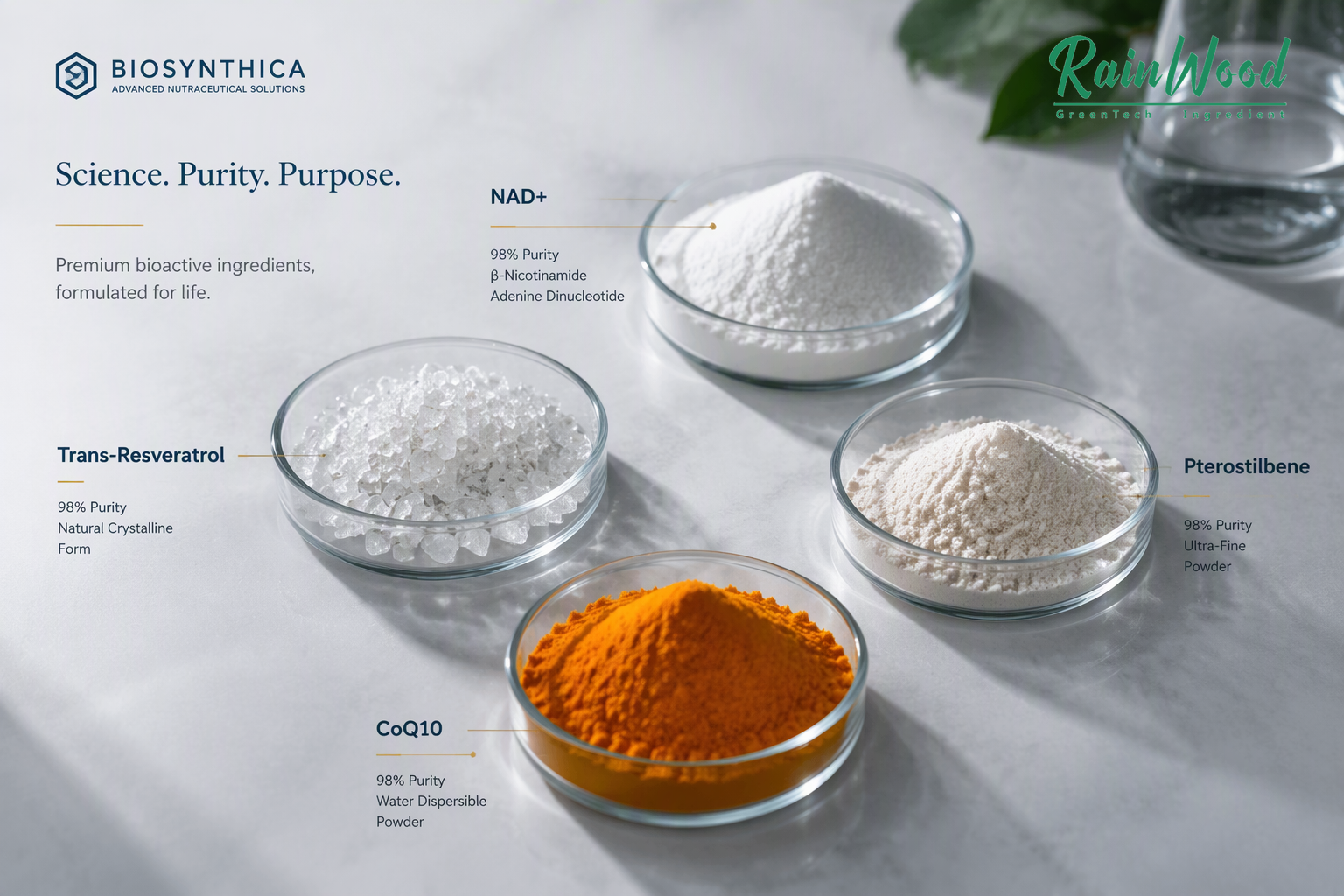
Multi-ingredient formulation study combining pure NAD+ with trans-resveratrol, pterostilbene, and CoQ10.
A blend is a new product, not a shopping list
NAD+ is increasingly placed beside resveratrol, pterostilbene, CoQ10, polyphenols, vitamins, and minerals in premium formulas. The marketing logic is easy: all the ingredients can be connected to cellular energy or healthy-aging conversations. The formulation reality is harder. Once these ingredients share a capsule, tablet, powder, or sachet, they create a new chemical and commercial system. Each ingredient must remain identifiable, stable, measurable, and compatible with the selected format.
The common buyer error is to approve every ingredient separately and assume the blend is automatically approved. A supplier can provide a good NAD+ COA, a good resveratrol COA, and a good CoQ10 COA, while the final blend still has poor homogeneity, an unsuitable moisture profile, or a label that cannot be defended. The buyer needs a blend-specific specification and a process that proves the finished unit matches it.
Why these ingredients create different formulation pressures
NAD+ is a polar nucleotide coenzyme with a specification that can be sensitive to moisture, pH, temperature, and analytical method. Resveratrol and pterostilbene are polyphenolic compounds with different solubility, particle-size, and light-sensitivity considerations. CoQ10 is strongly lipophilic and is often supplied as a powder dispersion, oil suspension, or other delivery form rather than as a free-flowing water-soluble ingredient.
That contrast affects blending. A dry NAD+ powder may not flow or disperse like a CoQ10 powder. A fine polyphenol can segregate from a denser carrier. A flavor, acidulant, mineral, or botanical extract can change local moisture or pH. If the formula is placed in a hard capsule, the fill weight and powder density determine the actual dose. If it is placed in a sachet, flow, dusting, and seal integrity become part of quality. The product must be designed around the materials rather than around an attractive ingredient list.
Use the identity distinction in NAD+ identity guide and the presentation comparison in NAD+ format guide before writing a blend specification. The NAD+ ingredient should never be treated as interchangeable with NR or NMN simply because all three appear in the same marketing category.
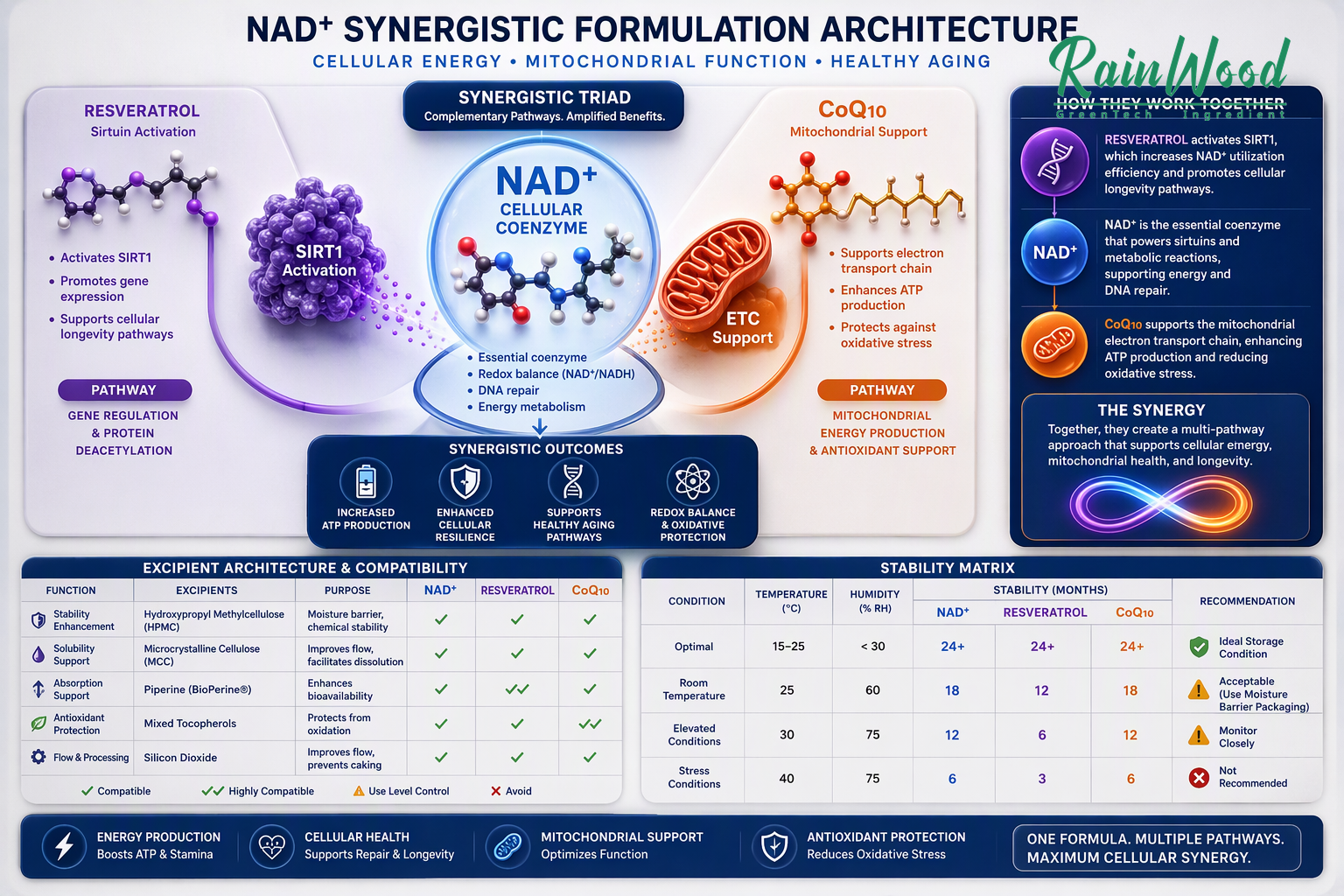
Cellular synergy architecture mapping Sirtuin activation, mitochondrial electron transport, and stability compatibility.
The buyer loss when blend compatibility is assumed
An incompatible blend can create underfilled units, dose variation, color migration, caking, odor transfer, or accelerated degradation. These failures are expensive because the brand may discover them after labels, cartons, and advertising have already been approved. A rework can involve new testing, new packaging, scrapped components, and delayed retailer delivery.
There is also a claim risk. If the front panel presents the formula as a coordinated “cellular energy” or “healthy-aging” system, but the finished-product testing only confirms individual raw-material identity, the evidence does not support the commercial story. The brand may be unable to answer a retailer’s question about the finished dose or a customer’s question about why the product changed during shelf life.
Build the specification ingredient by ingredient and unit by unit
Start by listing the exact form of every component. For NAD+, define whether it is free acid or a named salt, whether the assay is on an as-is or dry basis, and which related substances are controlled. For resveratrol or pterostilbene, define the chemical identity, assay basis, and particle or dispersion form. For CoQ10, define whether the declared amount is pure CoQ10 or a carrier-based preparation and how the carrier is accounted for in the formula.
Next define the finished-unit target. A capsule specification should include net fill weight, weight variation, blend uniformity, disintegration or dissolution requirements where applicable, and the sampling plan. A sachet specification should add flow, seal integrity, moisture barrier, and unit-dose homogeneity. A tablet specification should address compression behavior, hardness, friability, disintegration, and any coating interaction. Do not hide the unit dose behind a total blend weight.
The formula also needs a compatibility plan. Identify ingredients that can introduce water, acidity, alkalinity, reducing or oxidizing conditions, or strong adsorption to a carrier. Decide whether one ingredient requires a protective coating, a separate premix, a non-aqueous process, or a different package. The right answer may be a two-compartment sachet or a staged addition, not simply more excipient.
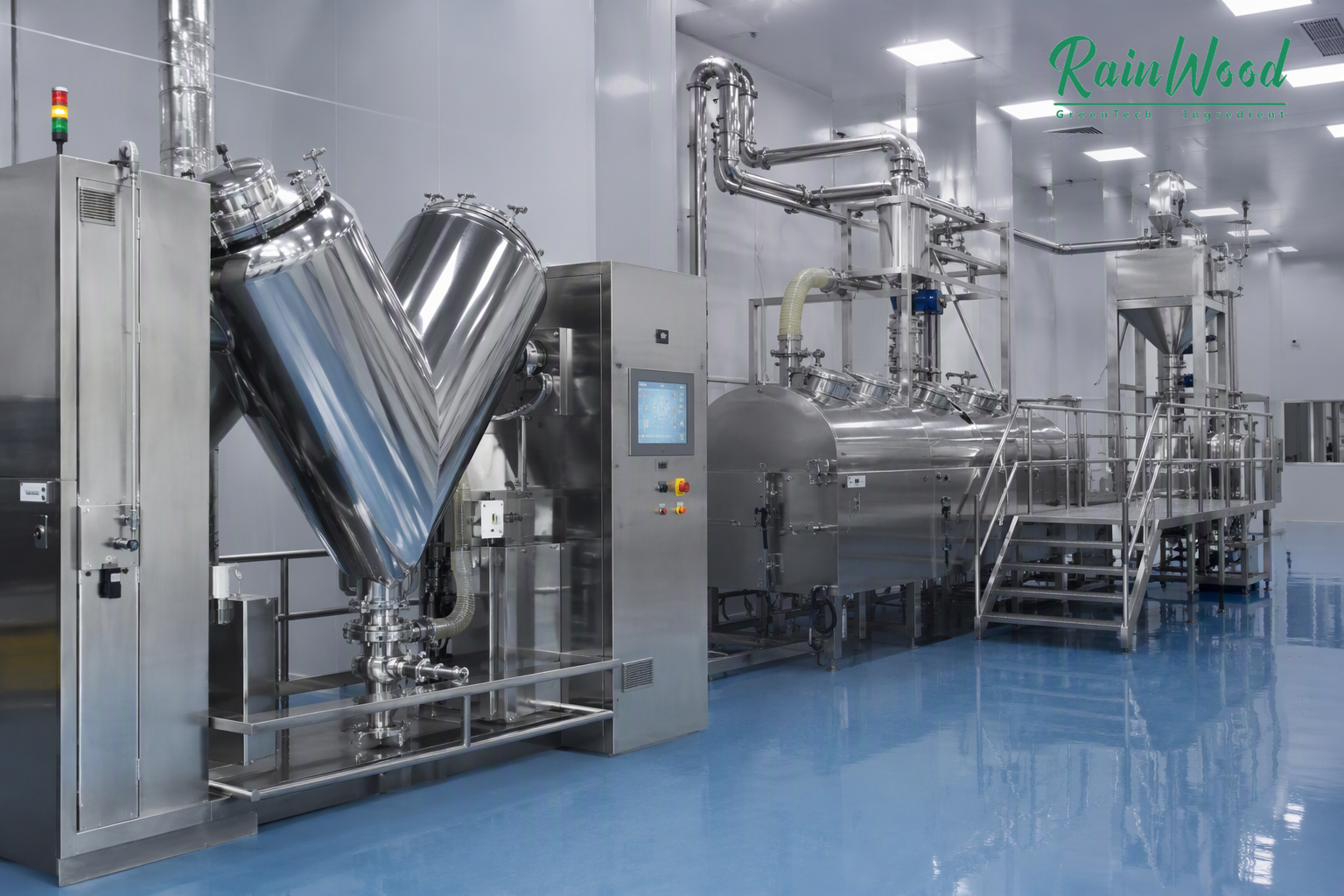
Industrial cGMP precision V-blender and ribbon mixer ensuring micro-uniformity across active botanical and coenzyme blends.
How to verify a finished NAD+ blend
Raw-material COAs are only the starting point. The finished product should have a method capable of distinguishing NAD+ from the other ingredients and degradation or interference peaks. A single UV absorbance reading can be misleading when polyphenols or CoQ10-related materials are present. The method should be suitable for the matrix, and the report should identify the reference standard, sample preparation, system suitability, and calculation basis.
Homogeneity is equally important. Sample multiple units from the beginning, middle, and end of a filling run. Test NAD+ and at least the ingredients most likely to segregate. If the blend uses a carrier-based CoQ10 input, include a mass-balance explanation so the declared active dose is not confused with the input material weight. Retain finished units for stability and complaint investigation.
Stability should be run on the actual blend and package, not inferred from separate raw-material studies. Track NAD+ assay and related substances, the sensitive polyphenol or CoQ10 attribute, water, appearance, odor, and unit performance. The study design should reflect the market: bottle, blister, stick pack, or bulk powder can have very different moisture and oxygen exposure.
What a capable OEM partner should control
The partner should be able to translate a brand concept into a controlled product specification, source and qualify each raw material, manage premixes and process order, test incoming and finished materials, and maintain traceability from the lot to the finished units. RainwoodBio publicly describes requirement confirmation, supplier management, GMP/process control, testing and release, and OEM formats including capsules, tablets, powder drinks, softgels, powders, and sachets. Those capabilities are relevant to a multi-ingredient NAD+ program, but the buyer should still request product-specific evidence for the proposed formula, method, package, and stability protocol.
Do not accept a generic “all ingredients are tested” statement as proof of finished-product homogeneity. Ask what is tested, at what stage, from how many units, by which method, and against what acceptance criteria.
A practical blend-development sequence
First, freeze the commercial claim and the target customer. This determines whether the formula needs a simple daily capsule, a premium softgel, or a convenient sachet. Second, lock the chemical forms and dose basis. Third, perform a compatibility screen with the actual carriers and process conditions. Fourth, make a pilot blend and test homogeneity, flow, water, appearance, and assay. Fifth, run accelerated and real-time stability in the intended package. Sixth, approve the label only after the finished-unit results support the declared amounts and permitted claims.
The sequence prevents a common failure: designing the marketing panel first and asking the factory to make the chemistry fit later.
Keep the blend story consistent across documents
Use the same active-amount basis in the formula, COA, label, quotation, and product page. If CoQ10 is supplied in a carrier or if a polyphenol is standardized to a marker, show how the active amount is calculated. If the blend includes a proprietary premix, request the composition and acceptance limits needed to release the finished product.
For a new formula, retain a blend sample and a sample of each critical raw material. This lets the laboratory investigate whether a later change began with NAD+, a polyphenol, CoQ10, the carrier, or the package. The NAD+ supplier checklist can help assign these responsibilities before production.
Frequently asked questions
Can NAD+ and CoQ10 be put into one capsule?
They may be combined, but the answer depends on dose, input form, fill weight, flow, homogeneity, and stability. A formula review and pilot data are required.
Is a blend COA just the sum of raw-material COAs?
No. A finished blend needs matrix-appropriate identity, assay, uniformity, and stability evidence. Raw COAs do not prove the finished unit.
Does resveratrol make an NAD+ product more effective?
That is a product-development and evidence question, not an assumption that can be made from ingredient proximity. Avoid implying a clinical benefit without product-specific human evidence and compliant claims review.
Which package is best for the blend?
Choose after assessing moisture sensitivity, dose, fill weight, light exposure, and consumer use. Bottle, blister, sachet, and powder formats have different risk profiles.
Conclusion
An NAD+ blend becomes credible when the final unit—not the ingredient list—is measurable and stable. Define each form, test the matrix, prove uniformity, and match the package to the chemistry. If you have a proposed NAD+ plus resveratrol, pterostilbene, or CoQ10 formula, send the target dose and format through the contact form for an OEM compatibility review.
Disclaimer: This article is for formulation and procurement information. It is not medical advice and does not establish that any ingredient or blend treats, prevents, or cures disease.
References
- https://pubmed.ncbi.nlm.nih.gov/34041853/
- https://pubmed.ncbi.nlm.nih.gov/41655607/
- https://www.fda.gov/food/dietary-supplements-guidance-documents-regulatory-information/dietary-supplement-labeling-guide
Looking for Reliable NAD+ or Coenzyme Ingredient Supply?
Rainwood Bio delivers verified HPLC-grade NAD+, Liposomal NMN, and NR raw materials supported by full identity testing, moisture control, and cGMP finished-dosage manufacturing.
Table of Contents
- A blend is a new product, not a shopping list
- Why these ingredients create different formulation pressures
- The buyer loss when blend compatibility is assumed
- Build the specification ingredient by ingredient and unit by unit
- How to verify a finished NAD+ blend
- What a capable OEM partner should control
- A practical blend-development sequence
- Keep the blend story consistent across documents
- Frequently asked questions
- Conclusion
- References