 EN
EN
How NMNH Skips Rate-Limiting Enzymes to Redefine NAD+ Synthesis
Prepared for: R&D Strategy Teams, Nutraceutical Formulators, and Biotechnology Buyers
Date: April 20, 2026
Source: Rainwood Biotech Scientific Communications Series
1. The NAD+ Arms Race: Beyond the Conventional Precursors
The landscape of longevity science has been dominated for nearly a decade by two primary molecules: Nicotinamide Riboside (NR) and Nicotinamide Mononucleotide (NMN). These precursors have formed the backbone of the NAD+ booster market, leveraging the salvage pathway to restore cellular levels of Nicotinamide Adenine Dinucleotide (NAD+). However, as the aging population seeks more potent solutions and R&D buyers demand higher efficiency, the limitations of first-generation precursors have become increasingly apparent. The metabolic pathways that govern NMN and NR are often constrained by enzymatic bottlenecks and specific transporters that can become saturated or downregulated with age.
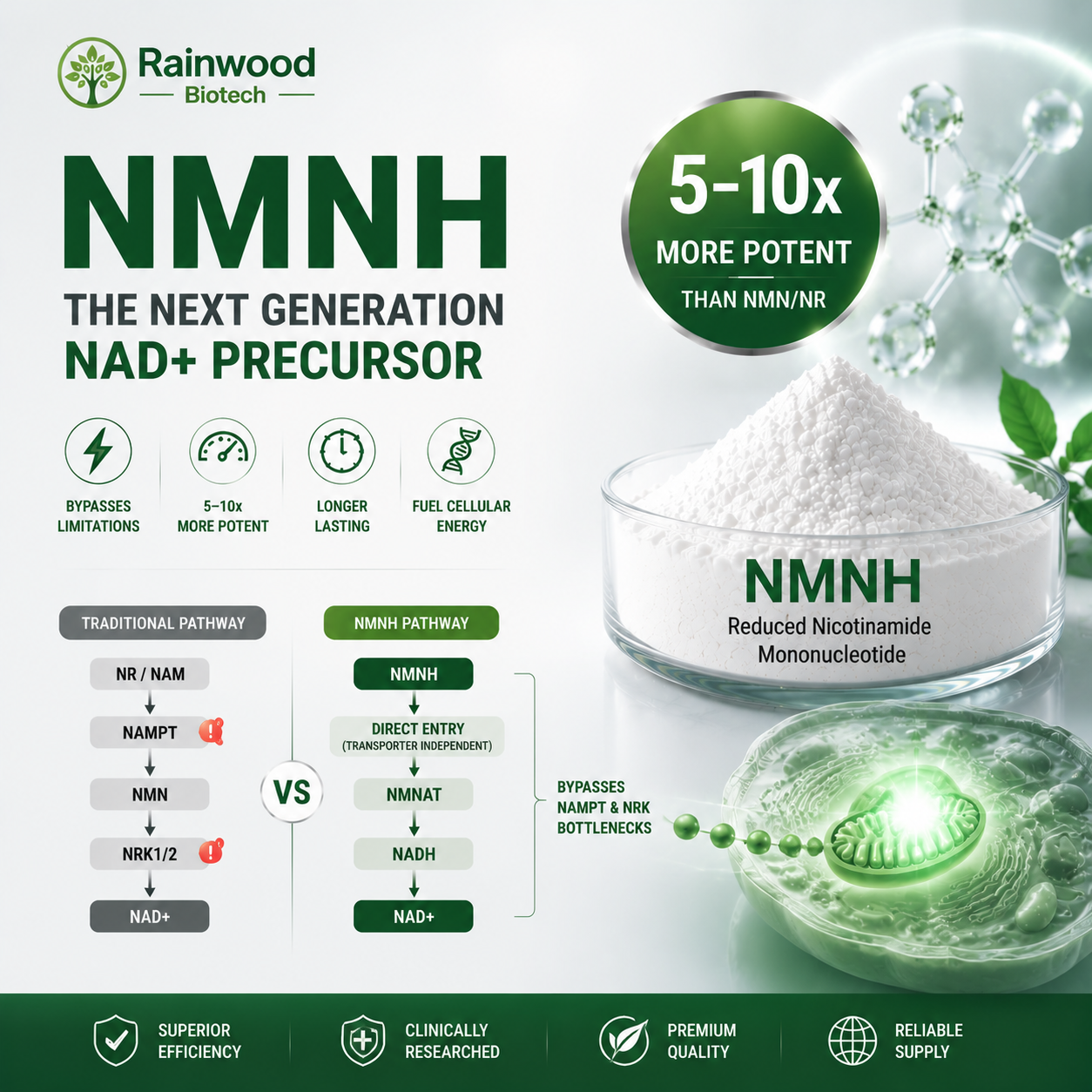
Enter Reduced Nicotinamide Mononucleotide (NMNH) – a molecule that does not merely supplement the existing pathway but fundamentally bypasses its most restrictive barriers. NMNH represents the next evolution in nicotinamide adenine dinucleotide (NAD+) precursors. Unlike its precursor cousins, NMNH exists in a reduced state (dihydronicotinamide mononucleotide), a structural difference that grants it unique metabolic properties and superior bioavailability. Rainwood Biotech’s Perspective 05 explores the biochemical mechanics of NMNH, focusing on its ability to circumvent the rate-limiting enzymes and specific transporters that often constrain the efficacy of NMN and NR.
2. The NAMPT Bottleneck: The Ceiling of Conventional Salvage
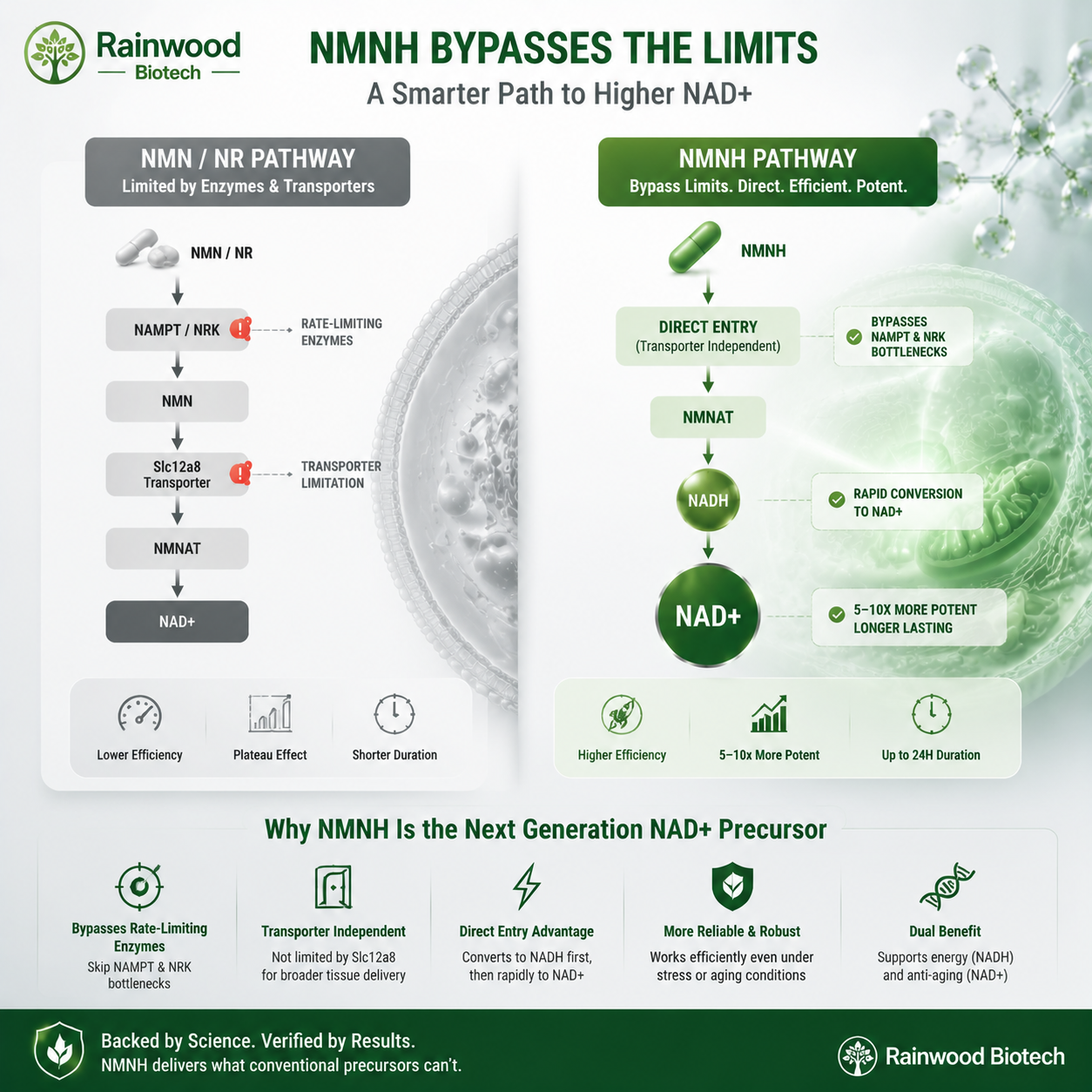
To appreciate the advantage of NMNH, one must first understand the primary limitation of the NAD+ salvage pathway: Nicotinamide phosphoribosyltransferase (NAMPT). NAMPT is the rate-limiting enzyme that converts nicotinamide (NAM) into NMN. This step is the narrowest point in the metabolic funnel; no matter how much NAM is provided, the synthesis of NAD+ cannot exceed the catalytic capacity of NAMPT. This fundamental biological constraint limits the efficiency of many early-stage NAD+ supplements.
Aging is characterized by a systemic downregulation of NAMPT expression, particularly in key metabolic tissues. This creates a state of ‘enzyme exhaustion,’ where conventional precursors may fail to elevate NAD+ to youthful levels because the metabolic infrastructure is too degraded to process them efficiently. Even if high doses of NMN or NR are administered, the cell's inability to process them through the NAMPT or NRK pathways limits their final impact, leading to a 'plateau effect' where increasing the dosage does not proportionally increase NAD+ levels.
NMNH fundamentally changes this equation. Because it is already in a reduced state, NMNH enters a parallel metabolic track that is significantly less dependent on the high-flux requirements of the standard salvage pathway. By skipping the NAMPT-mediated bottleneck, NMNH provides a high-velocity injection into the NAD+ pool. It effectively 'front-loads' the system with a precursor that is ready for immediate utilization, bypassing the regulatory feedback loops that inhibit NAMPT.
3. Bypassing the Transporter Dilemma: Slc12a8 Independence
The discovery of Slc12a8 as a specific NMN transporter in the small intestine provided a long-sought explanation for NMN’s rapid absorption. However, Slc12a8 expression is highly tissue-specific and its efficiency can be influenced by physiological factors. This leaves many tissues dependent on the extracellular conversion of NMN back to NR before it can enter the cell—a process that introduces more enzymatic overhead and potential for loss.
NMNH operates through Slc12a8-independent pathways. While the exact molecular ‘doorway’ for NMNH is still being characterized—with evidence pointing toward equilibrative nucleoside transporters (ENTs)—the result is undeniable: NMNH does not compete with NMN for the Slc12a8 transporter. This independence is a critical strategic advantage. It means that NMNH formulations can achieve systemic bioavailability even in tissues where Slc12a8 expression is low or compromised by age-related pathology. Whether the target is brain health or cardiac function, NMNH offers a more reliable delivery mechanism.
Scientific storytelling for R&D buyers must emphasize the ‘path of least resistance.’ NMNH represents a streamlined delivery system that avoids the complex extracellular-to-intracellular conversion cycles that plague NR and NMN. By providing a molecule that can penetrate the cellular membrane through broader, more robust mechanisms, Rainwood Biotech enables a more reliable and potent dosage response. This 'transport-agnostic' profile is a major differentiator in the nutraceutical marketplace.
4. The Molecular Bypass: Direct Entry into the NAD+ Pool
The chemical identity of NMNH allows it to follow a metabolic shortcut that is functionally distinct from the standard precursors. Once inside the cytoplasm, NMNH is converted to NADH by the enzyme Nicotinamide Nucleotide Adenylyltransferase (NMNAT). This enzyme is ubiquitous and highly conserved, ensuring that the conversion can happen in almost any cell type regardless of its metabolic state or age-related decline. This 'metabolic robustness' is a key advantage for therapeutic applications.
This step is crucial and represents a significant departure from the NMN and NR pathways. In the standard salvage pathway, NMN is converted to NAD+ by NMNAT. In the NMNH pathway, NMNH is converted to NADH by the same NMNAT enzymes. Because the cellular environment is geared toward maintaining a very high NAD+/NADH ratio (often 100:1 or higher in the cytoplasm), any newly formed NADH is rapidly and almost completely oxidized into NAD+ by various dehydrogenases. This process is not only highly efficient but also provides a dual benefit: it briefly restores the pool of reduced cofactors (NADH) which can be utilized for immediate ATP production in mitochondrial respiration before being converted to the oxidized signaling molecule (NAD+).
Furthermore, this pathway bypasses the NRK1 and NRK2 enzymes entirely. NRK enzymes are the gatekeepers for Nicotinamide Riboside (NR). Research has shown that NRK expression is often compromised during periods of physiological stress, viral infection, or chronic inflammation. By bypassing these gatekeepers, NMNH ensures that the cell can continue to produce NAD+ even when its normal survival pathways are impaired. This makes NMNH a more 'fail-safe' precursor for clinical and high-performance applications.
This ‘Direct Entry’ mechanism is the crown jewel of NMNH bioavailability. It creates a high-pressure gradient that drives NAD+ levels upward far faster than NMN could achieve. For the R&D buyer, this translates to a product that provides ‘felt’ results more quickly, enhancing consumer satisfaction and brand loyalty. The molecular bypass isn’t just a scientific curiosity; it is the reason why NMNH is now considered the most potent NAD+ precursor discovered. By providing both the 'fuel' (NADH) and the 'signal' (NAD+), NMNH addresses cellular energy on two fronts simultaneously, providing a holistic boost to cellular vitality.
5. Proving the Superiority: A Review of the Evidence
The landmark study by Liu et al. (2021) revolutionized our understanding of these cofactors. In direct head-to-head comparisons, NMNH was shown to increase cellular NAD+ levels to a degree that was 5 to 10 times higher than the increases seen with equivalent doses of NMN or NR. This was not a marginal gain—it was a categorical shift in potency. The study found that NMNH could reach peak NAD+ levels in as little as one hour, demonstrating superior pharmacokinetics over traditional precursors.
The data showed that while NMN reached a plateau in NAD+ elevation relatively quickly, NMNH continued to drive levels higher, suggesting that the system was not ‘saturated’ by NMNH in the same way it was by NMN. This indicates that NMNH can push the physiological ceiling of NAD+ further than previously thought possible. For the formulator, this opens up new possibilities for ‘high-impact’ products targeted at severe NAD+ depletion, such as those caused by metabolic stress, excessive alcohol consumption, or advanced chronological aging. NMNH can achieve at lower doses what NMN cannot achieve even at very high doses, which is a major advantage for reducing pill size.
Moreover, NMNH exhibits a longer half-life in the bloodstream compared to NMN. This sustained presence allows for a more prolonged elevation of tissue NAD+, reducing the need for multiple daily doses and improving patient compliance. In vivo studies showed that a single dose of NMNH maintained elevated NAD+ levels for up to 24 hours in some tissues, whereas NMN's effect dissipated much faster. This 'extended-release' effect is naturally built into the molecule's metabolic fate, providing a steady supply of NAD+ throughout the day and night cycle, which is essential for maintaining circadian rhythms and DNA repair mechanisms.
6. Strategic Implications for R&D Buyers
For R&D teams, the transition to NMNH requires a shift in how bioavailability is measured. The focus must move from ‘milligrams per capsule’ to ‘metabolic flux.’ Rainwood Biotech’s NMNH series provides the high-purity, stable material required to exploit these biochemical advantages.
• Stability: NMNH is sensitive to oxidation. Rainwood Biotech uses proprietary stabilization techniques to ensure that our NMNH powder maintains its reduced state. We provide detailed SOPs for handling and storage to our partners.
• Synergistic Ingredients: Because NMNH bypasses NAMPT, it can be combined with NAMPT activators like Quercetin to create a multi-pronged approach to NAD+ restoration.
• Bioavailability Profiling: Given its Slc12a8 independence, NMNH is an ideal candidate for delivery systems that target tissues beyond the gut, such as sublingual or liposomal formulations.
• Cost-Benefit Analysis: While NMNH is a premium ingredient, its 5-10x higher potency means that a lower dose can be used to achieve superior results, resulting in a more favorable cost-per-effect ratio.
7. Conclusion: Redefining the Bioavailability Ceiling
The ‘Bioavailability Bypass’ is a molecular reality that places NMNH at the forefront of longevity science. By skipping the rate-limiting enzymes like NAMPT and the specific transport requirements of Slc12a8, NMNH offers a direct, potent, and efficient route to cellular vitality.
Rainwood Biotech is proud to lead the supply chain for this revolutionary precursor. We provide R&D buyers with the tools they need to redefine what is possible in the field of NAD+ optimization. The era of the bypass has arrived.
References
1. Liu, Y., et al. (2021). 'Reduced nicotinamide mononucleotide is a new and potent NAD+ precursor in mammalian cells and mice.' FASEB Journal.
2. Zapata-Pérez, R., et al. (2021). 'Reduced nicotinamide mononucleotide is a potent and cell-permeable NAD+ precursor.' Nature Communications.
3. Grozio, A., et al. (2019). 'Slc12a8 is a nicotinamide mononucleotide transporter.' Nature Metabolism.
4. Yoshino, J., et al. (2018). 'NAD+ Intermediates: The Biology and Therapeutic Potential of NMN and NR.' Cell Metabolism.
Table of Contents
- 1. The NAD+ Arms Race: Beyond the Conventional Precursors
- 2. The NAMPT Bottleneck: The Ceiling of Conventional Salvage
- 3. Bypassing the Transporter Dilemma: Slc12a8 Independence
- 4. The Molecular Bypass: Direct Entry into the NAD+ Pool
- 5. Proving the Superiority: A Review of the Evidence
- 6. Strategic Implications for R&D Buyers
- 7. Conclusion: Redefining the Bioavailability Ceiling
- References