 EN
EN


Meta title: Creatine Electrolyte Powder Use Case Formula Guide
Meta description: A pre-workout, intra-workout, and daily hydration powder need different creatine, electrolyte, flavor, and claim decisions. Start with the use moment.
The same powder is advertised before training, during training, after training, and as an everyday hydration product. That broad positioning may attract clicks, but it creates a difficult formulation question: which use moment did the dose, electrolyte profile, flavor intensity, and label actually serve?
Creatine is commonly discussed as a regular supplementation ingredient, while electrolytes are often positioned around fluid and sweat replacement. Combining them can be commercially attractive, but it does not make every use case interchangeable. A pre-workout customer may prioritize scoop convenience and flavor. An endurance user may need a different sodium concentration and water volume. A daily wellness buyer may reject a salty product or a stimulant-heavy formula.
Define the use moment before you write the directions
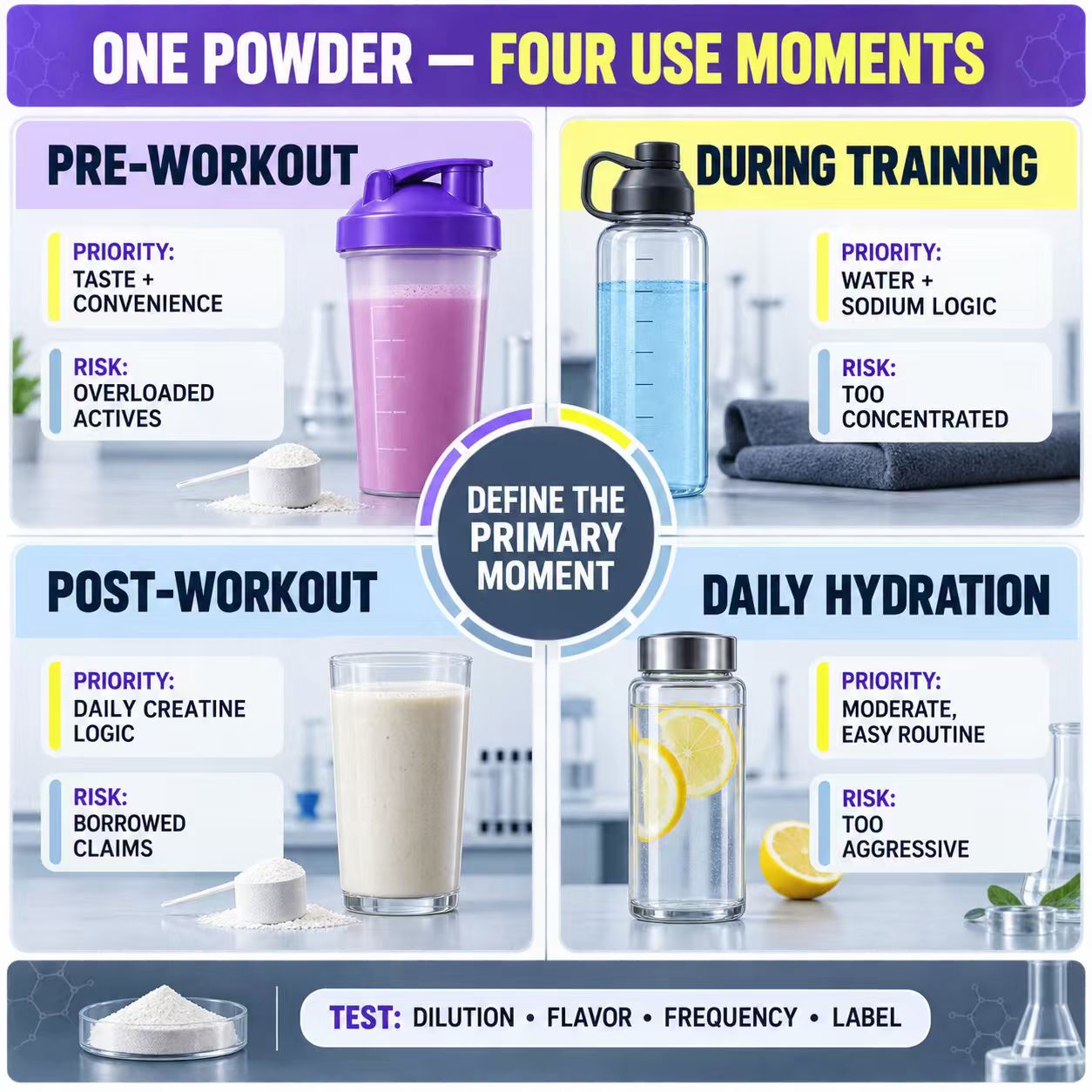
Choose a primary use case:
- Pre-workout: consumed before exercise, with attention to flavor, stomach comfort, and any stimulant or carbohydrate components.
- During training: mixed into a larger bottle, with attention to fluid volume, sodium, sweat scenario, and drinking rate.
- Post-workout: evaluated alongside recovery nutrition and total daily creatine use.
- Daily hydration: expected to be pleasant, moderate, and easy to use outside a specific training event.
Use our creatine electrolyte use-case planning guide to keep the product promise narrower and more credible.
Pre-workout is not a license to add every popular ingredient
A pre-workout formula often attracts caffeine, beta-alanine, taurine, amino acids, or botanical stimulants. Each addition changes taste, serving size, stability, safety review, and claim language. Creatine may be the daily-use anchor, while electrolytes may be present for flavor or positioning rather than a validated sweat-replacement objective.
Ask whether the customer is expected to take the product every day or only on training days. If the creatine target assumes daily use but the directions say “take before training,” some users may underuse it. If the formula contains caffeine, the label also needs a clear amount and target-user review.
During-training formulas need water and sodium logic
An intra-workout powder is prepared in a bottle and consumed over time. Sodium per liter, taste at the actual dilution, and the time the drink sits in the bottle matter. The formula may need a lower sweetness level than a pre-workout shot and a profile that remains drinkable in a warm gym or outdoor environment.
Sweat loss varies widely. Avoid promising that one blend matches everyone. Instead, define the intended exercise duration, climate, and water volume, and give directions that allow the buyer to understand the serving.
Read the sodium-led sweat-loss formulation guide before reusing a daily hydration ratio for endurance training.
Post-workout positioning needs a different evidence bridge
A post-workout product may sit beside protein, carbohydrate, amino acids, or recovery claims. Creatine is often discussed in relation to ongoing supplementation rather than an instant post-workout effect. Electrolytes may support fluid replacement, but the formula should not imply that it repairs injury, prevents a medical condition, or guarantees recovery.
The buyer loss is a product page that promises too much and a label that cannot carry the claim. Keep structure/function language separate from disease or guaranteed-outcome language and review it for the target market.
Daily hydration must survive non-athlete use
If the product is intended for flights, office work, travel, or general wellness, the sodium, sweetness, acidity, and serving size may need to be more moderate. An endurance-style salt profile can reduce repeat use outside heavy sweating. A large creatine dose may also make the scoop bulky for users who do not identify as athletes.
Define whether “hydration” means a general beverage experience or a sport-specific electrolyte replacement. That single decision affects formula, packaging, claims, and audience targeting.
Use-case formula matrix
| Use moment | Formula priority | Common risk |
|---|---|---|
| Pre-workout | Taste, convenience, stimulant clarity | Overloaded ingredient list |
| During training | Water volume, sodium, drinkability | Too salty or too concentrated |
| Post-workout | Daily creatine logic, recovery context | Borrowed performance claims |
| Daily hydration | Moderate taste and easy routine | Formula too aggressive for everyday use |
Do not make the matrix a promise of physiological outcome. Use it to choose what the pilot must test and what the label should explain.
How RainwoodBio can build one primary formula around one clear occasion
RainwoodBio publishes requirement confirmation, formula development, powders, sachets, capsules, gummies, tablets, testing and release documentation, packaging, and traceability. For a multi-use creatine electrolyte concept, the relevant capability is deciding whether one formula can honestly serve all stated occasions or whether separate versions are safer.
Request a creatine electrolyte use-case and format feasibility review with the target customer, training duration, water volume, stimulant preference, creatine dose, and market.
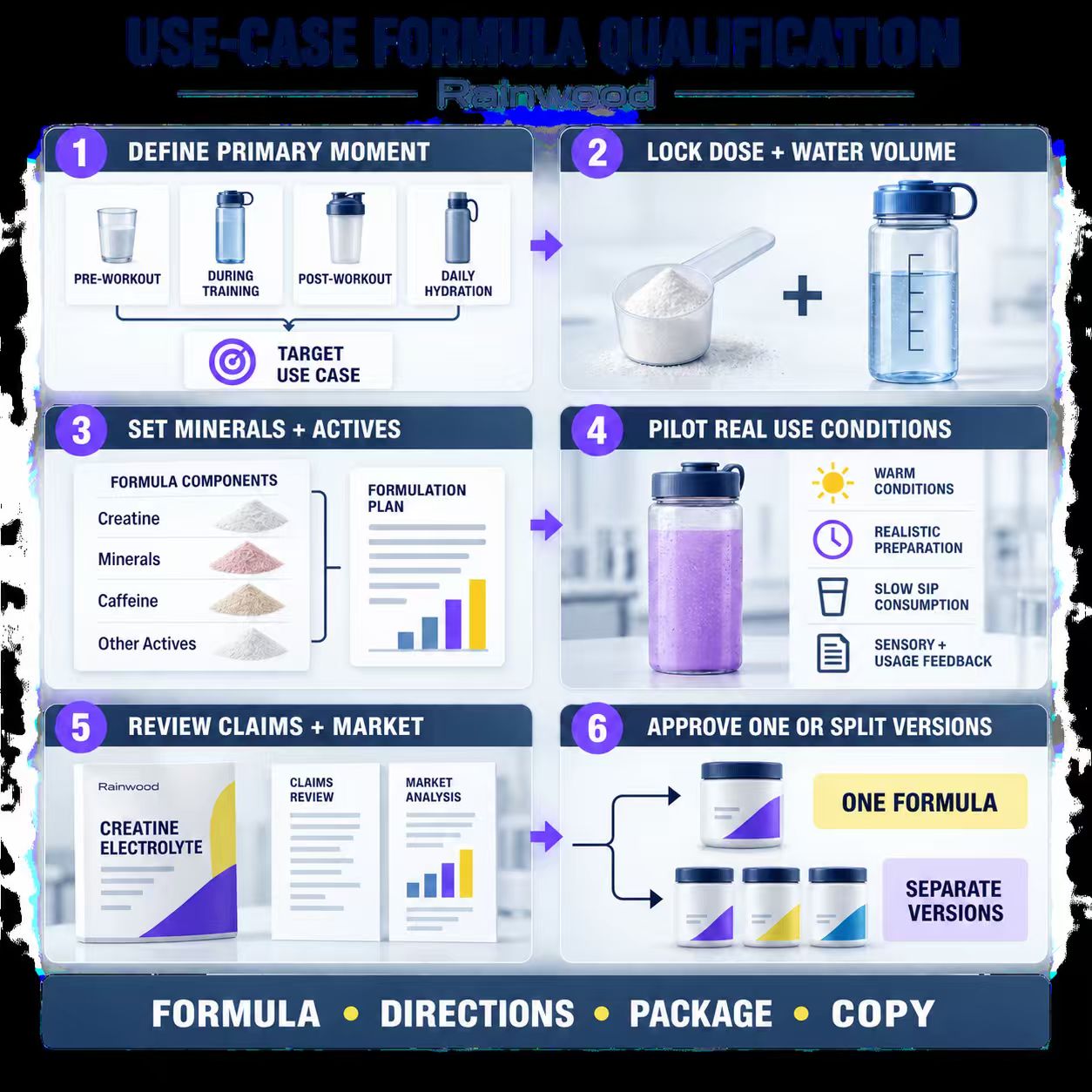
The use-case approval gate
Before launch, confirm:
- one primary use moment is stated;
- creatine directions match the intended daily or training frequency;
- sodium and other minerals match the scenario and water volume;
- caffeine and other actives have separate calculations and warnings where needed;
- flavor and sweetness work when the product is consumed slowly;
- claims are matched to evidence and market rules;
- product-page copy does not quietly expand the use case.
Send your use-case brief, formula, target users, directions, COAs, and draft product-page copy for a creatine electrolyte positioning review. RainwoodBio can help reveal where one broad formula is trying to serve too many incompatible moments.
One formula can serve several moments only with clear boundaries
If the brand insists on one product for pre-workout and daily hydration, write separate directions for each moment and test both preparations. The pre-workout customer may use a smaller volume and drink quickly, while the daily user may sip a larger bottle over several hours. Taste, sodium concentration, caffeine exposure, and the total daily creatine amount can change. If the same formula cannot perform acceptably in both scenarios, split the product line rather than using broad copy to hide the conflict. A focused product is easier for a distributor to explain and easier for the buyer to reorder.
Frequently asked questions
1.Should creatine electrolyte powder be taken only before training?
Not automatically. The correct directions depend on the exact creatine form, daily amount, formula, evidence, and market. Do not let the use moment create an unsupported timing claim.
2.Can the same formula work for endurance and daily hydration?
Possibly, but taste, sodium, serving size, and audience expectations may conflict. Validate the formula in both real use conditions before making a broad promise.
3.Does adding electrolytes make a pre-workout more effective?
Not automatically. Each ingredient needs a defined purpose, dose, evidence, and market-appropriate claim.
References
- NIH Office of Dietary Supplements, Exercise and Athletic Performance: https://ods.od.nih.gov/factsheets/ExerciseAndAthleticPerformance-HealthProfessional/
- ISSN position stand on energy drinks and electrolytes: https://pmc.ncbi.nlm.nih.gov/articles/PMC9987737/
- FDA, Label Claims for Food and Dietary Supplements: https://www.fda.gov/food/nutrition-food-labeling-and-critical-foods/label-claims-food-dietary-supplements
- RainwoodBio OEM information: https://www.rainwoodbio.com/oem
*This article is for B2B procurement and educational purposes. Use-case, dose, safety, labeling, analytical, and regulatory requirements must be confirmed for the exact formula, audience, channel, and destination market.*