 EN
EN

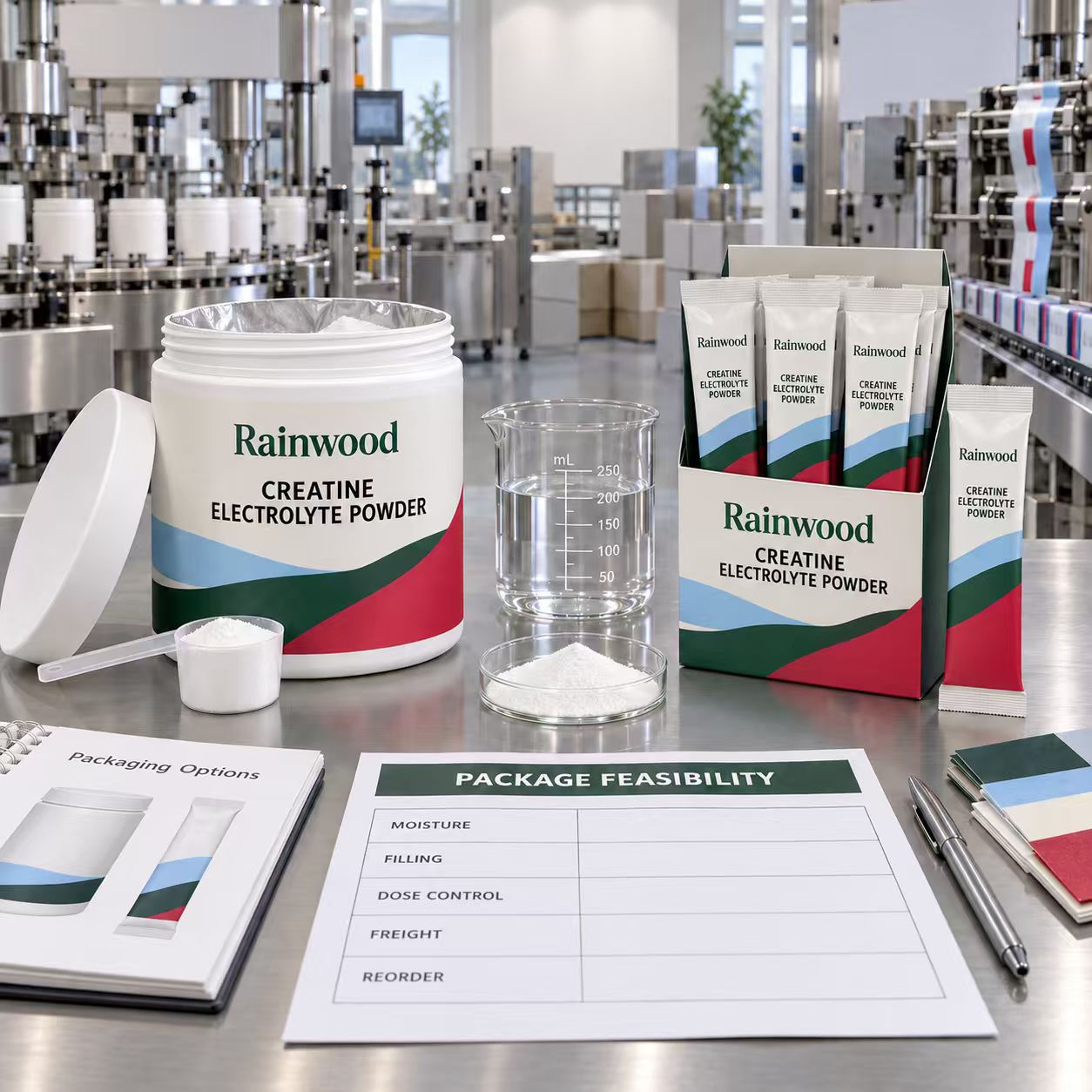
Meta title: Creatine Electrolyte Stick Pack or Tub Guide
Meta description: Stick packs and tubs create different moisture, dose, filling, shipping, and reorder risks for creatine electrolyte powders.
The product team wants a premium tub for subscription customers. The distributor wants portable stick packs. Both packages can hold the same creatine electrolyte powder, but they do not create the same manufacturing, moisture, dose, or customer-use conditions.
Creatine salts, mineral salts, sweeteners, acids, and flavors can respond differently to humidity and repeated opening. A tub may be opened dozens of times in a humid gym. A stick pack may protect each serving better but demand tighter filling and seal control. The packaging choice can change caking, scoop accuracy, shipping cost, sensory life, and reorder behavior.
Packaging begins with the powder profile
Before choosing the container, record:
- moisture and water-activity targets;
- hygroscopicity and caking tendency;
- particle size and bulk density;
- flavor and acid system;
- serving weight and expected fill tolerance;
- number of openings or use occasions;
- storage climate and transport route.
Use our creatine electrolyte packaging specification guide to compare package performance with the actual powder, not with a generic sports supplement.
Tub: flexible serving, repeated moisture exposure
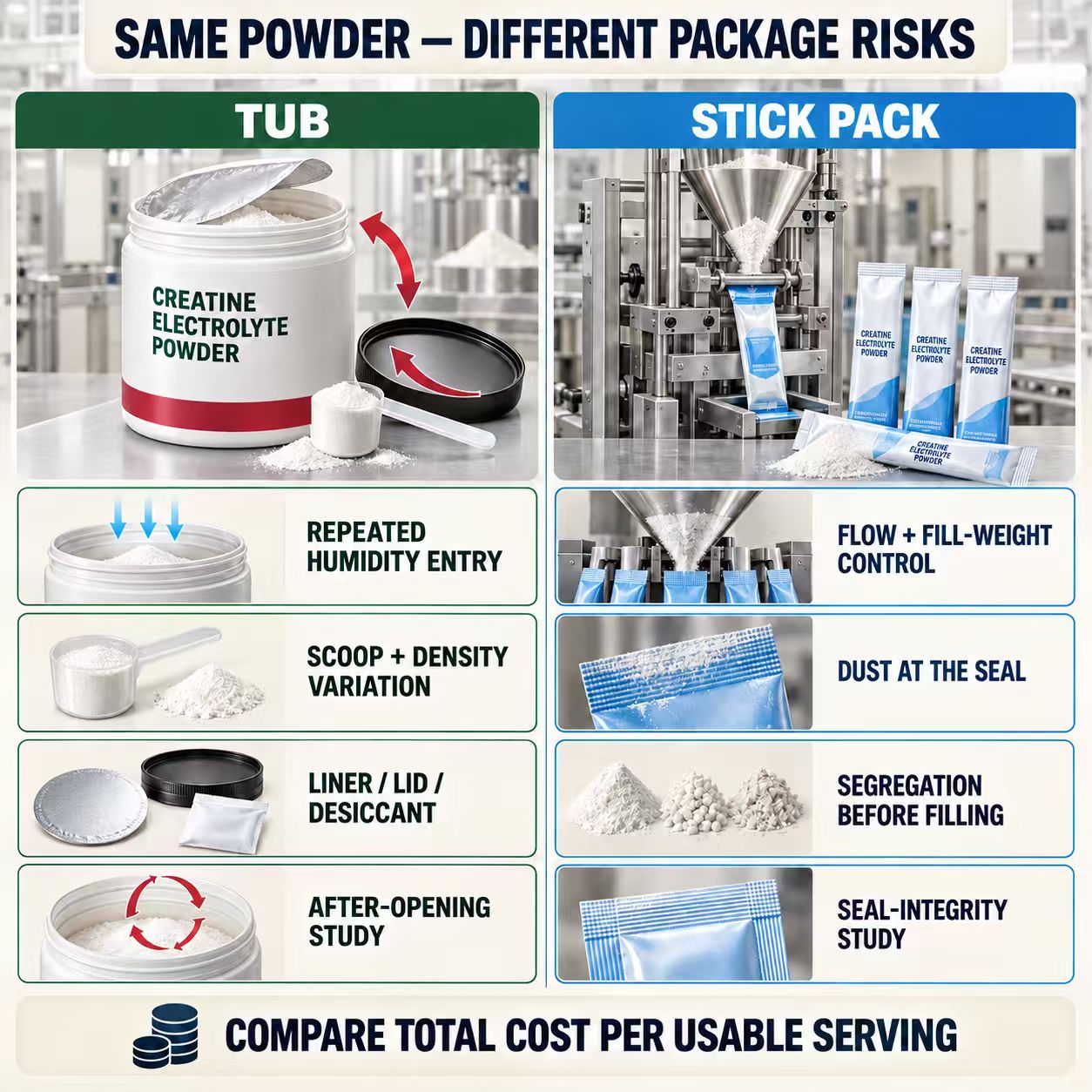
A tub can support a large serving, a scoop, and a lower per-serving packaging cost. It also exposes the blend to repeated air and humidity entry. The scoop may be wet, the lid may not be closed fully, and the powder can compact or clump over time. If density changes, a scoop that delivered the expected mass on day one may not behave the same way later.
Test the liner, closure, desiccant, headspace, and scoop. Simulate repeated opening and closing in the destination climate. Record caking, flow, color, odor, and scoop-weight variation. A tub that protects the powder for one month in a dry warehouse may fail during a humid summer subscription cycle.
Stick pack: portion control, higher filling demands
Stick packs can improve portion accuracy, portability, and moisture isolation after sealing. The trade-off is more packaging material, tighter fill-weight control, seal integrity requirements, and sensitivity to powder flow. A fine mineral blend can create dust at the seal, leading to leaks or weak seals.
The buyer loss is a production line that runs slowly or rejects too many packs. If the blend segregates before filling, every pack may have a different creatine or electrolyte amount even though the total batch average passes. Validate the powder and the machine together.
Read the blend-uniformity and sample-to-bulk guide before deciding that a stick pack automatically solves dose control.
Packaging changes customer behavior
A tub encourages flexible scooping but relies on the customer to measure correctly. A stick pack gives a clearer portion but may be less convenient for a customer who wants half a serving or two servings in one bottle. The package also signals the use occasion: travel hydration, pre-workout convenience, or a daily sports ritual.
Match the package to the product promise. If the directions require a precise water volume and a full serving, pre-portioned packs may be easier to explain. If the formula is designed for flexible daily use, a tub may be more practical, but the scoop and moisture instructions must be clear.
The moisture and shelf-life plan
Do not approve a shelf life based only on the dry raw-material COAs. Test the final blend in the final package under realistic storage and transport conditions. Monitor moisture, water activity where relevant, flow, caking, seal integrity, assay, appearance, and sensory changes.
If the powder includes acids, sweeteners, or hygroscopic salts, test after opening and after humidity exposure. A product can pass sealed-package stability and still fail after the consumer repeatedly opens a tub.
Package cost is not the complete cost
Compare:
- packaging material and decoration;
- filling speed and line yield;
- seal or closure rejection;
- desiccant and liner;
- freight cube and case count;
- warehouse handling;
- customer dose accuracy;
- expected returns and reorder frequency.
A cheaper tub may increase returns if the powder clumps. A stick pack may cost more per unit but reduce waste and simplify portion control. Use cost per accepted, usable serving rather than cost per empty package.
Packaging decision table
| Question | Tub | Stick pack |
|---|---|---|
| Serving flexibility | High | Fixed portion |
| Moisture exposure | Repeated opening | Sealed individual units |
| Filling challenge | Scoop and tub fill | High-speed weight and seal |
| Customer control | Depends on scoop | Strong portion control |
| Shipping cube | Often efficient for bulk | More individual material |
| Best fit | Daily users and large formats | Travel, trial, and precise dosing |
The answer may be different for different markets or channels. Test the package that will actually be sold.
How RainwoodBio can validate the package with the powder and line
RainwoodBio publishes powder, stick-pack and sachet formats, packaging, logistics, testing and release documentation, requirement confirmation, and traceability. For a creatine electrolyte blend, the relevant capability is comparing package barrier, filling behavior, and finished-serving consistency before a large packaging order.
Request a creatine electrolyte tub-versus-stick-pack feasibility review with powder flow data, serving weight, climate, shipment route, package size, and forecast volume.
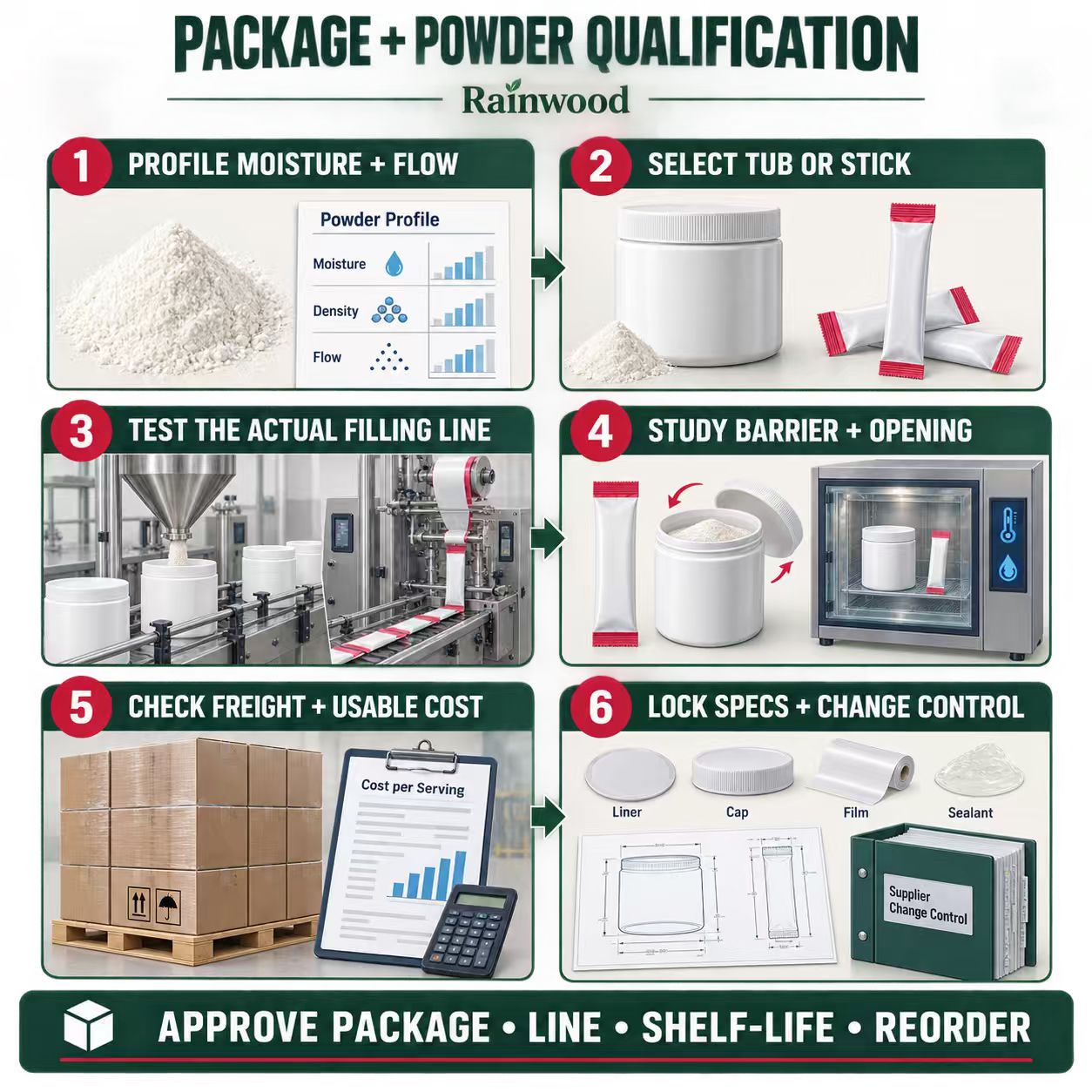
The packaging approval gate
Before launch, confirm:
- powder moisture and flow fit the filling equipment;
- package barrier and closure or seal are validated;
- dose uniformity is checked across the run;
- repeated opening or transport conditions are simulated;
- shelf-life data use the final blend and final package;
- directions match the customer’s measuring method;
- package cost includes rejection, freight, and handling.
Send your powder COA, package drawings, target serving, shipping climate, and filling plan for a creatine electrolyte packaging-risk review. RainwoodBio can help identify whether the package protects the product or merely makes it look more premium.
Reorder continuity depends on the package specification
Do not approve a new liner, film, cap, sealant, or desiccant only because the supplier says it is equivalent. Compare barrier data, seal performance, dimensions, filling settings, and storage results. A package change can alter the amount of moisture the powder sees during shipping, even when the formula and COA remain unchanged. Put packaging components and approved suppliers into the change-control file. If the brand sells across several climates, keep the package decision linked to the route and warehouse condition rather than treating one material as universally protective.
Frequently asked questions
1.Is a tub always cheaper than stick packs?
Not after filling speed, rejection, serving waste, freight, and customer returns are included. Compare the total cost per usable serving.
2.Can I use the same powder flow specification for both formats?
Not necessarily. Stick-pack filling and tub filling expose different risks. Validate the powder with the actual equipment.
3.Do desiccants solve all tub caking problems?
No. Seal, liner, headspace, opening behavior, powder moisture, and humidity all matter. Use a complete package and storage study.
References
- TGA, compositional guidance for hydrolysed chicken cartilage extract as an example of powder specifications: https://www.tga.gov.au/resources/resources/compositional-guidelines/hydrolysed-chicken-cartilage-extract
- NIH Office of Dietary Supplements, Exercise and Athletic Performance: https://ods.od.nih.gov/factsheets/ExerciseAndAthleticPerformance-HealthProfessional/
- RainwoodBio OEM information: https://www.rainwoodbio.com/oem
This article is for B2B procurement and educational purposes. Packaging, moisture, stability, dose, safety, labeling, analytical, and regulatory requirements must be confirmed for the exact blend, package, equipment, and destination market.