 EN
EN

Meta title: Glucosamine Chondroitin MSM Ratio: Evidence or Label Theatre?
Meta description: How B2B buyers audit joint-formula ratios, ingredient forms, daily amounts, serving compliance, evidence match, capsule fit, and cost.
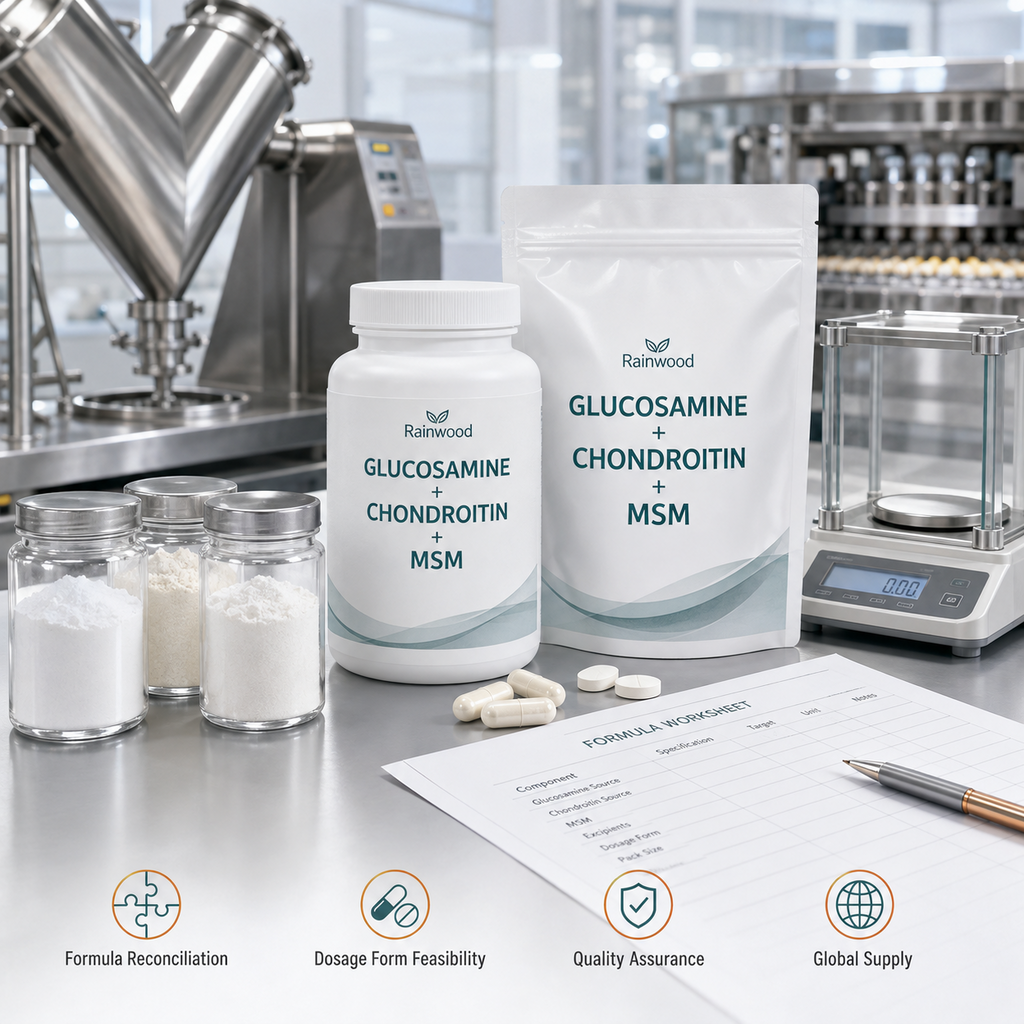
Many joint formulas display three large numbers as if the ratio itself were a proven recipe. Competitors copy it. Factories quote it. Buyers compare it. Nobody asks whether the numbers describe raw-material inputs, active equivalents, per-capsule amounts, or a full daily serving consumers are expected to take.
A familiar ratio can be a useful market benchmark. It is not automatically a scientifically validated formula.
The risk is label theatre: recognizable ingredients and impressive numbers arranged to look evidence-led while the underlying forms, doses, serving, and evidence do not reconcile.
A ratio without definitions is not a formula
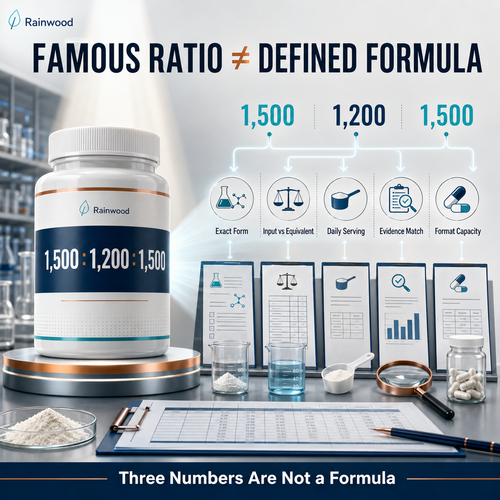
“1,500:1,200:1,500” may appear precise, but a buyer still needs to ask:
- 1,500 mg of which glucosamine form?
- Is the amount raw material or glucosamine equivalent?
- Is chondroitin reported as material input, assay-adjusted chondroitin sulfate, or something else?
- Is MSM amount per serving or per day?
- How many tablets, capsules, scoops, or sachets deliver the numbers?
- Do the cited studies use the same materials and regimen?
Ratios cancel important units and identities. Commercially, the formula is a set of exact materials, specifications, amounts, and directions—not three integers.
Use the glucosamine sulfate-versus-hydrochloride calculation to prevent the first number from being misread.
The five ways a famous ratio becomes misleading
1. Per-unit numbers are presented like daily amounts
A front panel may highlight an amount while the Supplement Facts or directions require three, four, or six units. Benchmark the daily serving and the number of servings consumers realistically use.
2. Commercial material mass is treated as active equivalent
Stabilized glucosamine sulfate complexes include counterions. Chondroitin material has its own assay basis. A formula sheet must distinguish input from declared constituent. Otherwise two products with the same headline number can contain different amounts of the intended component.
3. Ingredient forms are ignored
Glucosamine HCl, glucosamine sulfate preparations, and N-acetyl glucosamine are not interchangeable names. Chondroitin source and analytical profile matter. MSM assay and chromatographic purity are different quality questions. A copied ratio does not resolve any of them.
4. Evidence is assembled ingredient by ingredient
Three separate citations do not prove that the three-ingredient blend has the promoted combined effect. Study materials, doses, populations, endpoints, duration, and formula matrices must be matched honestly.
5. The amount cannot fit the promoted format
Gram-level totals do not disappear because the label promises two capsules. Reducing every ingredient until the blend fits preserves the visual ratio while destroying the intended daily amounts.
Run the joint-formula capsule-fit reality check before approving the front label.
Start with a line-by-line formula ledger
For each ingredient, record:
| Field | Required answer |
|---|---|
| Exact chemical/material identity | Not a generic family name |
| Upstream manufacturer and site | Traceable supply chain |
| Source | Animal, marine, fermentation, or specified botanical source |
| Raw-material specification | Revision-controlled |
| Assay or standardization | Method and basis |
| Input per unit | Actual manufacturing input |
| Input per daily serving | Unit input multiplied by directions |
| Declared component/equivalent | Calculation and label basis |
| Evidence preparation and amount | Exact match or stated gap |
| Overages | Justified, controlled, and labeled correctly |
| Finished test | Suitable for the complete matrix |
This ledger exposes formulas that are cosmetically comparable but chemically different.
Benchmark by job, not by imitation
Ask what the formula is supposed to do commercially:
- compete directly with traditional mass-market joint products;
- offer a compact capsule format;
- create a premium high-dose powder;
- emphasize source transparency;
- target active-lifestyle support;
- build a botanical or collagen-centered alternative.
Each job creates different priorities. A compact capsule may require fewer gram-level actives. A powder can carry more mass but must solve taste and packaging. A source-led formula needs deeper traceability. A traditional benchmark needs disciplined comparison of forms and daily amounts.
The best formula is not the one that copies the most familiar ratio. It is the one whose materials, serving, evidence, cost, and claim all support the chosen job.
Do the “consumer actually takes it” test
A technically adequate daily amount can become commercially fictional when it requires an unattractive unit count. Review:
- capsule or tablet size;
- units per serving and servings per day;
- days of supply per package;
- cost per day;
- directions complexity;
- taste and volume for powders;
- likely consumer adherence;
- whether marketing presents the full burden clearly.
If the study regimen requires a consumer behavior your product is unlikely to achieve, the evidence match is weaker in practice—even if the arithmetic is correct.
Review the MSM study-to-formula evidence bridge before placing “clinically studied” near the ratio.
The cheap-ratio trap
A supplier can quote the familiar ratio at a surprisingly low price by changing what the numbers mean. Warning signs include:
- glucosamine form omitted;
- chondroitin source or assay method missing;
- percentages shown without calculation basis;
- low bulk input masked by “equivalent” language that is not reconciled;
- per-capsule price compared with a competitor's per-serving price;
- finished testing limited to easy-to-measure ingredients;
- token additions of premium actives for front-label recognition;
- no stability or method-suitability plan.
Calculate landed cost per released, compliant daily serving. Add testing, packaging, scrap, freight, and evidence costs. A cheap bottle can become expensive when the claim must be removed or the formula must be remade.
How RainwoodBio can support a ratio audit
RainwoodBio publishes glucosamine and glucosamine-plus-chondroitin product pages and describes custom formula development, sampling, manufacturing, testing, packaging, and documentation. The published examples do not prove that one ratio, form, or ingredient source is suitable for every project.
Ask RainwoodBio to produce:
- exact form and source options for each hero ingredient;
- input-to-declaration reconciliation;
- capsule, tablet, or powder feasibility options;
- a daily-serving and days-of-supply comparison;
- representative specifications and available COAs;
- proposed raw and finished testing;
- evidence-match gaps and claim-review questions;
- cost per compliant daily serving at target volumes.
Use RainwoodBio's published requirement and sampling workflow to review at least two formula alternatives before locking the ratio.
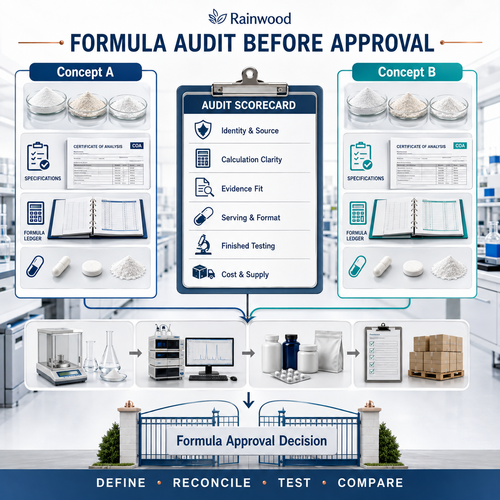
The approval scorecard
Score each concept from zero to two on:
1. exact ingredient identity;
2. calculation clarity;
3. evidence fit;
4. serving feasibility;
5. finished-test feasibility;
6. source and change control;
7. compliant differentiation;
8. cost per daily serving;
9. consumer usability;
10. supply reliability.
A famous ratio that scores poorly is still a poor product. A different ratio that scores strongly may be easier to defend and sell.
Request a glucosamine-chondroitin-MSM formula audit. Send RainwoodBio the benchmark label, exact target amounts and bases, destination, dosage form, maximum unit count, full evidence references, source requirements, testing expectations, target retail price, pack size, and volume. The team can return a comparison that shows what every number means.
Frequently asked questions
1.Is there one universally proven glucosamine-chondroitin-MSM ratio?
Do not assume so. Evidence depends on the exact materials, amounts, regimen, population, outcomes, and study design. Review the totality for the intended product and claim.
2.Can we reduce all three ingredients proportionally to fit two capsules?
That preserves a mathematical ratio, not necessarily an evidence-aligned or commercially meaningful formula. Reassess the brief, claims, and serving.
3.Should ratios appear on the front label?
Only if the presentation is accurate, not misleading, and compliant. Exact required declarations and context depend on the market.
4.Is more MSM always better?
No. Select the amount using evidence, safety, formula role, serving, tolerability, and market review—not competitive number escalation.
5.Can raw-material COAs prove the final ratio?
They help control inputs but do not establish weighing, blend uniformity, finished content, stability, or consumer directions. Use production records and suitable finished-product controls.
References
- USP Glucosamine, Chondroitin Sulfate Sodium, and MSM Tablets: https://doi.usp.org/USPNF/USPNF_M2189_01_01.html
- NCCIH, Glucosamine and Chondroitin for Osteoarthritis: https://www.nccih.nih.gov/health/glucosamine-and-chondroitin-for-osteoarthritis-what-you-need-to-know
- NCCIH, Complementary Health Approaches for Osteoarthritis: https://www.nccih.nih.gov/health/tips/things-to-know-about-complementary-health-approaches-for-osteoarthritis
- RainwoodBio glucosamine powder page: https://www.rainwoodbio.com/hot-sale-glucosamine-powder-high-quality-pure-glucosamine-powder
- RainwoodBio glucosamine and chondroitin capsule page: https://www.rainwoodbio.com/oem-odm-glucosamine--chondroitin-sulfate-capsules-500mg-glucosamine--chondroitin-sulfate-capsules
*This article is for international B2B formulation and educational purposes. Ingredient forms, sources, amounts, equivalents, specifications, methods, evidence, serving, dosage form, finished testing, labels, claims, and regulatory requirements must be confirmed for the exact formula, product, and destination market.*