 EN
EN

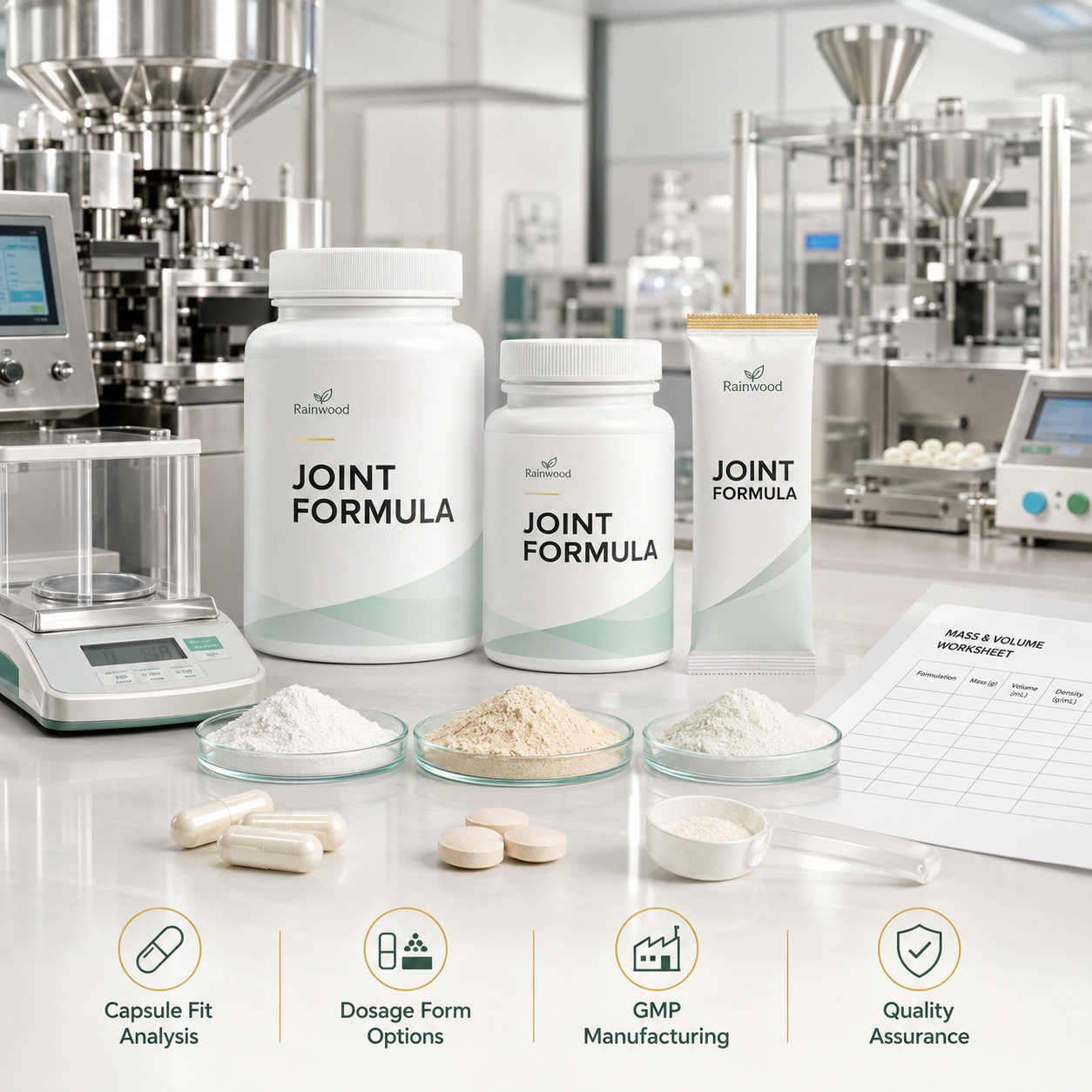
Meta title: Your Joint Formula Will Not Fit in Two Capsules—Now What?
Meta description: A B2B feasibility guide for glucosamine, chondroitin, MSM, capsule fill, serving count, excipients, testing, cost, and label approval.
The product brief promises glucosamine, chondroitin, MSM, botanical extracts, and minerals in two easy capsules per day. The front-label numbers look competitive. Then the manufacturer calculates the blend and delivers the answer nobody wants:
It will not fit.
This is not a minor production inconvenience. If serving feasibility is checked after artwork, the brand must reduce ingredient amounts, raise capsule count, enlarge the dosage form, remove ingredients, or misalign the formula with its evidence and positioning.
Joint-support products are especially vulnerable because several familiar ingredients are used at hundreds or thousands of milligrams per daily serving.
The fastest reality check is simple mass balance
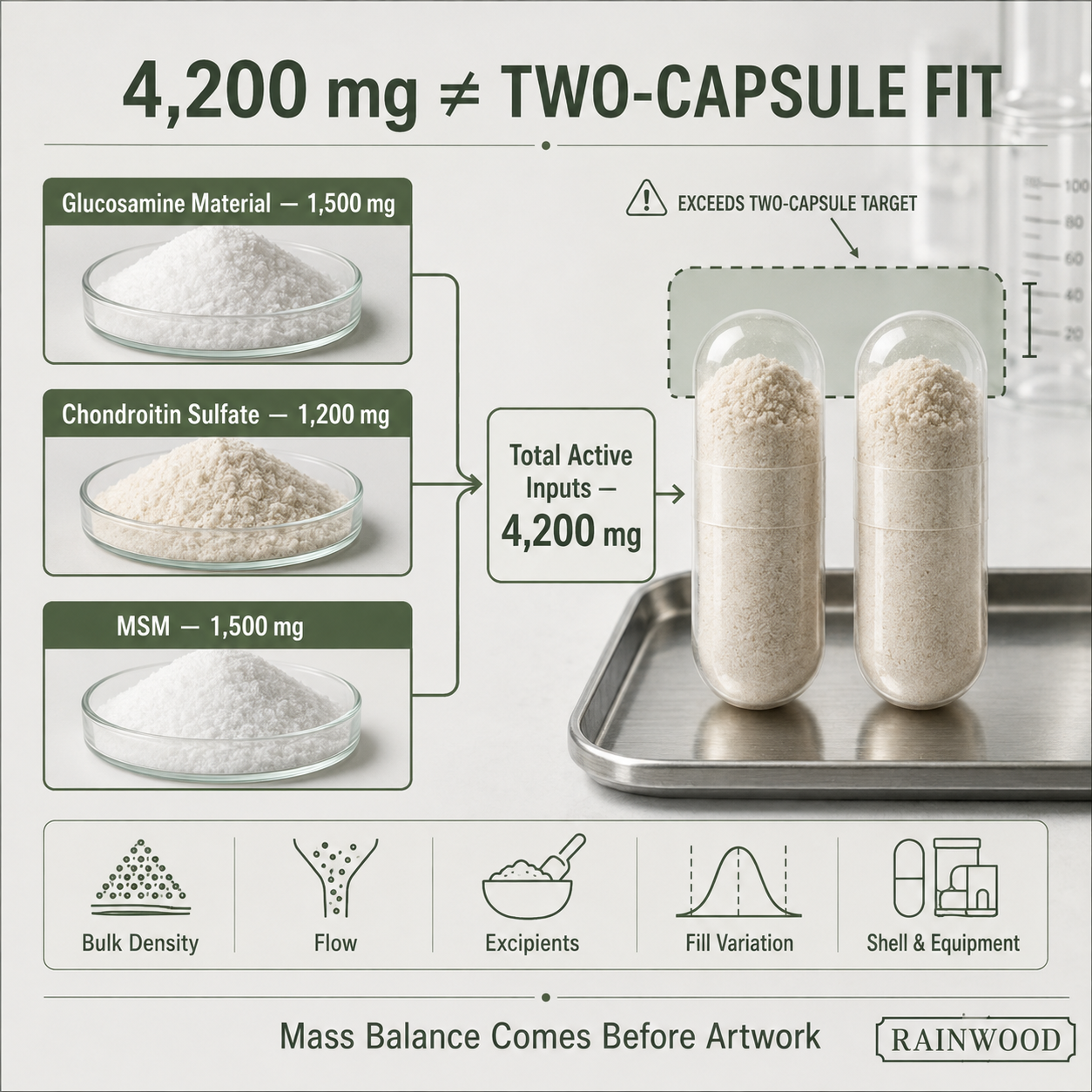
Consider a concept with these illustrative daily inputs:
- 1,500 mg glucosamine material;
- 1,200 mg chondroitin sulfate material;
- 1,500 mg MSM.
That is 4,200 mg of active inputs before flow aids, lubricants, carriers, overages, shell weight, or additional ingredients. A two-capsule serving would require an average of 2,100 mg of actives inside each capsule.
That arithmetic does not by itself select a capsule size or prove manufacturability. It exposes the gap between the marketing brief and physical reality. Actual fill depends on capsule size, allowable shell, powder bulk and tapped density, particle profile, flow, compressibility, blend behavior, equipment, and fill-weight variability.
Do the glucosamine form and equivalent calculation first; otherwise even the 4,200 mg input total may be defined incorrectly.
Label amount is not the only mass in the capsule
A development sheet should separate:
1. raw-material input per serving;
2. declared component or equivalent per serving;
3. assay adjustment and justified overage;
4. carriers already present in standardized ingredients;
5. processing excipients added to the blend;
6. target fill weight per unit;
7. number of units per serving.
For example, a standardized botanical can require more material than its highlighted constituent amount. A stabilized glucosamine sulfate complex contains more than parent glucosamine. A low-bulk-density powder can occupy more volume than its weight suggests. A neat spreadsheet total can therefore understate the required capsule volume.
Use the glucosamine counterion reconciliation before locking the nutrition and ingredient panels.
Why “just use a bigger capsule” often fails
Larger capsules can create consumer swallowing concerns, packaging changes, equipment limitations, slower filling, higher shell cost, or retailer resistance. They may still not accommodate the formula.
The team must evaluate:
- available capsule sizes and shells;
- target consumer and swallowing expectations;
- shell source and claim requirements;
- powder density and flow under production conditions;
- weight variation and content-uniformity strategy;
- bottle count, desiccant, closure, and pack dimensions;
- daily serving directions and adherence burden;
- production speed, yield, and cost.
A prototype that can be hand-filled is not proof that a commercial batch will run consistently.
Five legitimate ways to solve the problem
1. Increase the daily unit count
Four or six capsules can preserve ingredient amounts, but the label, bottle count, cost per day, and consumer experience change. Benchmark the actual daily serving, not the front-of-pack capsule count.
2. Move to tablets
Tableting can provide a different mass and volume solution, but high-load tablets may be large and difficult to compress or swallow. Disintegrants, binders, lubricants, hardness, friability, disintegration, coating, and tooling become central.
3. Use a powder or sachet
A drink mix can carry gram-level actives more naturally. It introduces flavor, solubility or suspension, odor, mouthfeel, sweetener, moisture, scoop or sachet accuracy, and packaging challenges. MSM and glucosamine do not make every botanical sensory issue disappear.
4. Prioritize the formula
Remove decorative ingredients or reduce the number of hero actives. A shorter formula at an evidence-aligned and manufacturable amount may be stronger than a long label filled with token quantities.
5. Build a day-and-night or multi-format system
Separating ingredients across products can solve physical or sensory conflicts, but it complicates instructions, compliance, packaging, stability, and cost. Use it only when the commercial story justifies the complexity.
RainwoodBio's published OEM workflow places formula development and sample confirmation before production; serving feasibility should be a written output of those stages.
The prototype must test more than “it fits”
An early feasibility sample should answer:
- Can the blend flow and fill on the intended equipment?
- What is the achieved average fill weight and variation?
- Does the blend segregate?
- Are identity and assay methods suitable for the full matrix?
- Can the finished product meet physical and microbiological specifications?
- Does the capsule remain stable through the intended shelf life?
- Does the consumer accept the unit size, count, odor, and directions?
If the formula includes chondroitin, complex matrix testing deserves special attention. A raw-material COA does not establish finished-product recovery in a multi-ingredient blend.
See why a chondroitin release method can be fooled or misapplied before selecting the finished test plan.
Cost must be calculated per compliant daily serving
Capsule quotes can mislead when one supplier prices per bottle and another prices per thousand capsules. Normalize:
- active and excipient cost per daily serving;
- shell cost per daily serving;
- manufacturing and testing cost per daily serving;
- packaging cost at the required bottle count;
- freight impact from larger bottles or sachet cartons;
- expected yield and scrap;
- consumer days of supply;
- retailer margin and target retail price.
A three-capsule product in a 90-count bottle provides only 30 days. A six-capsule serving doubles the count needed for the same days of supply. The formula decision becomes a packaging and working-capital decision.
How RainwoodBio can support a feasibility gate
RainwoodBio publishes capsule and joint-product pages and describes custom formulation, sample confirmation, production, testing, packaging, and documentation. Those pages do not prove that any requested ingredient load will fit a chosen capsule count or that a specific formula has passed stability and finished-product testing.
For a real quote, ask RainwoodBio to provide:
- a line-by-line input and declaration calculation;
- estimated blend mass and volume per serving;
- proposed capsule size, shell, count, and target fill weight;
- assumptions for densities, excipients, and overages;
- bench or pilot sample results;
- manufacturing and finished-testing risks;
- bottle count, days of supply, MOQ, and landed-cost inputs;
- alternatives with explicit tradeoffs.
Review the published glucosamine and chondroitin capsule example as a starting point, then request a project-specific feasibility calculation.
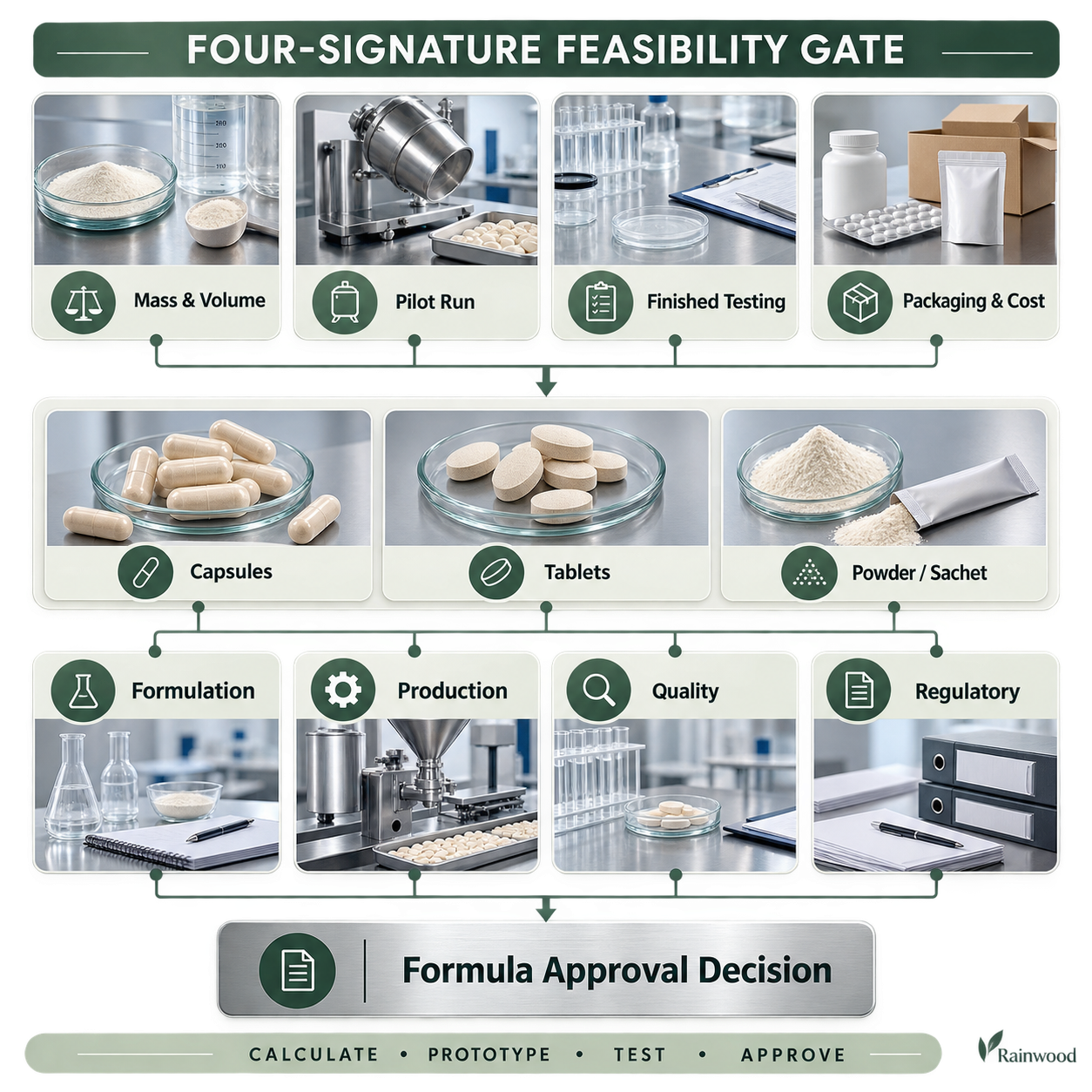
Approve a formula only after these four signatures
Formulation approves the chemical and physical mass balance. Production approves process feasibility. Quality approves specifications and test strategy. Regulatory approves label basis, directions, and claims.
Marketing should approve the final consumer proposition only after seeing the unit size, serving count, and daily cost. This prevents a front label from becoming an impossible manufacturing instruction.
Request a joint-formula capsule-fit calculation and sample plan. Send RainwoodBio every raw-material specification, target amount and declaration basis, daily serving, maximum capsule count, preferred shell, market, claims, bottle size, pack count, annual volume, and target cost. The team can return feasible capsule, tablet, or powder options with the compromises visible.
Frequently asked questions
1.How many milligrams fit in a capsule?
There is no universal answer. Capacity depends on capsule size and the blend's bulk behavior, flow, equipment, and acceptable fill variation. Use measurements from the proposed blend.
2.Can higher-density ingredients solve the problem?
They may improve volume efficiency, but source, identity, processing, evidence, and specification cannot be changed only to increase density. Revalidate the full product.
3.Can we remove excipients to create space?
Sometimes excipient levels can be optimized, but removing functional excipients can damage flow, uniformity, filling, release, or stability. Confirm through trials.
4.Is a six-capsule serving commercially unacceptable?
Not automatically. It depends on audience, channel, price, competitive set, perceived value, unit size, and adherence. Test the proposition with the real pack and directions.
5.When should the label be designed?
Creative exploration can begin early, but final artwork should wait until formula, serving, specifications, claim basis, and required statements are approved.
References
- USP Glucosamine, Chondroitin Sulfate Sodium, and MSM Tablets: https://doi.usp.org/USPNF/USPNF_M2189_01_01.html
- USP Glucosamine Hydrochloride: https://doi.usp.org/USPNF/USPNF_M35200_05_01.html
- USP Glucosamine Sulfate Potassium Chloride: https://doi.usp.org/USPNF/USPNF_M35208_05_01.html
- RainwoodBio OEM service: https://www.rainwoodbio.com/oem
- RainwoodBio glucosamine and chondroitin capsule page: https://www.rainwoodbio.com/oem-odm-glucosamine--chondroitin-sulfate-capsules-500mg-glucosamine--chondroitin-sulfate-capsules
*This article is for international B2B formulation and educational purposes. Material input, equivalents, overages, serving, dosage form, excipients, manufacturing feasibility, specifications, test methods, stability, labels, claims, packaging, and regulatory requirements must be confirmed for the exact formula, batch, and destination market.*