 EN
EN
Meta title: Type II Collagen vs HA vs Boswellia vs Curcumin for Joint Formulas
Meta description: A B2B decision framework comparing type II collagen, oral hyaluronic acid, Boswellia, and curcumin by evidence, dose, format, testing, claims, and cost.
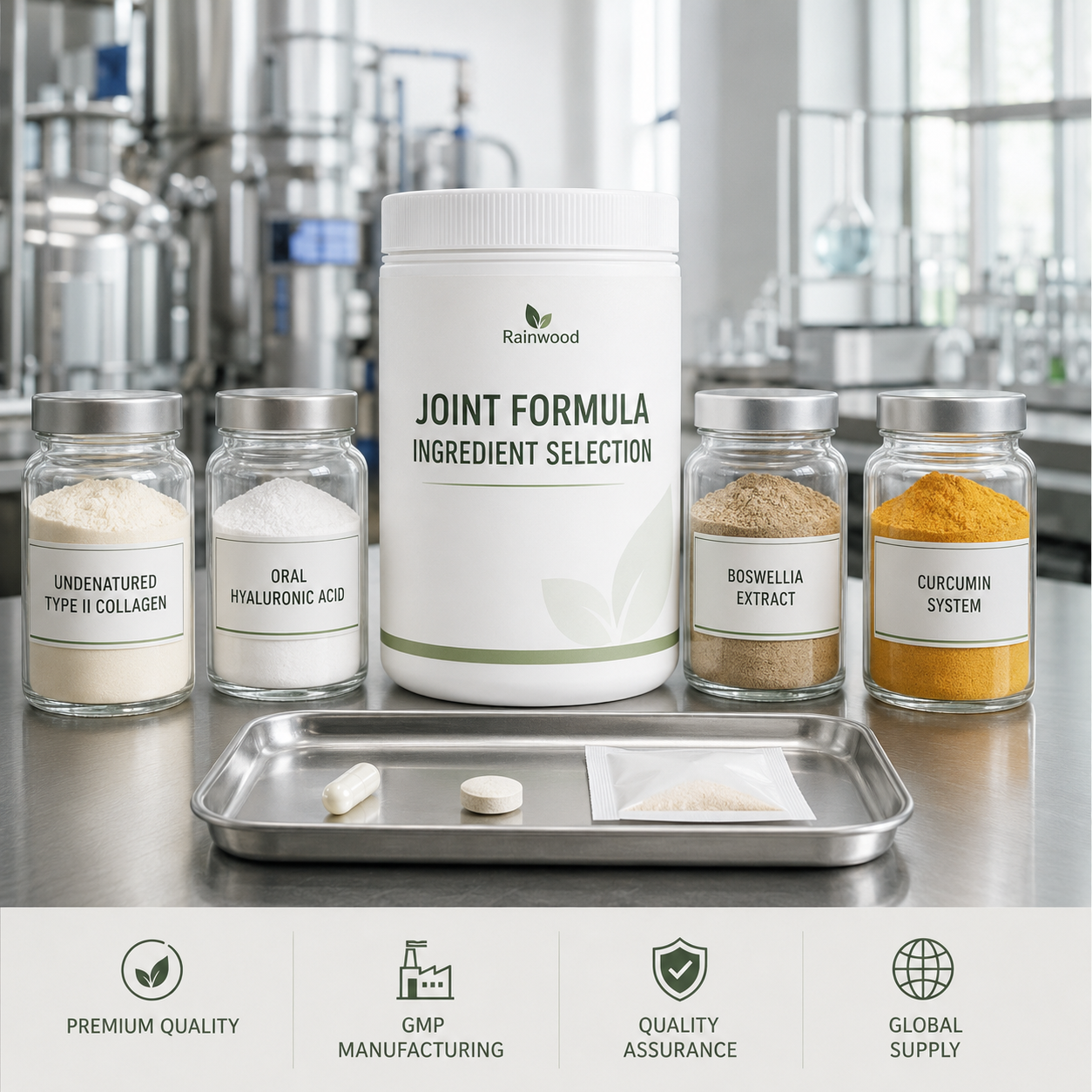
The easiest joint formula to design is the one with every fashionable ingredient. The hardest product to sell profitably is often that same formula.
Type II collagen, hyaluronic acid, Boswellia, and curcumin can each create a different commercial story. They also bring different identity questions, evidence limitations, daily amounts, sensory effects, test methods, source claims, and regulatory risks. Adding all four at token levels may produce an impressive ingredient panel and an indefensible product.
For brands and OEM buyers, the decision should be: **which ingredient best performs the product's chosen job?
First decide what you are replacing—or adding
Decide whether you need a compact alternative to gram-level actives, a premium addition to a traditional base, a botanical concept, a source-led story, or one clean hero. Each job changes the best candidate.
If you are replacing a traditional formula because it will not fit, run the joint-formula capsule feasibility calculation first. Do not solve a physical problem by creating an evidence problem.
Option 1: undenatured type II collagen
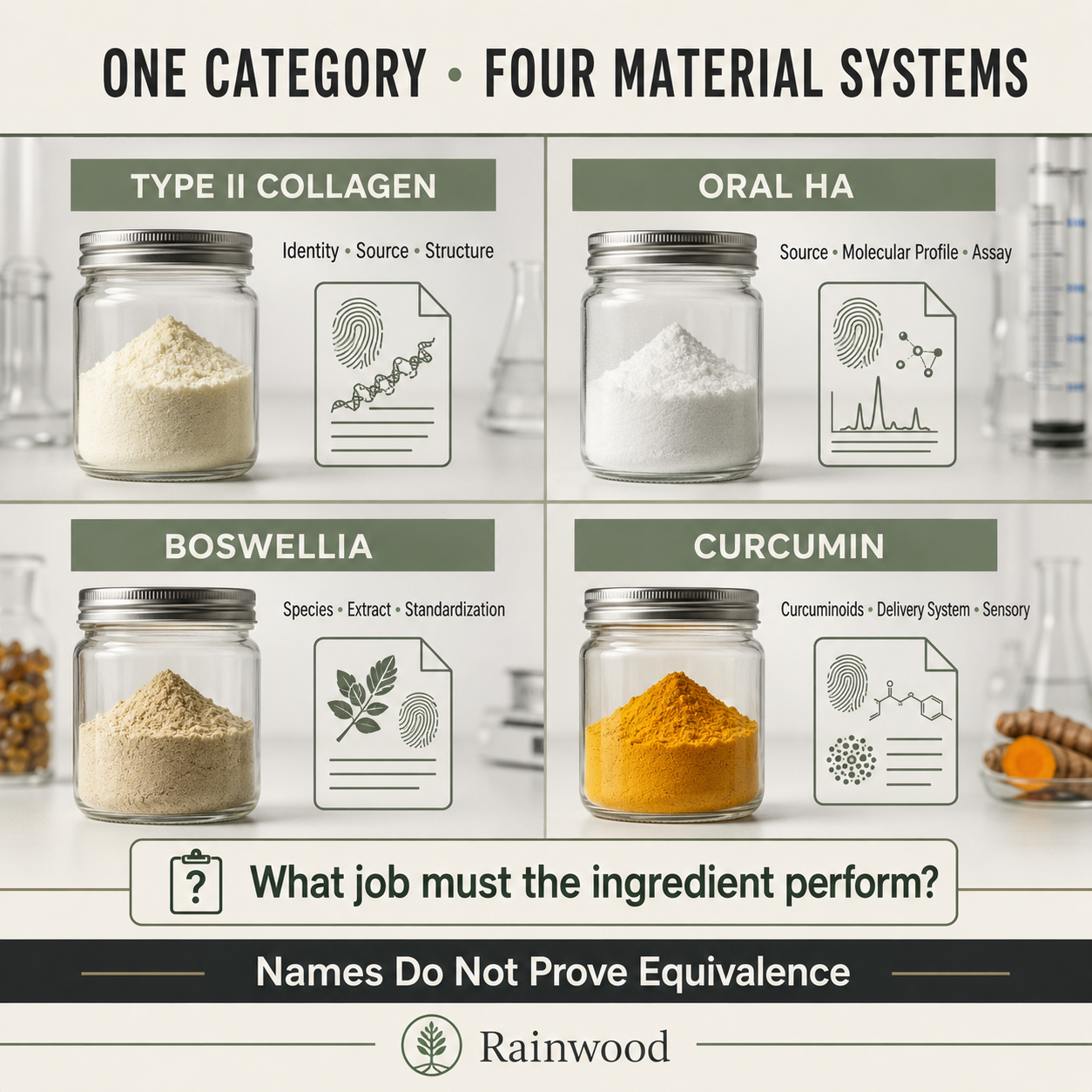
“Type II collagen” can refer to materially different products. Undenatured type II collagen is not the same as hydrolyzed collagen peptides, gelatin, or a generic collagen powder. The source, manufacturing conditions, preservation of the intended structural attributes, carrier system, specification, and study material matter.
Defined undenatured type II collagen products may be used at relatively low material amounts compared with gram-level traditional actives, which can suit compact capsules. That advantage belongs to the exact defined material and formulation—not to every powder labeled “type II collagen.”
Buyer checks
Verify undenatured versus hydrolyzed identity, animal tissue/species, manufacturer and site, carrier and active basis, analytical control of the relevant collagen attribute, study match, animal-origin documents, and processing conditions.
A 2023 meta-analysis reported potentially favorable findings for undenatured type II collagen but also emphasized the limited number of studies and need for more high-quality research. That supports careful evaluation, not a universal “clinically proven” claim.
Option 2: oral hyaluronic acid
Commercial materials may be described as hyaluronic acid or sodium hyaluronate and can differ by source, fermentation process, molecular characteristics, assay basis, and formulation. The ingredient name does not establish the molecular-weight distribution or equivalence to a studied product.
Oral HA can offer a differentiated joint-lubrication or connective-tissue story and may fit smaller servings than traditional gram-level actives, depending on the exact material and evidence brief.
Buyer checks
Verify form, fermentation or animal source, molecular profile where relevant, identity and assay, process-related risks, oral study material and daily amount, stability, and finished-method suitability.
A recent systematic review of oral hyaluronic acid evaluated human studies, but study heterogeneity and product differences still require an exact evidence bridge. “Oral HA has research” is not the same as “this HA formula is proven.”
Use the formula-study equivalence review whenever the HA source, molecular profile, amount, or co-ingredients change.
Option 3: Boswellia extract
Boswellia is not one uniform powder. Buyers may encounter different species, plant parts, extract ratios, solvents, standardized boswellic-acid profiles, AKBA-related specifications, proprietary extracts, and analytical methods. “10:1 extract” does not by itself state what chemical constituents are present.
Boswellia can anchor a botanical joint-positioning concept and may differentiate a formula crowded with glucosamine lookalikes. Some clinical research and meta-analyses report promising results, while variation in extracts and study quality limits simple product-wide conclusions.
Buyer checks
Verify species, plant part, solvent, native versus commercial extract ratio, standardized constituents and method, fingerprint and adulteration controls, relevant contaminants, exact study-material match, and sensory or processing impact.
Do not convert an extract ratio into an invented constituent percentage. Do not cite a proprietary standardized extract to support a generic Boswellia powder without establishing the bridge.
Option 4: curcumin or turmeric extract
“Curcumin,” “turmeric,” and “turmeric extract” can describe different products. Extracts may be standardized to curcuminoids and may use phospholipids, oils, micelles, polysaccharides, or piperine-containing systems intended to change exposure. These systems add their own ingredients, specifications, evidence, claims, and interaction questions.
Curcumin has strong consumer recognition and can support a broader active-lifestyle or botanical concept. It also brings intense color, potential staining, sensory effects, bioavailability-story complexity, and a crowded competitive field.
Buyer checks
Verify species, plant part, curcuminoid definition and method, full delivery-system composition, bioavailability comparator, piperine implications, relevant contaminants and adulteration, product amount, stability, finished testing, and claim fit.
NCCIH notes that evidence for turmeric/curcumin across health uses is still not definitive enough for broad conclusions. Avoid upgrading consumer familiarity into a treatment promise.
The decision matrix
Score candidates against the actual brief rather than a generic “best ingredient” ranking.
| Decision factor | Undenatured type II collagen | Oral HA | Boswellia extract | Curcumin system |
|---|---|---|---|---|
| Compact-capsule potential | Often attractive for defined low-input materials | Often potentially attractive | Depends on studied extract and amount | Depends heavily on material and delivery system |
| Animal-free positioning | Usually conflicts unless source proves otherwise | Possible with documented fermentation route | Possible with controlled botanical source | Possible with controlled botanical/excipient chain |
| Identity challenge | Conformation/type/source | Form/source/molecular profile | Species/extract/standardization | Species/curcuminoid/delivery system |
| Sensory impact | Often manageable; test exact carrier | Often manageable; test exact grade | Color/odor may matter | Strong color and staining can matter |
| Evidence transfer risk | High if genericized from defined material | High across molecular/source differences | High across extracts | High across bioavailability systems |
| Primary sourcing trap | Generic collagen substituted | HA name treated as one grade | Extract ratio treated as potency | “Enhanced absorption” borrowed |
| Best commercial role | Compact defined-ingredient hero | Differentiated HA/connective story | Botanical joint hero | Recognizable botanical platform |
These are decision prompts, not universal ratings. The exact supplier material may reverse an apparent advantage.
Do not solve differentiation with fairy-dust quantities
A formula may include all four ingredients so each can appear on the front label. If their amounts have no clear evidence or functional rationale, the label becomes a keyword collection.
For each ingredient, require one sentence:
> We selected this exact material at this exact daily input because it performs this defined role, supported by this evidence, and it can be controlled by this specification and finished-product plan.
If the team cannot complete the sentence, remove the ingredient or return to research.
Review the ratio-versus-label-theatre audit before combining the new hero with a traditional base.
Cost comparison must include evidence and testing
Compare cost per compliant daily serving, including carrier and assay-adjusted input, testing, trademark rights, dosage form, packaging, sensory work, stability, evidence review, MOQ, lead time, yield, and change-control risk. A high-price low-input material may cost less per bottle than a commodity ingredient used in grams.
How RainwoodBio can support ingredient selection
RainwoodBio describes custom formula development, samples, manufacturing, testing, packaging, and documentation. Its published pages do not prove that every adjacent joint ingredient, branded material, clinical dose, trademark, or test method is available for every project.
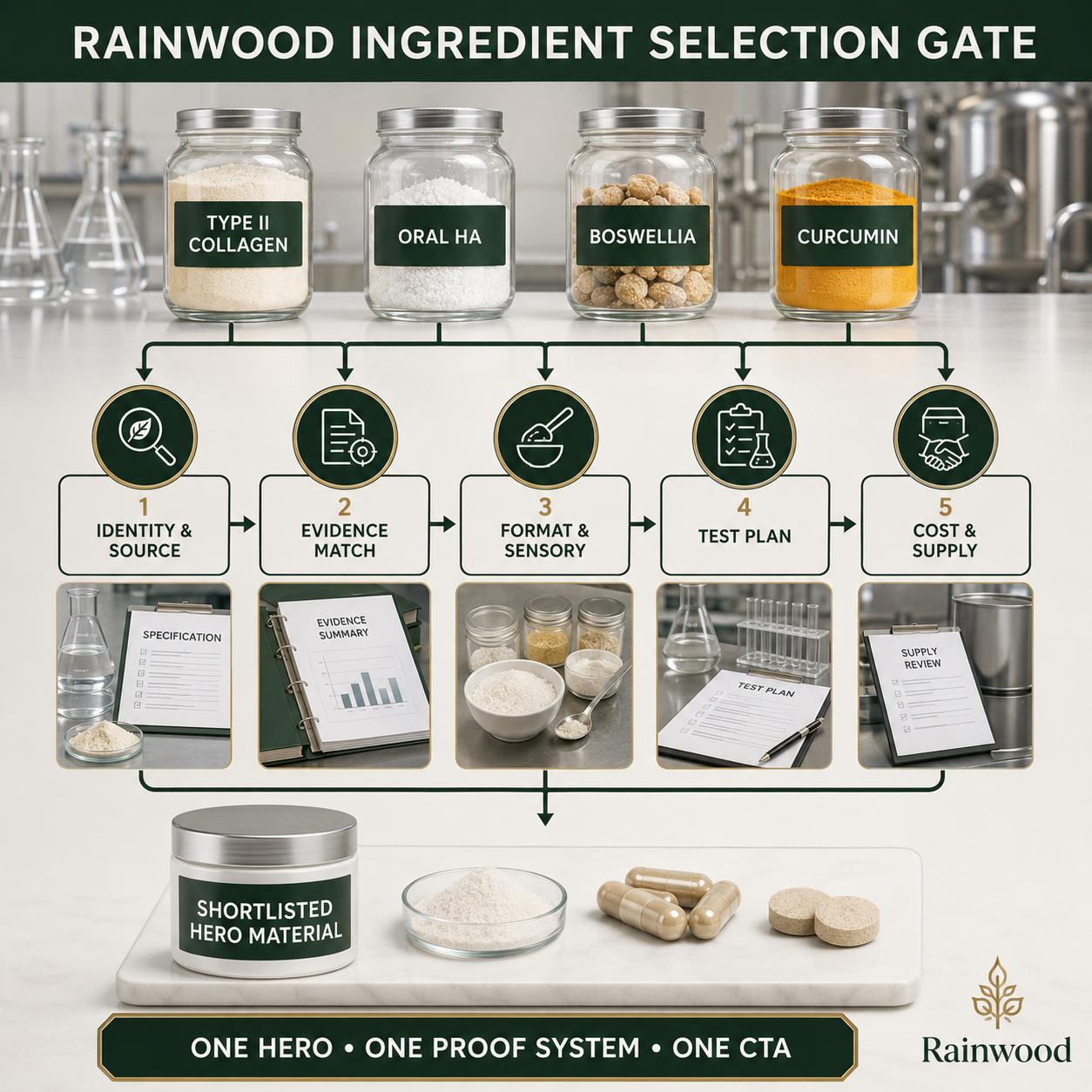
Ask RainwoodBio to compare candidate materials using:
- exact identity, manufacturer, site, source, and specification;
- representative COAs and claim documents;
- study-material and daily-amount match;
- capsule, tablet, powder, or softgel feasibility;
- sensory and processing observations from samples;
- raw and finished-product test plan;
- cost per compliant daily serving;
- MOQ, lead time, and change control.
Use RainwoodBio's published OEM process to turn the winning material into two or three sample concepts rather than approving from brochures.
Choose one hero, one proof system, and one CTA
A strong B2B joint product usually has a clear center. Make one ingredient or one coherent combination the hero. Build one traceable evidence and quality system around it. Then communicate one realistic consumer proposition.
Request a joint-ingredient shortlist and OEM feasibility review. Send RainwoodBio your target buyer, market, positioning, current formula, preferred source claims, maximum serving, dosage form, evidence standard, target cost, pack, volume, and launch date. The team can compare available type II collagen, HA, Boswellia, curcumin, and traditional joint options—without pretending every candidate is interchangeable.
Frequently asked questions
1.Is undenatured type II collagen the same as collagen peptides?
No. They are materially different product categories. Confirm identity, source, process, amount, specification, and evidence for the exact ingredient.
2.Does lower molecular weight make oral HA better?
Do not apply a universal ranking. Match the exact molecular specification and material to the intended function, studies, stability, and quality controls.
3.Is a high Boswellia extract ratio automatically stronger?
No. Extract ratio, standardized constituents, carriers, methods, and studied-material match answer different questions. Require a complete specification.
4.Does piperine make every curcumin product equivalent to an enhanced-bioavailability study?
No. Delivery systems, ratios, materials, regimens, and evidence differ. Piperine also creates formulation and review questions that should be assessed for the exact product.
5.Should we combine all four for broader appeal?
Only if every ingredient has a defined role, defensible amount, compatible format, suitable test plan, evidence rationale, and acceptable cost. More label names do not guarantee a better product.
References
- Meta-analysis of undenatured type II collagen for osteoarthritis: https://pubmed.ncbi.nlm.nih.gov/37854210/
- Systematic review of orally administered hyaluronic acid: https://pubmed.ncbi.nlm.nih.gov/39886281/
- Systematic review/meta-analysis of Boswellia for osteoarthritis: https://pubmed.ncbi.nlm.nih.gov/39314013/
- NCCIH, Turmeric: https://www.nccih.nih.gov/health/providers/digest/nutritional-approaches-for-musculoskeletal-pain-and-inflammation
- FTC, Health Products Compliance Guidance: https://www.ftc.gov/business-guidance/resources/health-products-compliance-guidance
- RainwoodBio OEM service: https://www.rainwoodbio.com/oem
*This article is for international B2B formulation and educational purposes. Ingredient identity, source, processing, standardization, specifications, methods, evidence, safety, interactions, dose, dosage form, stability, labels, claims, trademark rights, and regulatory requirements must be assessed for the exact material, formula, target consumer, and destination market.*