 EN
EN
Meta title: USP Grade Chondroitin and the Marine Source Spec Trap
Meta description: A USP claim can fail when the material source falls outside the monograph definition. Learn how marine chondroitin buyers should lock specification scope.
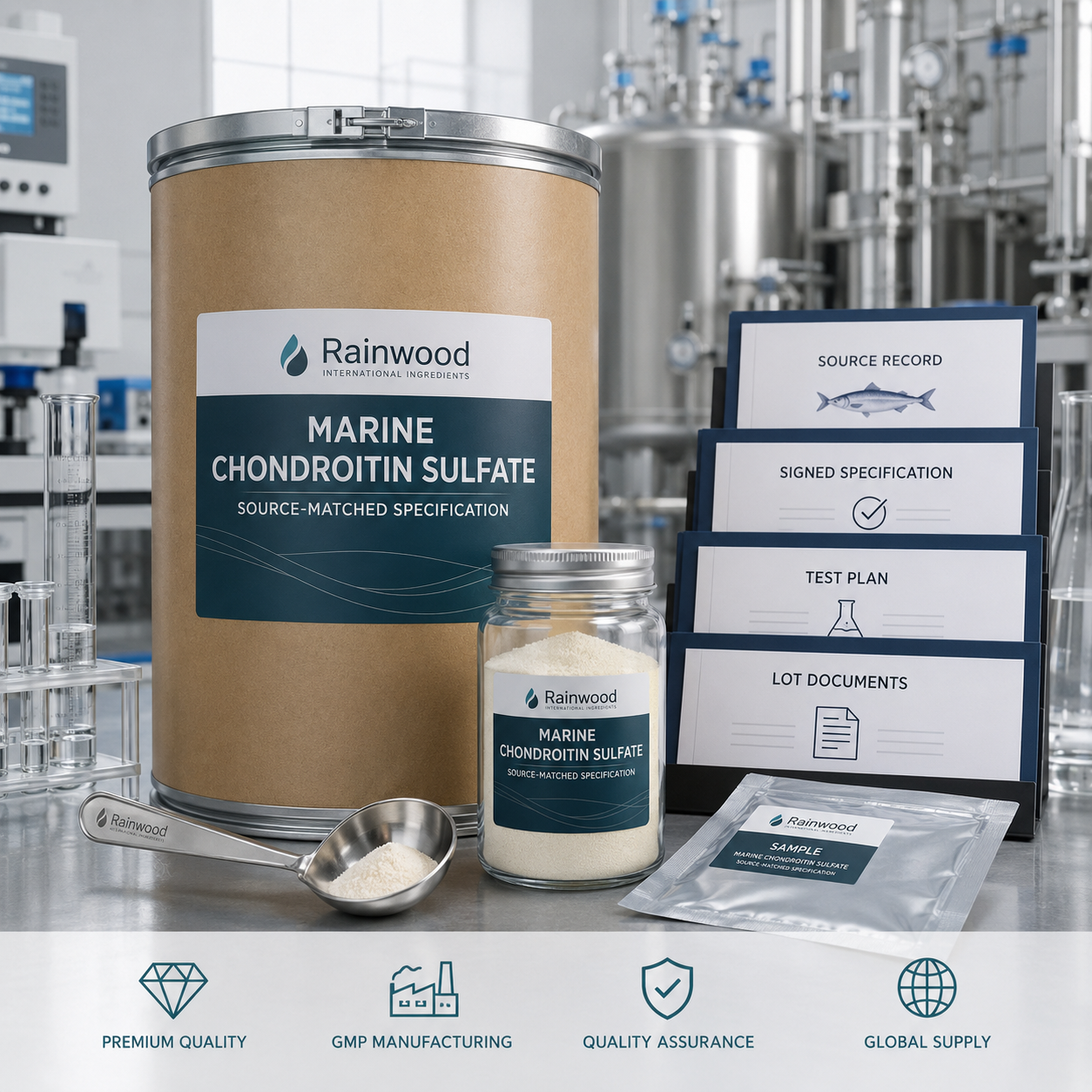
Your supplier offers “marine chondroitin sulfate, USP grade.” The phrase combines two powerful buying signals: a premium source and a recognized standard.
It may also combine two requirements that have not been reconciled.
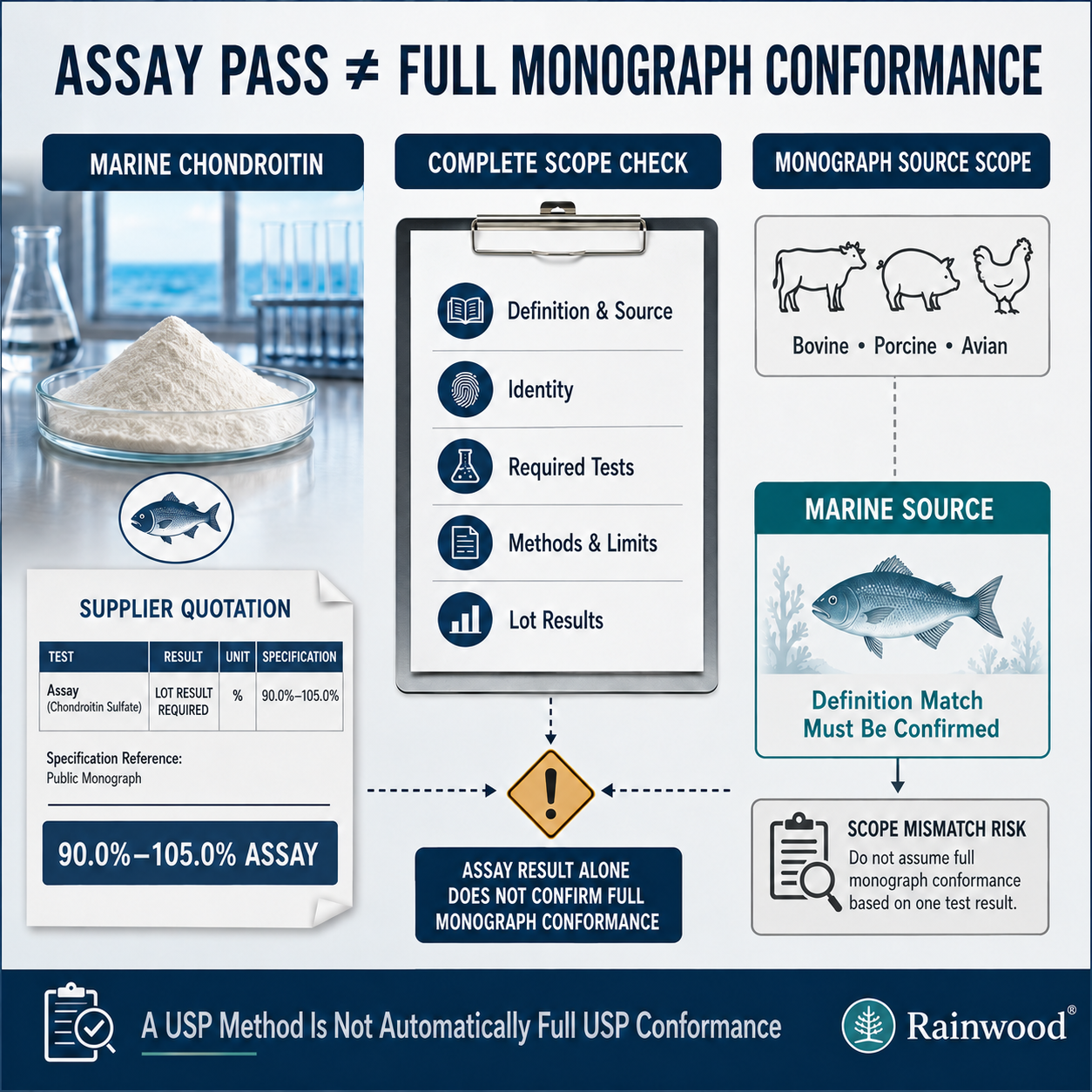
The public USP definition for Chondroitin Sulfate Sodium identifies material obtained from bovine, porcine, or avian cartilage. Marine chondroitin exists commercially and is discussed in scientific literature, but a buyer should not assume that the same USP claim automatically covers a fish or shark source.
For a marine-ingredient importer, the standard must match the material—not merely appear on the quotation.
A monograph is a complete scope, not a purity number
Buyers often reduce “USP” to the 90.0%–105.0% dried-basis assay range shown in the public preview. That is only part of the decision.
A compendial claim involves:
- the monograph title and current version;
- the definition and source scope;
- identity and other required tests;
- methods, reference standards, and acceptance criteria;
- calculation basis;
- actual lot results;
- applicable compendial and regulatory interpretation.
If the material does not fit the monograph definition, passing one numerical test does not solve the mismatch. “Tested by a USP method” is also not necessarily the same as “conforms to the USP monograph.” Those phrases communicate different scopes.
Review a source-matched chondroitin product specification before accepting grade language.
Marine is not one precise technical definition
“Marine chondroitin” can refer to materials from different species and tissues. Scientific reviews describe shark, skate, cartilaginous fish, and bony fish sources. Their polymer characteristics can vary.
Ask:
- Which species or controlled source category is used?
- Which tissue is processed?
- Is the source single, blended, or subject to change?
- Which salt and commercial grade are supplied?
- Which standard or customer specification governs it?
- How are source, identity, assay, molecular characteristics, contaminants, and microbiology controlled?
- Which sustainability, allergen, or religious claims are intended?
A broad marine label cannot answer those questions. The specification must turn the marketing category into an auditable product.
Read the source-evidence chain for bovine porcine avian and marine chondroitin before approving a claim.
Separate three legitimate specification routes
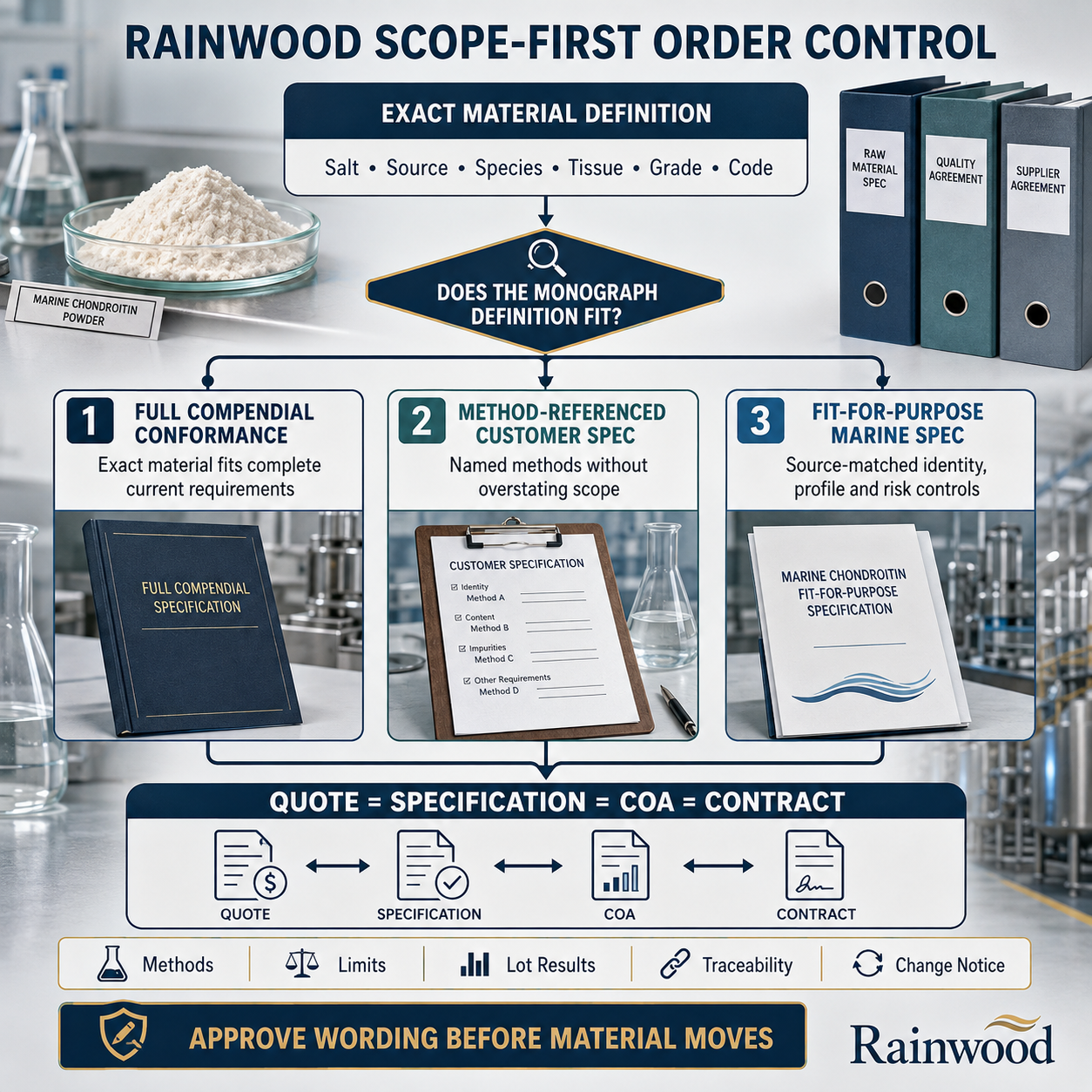
Route 1: Full compendial conformance
Use this route only when the exact material fits the current monograph definition and meets the complete applicable requirements. Verify the claim with qualified regulatory and quality personnel.
Route 2: Method-referenced customer specification
A buyer may use selected compendial or published methods within a customer specification. State exactly which methods or principles are used and avoid implying full monograph conformance when that is not established.
Route 3: Fit-for-purpose marine specification
Build a specification for the exact marine source, intended use, customer, and market. It can incorporate validated identity, quantitation, profile, contaminant, physical, microbiological, and document controls selected for the risk.
None of these routes is automatically “lower quality.” The weak route is the one whose language overstates its evidence.
Use a monograph-scope decision gate
| Question | Required evidence |
|---|---|
| What is the exact material? | Salt, source, species category, tissue, grade, code |
| Which standard is claimed? | Monograph title, jurisdiction, edition or current version |
| Does the definition fit? | Documented comparison of source and material definition |
| What is actually tested? | Full test list, methods, limits, and lot results |
| What wording is permitted? | Approved quotation, specification, COA, and label language |
| What remains customer-specific? | Additional source, contaminant, profile, or market requirements |
If the definition does not fit, stop using the grade claim until an appropriate specification and wording are agreed. The fix is not to hide the source. The fix is to describe the material accurately.
Explore RainwoodBio's published compliance-documentation workflow as a starting point, then request exact material and standard records for the proposed grade.
The commercial loss appears after the quote
A specification-scope error can produce:
- customer rejection during technical review;
- retesting against the wrong criteria;
- relabeling or quotation correction;
- delayed customs or registration documentation;
- lost premium-source positioning;
- disputes about whether the order met the contract.
The headline price rarely includes those costs. Put the approved standard, source, test package, and wording into the purchase order before material moves.
The chondroitin quotation normalization guide can help compare offers after scope is corrected.
How RainwoodBio can support a scope-first order
RainwoodBio's website describes requirement confirmation, supplier management, compliance documentation, testing and release, and traceability. It does not currently provide enough public product-level evidence to claim that every chondroitin source meets a named compendial standard.
For a marine project, ask RainwoodBio to provide or confirm:
- exact source and commercial material definition;
- proposed signed specification and claim wording;
- test methods, acceptance criteria, and lot document package;
- source traceability and change notification;
- certificate and market-document scope;
- finished-formula consequences for the intended product.
That evidence lets the article and quotation sell a real advantage without borrowing authority from a mismatched word.
Do not approve the purchase order until
- the material fits the claimed definition or the claim is corrected;
- source and standard are consistent across quote, specification, COA, and contract;
- selected methods answer the actual risks;
- extra customer and market requirements are listed;
- lot release and dispute criteria are agreed;
- source or standard changes require notification.
Request a chondroitin specification-scope review. Send RainwoodBio the quoted grade, source, supplier specification, COA, destination market, customer standard, dosage form, and annual quantity; the team can identify definition conflicts and prepare a corrected requirement list.
Frequently asked questions
1.Does a 90% result make marine chondroitin USP grade?
No. The assay range is only one element. The material must fit the monograph definition and meet the complete applicable requirements before full conformance is claimed.
2.Can a supplier use a USP method for a non-USP material?
A method may be referenced in a customer specification when technically appropriate, but the wording should accurately describe what was tested and should not imply full monograph conformance without support.
3.Is marine chondroitin lower quality than terrestrial chondroitin?
Not inherently. Quality depends on the exact source, process, specification, identity, purity, contaminants, consistency, and intended use. The issue is scope accuracy, not a universal source ranking.
4.Which standard should a marine buyer use?
That depends on the destination, category, customer, material, and intended claim. Qualified regulatory and quality teams should identify the applicable standard and create a fit-for-purpose specification.
References
- USP Chondroitin Sulfate Sodium: https://doi.usp.org/USPNF/USPNF_M17460_04_01.html
- Chondroitin Sulfate Safety and Quality review: https://pmc.ncbi.nlm.nih.gov/articles/PMC6515237/
- Review of Chondroitin Sulfate Preparation and Properties: https://pmc.ncbi.nlm.nih.gov/articles/PMC10609508/
- RainwoodBio homepage: https://www.rainwoodbio.com/
- RainwoodBio About Us: https://www.rainwoodbio.com/about-us
- RainwoodBio Contact: https://www.rainwoodbio.com/contact-us
*This article is for international B2B procurement and educational purposes. Monograph scope, source, specifications, methods, claims, import status, product category, and regulatory requirements must be confirmed for the exact material, lot, finished product, customer, and destination market.*