 EN
EN
Meta title: Why a 90% Chondroitin COA Can Mislead Import Buyers
Meta description: A 90% chondroitin result may answer the wrong analytical question. Use this importer scorecard to verify identity, specificity, source, and lot linkage.
The supplier COA says 90% chondroitin sulfate. The price is attractive. The powder is pale, the drums are sealed, and the shipment is already moving.
Then your customer asks one question: “Which method proves that the 90% result is actually chondroitin?”
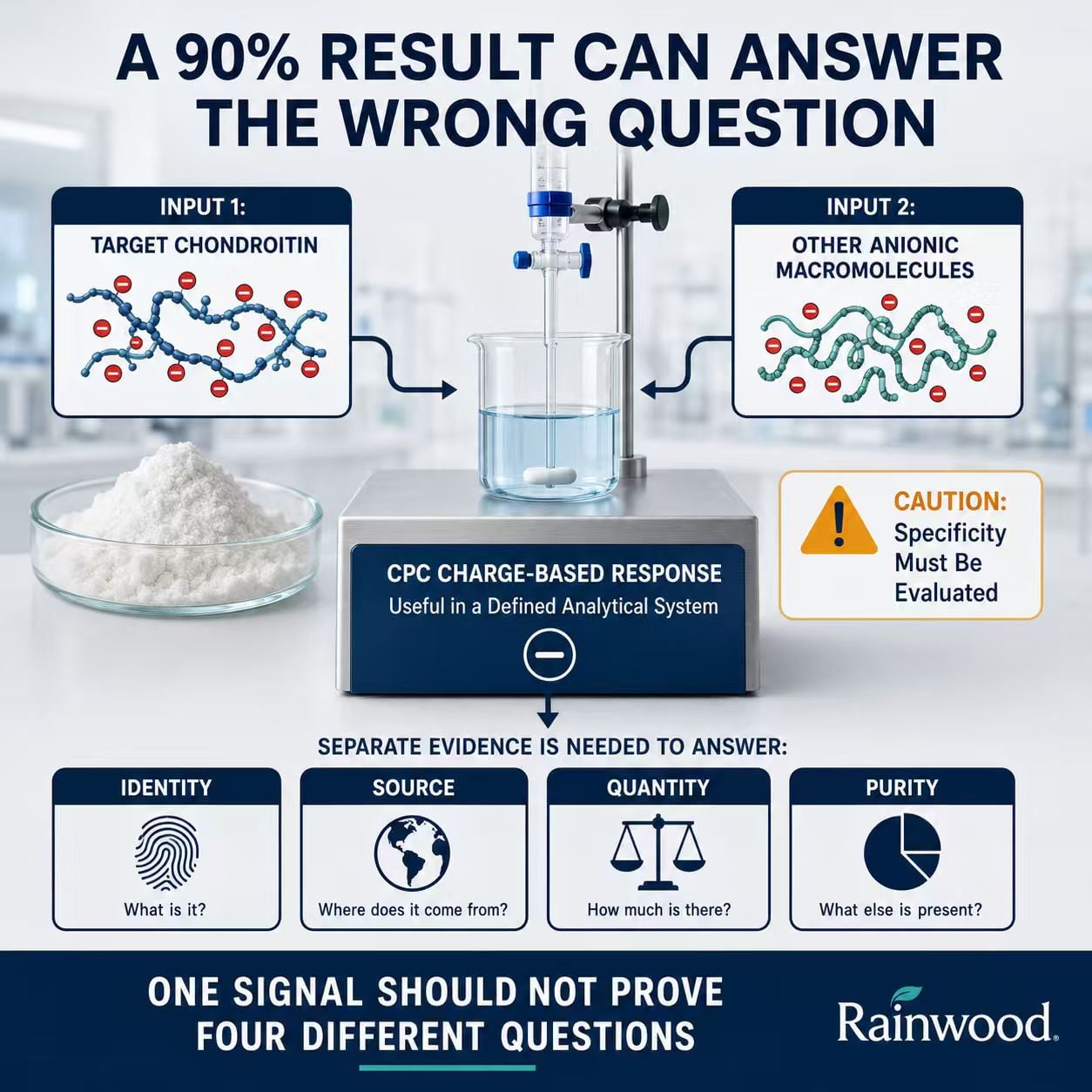
If the answer is only “CPC titration,” your release file may be weaker than it looks. Charge-based methods can respond to other anionic materials. That does not mean every CPC result is false. It means a single number from a nonspecific principle should not be asked to prove identity, purity, source, and quantity at once.
For a chondroitin importer, the real purchase is not a percentage on paper. It is a lot that can survive an informed analytical challenge.
Why the assay can answer the wrong question
Chondroitin sulfate is a sulfated polymer. Cetylpyridinium chloride can form complexes with negatively charged material, making CPC titration useful in a defined analytical system. The weakness is specificity: other anionic macromolecules can also contribute to the response.
USP educational material has highlighted documented “spoofing” of chondroitin CPC titration, including materials that artificially raised apparent results. Peer-reviewed reviews also describe how natural copurified substances or added materials can interfere with nonspecific quantitation.
The responsible conclusion is bounded:
- CPC can be part of a specification.
- CPC alone does not establish the complete identity and purity of every chondroitin lot.
- The full monograph or project-specific analytical package matters.
- Method names must be evaluated with their scope, controls, limitations, and actual data.
Start from the joint-support raw-material specification request, then define what the exact lot must prove before you compare prices.
Assay is not identity, and identity is not source
A 90% result can look like the strongest number on the COA. It still leaves separate decisions:
1. Is the material chondroitin sulfate sodium of the ordered identity?
2. Does the source match the signed requirement?
3. Does the quantitative method distinguish chondroitin from relevant interferences?
4. Does the result belong to the received lot?
5. Do other purity, contaminant, and physical attributes meet the intended use?
USP defines Chondroitin Sulfate Sodium and provides a reference standard. The public monograph preview states a 90.0%–105.0% dried-basis content range and a defined animal-source scope. A supplier cannot demonstrate compendial conformance by copying only the assay range onto a short specification.
Ask for the current specification version, every required test, actual lot results, methods, laboratory, reference materials, sample identity, and authorization. If the supplier claims a compendial grade, the claim should match the exact monograph, source, material, and version.
Read how chondroitin source changes the purchasing decision before treating identity and origin as the same evidence.
Document connection is part of analytical quality
Even an appropriate method is useless if the report is disconnected from the shipment.
Match:
- supplier, manufacturer, and manufacturing site where required;
- product name, grade, source, and product code;
- COA lot, container labels, packing list, sample, and external report;
- manufacturing, sampling, testing, release, and retest or expiry dates;
- specification version, limits, actual results, and approval status;
- who sampled the material and how the sample represents the shipment.
“Third-party tested” is not a chain of custody. An outside laboratory report proves only what was tested in the submitted sample under the reported method. The importer still needs to connect that sample to the drums and determine whether the sampling plan was representative.
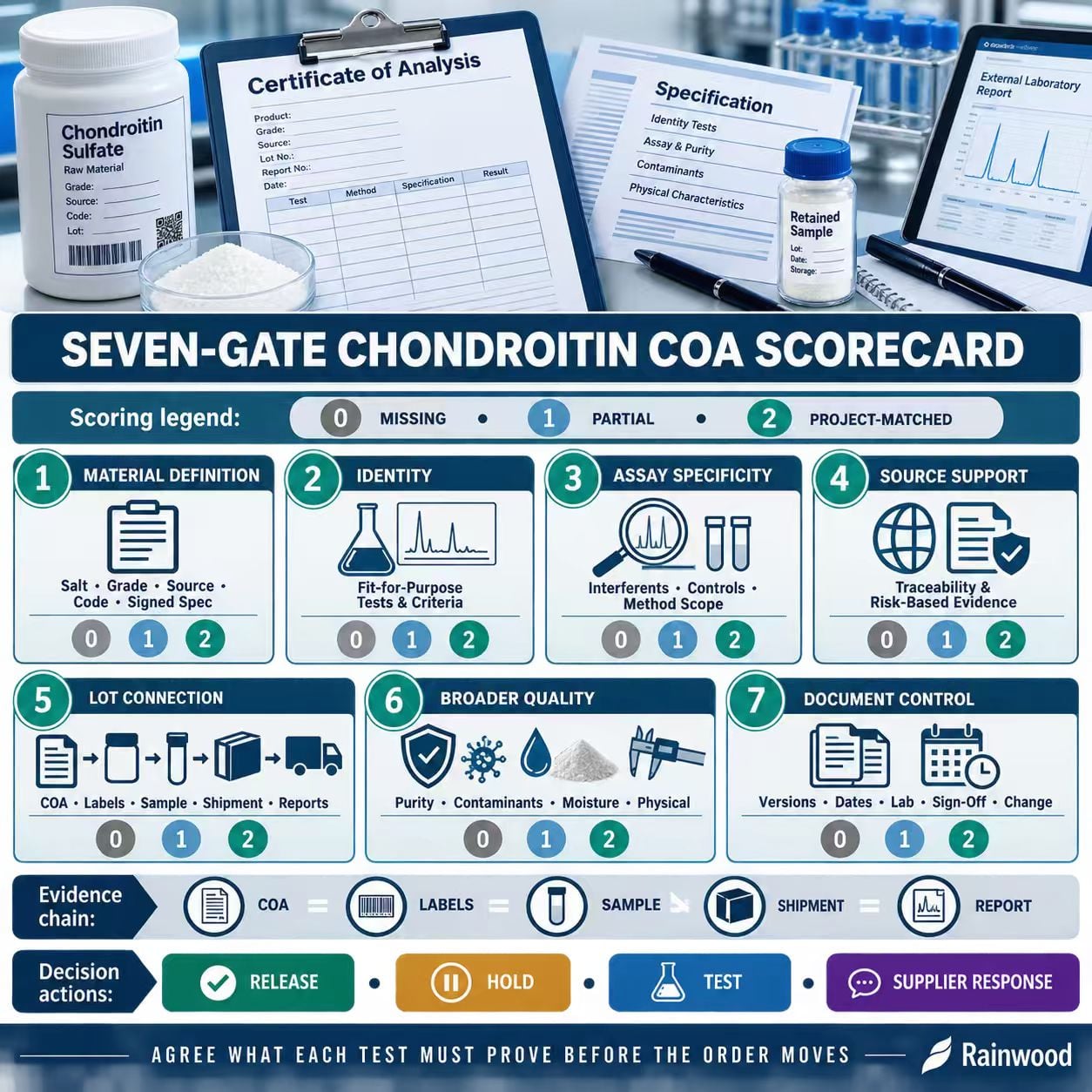
Use the seven-gate chondroitin COA scorecard
Score every gate from 0 to 2: 0 for missing, 1 for partial, and 2 for project-matched.
| Gate | Full-score evidence |
|---|---|
| Material definition | Exact salt, grade, source, code, and signed specification |
| Identity | Fit-for-purpose identity tests and acceptance criteria |
| Assay specificity | Method can address relevant interferents and has defined controls |
| Source support | Traceability and risk-appropriate source evidence |
| Lot connection | COA, labels, sample, shipment, and external reports match |
| Broader quality | Relevant purity, contaminants, moisture, and physical attributes |
| Document control | Current versions, dates, laboratory, sign-off, and change status |
A low score is not proof of fraud. It is proof that your release decision contains unanswered questions. Put those questions into a hold, test, supplier response, or quality agreement instead of covering them with another certificate logo.
Explore RainwoodBio's published supplier-management and release workflow as company context, then ask which exact records apply to the proposed chondroitin lot.
How RainwoodBio can support a method-aware purchase
RainwoodBio's website describes requirement confirmation, supplier management, quality testing and release, documentation, and traceability. These are useful project steps, not evidence that a named method is performed on every chondroitin lot.
Convert the published workflow into deliverables:
- an approved specification before the purchase order;
- a lot-linked COA and document list before shipment;
- an analytical plan that separates identity, quantity, source, and contaminants;
- independent confirmation where the risk and qualification program require it;
- deviation, rejection, replacement, and change-notification terms.
The stronger sales message is not “we test quality.” It is “we agree what each test must prove before the order moves.”
Stop the release if these answers are missing
- What exactly does the 90% line measure?
- Why is the method sufficiently specific for the identified risks?
- Which separate evidence establishes identity and source?
- Does the report match the received lot and representative sample?
- Which full specification and market requirements govern release?
- What happens if independent testing disagrees?
Request a chondroitin COA and method-gap review. Send RainwoodBio the supplier COA, specification, quoted source, target country, annual quantity, intended dosage form, and customer testing requirements; the team can return a marked evidence-gap list for your supplier discussion.
Frequently asked questions
1.Does CPC titration prove that a chondroitin lot is fake?
No. CPC is an established analytical approach, but it has specificity limitations. Evaluate it within a complete method and evidence package rather than treating the method name as proof of failure or success.
2.Does 90% assay prove the animal source?
No. Quantity and source are different decisions. Source may require supply-chain records and risk-appropriate structural or analytical evidence.
3.Is a third-party COA automatically stronger?
Only if the laboratory, method, sample, chain of custody, lot connection, and scope answer the purchasing risk. Outsourcing a weak question does not make the answer stronger.
4.Should importers run every possible test on every lot?
Not necessarily. Build a risk-based plan for the source, supplier history, use, customer, and market, then define identity, qualification, periodic, and lot-release controls with qualified personnel.
References
- USP Chondroitin Sulfate Sodium: https://doi.usp.org/USPNF/USPNF_M17460_04_01.html
- USP presentation on dietary ingredient identity and purity testing: https://www.usp.org/sites/default/files/usp/document/user-forums/03-complexity-of-ds-identity-and-purity-testing-james-kababick.pdf
- Chondroitin Sulfate Safety and Quality review: https://pmc.ncbi.nlm.nih.gov/articles/PMC6515237/
- 21 CFR 111.70, dietary supplement specifications: https://www.ecfr.gov/current/title-21/chapter-I/subchapter-B/part-111/subpart-E/section-111.70
- 21 CFR 111.75, determining whether specifications are met: https://www.ecfr.gov/current/title-21/chapter-I/subchapter-B/part-111/subpart-E/section-111.75
- RainwoodBio About Us: https://www.rainwoodbio.com/about-us
*This article is for international B2B procurement and educational purposes. Identity, source, methods, sampling, specifications, testing, safety, import, and regulatory requirements must be confirmed for the exact material, lot, finished product, and destination market.*