 EN
EN

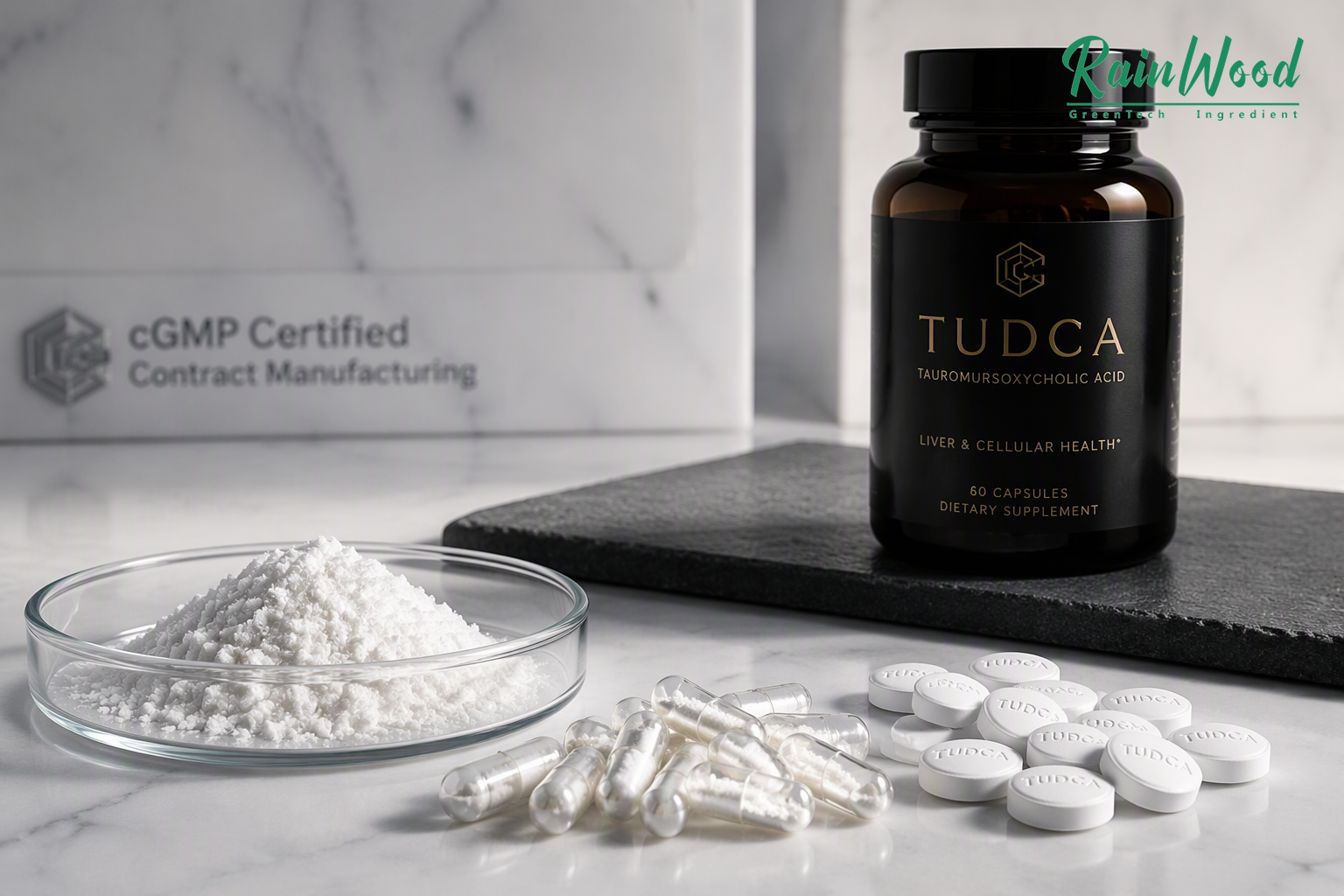
Executive Summary: Selecting the optimal finished dosage format for TUDCA—bulk powder, hard two-piece capsules, or direct compression tablets—is fundamentally a physical and chemical engineering decision. Raw material particle size distribution, moisture sensitivity, natural sensory bitterness, and high-speed tableting/encapsulation kinetics must be aligned with customer compliance routines and packaging barrier economics.
During new product development, different stakeholders pull in competing directions: the R&D team recommends a loose bulk TUDCA powder for dosing flexibility; the e-commerce brand team demands 500mg two-piece hard capsules for convenient customer adoption; and the retail buyer requests embossed tablets for shelf presentation. While the same pure raw material can theoretically be converted into all three, their physical processing tolerances, sensory profiles, packaging requirements, and unit economics differ substantially.
TUDCA is as much an encapsulation and tableting challenge as it is a chemical purity decision. Sourcing a high-potency raw powder without auditing bulk density, flowability, and hygroscopicity often leads to high capsule fill-weight variation, customer complaints over intense bitterness, or tablets that fail standard USP disintegration tests.
1. Dosage Form Trade-offs: Powder vs. Capsules vs. Tablets
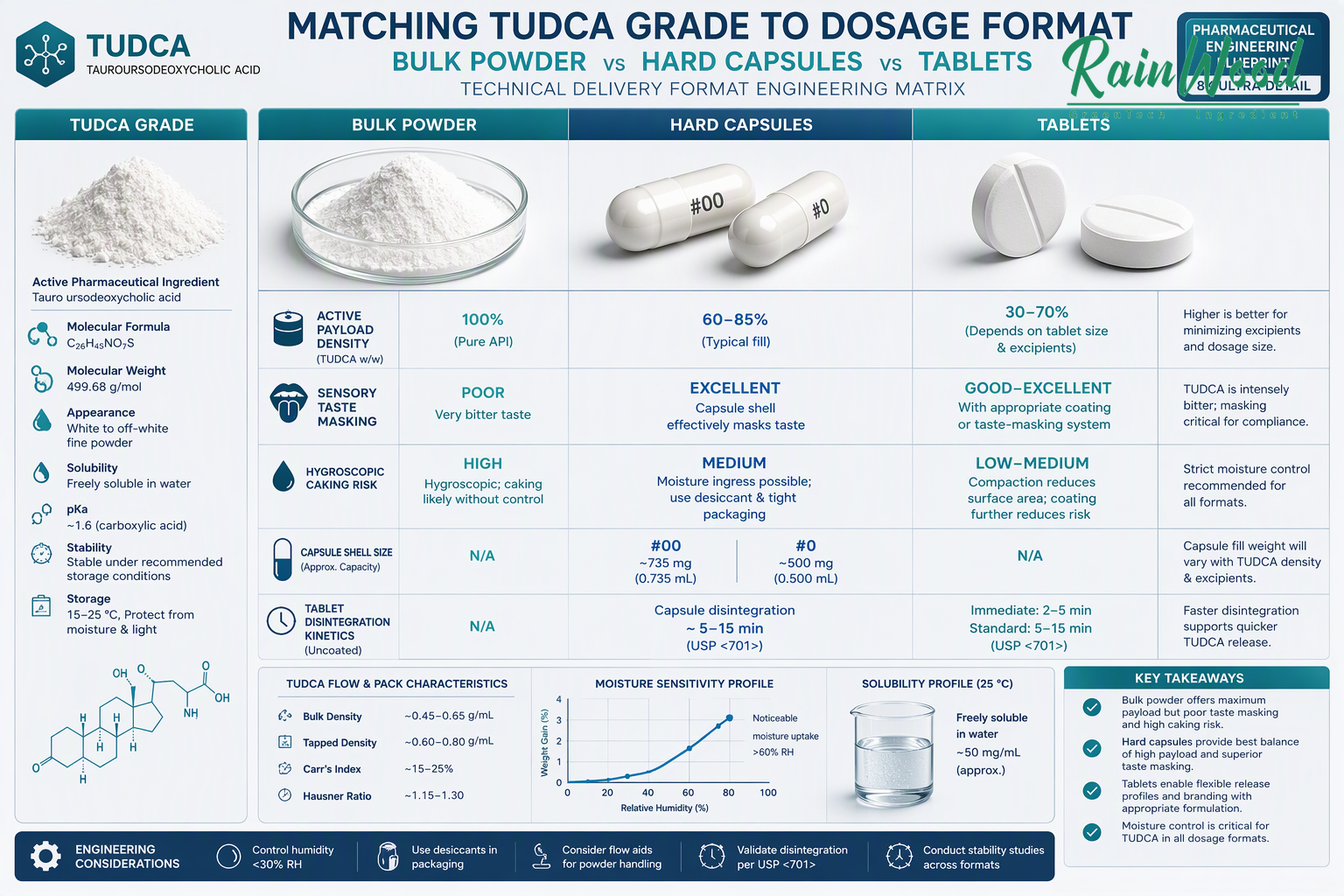
Utilize our TUDCA dosage-form engineering matrix to evaluate the operational advantages and failure modes of each delivery route:
2. Overcoming Sensory Bitterness and Hygroscopicity
TUDCA is an intensely bitter hydrophilic bile acid conjugate. In loose drink powders, unmasked TUDCA creates severe palate fatigue. For brands launching functional beverage or powder stick formulations, microencapsulation or complex flavor systems (combining sour organic acids like malic acid with high-potency sweeteners like Stevia Reb-M) are essential.
For capsule products, moisture migration represents the primary stability threat. Bulk TUDCA powder rapidly absorbs ambient moisture if relative humidity exceeds 50% during encapsulation. Excess moisture softens gelatin capsule shells and induces cross-linking. Utilizing vegetarian HPMC (Hydroxypropyl Methylcellulose) capsules with pharmaceutical silica desiccant packs in induction-sealed HDPE bottles provides superior long-term shelf stability.
3. Turnkey Contract Manufacturing Parameters
When selecting an OEM partner for TUDCA formulation and packaging, verify the following core manufacturing controls:
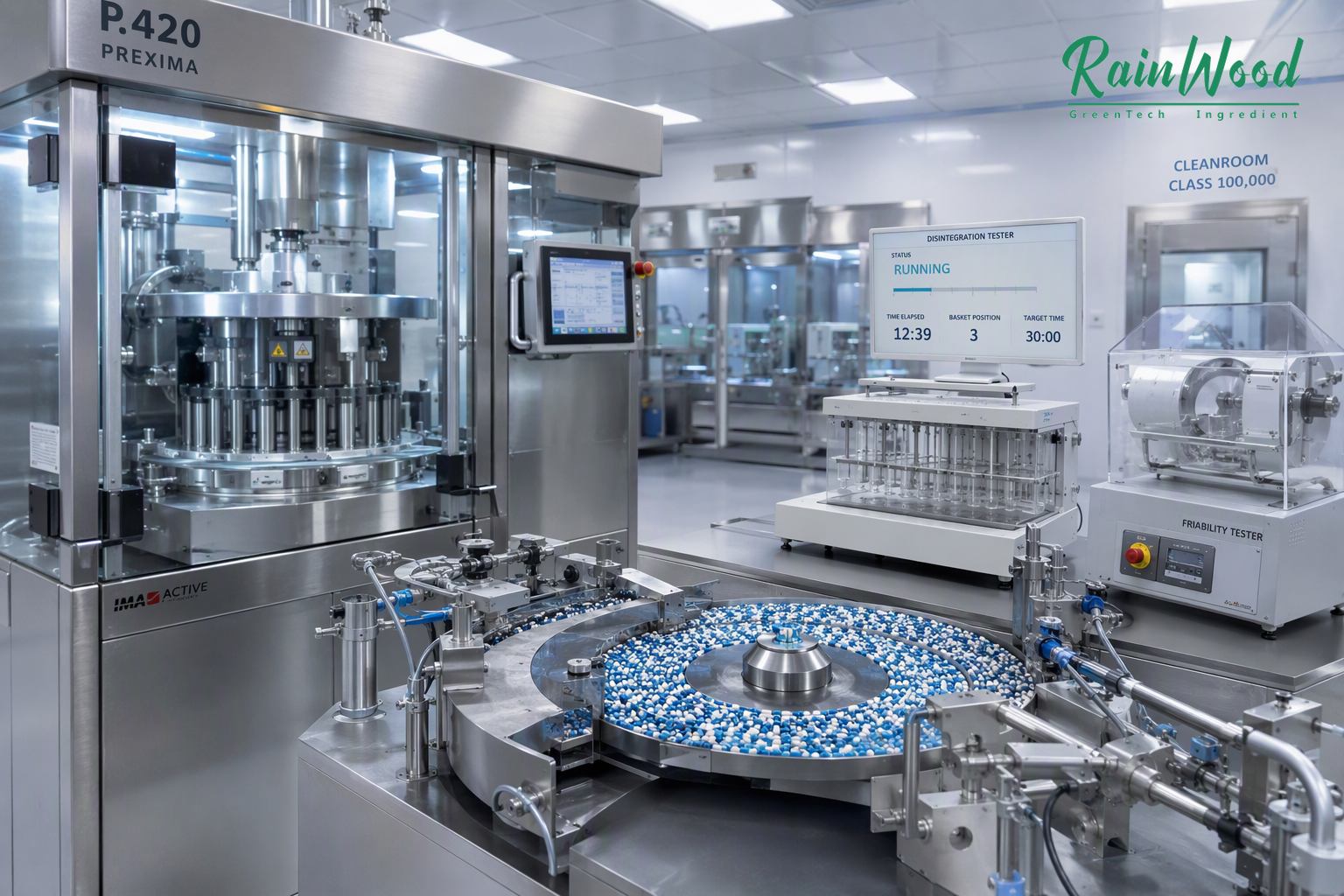
- Automated Capsule Weight Verification: In-line checkweighers ensuring each capsule meets ±3% fill-weight tolerance across 100,000+ unit runs.
- De-Aeration & Powder Flow Optimization: Precision blending with pharmaceutical-grade excipients (Microcrystalline Cellulose, Magnesium Stearate, Silicon Dioxide) to eliminate static agglomeration.
- Full Finished Product Testing: Every commercial batch released with third-party ISO 17025 COAs verifying active potency, USP <2040> disintegration, and heavy metal limits.
Scale Your Custom TUDCA Capsules, Tablets, or Powder Blends
Shaanxi Rainwood Biotech provides cGMP-certified bulk TUDCA raw powder and turnkey OEM/ODM capsule and tablet contract manufacturing with complete pilot validation and export-ready packaging.
Frequently Asked Questions (FAQ)
Q1: Why are hard capsules the most popular commercial format for TUDCA?
Hard two-piece capsules (HPMC or Gelatin) completely encapsulate TUDCA's intense natural bitterness, protect the powder against ambient moisture exposure, and deliver standard 250mg or 500mg doses in single easy-to-swallow units.
Q2: What capsule shell size is needed for a 500mg pure TUDCA dose?
Assuming standard bulk tapped density of 0.50–0.55 g/mL plus 10% flow excipients, a 500mg TUDCA active dose fits comfortably in a standard Size #00 capsule shell. Size #0 is optimal for 250mg formulations.
Q3: How can TUDCA tablets prevent capping and slow disintegration?
Formulating with microcrystalline cellulose (MCC 102), superdisintegrants (croscarmellose sodium), and precise compression tonnage ensures high mechanical hardness while maintaining rapid disintegration under 15 minutes in simulated gastric fluid.
References & Standards
- PubMed: Bile Acids as Therapeutic Agents and Cytoprotective Chaperones (PMID: 41601986)
- United States Pharmacopeia (USP): <2040> Disintegration and Dissolution of Dietary Supplements.
- Shaanxi Rainwood Biotech: TUDCA Powder Specifications and Turnkey Capsule OEM Solutions.