 EN
EN

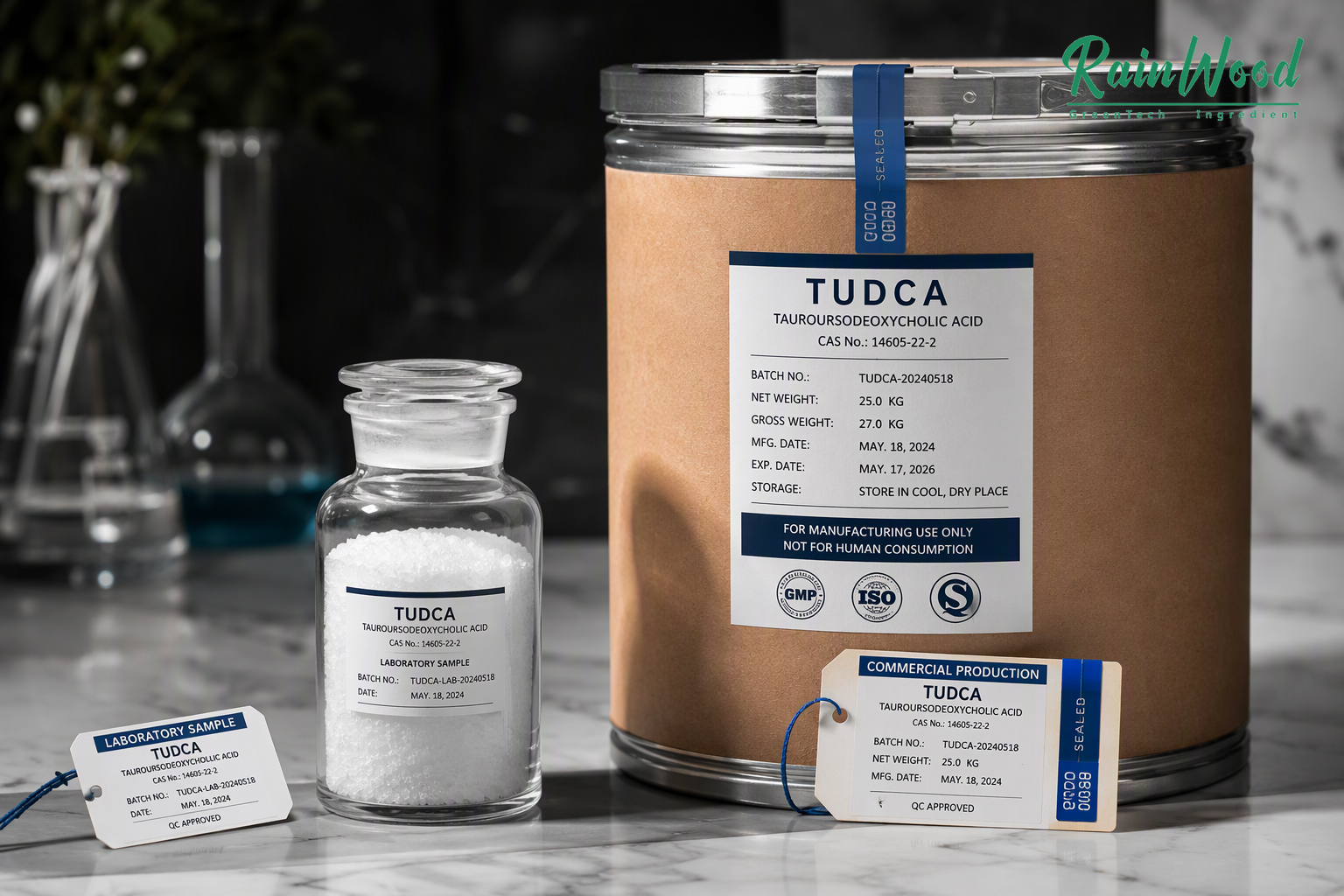
Executive Summary: Approving a pre-shipment TUDCA laboratory sample does not automatically guarantee that commercial multi-drum production lots will match in chemical purity, color consistency, particle morphology, or encapsulation performance. Establishing an enforceable Pass-Hold-Reject quality decision gate prevents costly manufacturing downtime, fill-weight variance, and finished product quarantine.
A classic supply chain conflict unfolds across the supplement industry: the pre-shipment qualification sample of bulk TUDCA powder is snow-white, fine-crystalline, and free-flowing. However, when the 500kg commercial production order arrives at the factory, the bulk material exhibits a slight off-white or yellowish hue, cakes rapidly inside the capsule filling hopper, and displays subtle secondary peaks on HPLC impurity screening. The raw material supplier claims the shipment is "within standard commercial tolerances," while the brand's manufacturing schedule faces immediate stoppage.
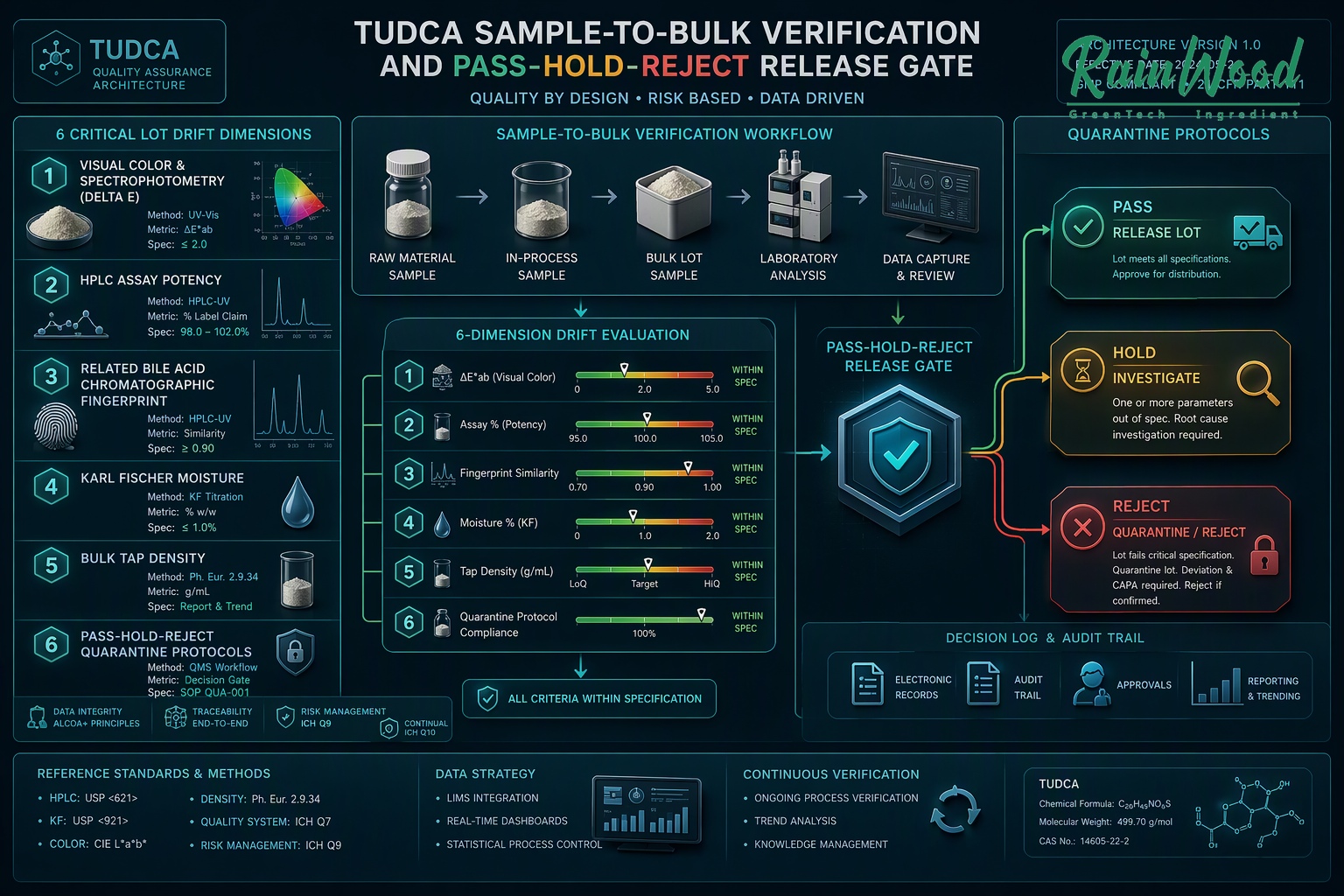
Sample-to-bulk equivalence for Tauroursodeoxycholic Acid (TUDCA) is not a trust exercise. It requires an objective, scientifically disciplined comparison of chemical identity, HPLC active assay, related bile acid fingerprints, spectrophotometric color metrics (ΔE), moisture content, and high-speed encapsulation performance for TUDCA capsule manufacturing.
1. Deconstruct the Sources of Lot-to-Lot Drift
To eliminate ambiguity between lab samples and scaled commercial batches, audit four primary vectors of variation:
- Synthesis Scaling & Recrystallization Kinetics: Laboratory pilot syntheses achieve faster solvent removal and tighter crystal growth than multi-ton industrial crystallizers, which can alter crystal habit and bulk density.
- Mother Liquor & Related Bile Impurities: Variations in washing efficiency can leave trace residual Ursodeoxycholic Acid (UDCA) or Taurodeoxycholic Acid (TDCA) on crystal surfaces, shifting powder hue.
- Moisture & Static Charge Drift: Bulk powder exposed during packaging or transfer absorbs ambient humidity, dramatically increasing cohesion and angle of repose.
- Retest Basis & Analytical Discrepancy: Testing samples on a dry-basis while testing incoming bulk drums on an as-is basis creates an artificial 2% to 3% apparent potency drop.
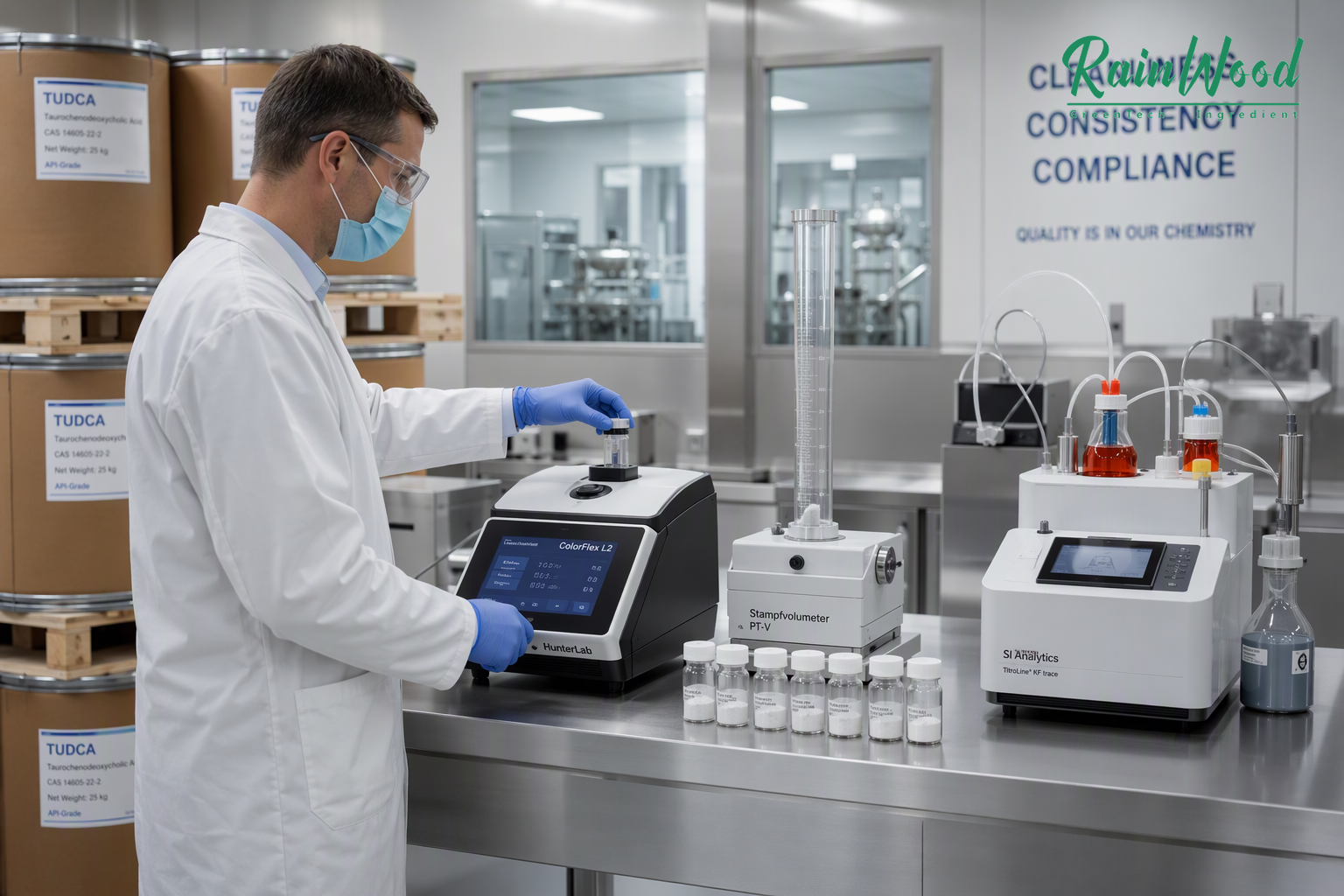
2. The Pass / Hold / Reject Quality Action Matrix
To protect production timelines, enforce a clear three-tier quarantine matrix upon raw material receipt:
3. Building Enforceable Change-Control Agreements
To eliminate commercial disputes before bulk shipment occurs, embed three mandatory contractual clauses into purchase orders:
- Representative Retained Sample Storage: Both buyer and supplier must archive sealed 50g aliquots under 20°C/60% RH storage for a minimum of 24 months.
- Mandatory Process Change Notification: Any alteration to synthesis solvents, crystallization vessels, or manufacturing facility triggers formal requalification.
- Defect Replacement & Re-Testing Cost Ownership: If an incoming commercial lot fails agreed chromatographic or physical tolerances, the supplier covers third-party ISO 17025 referee testing and expedited replacement.
Ensure Zero-Defect Lot Consistency for Your TUDCA Supply Chain
Shaanxi Rainwood Biotech guarantees lot-to-lot consistency for bulk TUDCA powder and turnkey OEM/ODM capsule formulations with complete pre-shipment sample testing and ISO 17025 release files.
Frequently Asked Questions (FAQ)
Q1: Why does commercial bulk TUDCA sometimes appear more yellow than lab samples?
Color drift typically results from trace unreacted bile acid intermediates (such as UDCA or taurochenodeoxycholic acid) or prolonged thermal exposure during large-scale industrial vacuum drying.
Q2: What is an acceptable color variation threshold (ΔE) for TUDCA powder?
On the Hunter L*a*b* color scale, a total color difference (ΔE) of ≤ 1.5 is virtually imperceptible to the human eye and represents high lot consistency. A ΔE > 2.5 warrants spectrophotometric and chromatographic investigation.
Q3: How does bulk powder moisture drift affect high-speed capsule filling?
An increase in moisture from 0.5% to 1.8% increases powder static adhesion, causing TUDCA to bridge in the dosing funnel and leading to erratic capsule fill weights exceeding standard ±3% cGMP tolerances.
References & Standards
- United States Pharmacopeia (USP): <621> Chromatography and <905> Uniformity of Dosage Units.
- Cayman Chemical: Tauroursodeoxycholic Acid Reference Data Sheet.
- Shaanxi Rainwood Biotech: TUDCA Powder Quality Architecture and Turnkey Contract Manufacturing Services.