 EN
EN

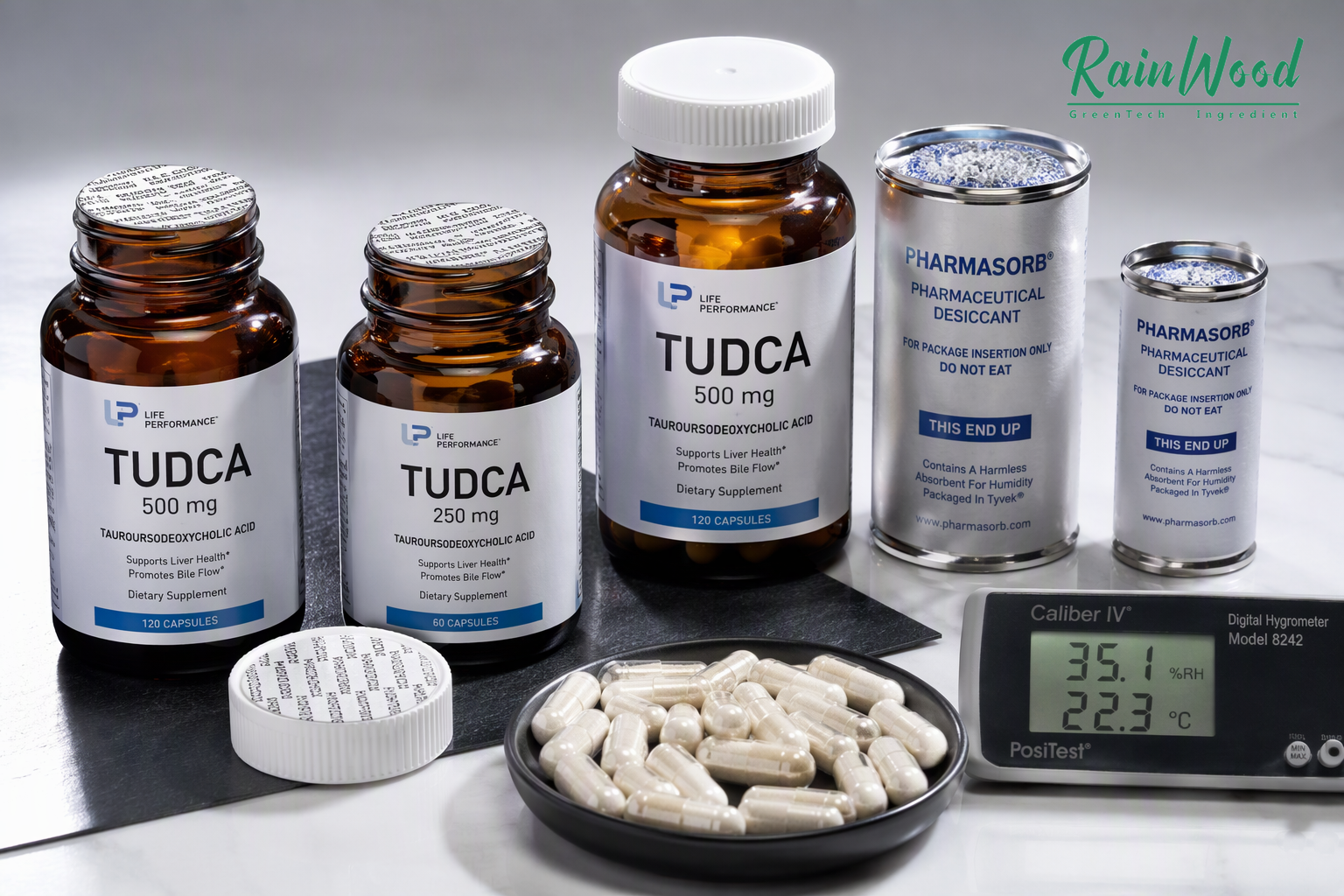
Executive Summary: True shelf-life stability for TUDCA dietary supplements is an empirical measurement of chemical potency, moisture barrier integrity, and physical capsule performance across environmental extremes. Relying solely on a raw material retest date overlooks finished product degradation risks, including amide bond hydrolysis, capsule shell embrittlement, and sensory sulfurous odor evolution during commercial supply chain transit.
A frustrating post-launch quality failure often occurs in the dietary supplement market: the bulk TUDCA powder meets 98.5% chemical assay when shipped from the synthesis facility. However, after six months in an Amazon fulfillment center and repeated consumer jar openings in humid environments, the powder cakes severely, develops a noticeable sulfurous odor, or causes gelatin capsule shells to become brittle and crack. While HPLC assay testing might still report an acceptable active number, the customer product experience is permanently damaged.
Stability is not simply an arbitrary date stamped on a commercial drum. It is verified empirical evidence demonstrating that the raw material grade, finished formulation, barrier packaging, induction seal integrity, and storage parameters perform synchronously throughout a 24 to 36-month shelf life. For brands launching turnkey TUDCA capsules or powder stick formulations, stability planning must precede inventory commercialization.
1. Deconstruct TUDCA Degradation Pathways
To engineer effective packaging and stability protocols, identify the primary environmental stress vectors affecting Tauroursodeoxycholic Acid:
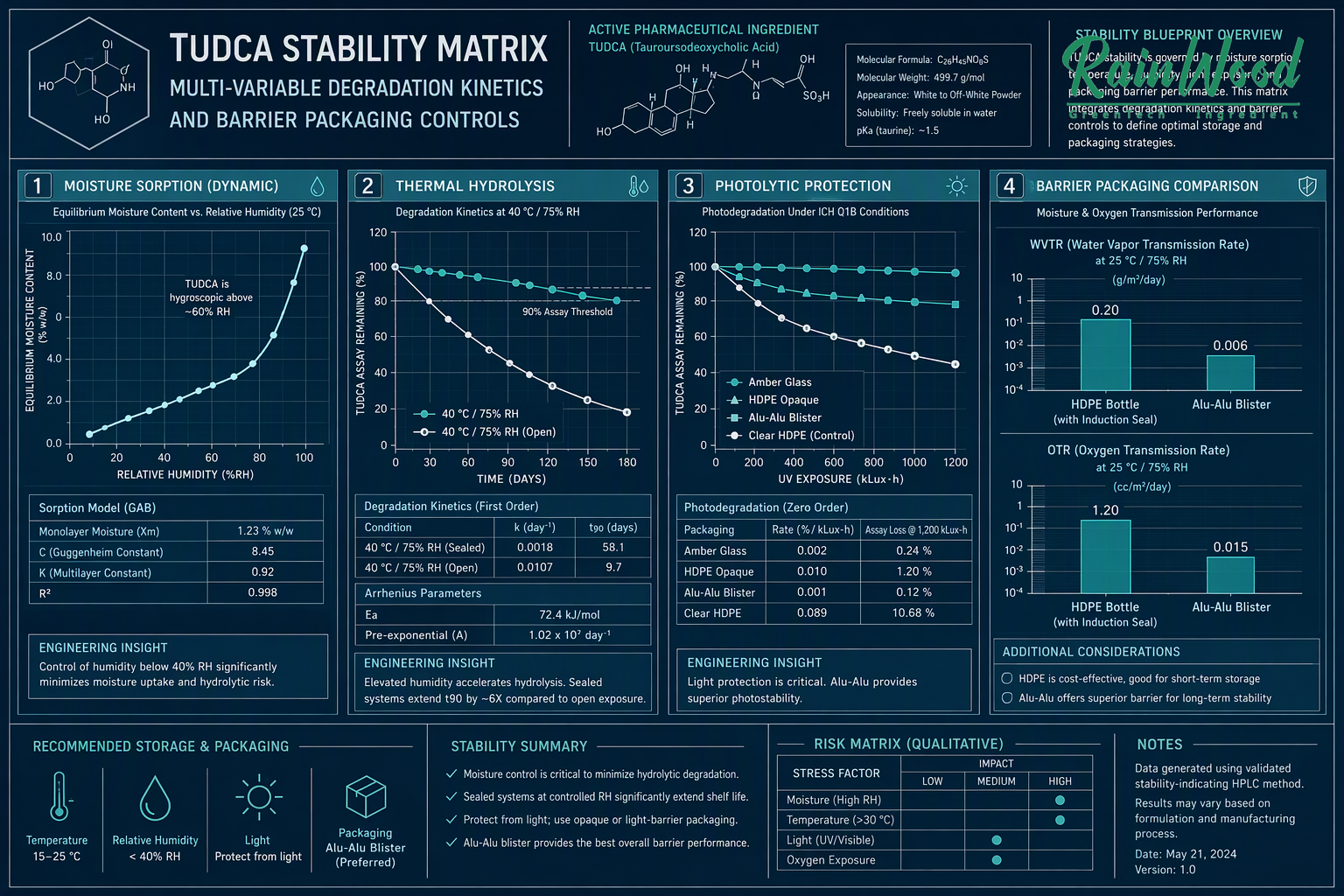
- Moisture-Induced Hydrolysis: Excess water activity ($a_w > 0.40$) at elevated temperatures accelerates the cleavage of TUDCA's amide bond, degrading the conjugate back into free Ursodeoxycholic Acid (UDCA) and taurine.
- Hygroscopic Caking & Agglomeration: Crystalline TUDCA powder rapidly adsorbs atmospheric moisture above 55% RH, forming hardened agglomerates that impair dissolution kinetics and capsule filling.
- Thermal Stress During Warehouse Transit: Summer shipping container transit temperatures exceeding 45°C stress container closure liners, inducing micro-leaks in induction seals.
- Capsule Shell Moisture Migration: In gelatin capsules, hygroscopic TUDCA draws plasticizing moisture out of the shell wall, resulting in brittle capsule fracturing during transport.
2. Packaging Is an Active Quality Control Barrier
Packaging material selection directly dictates whether a finished TUDCA SKU survives real-world distribution channels:
3. The Master Stability Verification Protocol
To establish legally defensible expiry dates for retail and e-commerce distribution, execute a structured testing schedule:
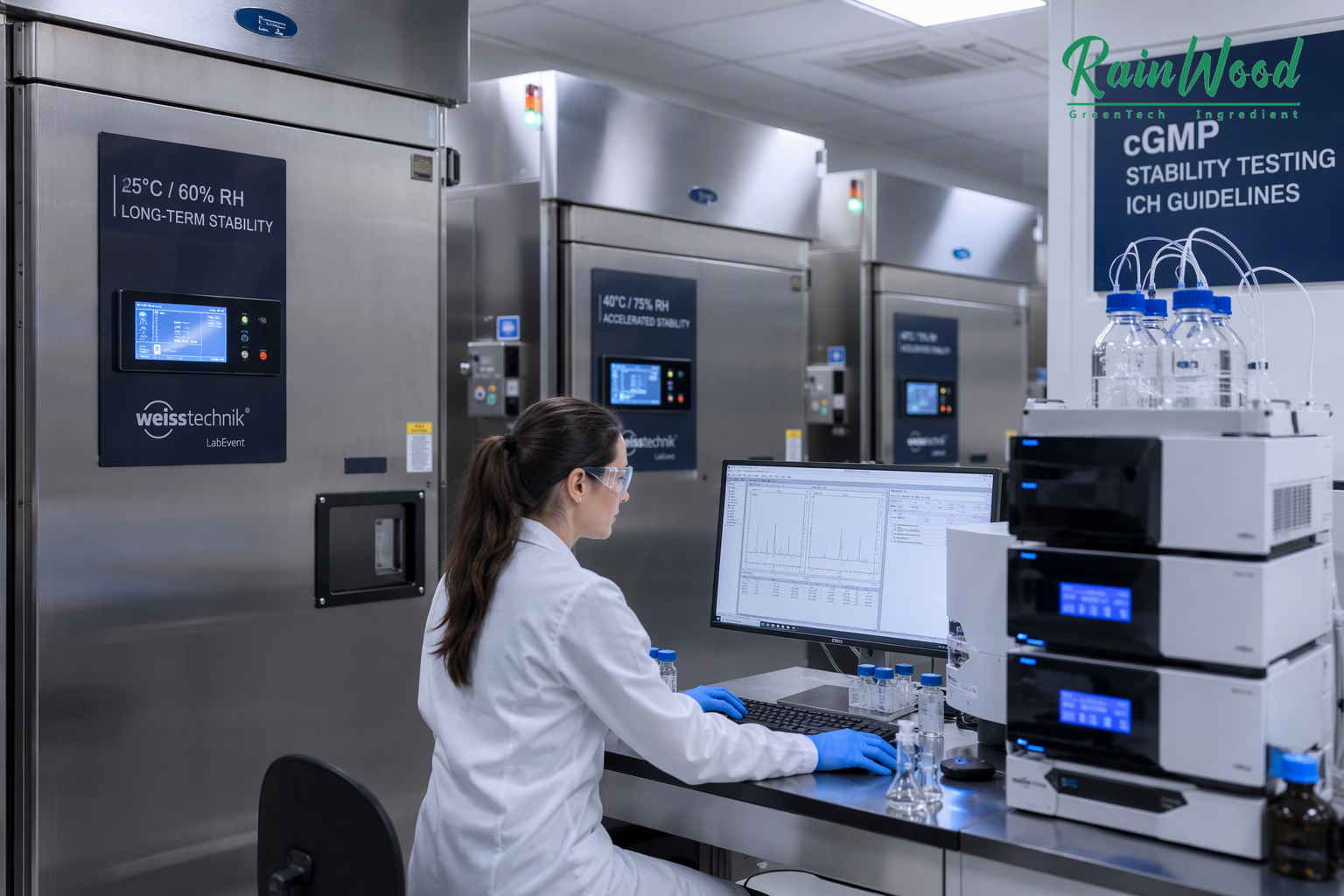
- Accelerated Stability Testing (6 Months): 40°C ± 2°C / 75% RH ± 5% RH with time points at 0, 1, 2, 3, and 6 months to establish provisional 24-month shelf life.
- Real-Time Long-Term Stability (36 Months): 25°C ± 2°C / 60% RH ± 5% RH with annual testing to confirm real-world retention.
- Critical Release Endpoints: Active TUDCA assay (≥100% of label claim), Related Substances (UDCA ≤ 0.5%), Capsule Disintegration (≤ 15 min), and Moisture Content (≤ 1.5%).
Lock Bulletproof Shelf-Life Stability for Your TUDCA SKU
Partner with Shaanxi Rainwood Biotech for cGMP-certified bulk TUDCA powder and turnkey OEM/ODM capsule manufacturing backed by comprehensive ICH stability testing and advanced moisture-barrier packaging.
Frequently Asked Questions (FAQ)
Q1: Does a supplier's raw material retest date prove stability for finished capsules?
No. A raw material retest date applies only to sealed factory bulk drums. Finished capsules introduce capsule shell moisture dynamics, bottling headspace, excipients, and consumer opening variables that require independent finished-product stability testing.
Q2: What type of capsule shell provides the highest moisture protection for TUDCA?
Vegetarian HPMC (Hydroxypropyl Methylcellulose) capsules possess a lower baseline moisture content (4–6%) compared to traditional gelatin shells (13–16%), significantly reducing moisture transfer to hygroscopic TUDCA powder.
Q3: How does temperature stress during transport impact TUDCA stability?
Temperatures exceeding 45°C during summer container shipping accelerate amide bond hydrolysis in the presence of trace moisture, increasing free UDCA impurity levels and degrading finished capsule appearance.
References & Standards
- ICH Harmonised Guideline: Stability Testing of New Drug Substances and Products Q1A(R2).
- United States Pharmacopeia (USP): <659> Packaging and Storage Requirements.
- Shaanxi Rainwood Biotech: Quality Infrastructure & Packaging Technology.