 EN
EN

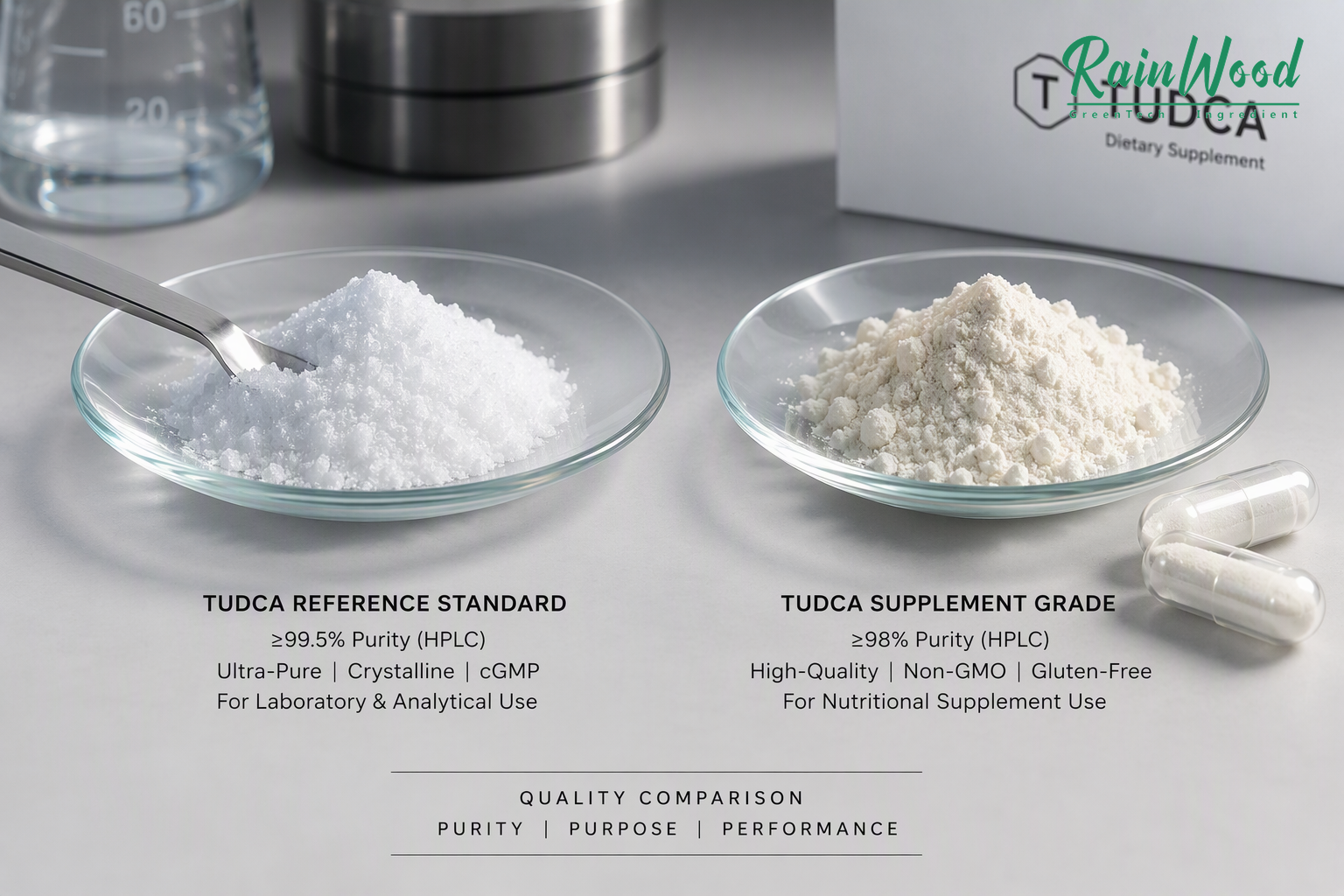
Executive Summary: The terms "Pharma Grade" and "Supplement Grade" TUDCA represent entirely distinct regulatory dossiers, impurity testing scopes, and batch release obligations. For B2B supplement brands, evaluating supplier quotations based solely on marketing grade labels risks substantial regulatory exposure. Material qualification requires auditing intended use, compendial monograph compliance, ICH Q3C residual solvents, and total batch documentation packages.
In B2B raw material procurement, a familiar scenario plays out: Supplier A promotes their material as "Pharma Grade TUDCA, 99% purity" with a premium price tag, while Supplier B offers "Supplement Grade TUDCA, 98% purity" at a 30% discount. Procurement teams frequently view these two offerings as simple quality tiers on a linear ladder, assuming the "pharma" label automatically confers legal superior efficacy or marketing authorization.
That assumption is a high-risk commercial shortcut. In chemical and regulatory reality, a grade is an integrated package of intended use, compendial monograph compliance, manufacturing process controls, analytical validation depth, and legal market expectations. Sourcing bulk TUDCA raw material powder for consumer TUDCA capsule manufacturing requires looking beyond marketing adjectives to audit tangible batch release data.
1. Deconstruct What "Grade" Actually Represents
Before accepting a supplier's grade classification, utilize our TUDCA grade and documentation checklist to audit:
- Intended Regulatory Pathway: Is the material intended as an Active Pharmaceutical Ingredient (API) under a Drug Master File (DMF), or as a dietary ingredient manufactured under cGMP (21 CFR Part 111)?
- Compendial Monograph Compliance: Does the material reference an official pharmacopeial standard (e.g., USP, EP, or ChP), and has full monograph testing been verified on the specific lot?
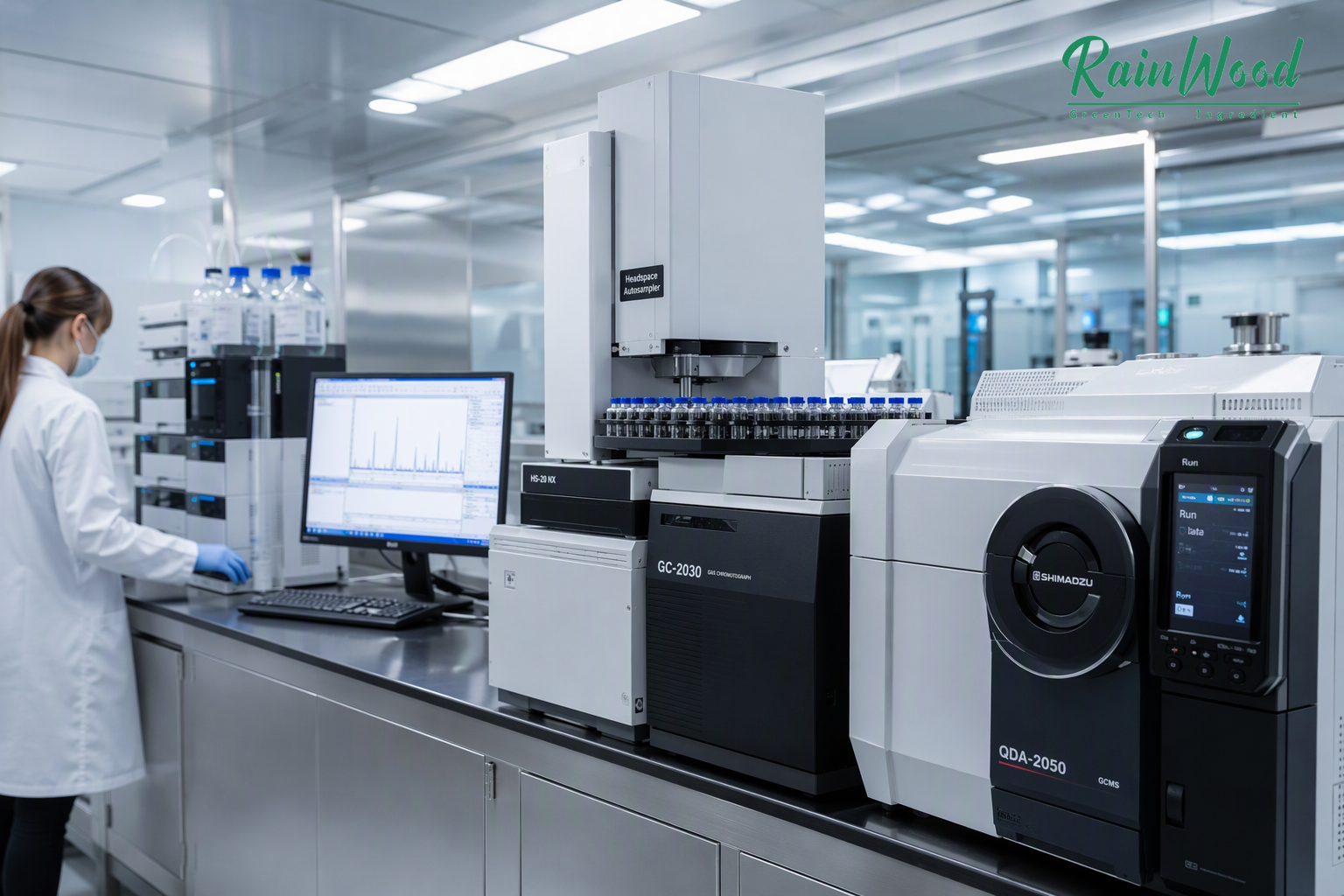
- Related Substance & Synthesis Byproduct Profiling: Are unreacted starting materials (UDCA), intermediate bile acid conjugates, and degradation peaks individually resolved and quantified via validated HPLC-UV?
- Residual Solvent Screening: Complete GC-MS screening for Class 2 and Class 3 organic solvents (methanol, ethanol, acetone) strictly adhering to ICH Q3C guidelines.
- Stability & Packaging Systems: Real-time and accelerated stability files supporting retest intervals in nitrogen-flushed, moisture-barrier bulk packaging.
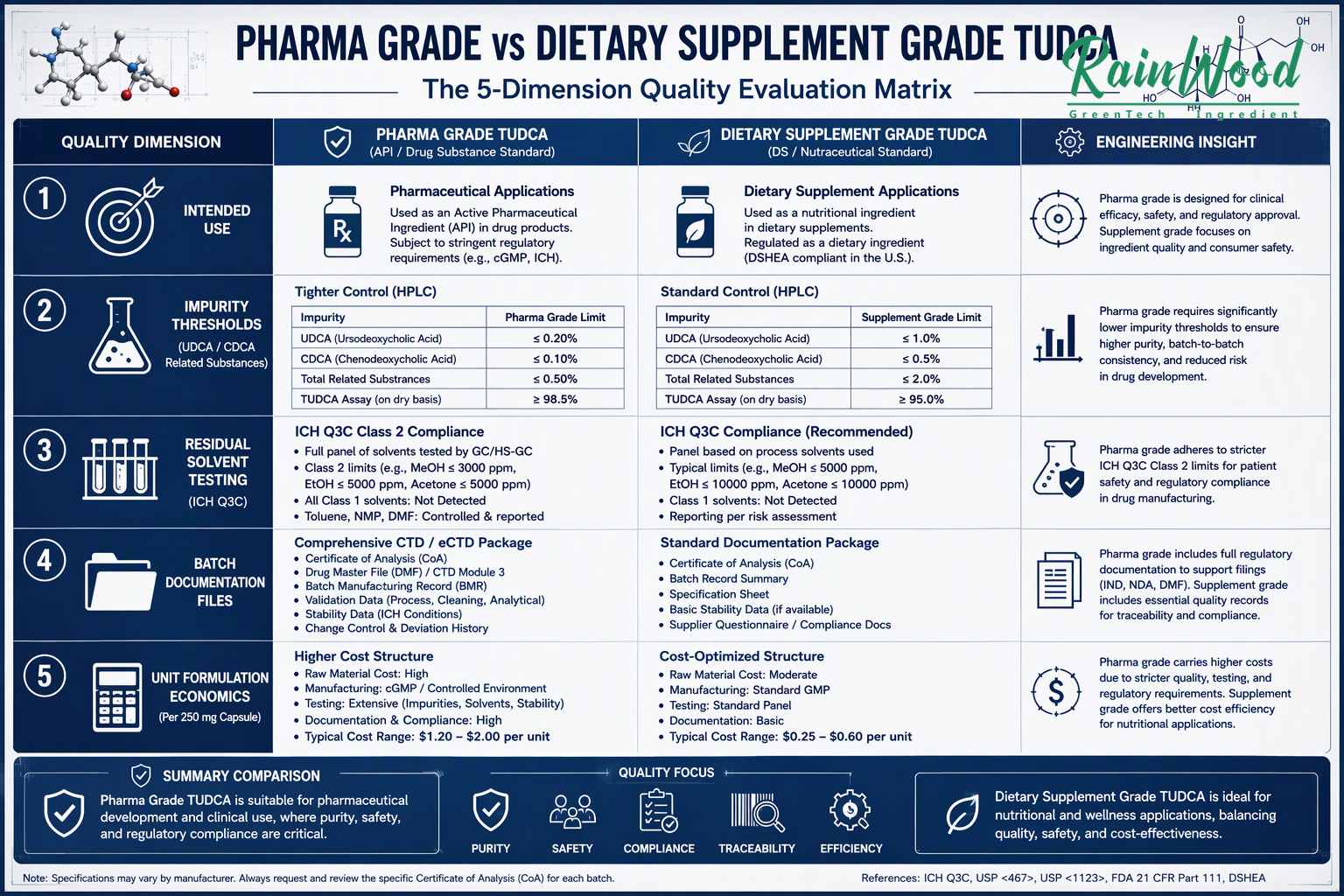
2. Direct Comparison: Pharmaceutical vs. Dietary Supplement Frameworks
The operational and legal differences between pharmaceutical API development and commercial dietary supplement production are substantial:
3. Normalize Supplier Quotations by Evidence, Not Claims
To avoid overpaying for marketing claims that provide no actionable compliance value, normalize competing TUDCA quotations across five critical criteria:
- Assay Reporting Standard: Ensure prices are compared on an identical "Dry Basis" vs "As-Is" calculation.
- Impurity Testing Scope: Confirm whether individual related bile acids (UDCA, CDCA, LCA) are quantified on every shipped batch.
- Packaging & Moisture Protection: Verify whether bulk powder is packed in double-layer pharmaceutical polyethylene bags with nitrogen barrier protection.
- Lot-Specific Testing vs. Typical Data: Ensure quoted parameters represent actual release testing rather than non-binding "typical analysis" estimates.
Source Full-Specification TUDCA Raw Materials & Turnkey OEM Formulations
Shaanxi Rainwood Biotech supplies cGMP-certified bulk TUDCA powder (≥98% dry basis) and turnkey custom capsule contract manufacturing with complete third-party ISO 17025 Certificate of Analysis (COA) batch release dossiers.
Frequently Asked Questions (FAQ)
Q1: Is "Pharma Grade" TUDCA legally required for dietary supplements?
No. Dietary supplements in major markets (like the US and EU) are governed by food and dietary supplement cGMP regulations (21 CFR Part 111). Supplement-grade material with verified purity, low related substances, and full heavy metal/microbial compliance meets all legal requirements without API registration overhead.
Q2: Can consumer supplement packaging claim "Pharmaceutical Quality"?
Brands should exercise extreme caution. Regulators in both the US and EU may interpret "pharmaceutical quality" as an implied medical or drug claim, potentially triggering regulatory scrutiny unless supported by rigorous legal qualification.
Q3: What analytical method is standard for quantifying TUDCA related bile acids?
Reversed-Phase High-Performance Liquid Chromatography (RP-HPLC) coupled with UV detection or Charged Aerosol Detection (CAD) provides validated baseline separation for UDCA, CDCA, and other related bile acid conjugates.
References & Standards
- PubMed: Unexpected Uses of Urso- and Tauroursodeoxycholic Acid (PMID: 24891994)
- ICH Harmonised Guideline: Good Manufacturing Practice Guide for Active Pharmaceutical Ingredients Q7.
- US FDA: 21 CFR Part 111 Dietary Supplement Current Good Manufacturing Practice.
- Shaanxi Rainwood Biotech: Company Quality Systems & cGMP Standards.