 EN
EN

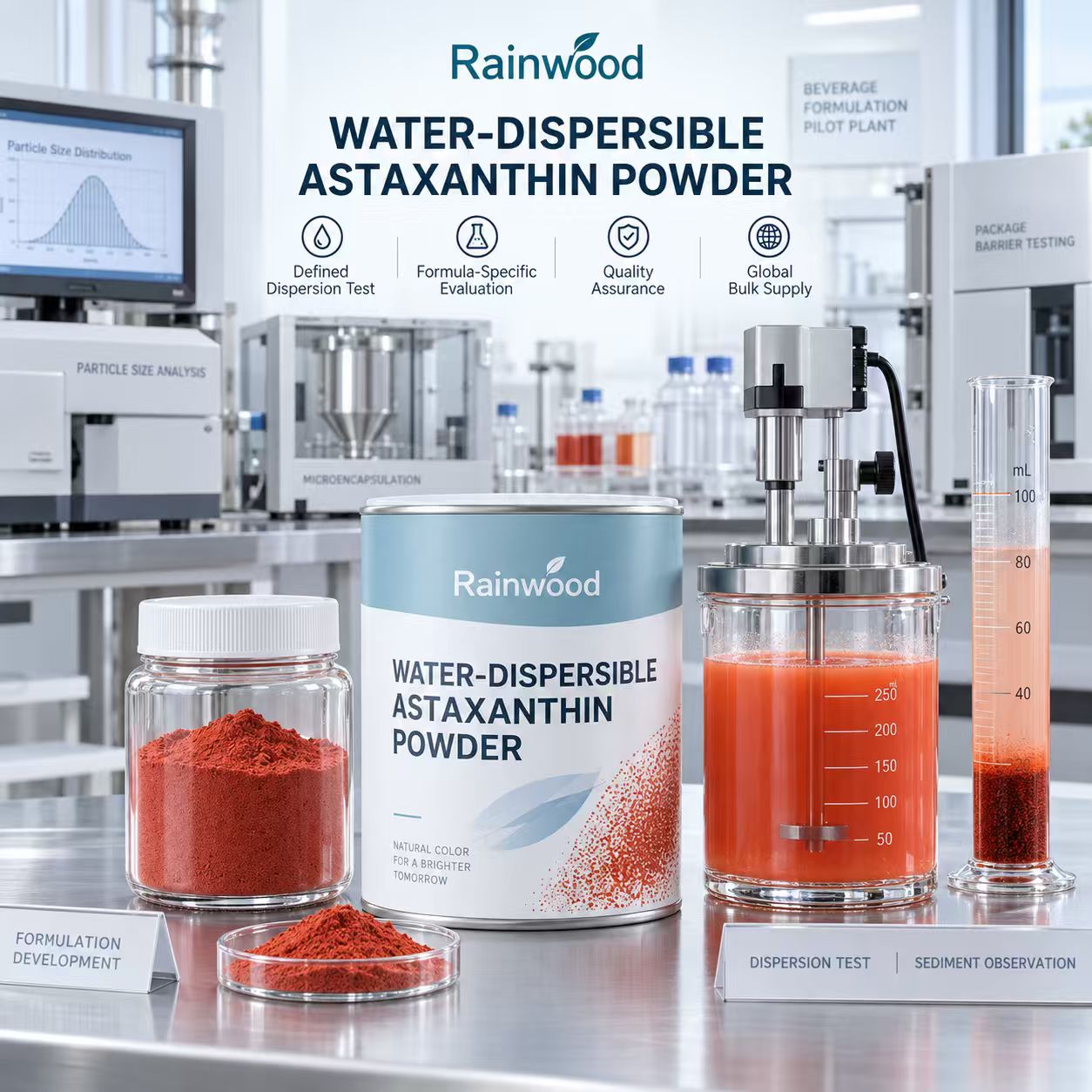
Meta title: Water-Dispersible Astaxanthin Powder: Verify Performance
Meta description: A water-dispersible astaxanthin powder COA cannot prove dispersion, encapsulation efficiency, or shelf-life performance. Ask for format-specific evidence.
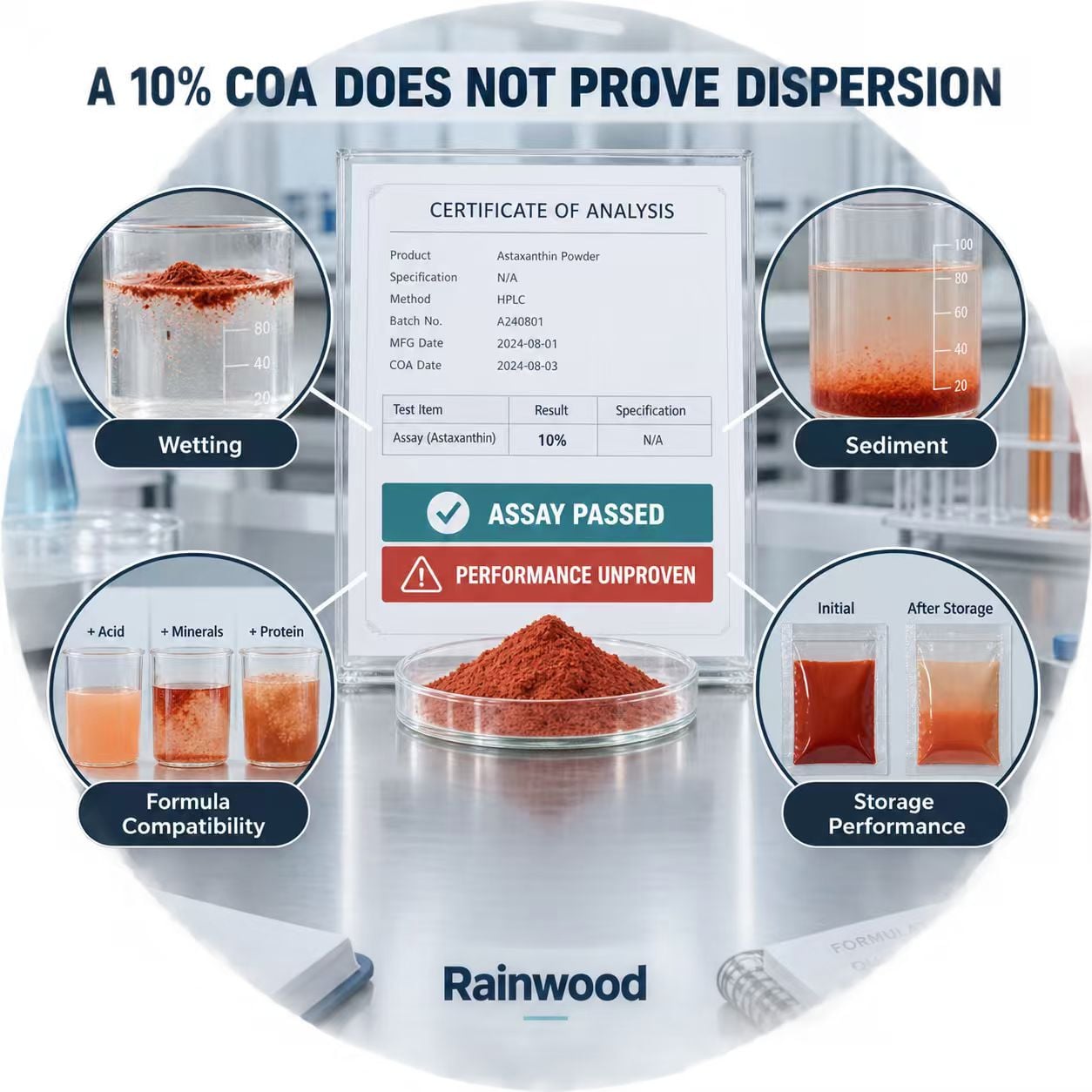
The supplier sends a 10% astaxanthin powder COA. The product team assumes it will make a clear drink. In the pilot, the powder floats, leaves orange sediment, and loses color after a week in the finished pouch.
“Water-dispersible” is not the same as “instantly soluble,” and an assay result does not prove how the powder behaves in your beverage, tablet, gummy, or sachet. The commercial question is whether the delivery system performs in the exact matrix and package you plan to sell.
Review the water-dispersible astaxanthin powder option before relying on a brochure phrase.
Dispersion, solubility, and encapsulation are different claims
Astaxanthin is lipophilic and poorly soluble in water. A powder may be designed to disperse through an emulsion, wall material, or microencapsulation system rather than dissolve as a molecular solution. A research study on food-grade encapsulation highlights the need to evaluate powder characteristics, oxidative stability, encapsulation efficiency, and reconstituted bioaccessibility separately. [Food-grade encapsulation study](https://pubmed.ncbi.nlm.nih.gov/32517928/)
Ask the supplier to define the performance term:
- Does the powder wet quickly or remain on the surface?
- Does it form a stable emulsion or only a temporary suspension?
- What percentage of active is encapsulated?
- What is the particle-size distribution after drying?
- What is the reconstitution procedure?
- How much sediment is acceptable after a stated time?
The answers should appear in a technical specification, not only in a sales presentation.
Your water conditions can change the result
The same powder can behave differently in purified water, mineral water, acidic drink bases, protein beverages, or a formula containing electrolytes and flavors. Temperature, ionic strength, pH, mixing energy, and waiting time all influence the visible result.
Define the use protocol:
1. water volume and temperature;
2. powder mass;
3. mixing device and time;
4. pH and major solutes;
5. acceptable haze or sediment;
6. time before consumption;
7. package and storage condition.
Then test the exact formula, not only a glass of water. A clear bench sample can become unstable when acids, minerals, proteins, or flavors are added.
Read the astaxanthin drink-powder stability guide before approving a water-dispersible grade.
Encapsulation efficiency does not equal shelf-life proof
A powder can show high initial encapsulation efficiency and still lose astaxanthin during storage if oxygen, light, moisture, heat, or the wall material is not controlled. The finished package may also expose the powder to repeated opening and humid air.
Request data for:
- initial total astaxanthin and free-basis calculation;
- retention after drying;
- moisture and water activity;
- oxygen or light exposure;
- storage at intended and stress conditions;
- color and odor change;
- dispersion after storage;
- package barrier and seal performance.
Do not use a single stability result from a different carrier or package to support your own product expiry.
A powder can disperse and still taste wrong
Wall materials, emulsifiers, antioxidants, and carriers may contribute sweetness, mouthfeel, chalkiness, or an aftertaste. In a beverage, the red-orange color may also become more intense than the marketing team expected. A sensory panel should evaluate the finished drink at the real dilution and after the intended storage period.
Record:
- color intensity and uniformity;
- sediment or ring formation;
- aroma and taste;
- mouthfeel;
- aftertaste;
- consumer preparation tolerance.
Assay and sensory performance should be released separately. A powder can pass one and fail the other.
Use the astaxanthin sensory and dispersion checklist to turn a vague “water-dispersible” claim into testable criteria.
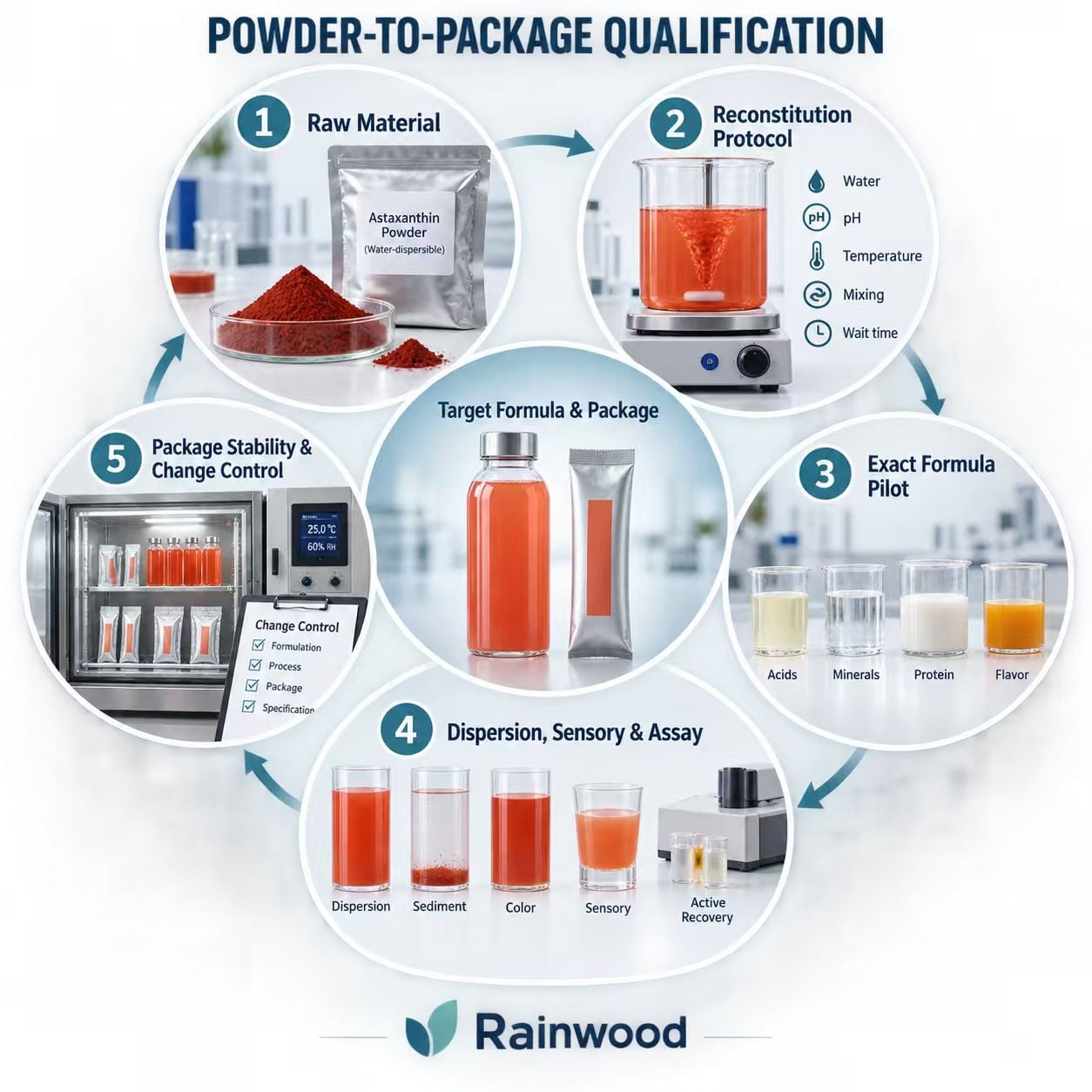
Pilot the whole chain from powder to package
Raw material
Confirm identity, form, assay basis, carrier, particle size, moisture, and lot traceability.
Process
Replicate the intended blending, filling, mixing, or compression conditions. Record heat, shear, residence time, and humidity.
Finished product
Test astaxanthin retention, dispersion, color, taste, sediment, microbial quality where relevant, and package integrity.
Stability
Recheck the same endpoints after storage. If the product is sold as a reconstituted beverage, use the consumer preparation protocol at each time point.
Explore the astaxanthin powder formulation and private-label service when you need the powder grade, beverage base, and package reviewed together.
How RainwoodBio can support the evaluation
RainwoodBio’s website describes powder drinks, sachets, tablets, gummies, capsules, testing and release, packaging, and traceability as company-published capabilities. The exact astaxanthin dispersion performance still needs project-specific confirmation. Request a sample made with the intended carrier, dose, flavor system, and package rather than a generic powder sample.
Approval gate before calling the powder water-dispersible
Require:
- a defined dispersion test and endpoint;
- performance in the real formula and water condition;
- encapsulation, moisture, and stability evidence;
- a suitable assay method for the powder and finished product;
- sensory acceptance after storage;
- package barrier and opening instructions;
- change control for carrier or encapsulation process.
Request a water-dispersible astaxanthin powder feasibility review. Send RainwoodBio your beverage base, dose, water volume, target market, package, and current pilot result so the team can identify the missing proof before scale-up.
Three questions to ask after reconstitution
Ask the laboratory to report what happens immediately, after the planned waiting time, and after the product is stored in its package. Does the active remain evenly distributed, or does it settle and concentrate at the bottom? Does the color stay within the approved visual range? Can the method recover the active from the reconstituted matrix without a misleading low result?
Also compare preparation by the intended consumer method, not only by a high-shear laboratory mixer. A product that needs special equipment may require different instructions or a different delivery form. Keep these observations with the batch and stability records so a later formula change does not erase the original acceptance criteria.
Record the acceptance time point and preparation method beside every dispersion result so the test can be reproduced during stability and complaint review.
Keep dispersion and potency decisions separate
A powder can disperse well and still lose potency, or retain potency and leave unacceptable sediment. Set separate acceptance limits for appearance, distribution, taste, and astaxanthin recovery so one passing result does not hide another failure.
Frequently asked questions
1.Is water-dispersible astaxanthin truly water-soluble?
Not necessarily. Many powders are designed to disperse or emulsify in water. Ask for the supplier’s exact definition and test method.
2.Can a clear glass test prove commercial beverage performance?
No. The finished formula, preparation method, storage, and package can change dispersion and sensory results.
3.Does microencapsulation guarantee oxidation protection?
No. Protection depends on the wall material, process, residual moisture, oxygen and light exposure, antioxidants, package, and storage conditions.
References
- Food-grade Pickering emulsion study for astaxanthin powder: https://pubmed.ncbi.nlm.nih.gov/32517928/
- USP Astaxanthin Esters: https://doi.org/10.31003/USPNF_M7359_03_01
- RainwoodBio homepage: https://www.rainwoodbio.com/
- RainwoodBio OEM service: https://www.rainwoodbio.com/oem
This article is for B2B procurement and educational purposes. Product, analytical, safety, labeling, and regulatory requirements should be confirmed for the exact ingredient, finished product, and destination market.