 EN
EN

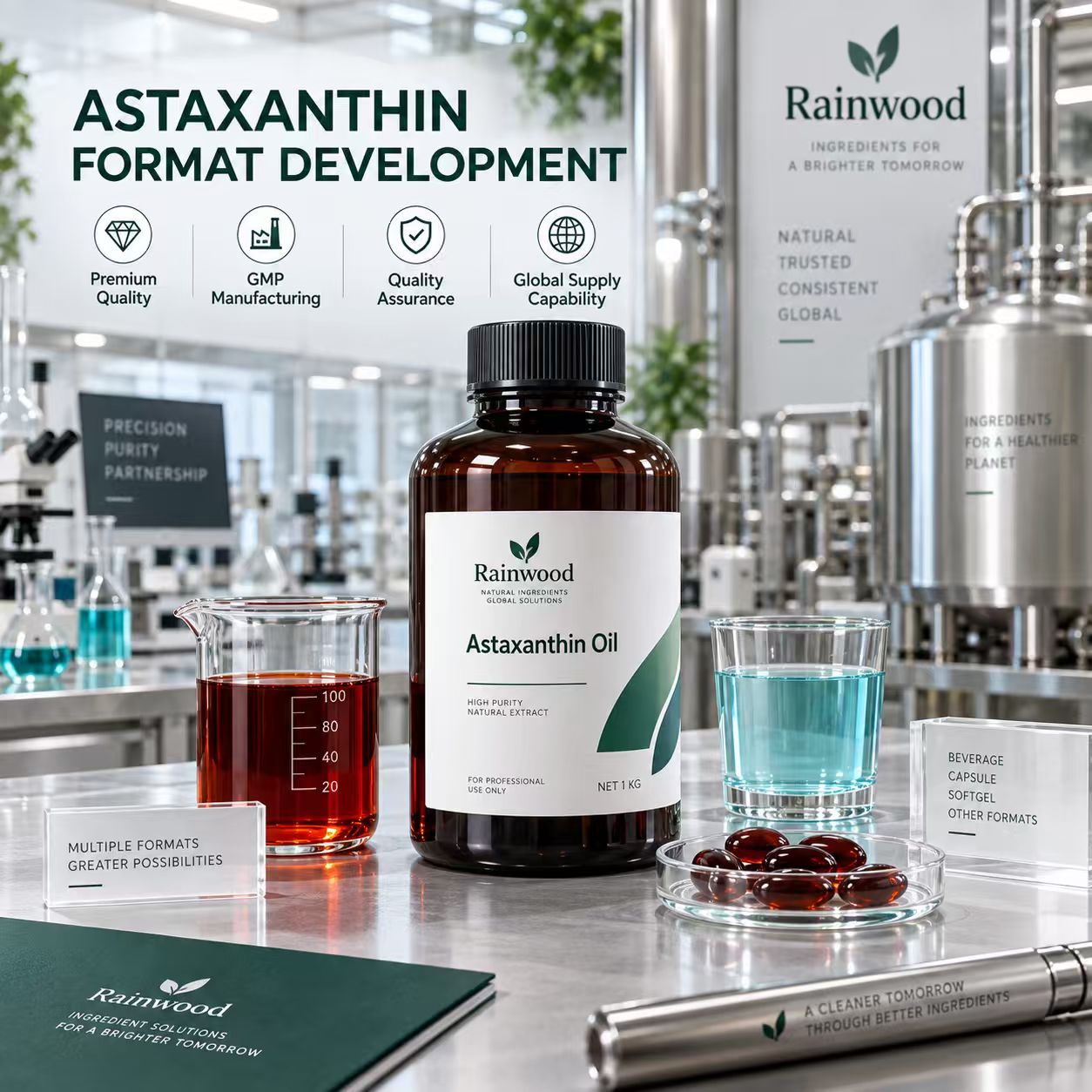
Meta title: Astaxanthin Oil in Beverages and Capsules: Check Fit
Meta description: Astaxanthin oil is not automatically suitable for beverages or hard capsules. Assess miscibility, emulsification, capsule fill, oxidation, and labels.
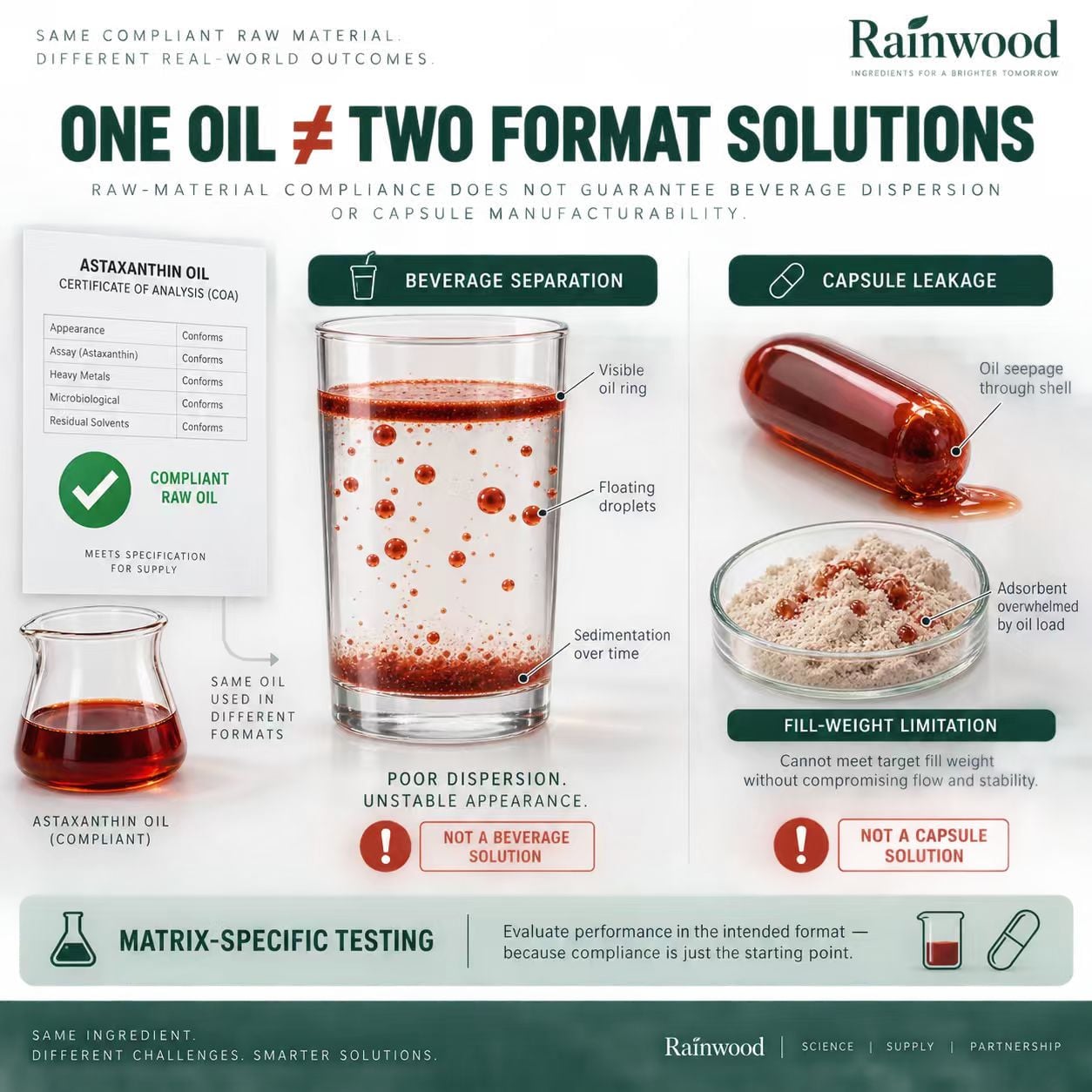
The product team wants one astaxanthin oil for a clear drink and a hard capsule. The drink shows an orange ring. The capsule leaks and the powder bed does not hold the target amount. Purchasing asks why the supplier did not warn them.
The supplier may have delivered a compliant oil. The project may simply be asking one delivery form to solve two different formulation problems.
Review the astaxanthin oil format information before transferring an oil between dosage forms.
Oil solubility is not beverage dispersion
Astaxanthin is lipophilic and practically insoluble in water. An oil concentrate can work in a lipid matrix while separating, floating, or depositing in a water-based drink. A beverage may need an emulsion or encapsulated powder system, not a direct oil addition.
Define the beverage target:
- clear, cloudy, or opaque appearance;
- oil droplet size and emulsion stability;
- pH and ionic strength;
- mixing energy;
- serving temperature;
- time before consumption;
- flavor and ring tolerance.
Do not call a liquid “water-compatible” without a test method and a time point.
Read the water-dispersible astaxanthin powder review if the beverage is the primary product.
A hard capsule needs a different fill design
An oil may be filled directly into a liquid-filled hard capsule, adsorbed onto a carrier, or used as an ingredient in a dry blend. Each route changes the shell, process, fill weight, leakage, and stability questions.
Ask:
- Is the oil intended for a liquid fill or a dry powder conversion?
- What is the viscosity at the filling temperature?
- Is an adsorbent or carrier required?
- Does the shell tolerate the oil and antioxidant system?
- What is the release and disintegration expectation?
- How will oxygen and light be controlled?
The oil’s red color can also bleed into the shell or create a different visual standard from the approved sample.
The same assay cannot release two formats
An incoming oil COA can support raw-material qualification. It cannot release a finished beverage or capsule without matrix-specific testing. The laboratory must confirm extraction, recovery, specificity, and reporting for the actual finished product.
For a beverage, assess potency after emulsification and storage. For a capsule, assess fill uniformity, shell integrity, leakage, release, and potency. Keep the methods and limits separate.
Use the astaxanthin finished-format testing checklist to avoid transferring raw-material assumptions into the wrong release plan.
Oxidation can look different in each format
In an oil drum, headspace and carrier oxidation may be the main issue. In a beverage, oxygen in the water phase and package can accelerate color or potency changes. In a hard capsule, shell moisture and the adsorbent can alter the local environment.
Record:
1. oxygen exposure;
2. package barrier;
3. antioxidant system;
4. light exposure;
5. temperature and residence time;
6. water activity or moisture;
7. end-of-shelf-life potency and appearance.
Explore the astaxanthin beverage and capsule OEM comparison when the same brand is considering two delivery formats.
How RainwoodBio can support format selection
RainwoodBio’s current site describes powders and sachets, capsules, gummies, tablets, softgels, testing and release, packaging, and traceability. These are company-published capabilities. Ask for separate feasibility samples for the beverage and capsule, using the same target dose but format-appropriate carriers and methods.
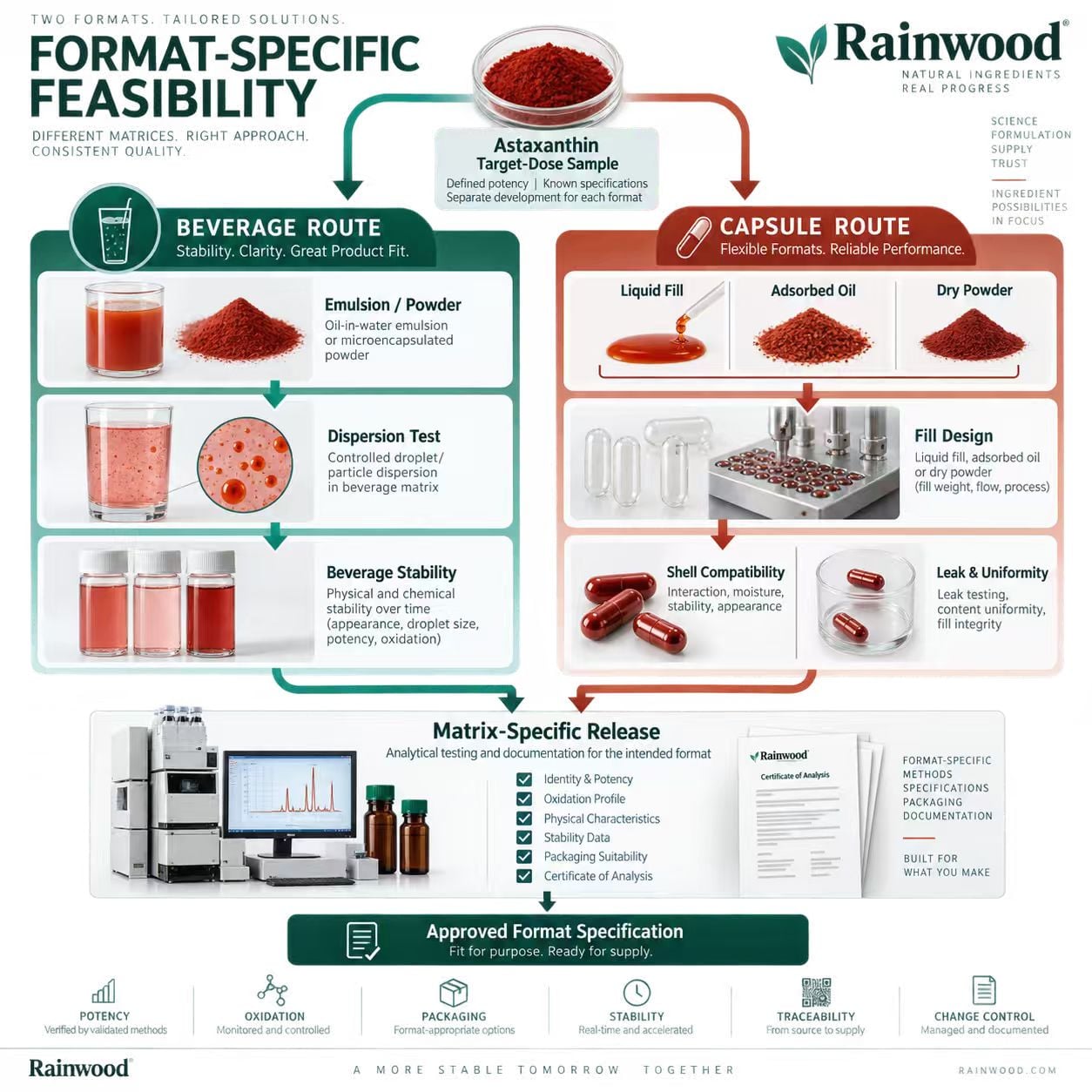
Approval gate before reusing the oil
Require:
- a defined format purpose;
- a beverage dispersion or capsule-fill test;
- suitable matrix-specific potency methods;
- oxidation and package controls;
- label and carrier review;
- stability in the intended format;
- a separate finished-product specification.
Request an astaxanthin oil format-fit review. Send RainwoodBio the oil COA, target dose, beverage or capsule concept, package, market, and pilot failure so the team can recommend the right delivery system.
One failed format should not invalidate the raw material
If the oil separates in a beverage, first determine whether the failure is caused by the carrier, emulsion process, pH, ionic strength, package, or consumer preparation. If a hard capsule leaks, separate oil-shell compatibility from fill weight, seam, drying, and storage. A structured investigation may show that the oil is suitable for a softgel even though it is unsuitable for the original beverage concept.
Keep the raw-material specification unchanged unless the evidence shows the oil itself is the problem. Then develop a format-specific alternative instead of lowering the assay or adding unapproved carriers simply to make one prototype look better.
Define the simplest commercial process first
Before asking the supplier to reformulate, decide whether the consumer actually needs a clear beverage. An opaque drink, a flavored emulsion, or a pre-filled softgel may remove a visual objection without weakening the raw-material specification. Likewise, a hard capsule may work better with a dry microencapsulated powder than with a direct liquid fill.
Test the simplest commercial process first: the intended carrier, mixing order, temperature, package, and preparation instruction. Record the limit for separation, ring formation, sediment, leakage, and color migration. These limits let the purchasing team compare a new oil or powder on performance rather than on a generic statement that it is “suitable for supplements.”
Ask the consumer-preparation question early
If the beverage requires shaking, waiting, or a special temperature, put that instruction into the prototype label and test it with the intended audience. If the capsule requires an unusual fill or shell, test swallowability and package handling before the marketing team presents it as a convenience product.
Freeze the format before requesting the final quote
An oil quote for a softgel is not automatically a quote for a beverage or hard capsule. Give the supplier the target format, dose, carrier restrictions, package, and process conditions so the material and testing scope match the actual project.
Add the failed prototype to supplier qualification
Save the formula, mixing order, package, photos, preparation instructions, and test result from the failed pilot. This gives the next supplier a precise problem to solve and prevents repeated sampling with different assumptions.
Keep the replacement proposal format-specific
Ask the supplier to recommend whether the failed beverage or capsule should use an emulsion, microencapsulated powder, adsorbed oil, or softgel fill. A format-specific recommendation is more useful than another generic oil sample.
Frequently asked questions
1.Can I add astaxanthin oil directly to a clear drink?
Do not assume so. Oil-water compatibility, emulsification, appearance, stability, and consumer preparation must be tested in the actual formula.
2.Can astaxanthin oil be converted into a hard-capsule powder?
Possibly, but the carrier, adsorption, flow, dose, shell, and release properties need development and testing.
3.Is the same oil COA enough for beverage and capsule orders?
It can support raw-material qualification, but each finished format needs its own process and release evidence.
References
- USP FCC Astaxanthin Esters: https://doi.org/10.31003/USPFCC_F102276_03_01
- Astaxanthin delivery and stability review: https://pmc.ncbi.nlm.nih.gov/articles/PMC13210799/
- RainwoodBio homepage: https://www.rainwoodbio.com/
- RainwoodBio OEM service: https://www.rainwoodbio.com/oem
This article is for B2B procurement and educational purposes. Product, analytical, safety, labeling, and regulatory requirements should be confirmed for the exact ingredient, finished product, and destination market.