 EN
EN

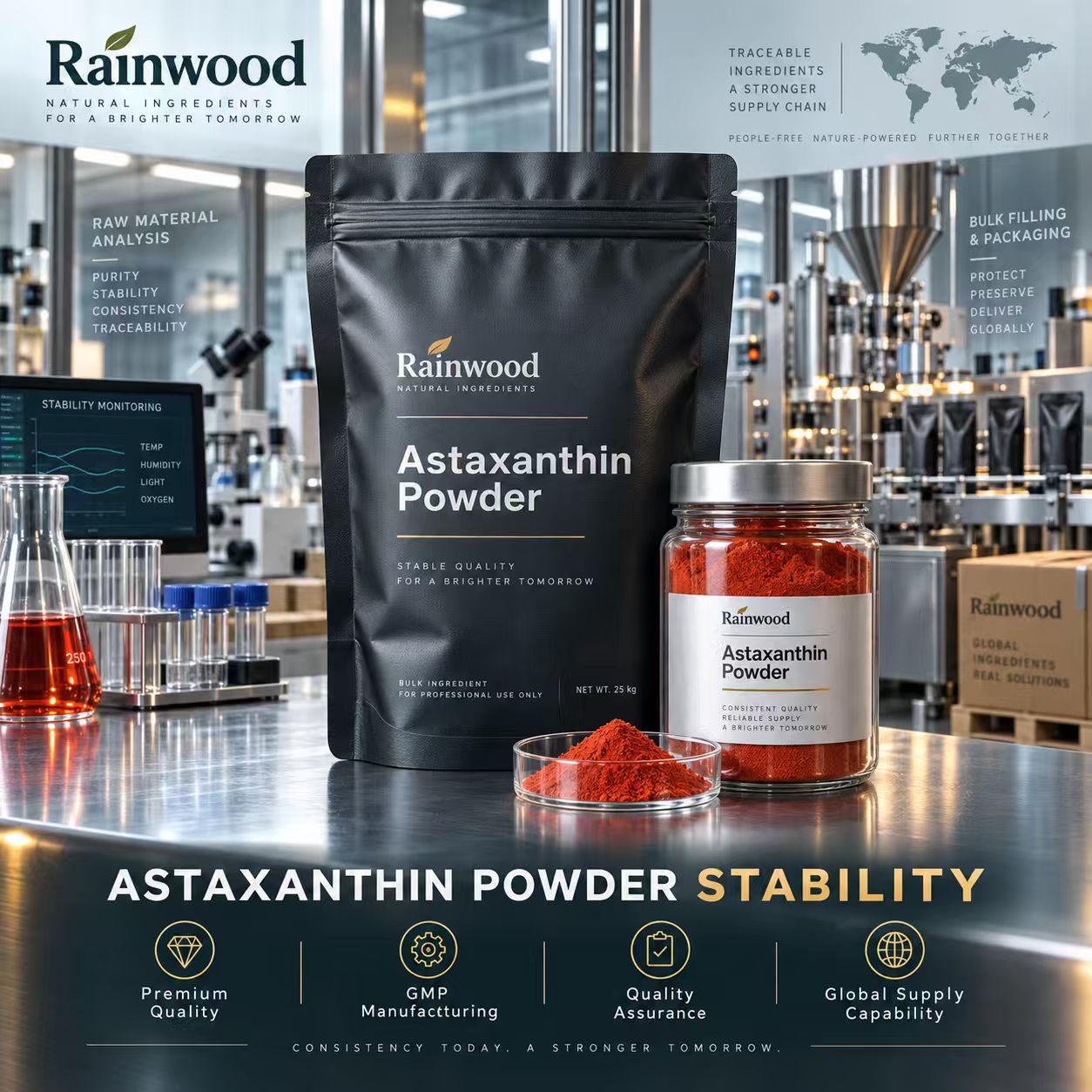
Meta title: Astaxanthin Powder Stability: Brown Color and Clumping Risks
Meta description: Brown color, clumping, and fading can signal astaxanthin powder stress. Trace oxygen, light, moisture, packaging, and process changes before blaming assay.
The powder arrives bright red-orange. After a few weeks, it looks darker, forms hard lumps, and leaves a different color in the finished sachet. The supplier points to the original 10% assay. The brand points to the warehouse.
Both may be missing the real question: what happened to the powder between release and use?
Astaxanthin’s conjugated structure makes it vulnerable to environmental stress. Light, oxygen, heat, moisture, metals, carrier composition, and package handling can affect appearance and chemical retention. Start with the astaxanthin powder stability specification before deciding that a visual change is harmless.
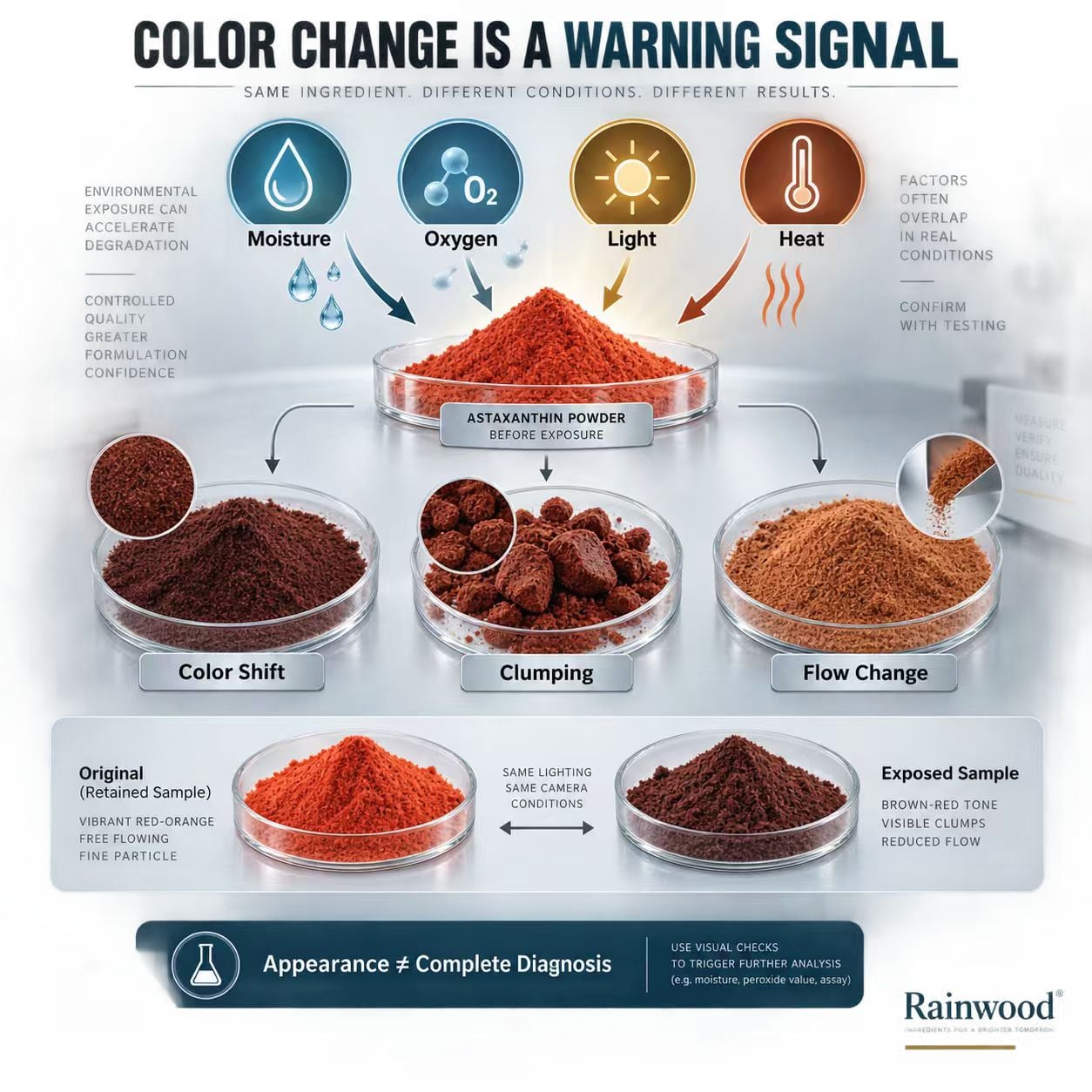
Color is a warning signal, not a complete diagnosis
Color can change because of concentration, particle aggregation, oxidation, carrier interaction, or lighting. A darker powder is not automatically unsafe, and a normal color is not proof of unchanged potency.
When appearance changes, compare:
- total astaxanthin and free-basis result;
- ester and free forms where relevant;
- moisture and water activity;
- peroxide or other agreed oxidation indicators;
- particle-size and agglomeration;
- odor and sensory profile;
- package and storage history.
The investigation should compare the same lot before and after exposure, not only a current sample with an old photograph.
Read the astaxanthin COA and assay-basis guide before interpreting a single number.
Clumping often starts with moisture, not poor purity
Powder can pick up water during sampling, blending, filling, transport, or repeated opening. Moisture may increase cohesion, alter density, slow flow, and create hot spots where the powder is exposed to oxygen or light.
Control:
- room humidity during handling;
- inner liner and seal;
- maximum open time;
- resealing practice;
- water activity or moisture limit;
- storage temperature;
- drum or pouch handling;
- desiccant or barrier package where appropriate.
Do not add an anti-caking agent or change the carrier before understanding the exposure mechanism. The fix can change the label, dispersion, dose, and stability profile.
Light exposure is easy to underestimate
A transparent sample bag on a laboratory bench, a clear bottle in a warehouse, and a retail pouch under store lighting do not provide the same protection. Ask for the package’s light-barrier specification and define how samples are stored during development.
Record:
1. package material and opacity;
2. time outside the package;
3. warehouse and transport exposure;
4. fill and headspace condition;
5. seal integrity;
6. sample-retention storage.
Use the astaxanthin package and stability checklist to keep the visual complaint connected to measurable controls.
A powder can pass assay and still fail the finished product
Clumps create uneven sampling and can distribute the active or carrier unevenly in a blend. A composite sample may pass while a poorly mixed portion creates a color or potency complaint in the finished batch.
Define sampling from:
- top, middle, and bottom of a bulk container where relevant;
- beginning, middle, and end of a blending or filling run;
- retained samples after opening and storage;
- finished units from different packaging positions.
The sample location and handling record should be part of the investigation.
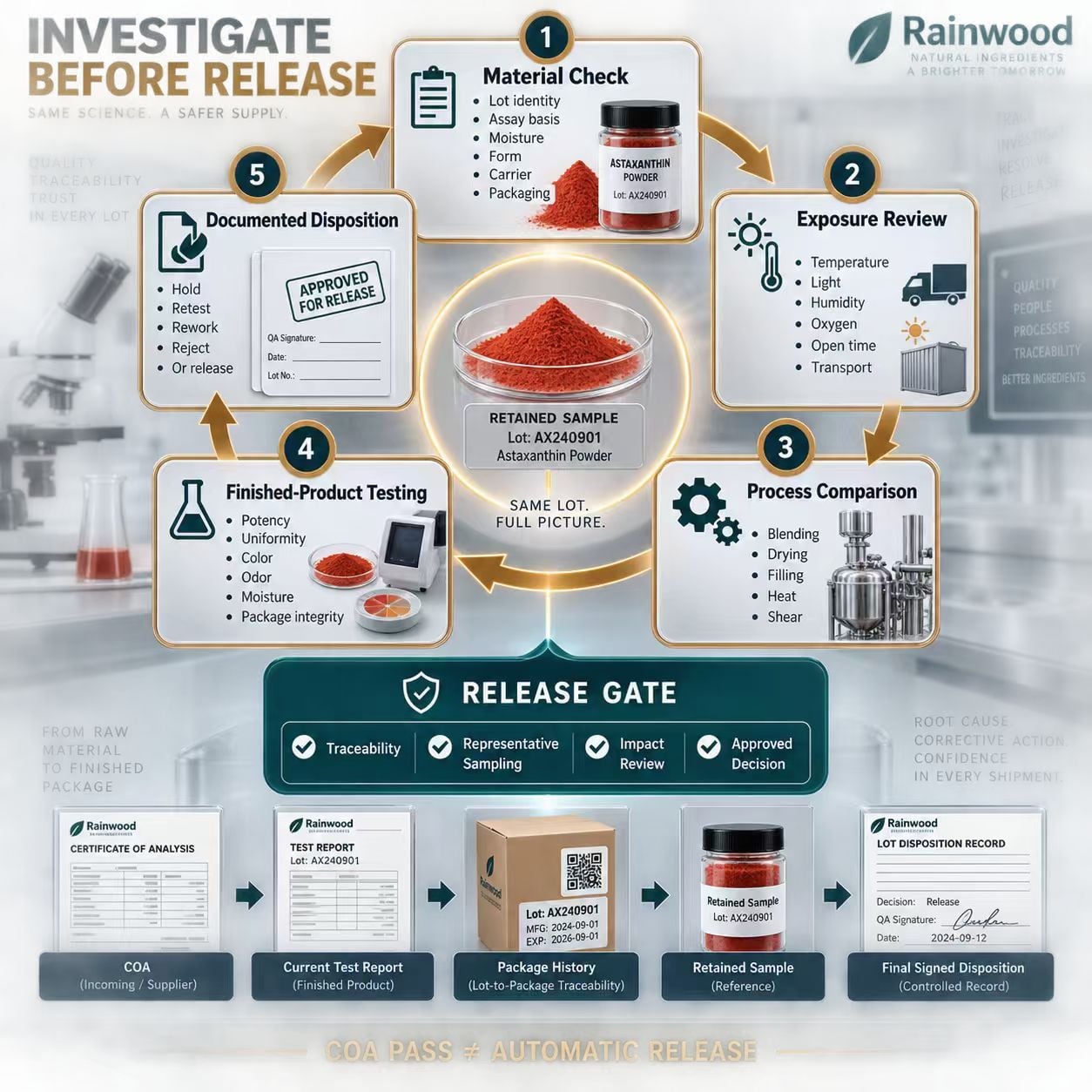
A practical root-cause sequence
Check the material
Confirm lot identity, assay basis, moisture, form, carrier, and packaging.
Check the exposure
Review temperature, light, humidity, oxygen, open time, transport, and warehouse records.
Check the process
Compare blending, drying, filling, heat, shear, and cleaning conditions with the approved pilot.
Check the finished product
Test potency, uniformity, color, odor, moisture, sensory behavior, and package integrity.
Decide the action
Hold, retest, rework, reject, or release only through the documented deviation process.
Explore the astaxanthin powder packaging and OEM review when the complaint involves both the material and the finished format.
How RainwoodBio can support the investigation
RainwoodBio’s public workflow describes testing and release, packaging, warehousing, logistics, and traceability. These are company-published capabilities. Ask for a lot-to-package review that identifies the sample history, storage exposure, test methods, and proposed corrective action for your astaxanthin powder.
Release gate for a visually changed lot
Do not release solely because the original COA passed. Require:
- lot and package traceability;
- an agreed appearance comparison;
- moisture and relevant oxidation checks;
- suitable potency and form analysis;
- representative sampling;
- finished-product impact review;
- a documented disposition.
Request an astaxanthin powder stability investigation. Send RainwoodBio the original and current COAs, photos, package details, storage history, and intended format so the team can separate a cosmetic issue from a real release risk.
Build a complaint sample plan before the complaint arrives
Retain the original raw powder, opened powder, and finished product in the commercial package. Record when each container was opened, how it was resealed, and where it was stored. If the customer reports a color or clumping issue, compare the returned product with the retained material under the same lighting and preparation conditions.
Ask the supplier whether the package uses a moisture and light barrier appropriate for the dose and storage route. Then define who can place a lot on hold, who authorizes retesting, and which result triggers a replacement or corrective action. A fast, documented complaint path protects the launch more effectively than a generic promise that the powder is “stable.”
Separate cosmetic investigation from release action
Start with a hold and a defined comparison, then decide whether the result is cosmetic, physical, chemical, or a finished-product failure. This prevents a supplier from dismissing a real potency issue as color variation and prevents the buyer from rejecting a usable lot without evidence.
Make the warehouse part of the quality plan
Record temperature, humidity, light exposure, pallet condition, and opening practice for bulk and finished goods. A good raw-material decision can be undone by a warehouse that stores the powder beside heat, moisture, or direct light.
Use the same lighting for appearance comparisons
Define the light source, background, sample thickness, and preparation method for color checks. A visual comparison is more useful when the team can reproduce it rather than argue over a photograph taken under unknown conditions.
Frequently asked questions
1.Does clumping always mean the powder is unusable?
No. Determine whether the clump changes identity, potency, flow, dispersion, sampling, or finished-product uniformity before deciding.
2.Can a darker red color still meet specification?
Possibly, but appearance should be assessed with potency, form, moisture, oxidation, and sensory data rather than judged alone.
3.Is vacuum or nitrogen packaging always necessary?
Not automatically. The appropriate package depends on the grade, oxygen sensitivity, fill volume, storage route, and validated stability data.
References
- Review of astaxanthin stability and delivery: https://pmc.ncbi.nlm.nih.gov/articles/PMC13210799/
- Food-grade astaxanthin powder encapsulation study: https://pubmed.ncbi.nlm.nih.gov/32517928/
- RainwoodBio About Us: https://www.rainwoodbio.com/about-us
- RainwoodBio homepage: https://www.rainwoodbio.com/
This article is for B2B procurement and educational purposes. Product, analytical, safety, labeling, and regulatory requirements should be confirmed for the exact ingredient, finished product, and destination market.