 EN
EN

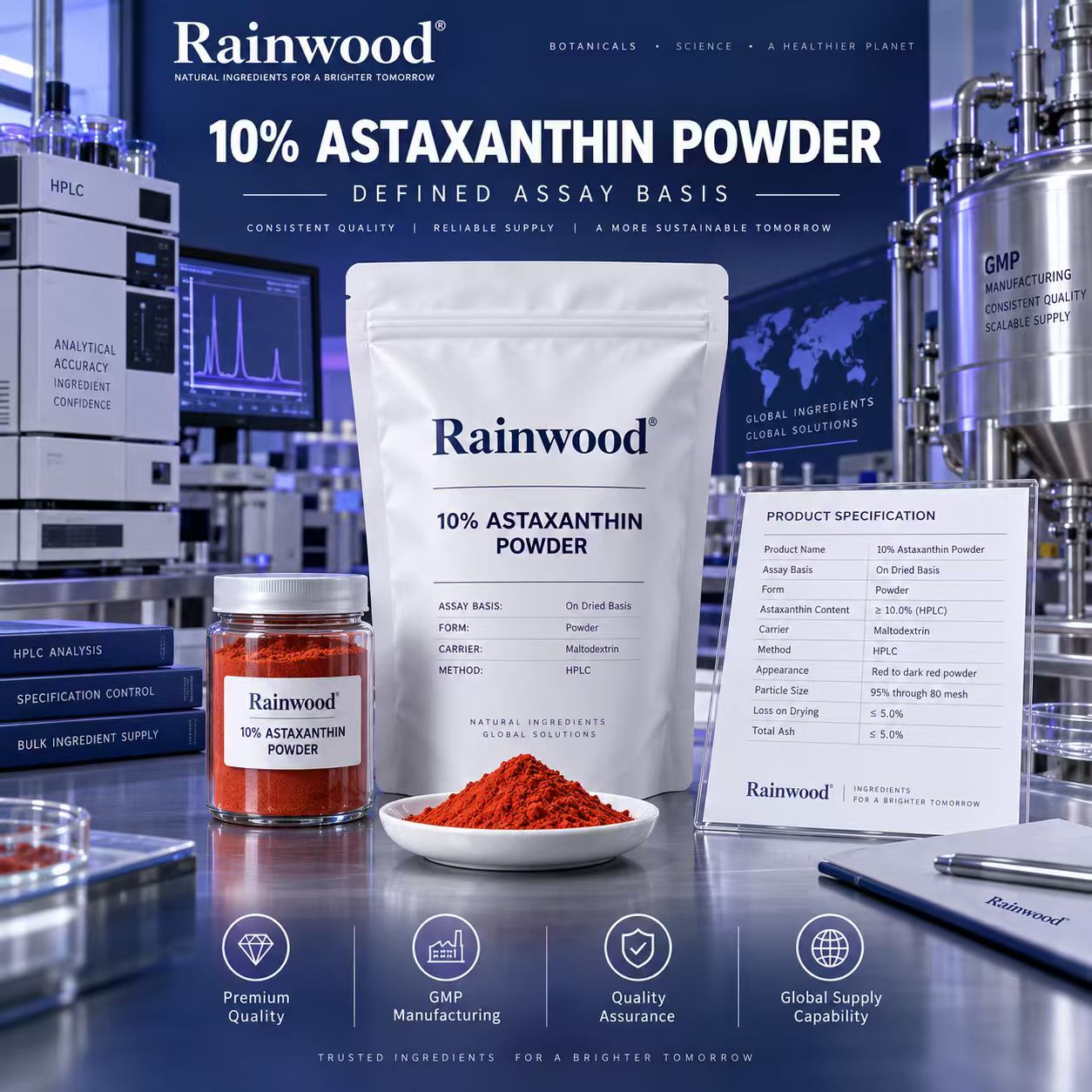
Meta title: 10% Astaxanthin Powder: Check the Assay Basis First
Meta description: Two 10% astaxanthin powders can deliver different commercial value. Compare free astaxanthin basis, esters, carriers, source, and lot evidence.
The quote says “10% astaxanthin powder.” Your formula team calculates 10 mg from 100 mg of material. The supplier’s technical sheet uses an oil-emulsion basis, a carrier is included in the powder, and the assay is reported differently from the number used in your label math.
The problem is not the percentage itself. The problem is that “10%” is incomplete until the buyer knows what is being measured, on which basis, in which commercial form, and against which reference standard.
Review the astaxanthin powder specification before comparing two offers by headline percentage.
The number may describe different astaxanthin forms
Astaxanthin can appear as free astaxanthin or as fatty-acid esters. A material obtained from *Haematococcus pluvialis* may contain mainly esterified forms, while another commercial product may use a different preparation or stabilization system. USP’s monograph for astaxanthin esters defines a material containing mainly 3S,3′S stereoisomers in monoester, diester, and free forms, with total astaxanthin calculated as free astaxanthin on an anhydrous basis. [USP Astaxanthin Esters](https://doi.org/10.31003/USPNF_M7359_03_01)
That wording matters. “10% astaxanthin” could mean:
- total astaxanthin calculated as free astaxanthin;
- a declared amount of astaxanthin esters;
- an oil concentrate diluted into a powder carrier;
- a water-dispersible microencapsulated preparation;
- a supplier’s internal color or potency convention.
Ask the supplier to define the analyte, calculation basis, reference standard, sample preparation, and reporting unit. If those items are absent, the percentage is not yet ready for formula use.
Free-basis and as-is numbers can change the dose
An anhydrous or dry-basis result excludes water or volatile material from the calculation. Your manufacturing line receives the material as packed, not as a theoretical dry substance. If the powder contains moisture or a carrier, the amount of material needed to deliver the declared astaxanthin may be different from a simple percentage calculation.
Write the dose equation into the specification:
`required powder weight = target astaxanthin amount ÷ as-received astaxanthin fraction`
Then record whether the fraction is based on total astaxanthin, free astaxanthin equivalent, or another agreed convention. Keep the same convention in the purchase order, master formula, Supplement Facts panel, and finished-product release method.
Read the astaxanthin dose and label-math review before finalizing the serving size.
A carrier can make a “10% powder” a different product
Water-dispersible powders often use wall materials, emulsifiers, antioxidants, or other carriers to protect a lipophilic carotenoid and help it disperse. Those materials may improve handling, but they change the commercial identity, label, density, taste, and stability plan.
Request:
- full carrier composition;
- astaxanthin content on total powder and active basis;
- encapsulation or loading ratio if applicable;
- residual moisture and water activity;
- particle-size distribution;
- dispersion or reconstitution method;
- storage and package requirements.
Do not compare a 10% single-ingredient concentrate with a 10% microencapsulated powder as though the bags contain the same thing. They may serve different formats and require different quality controls.
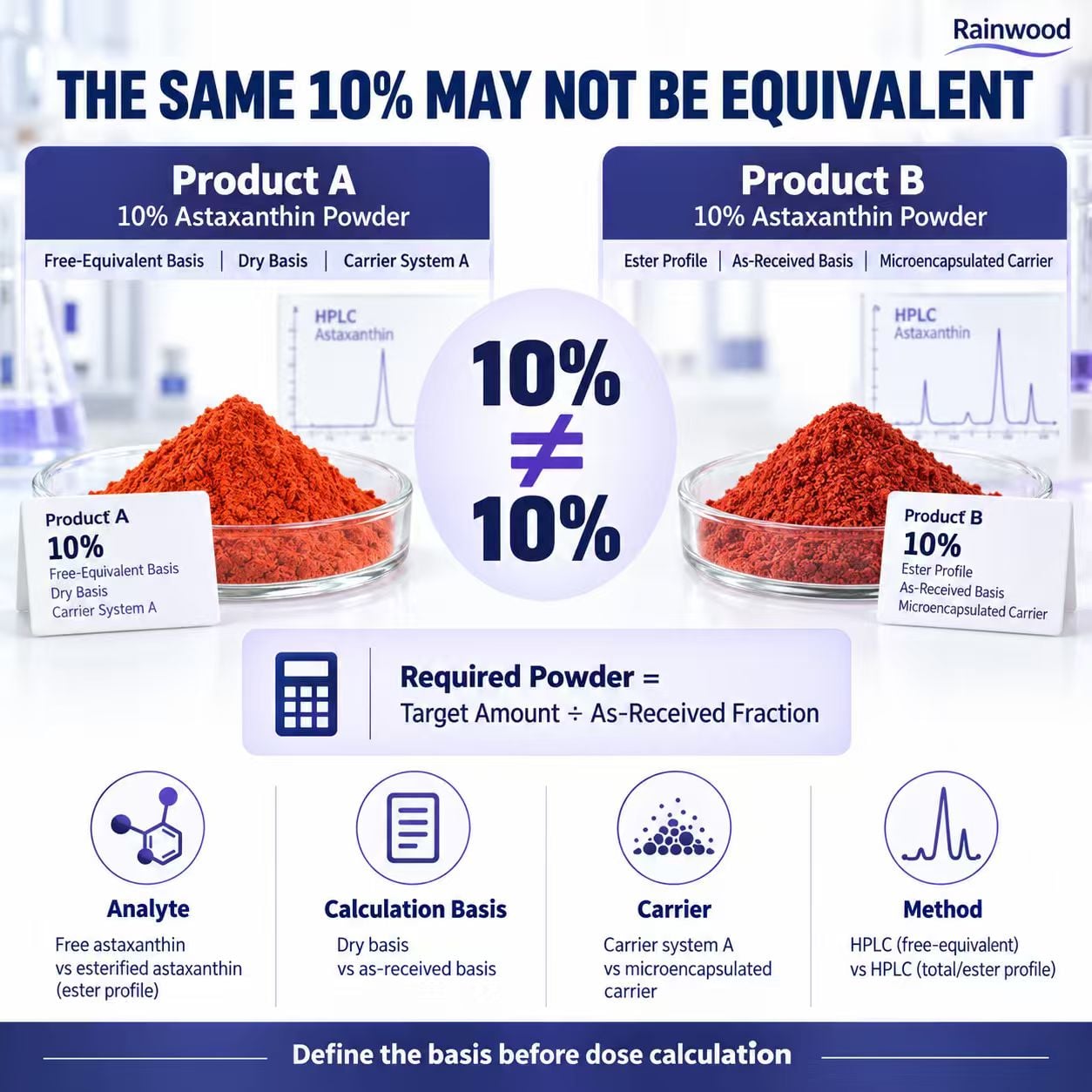
The method must see esters, carriers, and matrix effects
A supplier may write “HPLC tested” without showing whether the method hydrolyzes esters, quantifies individual forms, or reports a total equivalent. Ask for the method reference and confirm that the laboratory’s calculation matches your specification.
For a powder containing proteins, maltodextrin, gums, or emulsifiers, sample preparation can affect extraction and recovery. A raw-material method is not automatically suitable for a gummy, beverage, tablet, or finished capsule.
Use the astaxanthin identity and assay checklist to connect method suitability with the product you will actually sell.
Source and form belong in the same purchasing record
If the material is described as algal, natural, or derived from *Haematococcus pluvialis*, the source statement should connect to the exact manufacturer, site, lot, and process. Do not infer origin from a color or from a product photograph.
Record:
1. source organism or synthesis route;
2. free or esterified form;
3. concentration and calculation basis;
4. carrier and antioxidant system;
5. manufacturer and production site;
6. lot-specific COA and sample identity;
7. change-notification requirements.
Explore the astaxanthin raw-material and OEM specification service if you need the ingredient definition and finished format kept in one controlled file.
How RainwoodBio can support the comparison
RainwoodBio’s public workflow describes requirement confirmation, raw-material supplier management, testing and release, documentation, packaging, logistics, and traceability. These are company-published capabilities, not proof of a particular astaxanthin grade or batch. Ask for a project-specific specification that states the form, basis, carrier, method, and finished application.
Approval gate before selecting the cheaper 10% powder
Approve the material only when:
- the analyte and calculation basis are written;
- free and esterified forms are understood;
- carrier and moisture are declared;
- the identity and assay methods are suitable;
- source, manufacturer, and lot are traceable;
- the powder passes a format-specific pilot;
- label math and finished-product testing are aligned.
Request an astaxanthin powder assay-basis review. Send RainwoodBio the competing COAs, target dose, format, target market, and draft label so the team can normalize the percentages before you approve the order.
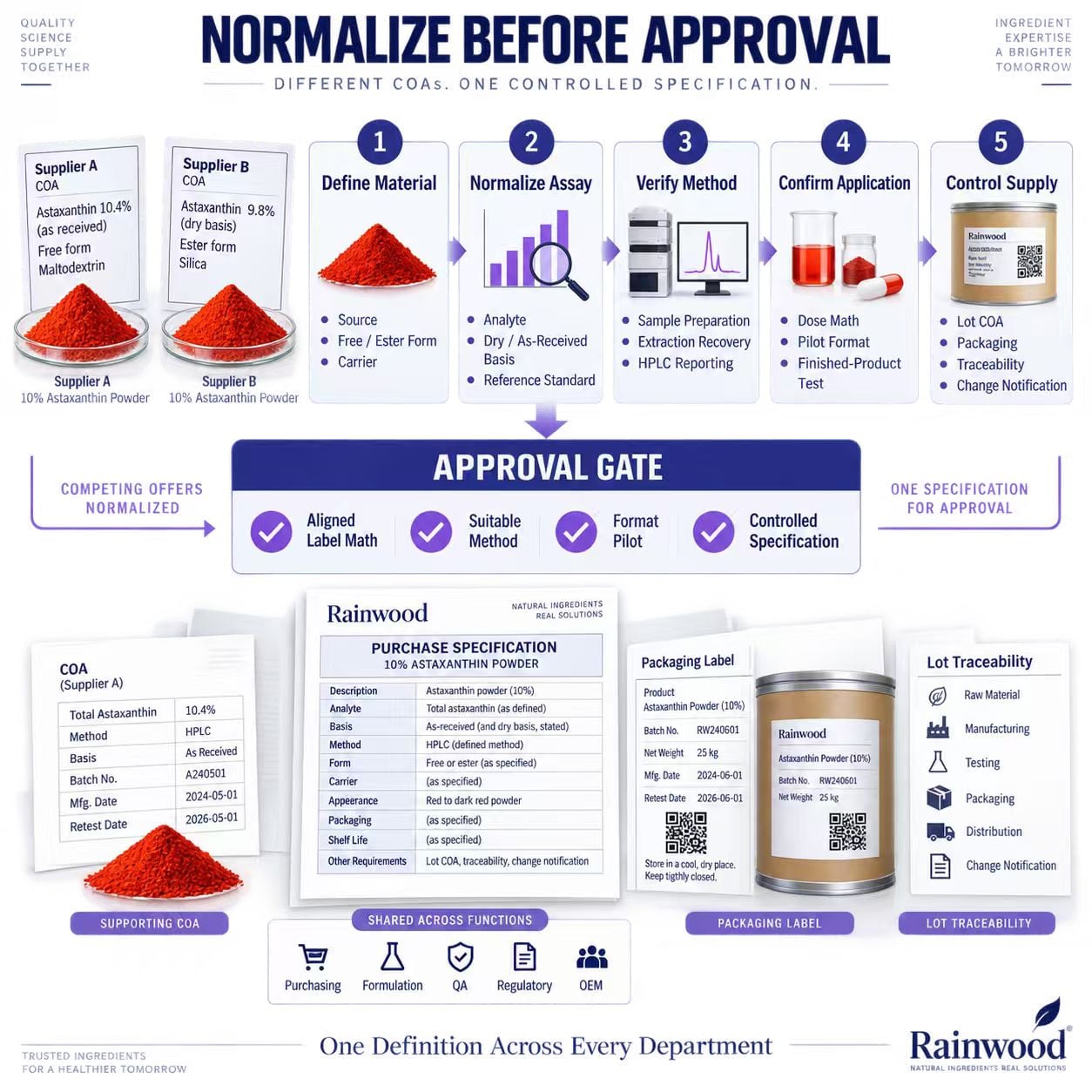
What to put in the purchase order
Write the commercial identity as a complete sentence, not a short product name. State the source, form, total astaxanthin basis, carrier, moisture limit, method, package, and lot documentation. Add a requirement that the supplier must notify you before changing the source, extraction route, ester or free-form profile, carrier, drying process, or analytical method.
Ask for a pre-shipment document pack containing the final specification, lot COA, package labels, storage statement, and any deviation record. If the powder is intended for a beverage or gummy, add the finished-format pilot and stability checkpoints to the same project brief. This prevents a sales quotation from becoming the only definition of what you bought.
Make the definition visible to every department
Purchasing, formulation, QA, regulatory, and the OEM should use the same wording for source, form, carrier, assay basis, and lot. A controlled one-page specification prevents a supplier’s short product name from becoming five different internal definitions.
Frequently asked questions
1.Is 10% astaxanthin always a high-potency powder?
Not until the calculation basis and carrier are clear. Two products with the same headline percentage may contain different forms, carriers, or reporting conventions.
2.Should astaxanthin esters be converted to free astaxanthin for label math?
Use the calculation required by the agreed specification and target market. The conversion and reporting basis must be documented and applied consistently.
3.Does a high assay prove the powder will disperse in water?
No. Assay measures content; dispersion depends on formulation, encapsulation, particle properties, water conditions, and process.
References
- United States Pharmacopeia, Astaxanthin Esters: https://doi.org/10.31003/USPNF_M7359_03_01
- United States Pharmacopeia FCC, Astaxanthin Esters from *Haematococcus pluvialis*: https://doi.org/10.31003/USPFCC_F102276_03_01
- RainwoodBio homepage: https://www.rainwoodbio.com/
- RainwoodBio OEM service: https://www.rainwoodbio.com/oem
This article is for B2B procurement and educational purposes. Product, analytical, safety, labeling, and regulatory requirements should be confirmed for the exact ingredient, finished product, and destination market.