 EN
EN

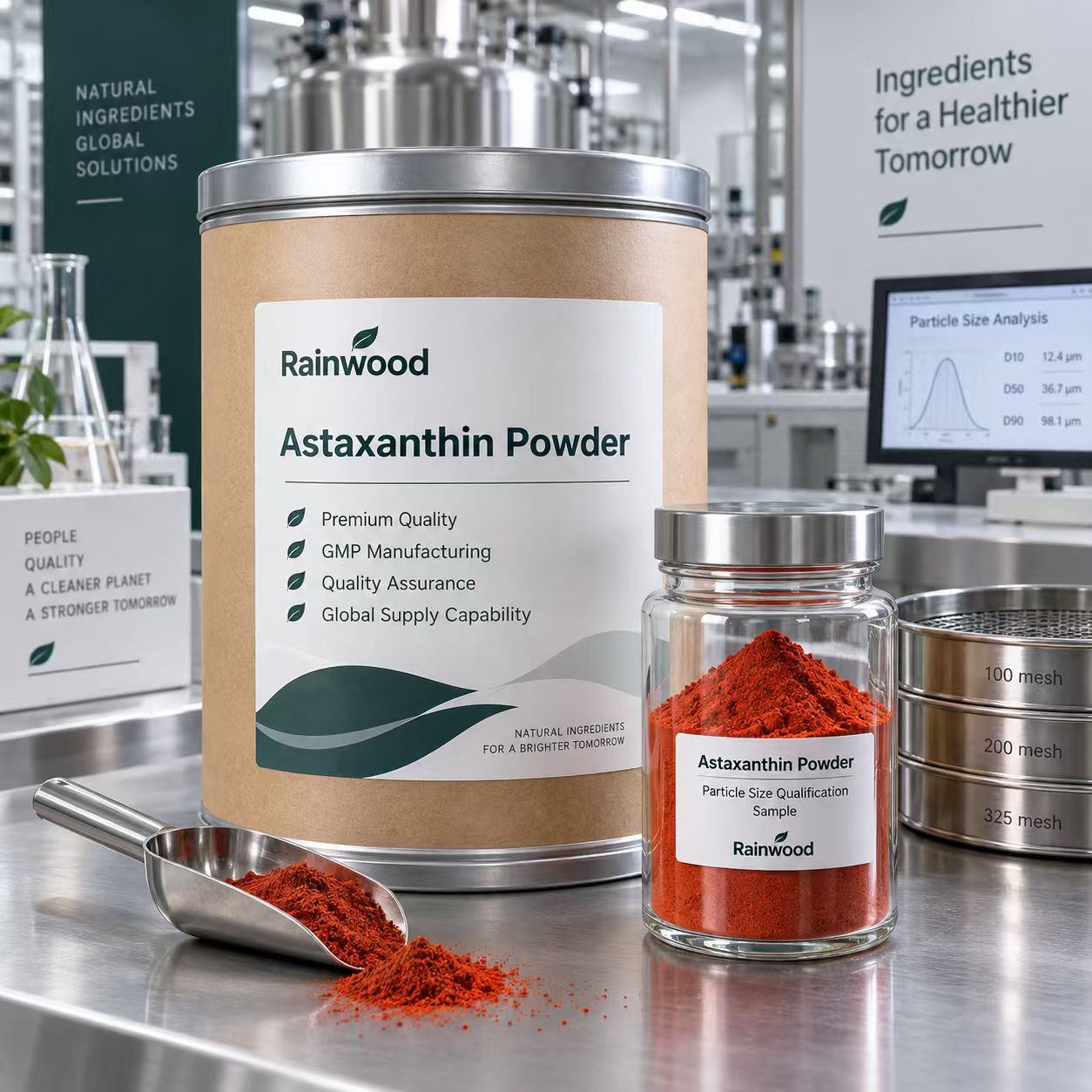
Meta title: Astaxanthin Powder Particle Size: Match the Format
Meta description: Fine astaxanthin powder is not automatically better. Compare particle size, density, wetting, flow, dissolution, and encapsulation for your format.
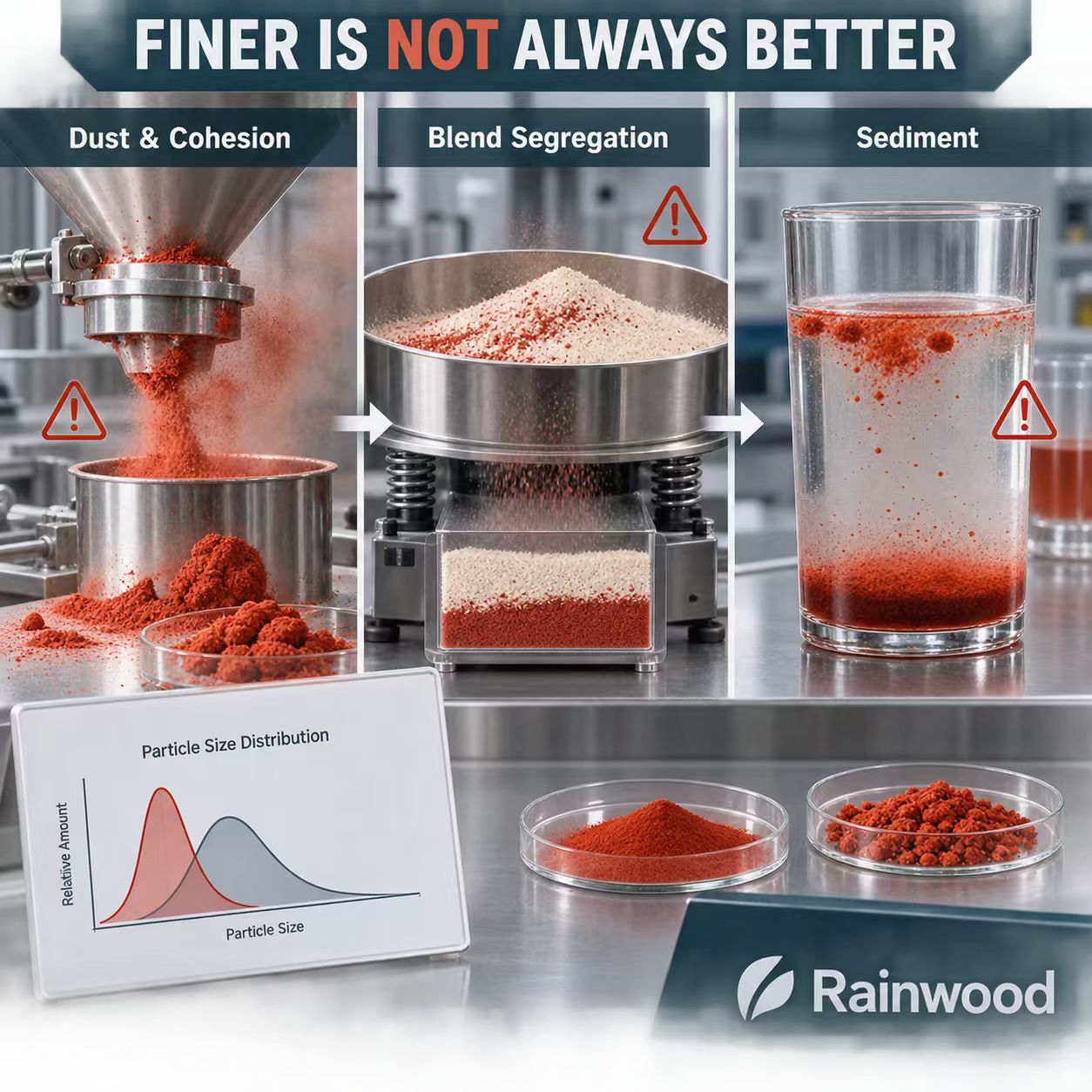
The supplier offers a “micronized” astaxanthin powder at a premium price. The beverage developer expects faster dispersion. The capsule filler gets more dust, the blend segregates, and the finished sachet still leaves sediment.
Particle size can matter, but the best range depends on the carrier, encapsulation, process, and finished format. Choose for the product outcome rather than for an attractive catalog adjective.
Review the astaxanthin powder grade options before approving a particle-size claim.
Finer particles change more than dissolution
Reducing particle size can increase surface area and alter wetting. It can also increase cohesion, electrostatic behavior, dust, agglomeration, and difficulty in sampling. If the powder is microencapsulated, the wall material and particle structure may matter more than the nominal size of the whole powder.
Ask for:
- particle-size method and distribution;
- bulk and tapped density;
- flow and cohesion indicators;
- moisture and water activity;
- encapsulation or wall-material description;
- reconstitution or dissolution method;
- lot-to-lot control range.
“Micronized” is not a complete process specification.
Match the test to the final use
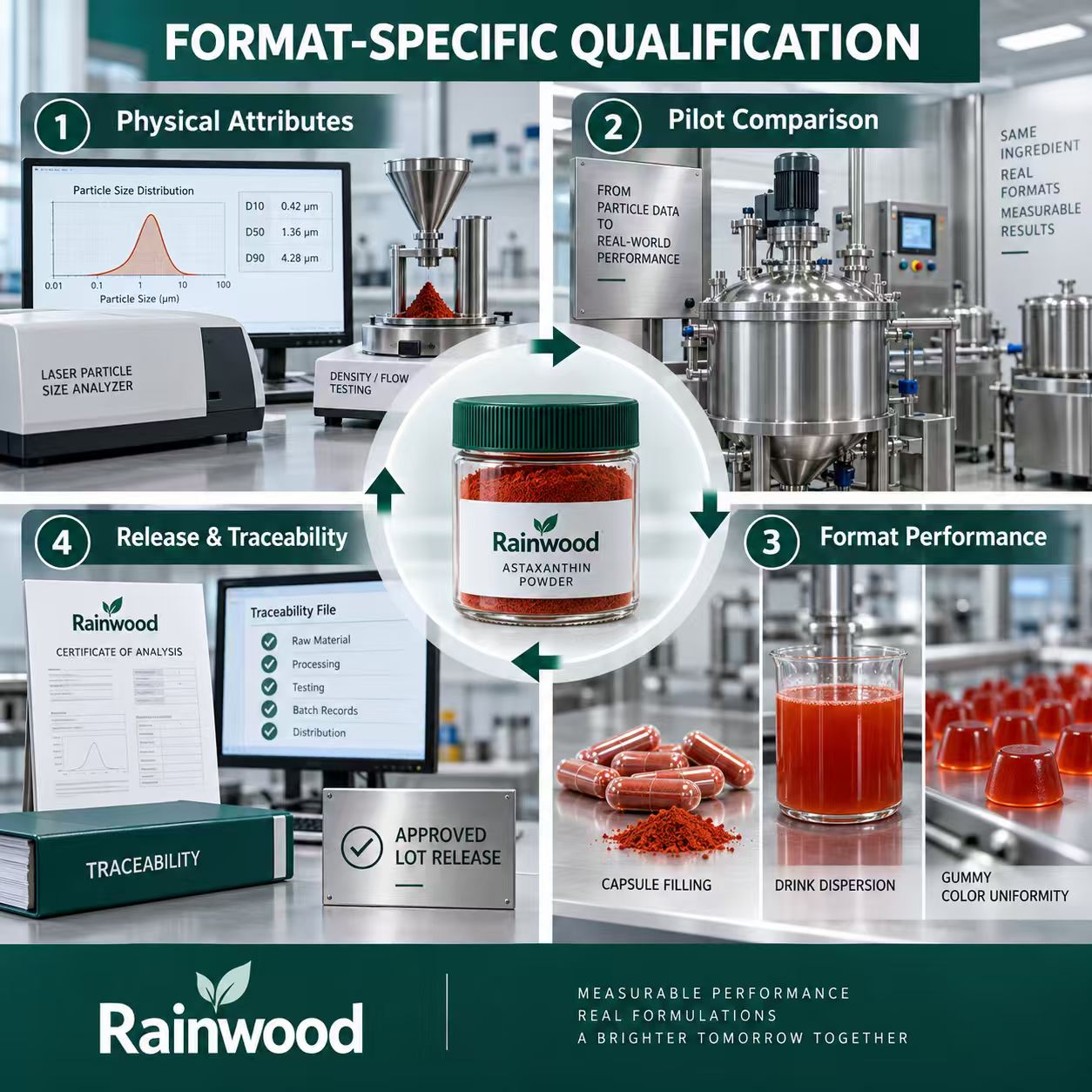
A powder for a hard capsule may need good flow and fill-weight consistency. A powder for a drink may need fast wetting, stable dispersion, and acceptable sediment. A gummy may need color uniformity and matrix compatibility. The same particle-size result does not answer all three questions.
Define the format target:
1. capsule or tablet: filling, compression, and uniformity;
2. sachet or drink: wetting, dispersion, sediment, and taste;
3. gummy: color distribution, process retention, and stability;
4. bulk ingredient: sampling, transfer, and package handling.
Read the water-dispersible astaxanthin powder guide when the powder will be reconstituted by consumers.
Density changes the dose calculation
Particle-size changes can change bulk density and the volume occupied by the same astaxanthin amount. A capsule may overflow, a sachet may require a different fill volume, or a tablet may need a different excipient balance.
Calculate using measured values:
`powder volume per serving = powder mass ÷ bulk density`
Then verify the result on the intended equipment. Do not use a theoretical density or a laboratory spoon measurement as the commercial fill setting.
Blend uniformity is not guaranteed by a smaller particle
A fine astaxanthin powder can segregate from a larger carrier or from other actives because density, shape, surface energy, and moisture differ. A visually uniform blend can separate during vibration, pneumatic transfer, or filling.
Use a sampling plan that tests:
- pre-blend materials;
- beginning, middle, and end of mixing;
- multiple container locations;
- beginning and end of filling;
- finished units from different positions.
Use the astaxanthin blend uniformity and sampling plan to connect particle control to finished-product evidence.
A controlled comparison beats a brochure promise
Run the current and proposed grades in the same formula and equipment. Measure:
- feed and hopper behavior;
- dust and material loss;
- blend time;
- fill-weight variation;
- dispersion or dissolution;
- color uniformity;
- sensory result;
- stability after packaging.
If the new grade improves one endpoint but worsens another, record the trade-off. The buying decision should reflect the finished product and total cost.
Explore the astaxanthin powder formulation and format service when the grade must work across several dosage forms.
How RainwoodBio can support particle-size qualification
RainwoodBio’s public information describes raw-powder sourcing, sample development, testing and release, multiple dosage forms, packaging, and traceability. These are company-published capabilities. Ask for a specification that identifies critical physical attributes and a pilot using the actual target format.
Approval gate for a new particle-size grade
Require:
- a defined particle-size method and range;
- density and flow evidence where critical;
- format-specific dissolution or dispersion data;
- blend-uniformity sampling;
- packaging and stability review;
- first-lot comparison with the approved sample;
- change notification for milling or encapsulation changes.
Request an astaxanthin particle-size and format-fit review. Send RainwoodBio your current grade, proposed COA, formula, equipment, target format, and line complaint so the team can compare the two powders on measurable output.
Do not make the specification narrower than the process needs
A narrow particle-size limit can increase cost, reduce available supply, or create unnecessary rejections if it is not tied to a finished-product outcome. Start with the process failure you need to prevent: hopper bridging, capsule fill drift, sediment, color nonuniformity, or slow reconstitution. Then set a range using development data and define how often it must be checked.
When the project uses a new encapsulation or milling step, require a change notice and a comparison sample. A new distribution may be acceptable for one format and unacceptable for another. The specification should preserve that distinction instead of forcing every astaxanthin product into one universal powder grade.
Link particle control to the buyer’s complaint
Ask which customer complaint the particle-size requirement is intended to prevent: powder bridging, capsule weight variation, visible sediment, slow mixing, or uneven color. Then select a method and sampling frequency that can see that failure. A single average particle-size result may miss agglomerates or a blend gradient, while an oversized specification can reject useful supply without improving the product.
Keep the critical attribute in the change-control list. Milling, spray drying, wall-material ratio, and storage can all alter physical behavior even when the chemical assay remains stable.
Compare the powder after the intended storage exposure
Particle behavior can change after moisture pickup, compaction, or repeated opening. Recheck flow and dispersion after the package has experienced the same route as the commercial product.
Keep the powder grade linked to the equipment
Record the hopper, blender, filler, tablet press, or reconstitution method used during approval. A grade that works on one line may not behave the same on another line with different shear, humidity, or transfer distance.
Review the carrier before changing the particle range
If the powder is encapsulated, the wall material, emulsifier, and carrier can influence dispersion as much as nominal particle size. Any particle-size change should therefore trigger a review of the complete powder composition.
Frequently asked questions
1.Is the finest astaxanthin powder the best choice?
No. Fine particles may improve wetting but worsen flow, dust, cohesion, or segregation. The right range depends on the formula and format.
2.Can particle size prove better absorption?
No. Particle size is a physical attribute. Absorption or bioavailability requires separate evidence for the exact formulation and use.
3.Should particle size be a release test for every lot?
If it is critical to your process or finished product, define the frequency and limit. If not, document why it is controlled through qualification or periodic verification.
References
- USP Astaxanthin Esters: https://doi.org/10.31003/USPNF_M7359_03_01
- Food-grade astaxanthin encapsulation study: https://pubmed.ncbi.nlm.nih.gov/32517928/
- RainwoodBio OEM service: https://www.rainwoodbio.com/oem
- RainwoodBio homepage: https://www.rainwoodbio.com/
This article is for B2B procurement and educational purposes. Product, analytical, safety, labeling, and regulatory requirements should be confirmed for the exact ingredient, finished product, and destination market.