 EN
EN

Meta title: Astaxanthin Softgel Dose: Check 4 mg vs 10 mg Early
Meta description: A 4 mg or 10 mg astaxanthin softgel changes fill weight, capsule size, label, cost, and market access. Do the dose math before tooling.
The marketing team wants a 10 mg astaxanthin softgel because it sounds stronger. The target market, oil concentration, softgel size, serving directions, stability file, and cost model were built around 4 mg.
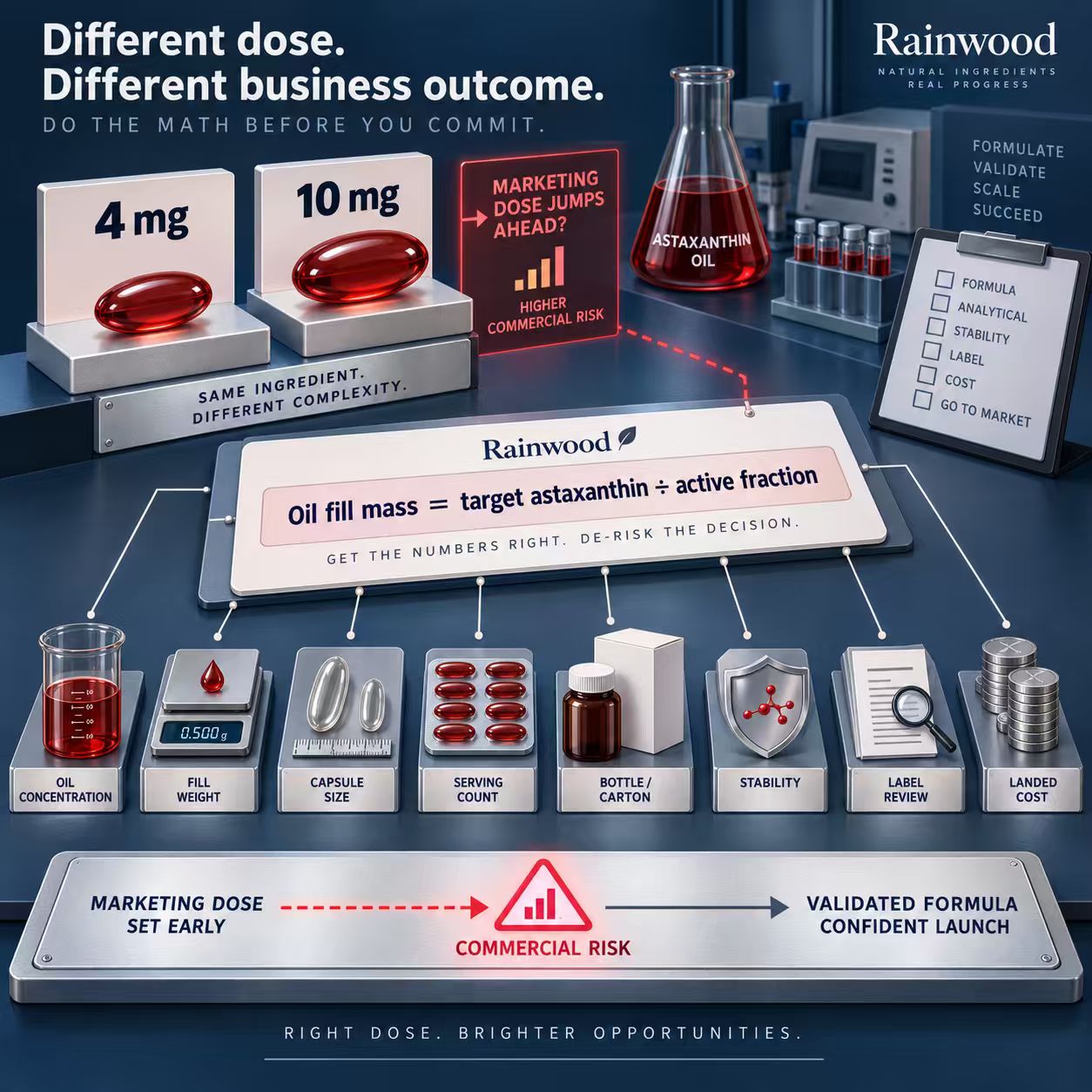
Dose is not a headline decision. It changes the oil amount, fill volume, capsule size, daily serving, label, manufacturing yield, and regulatory review.
Review the astaxanthin softgel product options before selecting the number on the front label.
Start with the intended market and buyer
Different markets and customer segments can use different dose ranges and labeling conditions. In the EU, the authorized novel-food entry for astaxanthin-rich oleoresin from *Haematococcus pluvialis* specifies food-supplement use resulting in no more than 8 mg astaxanthin per day and requires a specific label statement for products containing that ingredient. [EU Regulation 2021/1377](https://eur-lex.europa.eu/legal-content/EN/TXT/?uri=celex%3A32021R1377)
That does not decide the right dose for every country or every source. It does show why the dose cannot be finalized before the destination market and ingredient form are known.
Convert the dose into oil fill weight
Use the active basis stated in the COA and specification:
`oil fill mass = target astaxanthin amount ÷ as-received active fraction`
Then include density, viscosity, overage, and fill-weight variation. A 4 mg target from a 10% oil requires a different fill from a 10 mg target, and a different concentration changes it again.
Keep the equation in the master formula and label review. Do not rely on a rounded supplier recommendation.
Read the astaxanthin oil basis and dose-conversion guide before requesting a softgel sample.
Unit count changes the customer experience
If the formula uses a single softgel, dose and fill size may drive the shell choice. If the target requires two softgels per serving, bottle count, subscription weight, directions, and cost per day change.
Model:
- mg per softgel;
- softgels per serving;
- servings per bottle;
- bottle and carton size;
- fill and shell cost;
- freight and fulfillment weight;
- consumer price and margin;
- end-of-shelf-life potency target.
Do not hide a difficult dose inside a large serving recommendation that the customer may not follow.
The dose affects stability and release testing
A higher oil fill can increase oxygen exposure, headspace, shell contact, color intensity, and package requirements. The finished-product method must recover the intended amount from the softgel matrix and distinguish the active basis used in the label calculation.
Test:
1. fill-weight uniformity;
2. potency per softgel and serving;
3. shell integrity;
4. oxidation indicators;
5. release or disintegration where required;
6. stability through the proposed expiry.
Use the astaxanthin softgel release checklist to connect dose design with release evidence.
Compare concentration and format together
A 10% oil may minimize the fill mass, while a lower concentration may improve pumpability or reduce the risk of a concentrated color spot. A powder or microencapsulated form may fit a different dosage form altogether. Select the delivery form after comparing dose, matrix, process, package, and market—not before.
Explore the astaxanthin softgel and multi-format OEM service if the brand is deciding between 4 mg and 10 mg alongside powder or capsule formats.
How RainwoodBio can support the dose decision
RainwoodBio’s public website describes custom softgels, capsules, powders, gummies, tablets, sample development, testing and release, packaging, and traceability. These are company-published capabilities. Ask for a dose comparison that shows oil concentration, fill mass, shell size, unit count, stability plan, MOQ, and target cost.
Approval gate before ordering tooling
Require:
- target market and exact ingredient form;
- a documented dose and active-basis calculation;
- softgel size and fill-weight feasibility;
- label and serving review;
- finished potency and stability plan;
- cost per serving and landed-cost model;
- claim and regulatory review.
Request an astaxanthin softgel dose and tooling review. Send RainwoodBio your target market, desired mg per serving, oil COA, softgel size, bottle count, packaging, and target cost so the team can compare the two dose options.
Build a decision table that includes the next reorder
Compare not only the launch formula but also the likely reorder quantity, bottle count, freight weight, and storage space. A 10 mg concept may use fewer softgels while requiring a higher oil concentration, a different shell, more stringent stability controls, or a market-specific label review. A 4 mg concept may be easier to source but create a larger bottle and higher fulfillment cost.
Ask the supplier to quote both options with the same Incoterm, package, testing scope, and lead-time assumption. This prevents a lower unit price from hiding a different commercial basis and gives the brand a defensible reason for choosing the final dose.
Make the dose decision reversible during development
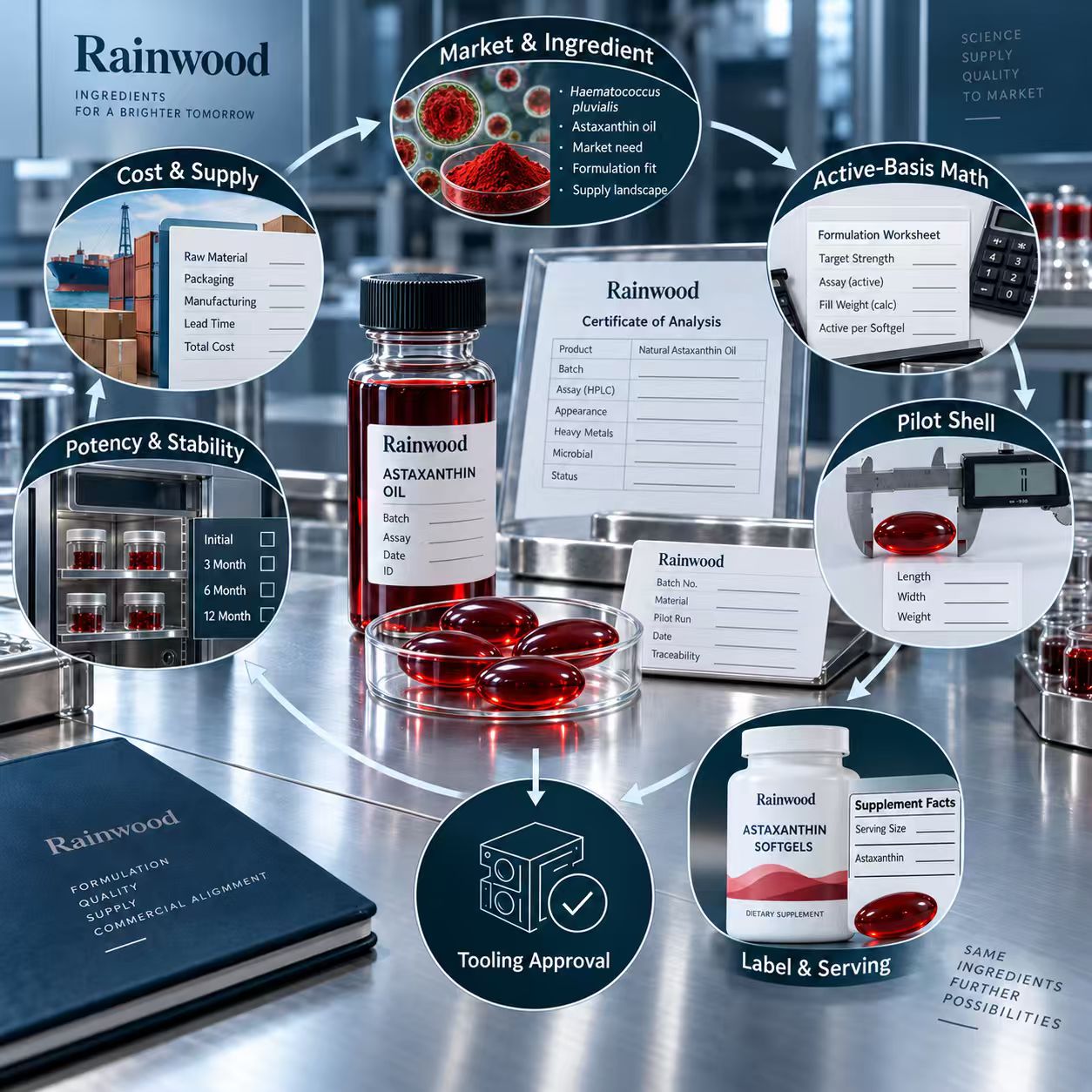
Do not order final tooling before the team has reviewed both dose options in a pilot shell and package. Confirm the fill weight, capsule dimensions, label space, serving directions, and stability pull quantity for each version. If the market review later changes the allowed amount or the desired daily serving, the project should be able to adjust without scrapping the entire package order.
Ask the OEM to quote samples and tooling assumptions separately from the commercial batch. This keeps a dose change from being hidden inside a new MOQ or a different concentration of oil and gives the brand a clear decision point before committing to the production plan.
Put the decision in the product brief
State why the brand is considering 4 mg or 10 mg: market condition, customer segment, evidence file, serving convenience, or cost target. If the reason is only “a stronger number sells better,” stop and test whether the label, stability, and market review can support the change. A documented reason makes later revisions faster and reduces pressure to treat a dose change as a cosmetic update.
Give the buyer a clear decision gate
Approve the selected dose only after formulation, QA, regulatory, purchasing, and commercial owners sign the same calculation and cost model. This prevents a sales request for a higher number from bypassing the technical file.
Frequently asked questions
1.Is 10 mg always better than 4 mg?
No. Dose must fit the target market, evidence, label, format, stability, and customer use case.
2.Does the EU 8 mg rule apply globally?
No. It is a market-specific requirement for the cited EU novel-food use. Review each destination separately.
3.Can a 4 mg softgel use the same fill formula as a 10 mg softgel?
Not automatically. The oil concentration, carrier, fill mass, shell, process, and stability may all change.
References
- EU Regulation 2021/1377: https://eur-lex.europa.eu/legal-content/EN/TXT/?uri=celex%3A32021R1377
- EFSA astaxanthin safety opinion: https://efsa.onlinelibrary.wiley.com/doi/10.2903/j.efsa.2020.5993
- RainwoodBio OEM service: https://www.rainwoodbio.com/oem
- RainwoodBio homepage: https://www.rainwoodbio.com/
This article is for B2B procurement and educational purposes. Product, analytical, safety, labeling, and regulatory requirements should be confirmed for the exact ingredient, finished product, and destination market.