 EN
EN

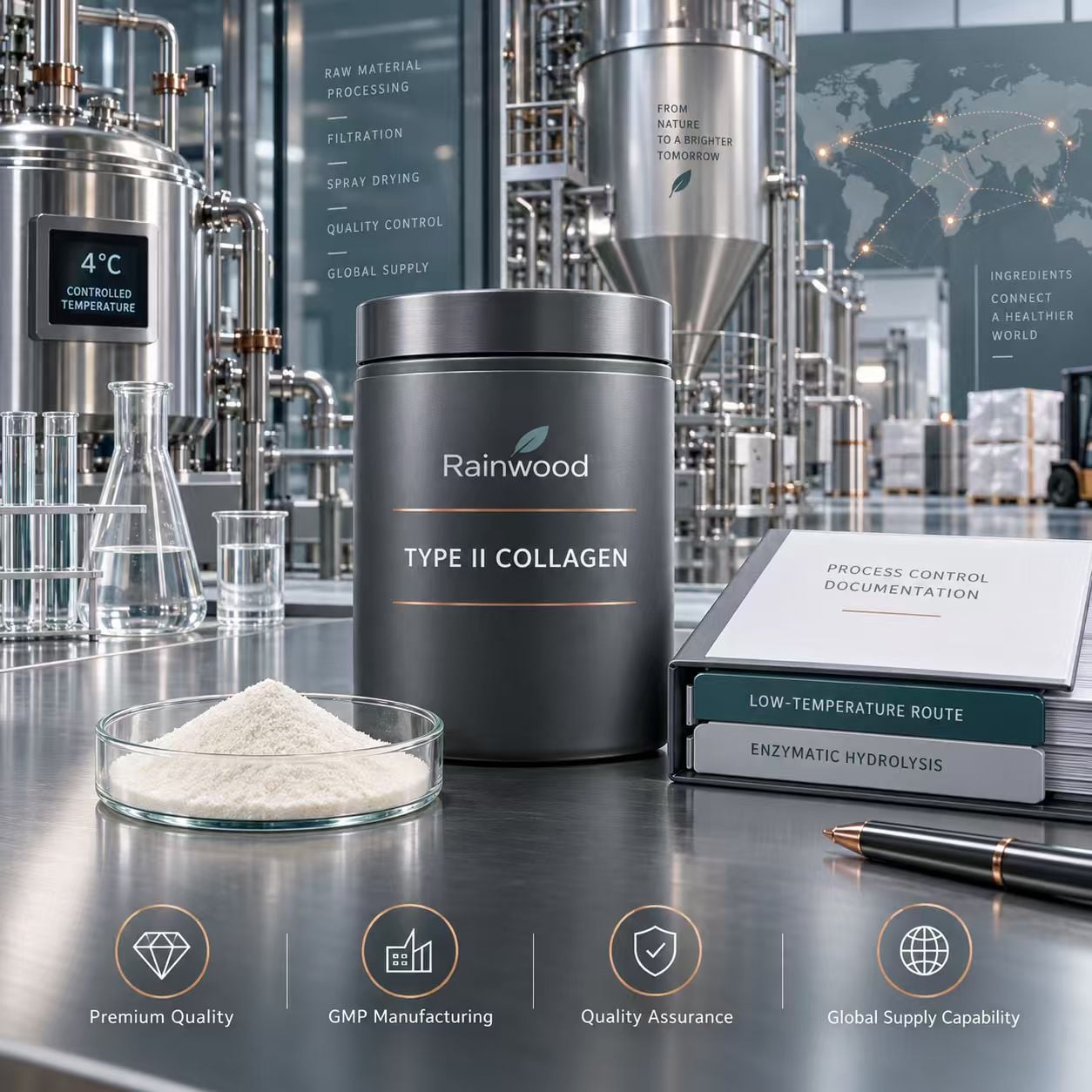
Meta title: Type II Chicken Collagen Processing Choice Guide
Meta description: Low-temperature preservation and enzymatic hydrolysis create different type II collagen materials. Learn which process records buyers should demand.
“Type II chicken collagen” can describe two very different process stories. One supplier emphasizes low-temperature processing to preserve native structure. Another emphasizes enzymatic hydrolysis to create short peptides. Both may use chicken cartilage. Both may show a professional COA. They are still not interchangeable products.
The process choice determines what your laboratory should measure, what your formula can do with the powder, what dose logic is credible, and which evidence belongs in your dossier. If the supplier cannot explain the process route, you may be buying a name rather than a defined ingredient.
Processing intensity creates a different product proposition
Undenatured type II collagen depends on preserving structural features that can be damaged by excessive heat or hydrolysis. Hydrolyzed type II collagen peptide depends on controlled breakdown into smaller peptide fragments. The objective is not “more processing” or “less processing.” The objective is a defined material that matches the intended use.
Scientific work on type II collagen short peptides shows that homogenization and hydrolysis temperature can affect denaturation and peptide properties. Other research shows that enzyme choice, time, pH, and degree of hydrolysis influence molecular-weight distribution. These are technical reasons to document the process, not invitations to claim that one route is universally superior.
Use our type II collagen process and form guide before your team compares a preserved-structure ingredient with a peptide grade using only the same species name.
The supplier incentive behind vague process language
Process descriptions are often shortened for commercial reasons. A supplier may not want to disclose proprietary enzyme details, or a trader may not possess the manufacturing record. “Advanced enzymatic process” sounds persuasive but does not tell you the hydrolysis endpoint, filtration step, drying temperature, or change-control triggers.
The buyer loss is a failed equivalence decision. You may switch suppliers because the assay and price look similar, then discover that the new material dissolves differently, carries a stronger odor, or does not support the same structure-related claim. If your product relies on an undenatured mechanism, a fully hydrolyzed substitute can invalidate the evidence file even if the label still says “type II collagen.”
Read hydrolyzed versus undenatured collagen evidence boundaries before approving a process change as a simple supplier replacement.
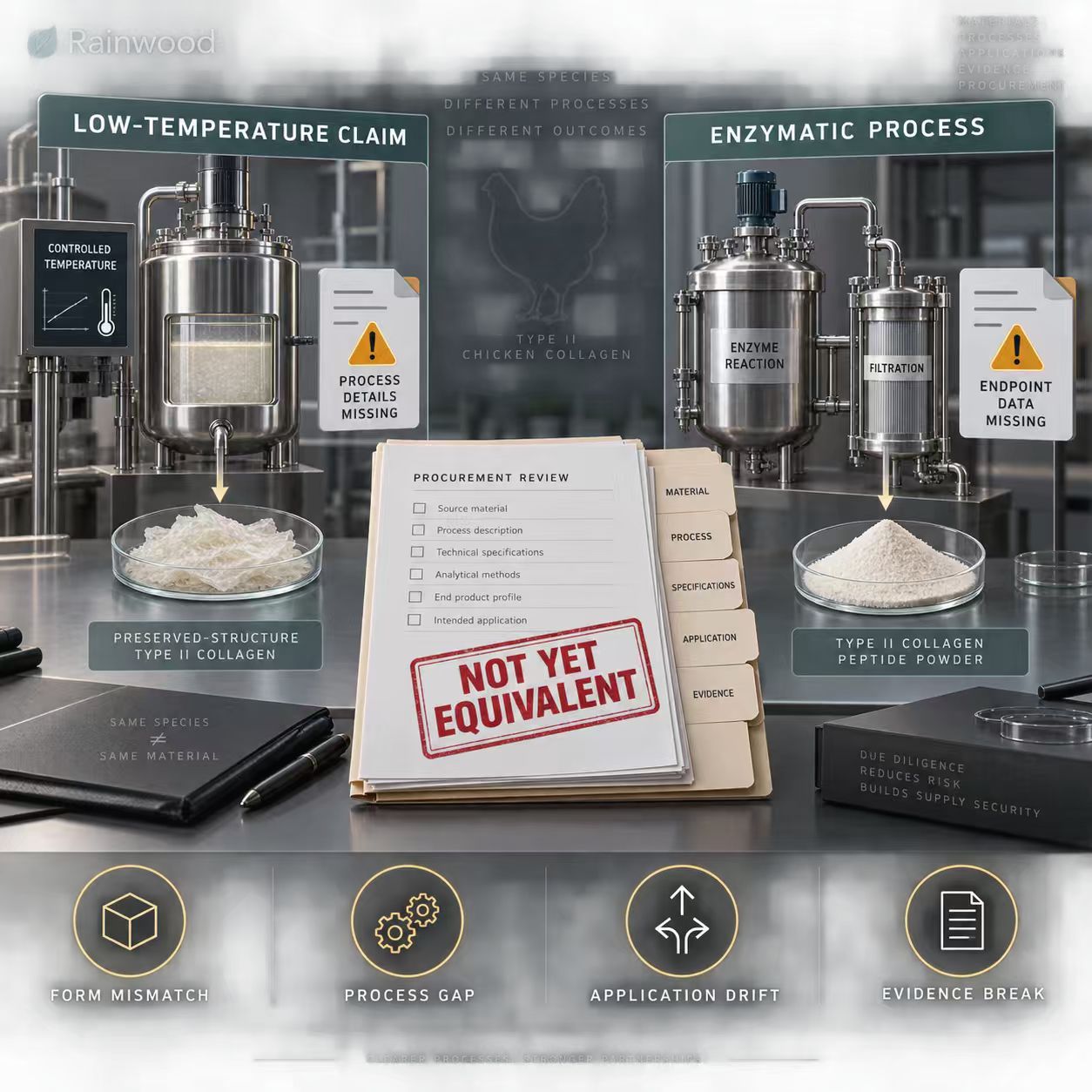
What the process record should contain
You do not need the supplier to reveal every trade secret. You do need enough information to assess identity and control. Request:
- starting material and tissue source;
- pre-treatment, cleaning, and temperature controls;
- whether hydrolysis is used and how the endpoint is defined;
- enzyme category or food-grade status where relevant;
- pH, time, and temperature ranges that affect the final grade;
- separation, concentration, filtration, and drying steps;
- rework, blending, and carrier controls;
- in-process checks and final release tests;
- change-notification requirements for source, site, enzyme, or process window.
The record can be a controlled summary rather than an open formula. The important point is that the commercial specification must be linked to the process conditions that create it.
Low temperature does not automatically mean undenatured
A low-temperature statement can be useful, but it is not a complete structural proof. Ask what temperature was controlled, at which stages, for how long, and which test demonstrates that the relevant structure was retained. A process claim without a structure-sensitive identity method remains a process narrative.
The same caution applies to “enzymatically hydrolyzed.” Enzyme use does not by itself establish a target molecular-weight distribution, high purity, or better formula performance. Ask for the endpoint, method, and acceptance range. Then test the physical behavior in your intended format.
Connect process controls to buyer loss
For a capsule brand, an uncontrolled drying step can change residual moisture and fill-weight variation. For a beverage, filtration and concentration can affect clarity, sediment, and flavor. For a gummy, the peptide profile can change texture and the masking load. For a claim-focused product, a source or process change can break the link between study material and commercial batch.
Create a process-to-risk table:
| Process point | Possible drift | Buyer check |
|---|---|---|
| Cartilage source | Different tissue or species | Source declaration and lot traceability |
| Heat exposure | Structural or sensory change | Temperature record and form-specific assay |
| Enzyme hydrolysis | Different peptide distribution | Degree or molecular-weight profile |
| Filtration | Removal or retention of components | Composition and recovery record |
| Drying | Moisture, solubility, odor, flow | Moisture, water activity, format trial |
| Blending | Nonuniformity or carrier change | Blend record and identity checks |
This table is more useful than asking whether the process is “premium.”
How RainwoodBio can structure a controlled process brief
RainwoodBio describes requirement confirmation, supplier management, production control, testing and release documentation, and traceability within its project workflow. For this product, the relevant capability is documenting the intended form and acceptance criteria before sample approval, then connecting a commercial-lot review to the approved process summary.
Request a process-to-specification OEM assessment with the target market, dose, format, evidence language, and change-control expectations included.
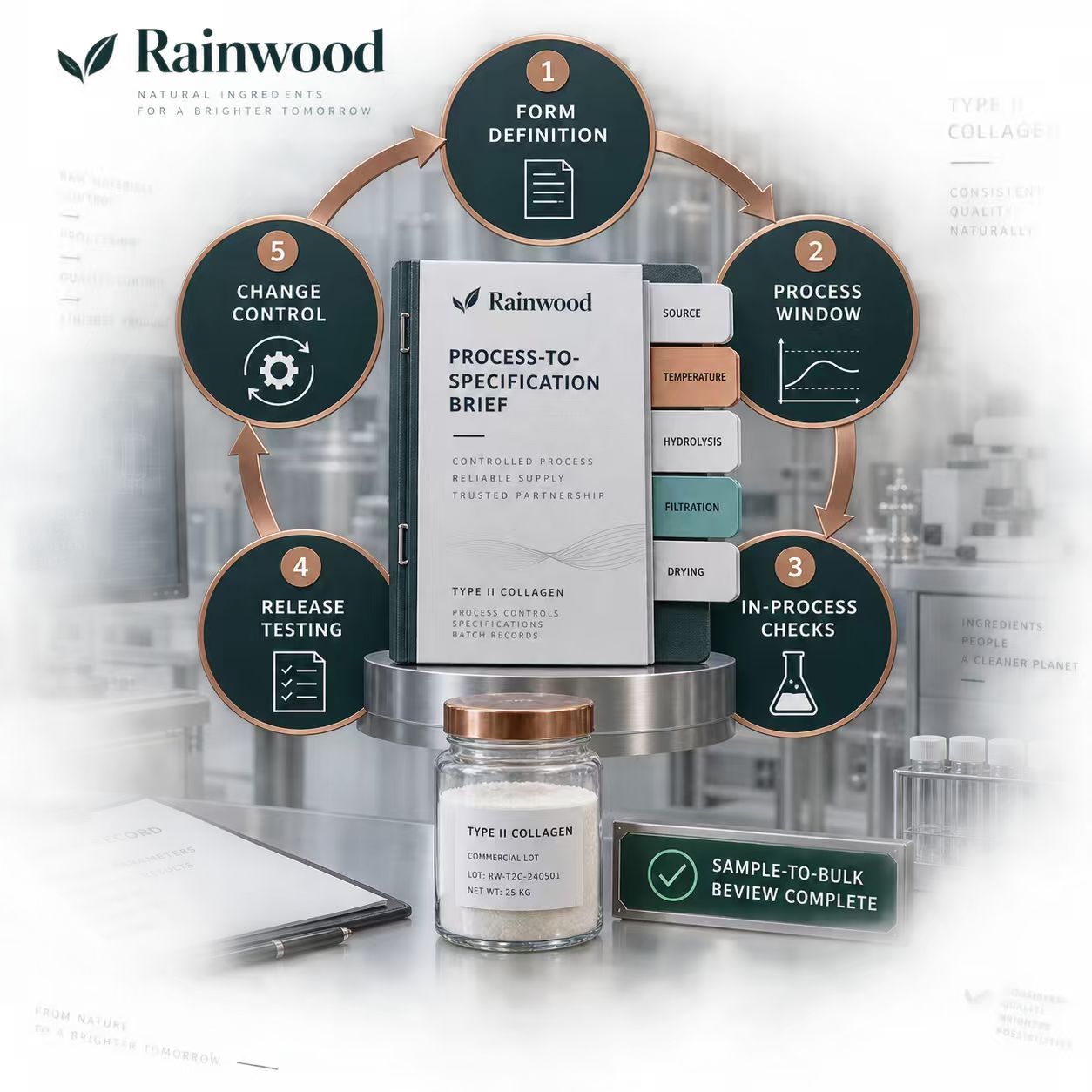
Process approval gate
Before you sign a supply agreement, require written answers to these questions:
- Is this hydrolyzed, partially hydrolyzed, or undenatured?
- Which process conditions define the grade?
- What proves the claimed form at release?
- What happens if the enzyme, site, source, or drying system changes?
- Which process records are available for an audit or deviation investigation?
- What sample-to-bulk checks will be repeated?
- Which customer-facing claims are excluded unless additional evidence is supplied?
Send the process summary, COA, sample report, target format, and planned claim language for a type II collagen process-control review. RainwoodBio can help separate a persuasive process description from a release-ready control plan.
Frequently asked questions
1.Is enzymatic hydrolysis required for a type II collagen peptide?
Not as a universal rule. The product must be defined by its source, process, resulting peptide profile, and applicable specification. If the product is sold as a hydrolyzed peptide, the hydrolysis process should be documented and controlled.
2.Can a low-temperature process create a peptide powder?
It can be part of a broader process, but the final form still depends on whether hydrolysis, filtration, concentration, and drying occur. Ask which stages are low temperature and which structural or peptide tests support the final identity.
3.Does a process summary replace batch testing?
No. The process explains how the product should be made. Batch testing and traceability show whether the purchased lot meets the agreed specification.
References
- Preparation of Type II Collagen Short Peptides: https://pubmed.ncbi.nlm.nih.gov/34046790/
- Low molecular weight type II collagenous polypeptide study: https://pmc.ncbi.nlm.nih.gov/articles/PMC4573174/
- U.S. FDA, Exploring the Scope of Dietary Supplement Ingredients: https://www.fda.gov/media/191964/download
- RainwoodBio OEM information: https://www.rainwoodbio.com/oem
This article is for B2B procurement and educational purposes. Process, analytical, safety, labeling, and regulatory requirements must be confirmed for the exact ingredient, batch, finished product, and destination market.